

Anggita Putri
School of Business, Bogor Agricultural University, Indonesia
LiveDNA: 62.20186
Dodik Ridho Nurrochmat
School of Business, Bogor Agricultural University, Indonesia
Toni Bakhtiar
Department of Mathematics, Bogor Agricultural University, Indonesia
Asian Journal of Scientific Research
Year: 2018 | Volume: 11 | Issue: 3 | Page No.: 337-343





ABSTRACT
Background and Objective: E-co farm is a business unit of IPB livestock faculty which engaged in fresh milk processing. E-co farm hopes to be able to produce and sell more processed dairy products but in fact until now E-co farm has not been able to meet its expectations in terms of producing more products and expanding the marketing area. This research is conducted in order to see the consumers behaviour by analysing market segmentation and the positioning of E-co farm milk products based on attributes in the product and formulating the right strategy for the development of beverage business of processed products of cow's milk of E-co farm IPB. Methodology: This research used sample as many as 100 respondents, with the criteria of buying and consuming the dairy products of E-co farm and D-farm in the last 6 months. Segmentation analysis was conducted with the help of K means cluster and analysis of products positioning was conducted with the help of correspondence analysis. Both of these analysis were processed using SPSS 22.0. Results: The result of the analysis shows that there are three groups of segments formed based on the psychographic aspect that is called experiencer (8%), rational (27%) and conventional (65%). The target segment in this research is conventional segment. Products positioning or image that are most attached to the consumers about the processed products of cow’s milk of E-co farm IPB is affordable price, lots of variations of size/volume and health benefits. Conclusion: The study showed the strategy that can be formulated to develop beverage business of processed products of cow’s milk of E-co farm IPB is improving the human resources and expanding the potential market area, improving the promotion activity with the "above the line" nature where the network is wider and spread evenly to increase the consumers awareness on the products brand so that the product image will be more attached to the consumers.
PDF Abstract XML References Citation
Article History
Received: September 29, 2017;
Accepted: December 14, 2017;
Published: June 15, 2018
Copyright: © 2018. This is an open access article distributed under the terms of the Creative Commons Attribution License , which permits unrestricted use, distribution and reproduction in any medium, provided the original author and source are credited.
How to cite this article
Anggita Putri, Dodik Ridho Nurrochmat and Toni Bakhtiar, 2018. Market Segmentation and Product Positioning Analysis of Cow Milk Processing Brand E-co Farm Bogor Agricultural University. Asian Journal of Scientific Research, 11: 337-343.
DOI: 10.3923/ajsr.2018.337.343
URL: https://scialert.net/abstract/?doi=ajsr.2018.337.343
DOI: 10.3923/ajsr.2018.337.343
URL: https://scialert.net/abstract/?doi=ajsr.2018.337.343
INTRODUCTION
The agricultural sector has a huge contribution to the economic development in Indonesia1. Based on statistics, Indonesia agriculture is the second largest sector in total gross domestic product (GDP) after processing industry, which contributes to Rp. 880.2 trillion or 14.44% of the national GDP. Livestock is one of agriculture sub-sectors that gives significant contribution in agriculture development in Indonesia1, especially Bogor. The livestock sector experienced a growth trend of gross regional domestic product in Bogor almost 5% until 2015. Livestock sector is able to grow rapidly because one of them is supported by the development of livestock commodity processing industry. One of the commodities produced from livestock is milk. Milk contains essential proteins and essential amino acids that are important for human health2, followed by increased public awareness of the importance of nutritional value both in terms of drinks and food, both of which lead to a direct increase in egg and milk consumption in Indonesia, one of which occurred in statistics Indonesia stated that milk consumption in Bogor experienced an increasing trend from year to year until 2014.
This increase trend is seen as business opportunity for business actors in Bogor. Other than the increase of milk consumption in Bogor, there is also an increase of the amount of SMEs (small and medium enterprises) in Bogor especially in the beverage business. The number of SMEs in the field of beverages from 2011-2015 continues to increase. This increase indicates that the beverage business trend keeps attracting the business actors’ interest. This happens because the number of public demand for beverage products keeps increasing. Furthermore, the number of the beverage business actors is still low comparing to food business actors. It means that the competition for beverage business is not as difficult as food business. Thus, the opportunity for beverage business is still very large. These two reasons are seen as a great opportunity for business actors in Bogor to enter into the milk or dairy products market as well as beverage business in Bogor.
Education corporate farming (E-co farm) is business unit of IPB animal husbandry under the Department of Nutrition and Feed Technology, which is engaged in the processing of pure milk into qualified dairy products, such as pasteurized milk, yogurt and pudding. The product in the form of fresh milk is sold to D-farm Faculty of Livestock IPB and several other consumers who own a household-scale milk processing business, while others are used to make processed products which are then sold in the campus area of IPB.
E-co farm hopes to be able to produce and sell more dairy products but in fact until now E-co farm has not been able to meet its expectations in terms of producing more products and expand the marketing area. E-co farm only has the marketing area around the IPB campus and only produces the processed products based on the available stock. The manager of the marketing should be more observant to see the opportunity and strategy to be applied in the company. Therefore, they should know how the consumer’s buying behaviour against the E-co farm dairy products.
This has caused the E-co farm to position itself and to focus more on the target segment in the market. Therefore, to succeed in the market of processed dairy products, E-co farm requires the existence of a marketing research to get various information about market segmentation based on the characteristics that will affect the consumers on the consumption of the E-co farm processed milk as well as products positioning to know the position of the processed milk of E-co farm product against the competitors.
According to Goyat3, there are four basic ways to segment the market in the form of geographic, demographic, psychographic and behavioral segmentation. Geographic segmentation consists of variables like region, country size, city size, density and climate etc. Demographic segmentation consists of variable like age, gender, family size, family life cycle, income, occupation, education, religion, race nationality etc. Psychographic segmentation comprises of variables like social class, lifestyle, personality etc. Finally behavioral segmentation consists of variables like purchase occasion, benefits sought, user status, usage rate, loyalty status, readiness state, attitude toward product etc. This research uses psychography aspect as the segmentation determination.
Kotler and Keller4 added several segments of segmentation based on psychography, experiencer, rational and conventional. The use of these three names is adapted from segment breach based on the value and lifestyle (VALS) variables. Sarli and Tat5 describes psychographic segmentation can portion customers to different classes of social and predict future needs and wants of people as marketing strategy.
While the lifestyle reflects how someone spends some time and money expressed in several activities, interests and opinions (AIO). The psychographic aspect has tried to classify consumers based on sharper segments comparing to demographic variables6.
The research on the market segmentation and products positioning of processed products of cow's milk of E-co farm IPB is a novelty of this research. It is expected that this research can be an input for the business actors of E-co farm as well as enrich the scientific studies on similar topics.
 | |
| Fig. 1: | Framework for operational thinking |
The focus of this research was on the analysis of market segmentation and positioning of dairy products of E-co farm IPB, based on the attributes present in the product.
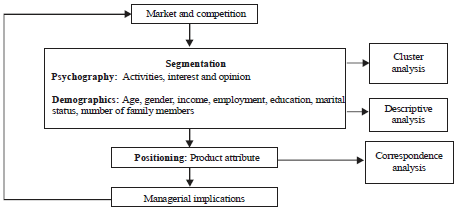
Based on the reason mentioned above, in order to process the distribution/marketing of the products from the company in order to reach the target market, the company should be able to meet the needs based on market segmentation and should be able to strengthen it through products positioning. The result of this analysis is used as reference for managerial implications for the business unit. In detail, the operational framework can be seen in Fig. 1.
MATERIALS AND METHODS
This study was conducted in April-May, 2017 in Dramaga IPB campus and Business Unit of Faculty of Animal Husbandry E-co farm IPB. Locations are chosen purposively based on certain considerations in accordance with the objectives of the study. This is taken on the basis of the researchers' consideration, the location should provide sales of processed cow's milk. The research is descriptive research with survey method. Survey method is done through interview using questioner distributed directly to the respondents. The respondents in this study are consumers who are at least 17 years old and had been considered responsible for the decision to purchase a product or service. In this study, the data as many as 100 respondents were used. The data were obtained through purposive sampling method (domicile in the city and regency of Bogor). Criteria of respondents in this study are those who are familiar with the products and have bought processed products of cow’s milk of E-co farm and D-farm brands in the last 6 months. This study uses primary data obtained through interviews and filling out the questionnaires done by the respondents or interviews and secondary data about internal company to meet the research objectives. Data collection technique is done by filling out questionnaires and interviews. Primary data are collected directly by: (1) Filling out the core questionnaires by completing the questionnaires and interviews and (2) Observation, collection of information through direct observation at the sales site of E-co farm Milk.
Descriptive analysis: Descriptive analysis is an analysis used to describe characteristics of relevant consumer groups. Descriptive analysis can also be used to estimate the units within a particular population that show certain behaviours7. Some data from respondents such as age, sex, educational background, occupation, marital status, number of family members, monthly income and monthly expenses for consumption, consumer buying decisions and usage patterns.
K means cluster analysis: Basically clustering is the method which includes the grouping of similar type objects into one cluster and a cluster which includes the objects of data set is chosen in order to minimize some measure of dissimilarity. Clustering is a type of unsupervised learning not supervised learning like classification. In clustering method, objects of the dataset are grouped into clusters, in such a way that groups are very different from each other and the objects in the same group or cluster are very similar to each other. Unlike classification, in which predefined set of classes are presented but in clustering there are no predefined set of classes which means that resulting clusters are not known before the execution of clustering algorithm8.
Cluster analysis groups the respondents into two or more groups. Each group consists of respondents with a relatively similar attitude toward certain variables, in this study variables used are variable AIO (activities, interest and opinion). Raval and Jani9 explain several steps in K means cluster as follows:
| • | Determine the number of clusters |
| • | Determine the value/object of the centroid that is randomly selected |
| • | Determine distance of Euclid with Euclidean distance formula |
| • | De = 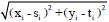 |
| • | Determine the grouping of objects viewed from the minimum Euclid distance |
| • | Repeat the steps from the step 2 until no cluster movement |
Correspondence analysis: Correspondence analysis is a graphical technique for representing the information in a two-way contingency table, which contains the count (frequencies) of items for a cross-classification of two categorical variables. With correspondence analysis, researchers construct a plot that shows the interaction of the two categorical variable along with the relationship of the rows to each other and the columns to each other10. Bendixen11 explain several steps in correspondence analysis as follows:
| • | Determine the contingency table |
| • | Determine the correspondence matrix of relative frequencies |
| • | Create a map of perceptual |
The determination of products positioning is done using correspondence analysis to see the comparison between products with other products based on proximity attribute11. By entering all product attributes, Xlstat is used to determine the correspondence of existing product attributes, then it can be calculated and the perceptual map will be visible between the proximity of the product attribute with the specified brand. The effect of each attribute is determined by the distance from each attribute to the brand. The farther the distance attribute with the product, the stronger the influence and vice versa11 .
RESULTS AND DISCUSSION
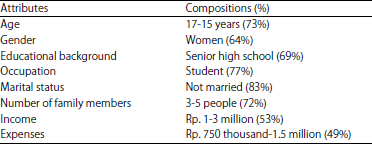
Demographic characteristics of respondents: The demographic characteristics of the various respondents can determine the respondent's behaviour in terms of purchasing and consumption pattern of processed cow's milk both from E-co farm and D-farm brands shown in Table 1. The demographic characteristics measured in this study are in the categories of age, gender, educational background, occupation, marital status, family size, monthly income and monthly expenses for consumption.
The majority of respondents in this study are female. The age of respondents is between 17-25 years old and the minority of respondents aged older than 55 years. The educational background of the respondents is senior high school/vocational high school with student status. Based on the results of the study, it was found that the marital status of the respondents are mostly not married. This is in line with the occupation of the majority of respondents which is students. The family size of the majority of respondents is 3-5 people. The majority of monthly income of the respondents of this study amounted to Rp. 1,000,000-3,000,000 with per month expenses for consumption that is equal to Rp. 750,000-1,500,000.
Consumer psychography segmentation: Market segmentation can be interpreted as a process of grouping a heterogeneous of whole market into groups or segments that have similarities in terms of needs, desire, behaviour and/or response to specific marketing programs5. Market segmentation is typically used in the field of marketing management to make marketing strategies focus more on the segments formed12. Psychographic is a quantitative measurement of lifestyle, personality and demographics of respondents. Bose6 describes that psychographics is, in common parlance, lifestyle analysis or AIO research.
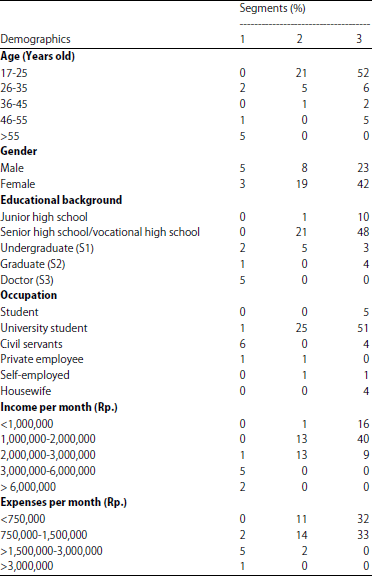
Based on the analysis of K means cluster 3 segments are formed with different psychographic characteristics as shown in Table 2. The use of experiencer, rational and conventional segment names is adapted from segment breaching based on the value and lifestyle (VALS) variables according to Kotler and Keller4.
Segment I (experiencer): The experiencer segment has psychographic characteristics in terms of work/activity, like to do practical things even though it costs more, they always want to be the centre of attention, love to collect or buy the luxurious/expensive stuff, always looking for products with high price and high quality and argue that the expensive price means higher quality. This segment is a segment with the least number of respondents amounted to 8%. The majority of respondents in this segment are men who work as civil servants, aged over 55 years, have bachelor as the educational background, married and have the number of family members as many as 3-5 people.
| Table 1: | Demographic characteristics of respondents |
 | |
| Table 2: | Segment distribution based on demographic variables |
 | |
The experience segment has average income of Rp. 3,000,001- 6,000,000 and monthly expenses for consumption of Rp. 750,000-1,500,000.
Segment II (rational): Rational segments have psychographic characteristics in doing the activities, do not want to be the centre of attention, argues that expensive products are not necessarily high quality, argues that dairy products cannot increase the immune system and argues that dairy products are not healthy, that dairy products from cow's milk are not nutritious. Respondents in the rational segment amounted to 27%, the majority of respondents is women with senior high school/vocational high school as the educational background and is currently unmarried with student status aged between 17-25 years old. The average income from this segment is around Rp. 1,000,001-2,000,000 and monthly expenses for consumption of Rp. 750,000-1,500,000.
Segment II (conventional): Conventional segment has psychographic characteristic in terms of work/activity, like to do practical things with little cost, like to try new things, tend to not to like modern or trend in society. Argues that dairy product of processed cow's milk can be healthy, argues that dairy products of processed cow's milk is a nutritious beverage. Respondents in the conventional segment are respondents with the highest number amounted to 65%. Based on the demographic aspect, the majority of this segment is woman with senior high school/vocational high school as the educational background and is currently unmarried with student status aged between 17-25 years old. The average income from this segment is around Rp. 1,000,001-2, 000,000 and monthly expenses for consumption of Rp. 750,000-1.500.000. Conventional segment is the most potential target segment for dairy products of E-co farm.
Attribute priority: Based on the research result of 8 attributes assessed by the consumers, taste, price and nutritional value attributes obtained the highest level of importance rating compared to other attributes. The three attributes do not have any huge gap between each other.
The taste attribute has the highest importance because in consuming the product, the consumer tends to pay attention to the matching taste that is offered in accordance with the expected taste of the consumer, in which different consumers may have preference to different taste.
Generally, the price attribute gets the greatest attention from the consumers in making the purchase. The content of nutritional value is considered important by consumers because there is a tendency to pay more attention to health in consuming food or beverage product. Milk with a good nutritional value is considered to provide great benefits in health. Similarly, study conducted by Vikraman and Ganesan13 on the segmentation of the dairy market in Kanchipuram state that the price attribute is the priority of consumers in buying the product. The appearance attribute of packaging and popularity get the lowest attention by the respondents compared to other attributes.
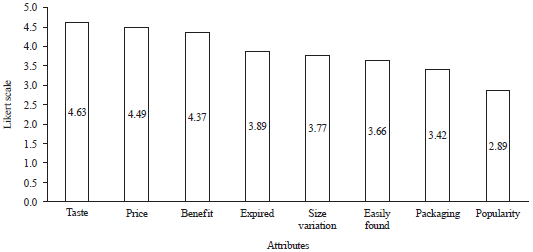 | |
| Fig. 2: | Order of interest of processed cow’s milk attributes of E-co farm brand |
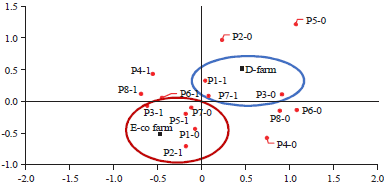 | |
| Fig. 3: | Positioning of 2 brands of processed products of cow's milk with product attributes, P1: Products easy to find, P2: Affordable price, P3: Size/volume variations, P4: Interesting packaging, P5: Health benefits, P6: Delicious taste, P7: Brand popularity and P8: Clarity of expiration date |
This is caused by the product of processed cow's milk of E-co farm is single consumption type of beverage product so the packaging is not important for the consumers. In addition to the popularity attribute, consumers pay less attention for this attribute in purchasing, this is due to the consumer's popularity of a product does not necessarily describe the benefits of the product. More details, the importance of attributes can be seen in Fig. 2.
Products positioning: Positioning is the process of creating a perception in the consumers’ minds about the name of the company and the products are relative to its competitors. Positioning is done to get a positive purchasing response from customers. A strong brand position directs a marketing strategy by explaining brand details, brand uniqueness and in common with competitive brands and also reasons to buy and use a particular brand. Brand perception is in the minds of customers and is not beyond the minds of the customers. Therefore, the effort of positioning is not directed at the product but rather directed to the customer's mind14.
Determination of products positioning through correspondence analysis, to measure the proximity of its product attributes with competing products, with the result of the image in the form of perceptual map15. Based on the result of the analysis, it can be seen that the attribute closest to one brand in one quadrant is the attribute that best describes the product based on consumer ratings.
The processed products of cow’s milk of E-co farm has close proximity to price, size variations and health benefits attributes as shown in Fig. 3. This is because the processed products of cow's milk of E-co farm has a relatively cheaper price than its competitor D-farm and the size of the processed products of cow's milk of E-co farm also more varied than its competitor's products.
Processed products of cow's milk of D-farm has close proximity to products that are easily found and brand popularity attributes. This is because the location of the sale of processed products of cow's milk of D-farm is in the Faculty of Animal Husbandry building, making it easier for consumers to purchase it. The location of sales closer to consumer activity also causes processed products of cow's milk of D-farm to be more famous and gain high popularity.
Positioning is one of the marketing tools used by companies to gain competitive advantage in the market. Positioning helps the company to differentiate its products offering with its competitors and ensure that the product reaches the right market profile for its purposes16.
Based on the perceptual map result, the processed products of cow's milk of E-co farm competes with D-farm in terms of P6 attribute, which is delicious taste. Figure 2 shows that the proximity of the processed products of cow's milk of E-co farm and D-farm has a similar proximity to the P6 attribute. This means that according to respondents, processed products of cow's milk of E-co farm of D-farm brand also has good taste.
CONCLUSION
Based on the result of research conducted at Business Unit of E-co farm IPB on market segmentation and positioning of processed products of cow's milk of E-co farm brand, it can be concluded as follows: (1) Consumers of processed products of cow's milk of E-co farm is psychographically grouped into three segment, namely: Experiencer segment, rational segments and conventional segment. The potential target segment for dairy products is the conventional segment of E-co farm, (2) In the selection of processed products of cow's milk of E-co farm from the eight studied attributes, flavour attribute is an important factor, followed by price and benefits. While the popularity attribute is the least important attribute and (3) Positioning or image that most attached in the eyes of consumers of processed products of cow's milk of E-co farm brand is an affordable price, the number of variations in size/volume and health benefits. The processed products of cow's milk of E-co farm compete with D-farm in terms of taste attribute.
SIGNIFICANCE STATEMENTS
This study involves consumer behavior in purchasing dairy cow farm E-co farm by dividing into several segments based on psychographical aspects with cluster method. This study will help the E-co farm to focus on potential segment targets and to know the positioning in order to continue to grow the business in Bogor city. Therefore, a new theory of cluster methods can be used in marketing study.
REFERENCES
- Muehlhoff, E., A. Bennett and D. McMahon, 2013. Milk and Dairy Products in Human Nutrition. Food and Agriculture Organization of the United Nations, Rome, ISBN: 978-92-5-107863-1 Pages: 376.
Direct Link - Goyat, S., 2011. The basis of market segmentation: A critical review of literature. Eur. J. Bus. Manage., 3: 45-54.
Direct Link - Sarli, A. and H.H. Tat, 2011. Attracting consumers by finding out their psychographic traits. Int. J. Fundam. Psychol. Soc. Sci., 1: 6-10.
Direct Link - Bose, T.K., 2012. Market segmentation and customer focus strategies and their contribution towards effective value chain management. Int. J. Market. Stud., 4: 113-121.
CrossRefDirect Link - Kaur, N., J.K. Sahiwal and N. Kaur, 2012. Efficient k-means clustering algorithm using ranking method in data mining. Int. J. Adv. Res. Comput. Eng. Technol., 1: 85-91.
Direct Link - Raval, U.R. and C. Jani, 2016. Implementing and improvisation of k-means clustering algorithm. Int. J. Comput. Sci. Mobile Comput., 5: 191-203.
Direct Link - Bendixen, M., 2003. A practical guide to the use of correspondence analysis in marketing research. Market. Bull., 1: 16-38.
Direct Link - Dickson, P.R. and J.L. Ginter, 2016. Market segmentation, product differentiation and marketing strategy. J. Market., 51: 1-10.
CrossRefDirect Link - Vikraman, A. and K.P. Ganesan, 2011. Market segmentation of milk-a study on consumer preferences in Kanchipuram district. Int. J. Enterp. Innovation Manage. Stud., 2: 150-156.
Direct Link - Ponduri, S.B. and V. Sailaja, 2014. Consumer involvement in brand positioning. J. Scient. Res. Manage., 2: 1040-1059.
Direct Link - Najafizadeh, N.S., M. Elahi, A. Moemeniand and Z. Lotfi, 2012. A model for brand positioning of hygienic products using the most effective factors on competitive position and perceptual map technique. Afr. J. Bus. Manage., 6: 8102-8117.
Direct Link - Ekmekci, A.K., 2010. The importance of product positioning and global branding for sustaining competitive advantage within the companie's global marketing strategy. J. Econ. Admin. Sci., 9: 17-26.
CrossRefDirect Link