






Jacob Olagbenro Popoola
Department of Biological Sciences, College of Science and Technology, Covenant University, Ota, Ogun State, Nigeria
LiveDNA: 234.16478
ORCID: 0000-0001-5302-4856
Comfort O. Ajani
Department of Biological Sciences, College of Science and Technology, Covenant University, Ota, Ogun State, Nigeria
LiveDNA: 234.38068
ORCID: 0000-0001-5764-2416
Olusola L. Oyesola
Department of Biological Sciences, College of Science and Technology, Covenant University, Ota, Ogun State, Nigeria
Margaret Oniha
Department of Biological Sciences, College of Science and Technology, Covenant University, Ota, Ogun State, Nigeria
Asian Journal of Plant Sciences
Year: 2022 | Volume: 21 | Issue: 3 | Page No.: 520-528
ABSTRACT
Background and Objective: Orphan legume species can provide cheap and quality nutrients, serve as sources of herbal medicine, forage crop, biomass feedstock and green manure but largely unexploited. The present study investigated phytochemical and proximate contents of three orphan legumes comprising three accessions of African Yam Bean (AYB), four of Kersting’s Groundnut (KG) and six of Winged Beans (WB). Materials and Methods: The seeds were collected from the Genebank of the International Institute of Tropical Agriculture via the Standard Material Transfer Agreement (SMTA). The samples were oven-dried, grounded into a fine powder and analyzed for their biochemical profiles using standard procedures. Results: Carbohydrate, betacyanin, quinone and terpenes were found in the samples, while saponins were found only in AYB and KG accessions. Alkaloids and coumarin were only detected in samples of WB and KG. The crude protein was quite high among all the samples ranged from 18.4% in TSs-33 of AYB-52.7% in TPt-126 of WB with a mean of 30.16±3.01. Conclusion: The study indicates that the species and the accessions are rich in proteins and essential proximate contents that can be explored as sources of food and feeds for both humans and animals.
PDF Abstract XML References Citation
Copyright: © 2022. This is an open access article distributed under the terms of the Creative Commons Attribution License , which permits unrestricted use, distribution and reproduction in any medium, provided the original author and source are credited.
How to cite this article
Jacob Olagbenro Popoola, Comfort O. Ajani, Olusola L. Oyesola and Margaret Oniha, 2022. Comparative Analysis of Phytochemical and Proximate Contents of Three Orphan Legume Species. Asian Journal of Plant Sciences, 21: 520-528.
DOI: 10.3923/ajps.2022.520.528
URL: https://scialert.net/abstract/?doi=ajps.2022.520.528
INTRODUCTION
The orphan legume species are members of the Fabaceae family that have been abandoned, less exploited and tagged as minor crops, based on the level of their utilization1,2. They are known to exhibit diverse agronomic and economically significant traits that can serve as a potential breeding solution to the issue of food insecurity, renewable energy and sustainable development if inexorably exploited3,4. Most orphan legume species are endemic to the developing countries of the tropics, in Asia and Africa, where protein and food security challenges are predominant3. The species can provide cheap and quality nutrients, serve as sources of herbal medicine, forage crop, biomass feedstock, green manure, amongst others3,5. Orphan legumes are strictly cultivated by subsistence farmers in rural areas, who still possess indigenous knowledge on how to grow them1,4,6.
Moreover, the species are resilient in a harsh climate, withstand pest, disease and drought and are capable of surviving in marginal lands, without compromising the quality of nutrients contained3. Thus, orphan legumes can be adopted into the cropping system to mitigate the effect of climate change on agricultural productivity. Determining the phytochemical and proximate components of these orphan legume species is critical and will serve as a reference base to confirm their quality nutritional profile. It will also help in identifying elite germplasms among and within the various species, that require crop improvement efforts. Studies have shown that the rich nutritional and phytochemical contents as well as genetic diversity of these crops, have not been fully explored and utilized in active breeding programmes6-8.
To the best of our knowledge, there still exists, a good number of accessions/landraces whose nutritional composition has not been adequately characterized for effective utilization in breeding programs and cultivation. The successful integration of some of these species and their valuable traits will have a notable impact on the global food basket and making available cheaper and quality proteins. Thus, this study aims to comparatively determining the phytochemical and proximate contents of three orphan legume crops. The species consisted of three accessions of African Yam Bean (AYB) (Sphenostylis stenocarpa), four of Kersting’s Groundnut (KG) (Macrotyloma geocarpum) and six of Winged Bean (WG) (Psophocarpus tetragonolobus). Data from this study will be useful in developing breeding and utilization strategies for the species via a selection of better traits.
MATERIALS AND METHODS
Study area: The study was carried out at the Biochemistry Laboratory, Department of Biochemistry, Covenant University, Ota, Ogun State, Nigeria from January-November, 2019.
Acquisition of seed samples: A total of thirteen samples of orphan legumes comprising three accessions of African Yam Bean (AYB)-Sphenostylis stenocarpa, four of Kersting’s Groundnut (KG)-Macrotyloma geocarpum and six of winged Beans (WB)-Psophocarpus tetragonolobus were collected from the Genetic Resources Centre of the International Institute of Tropical Agriculture (IITA), Ibadan, Oyo State, Nigeria. The collection followed the Standard Material Transfer Agreement (SMTA) of the International Treaty on Plant Genetic Resources with an SMTA number SMTA-00AF05-00AK77-180209. Table 1 shows the species, accessions codes and seed traits of the orphan legumes used for this study.
Sample preparation: The seeds of each sample were oven-dried at 70 for 24 hrs, milled into a fine powder using a VTCL heavy-duty solitaire blender grinder-750 Watts and then transferred into properly labelled ziplock bags. The samples were stored at room temperature and analyzed using standard procedures9. The proximate analysis consists of the moisture, ash, crude fat, crude fibre, nitrogen and carbohydrate contents, while phytochemicals such as tannins, saponins, alkaloids, anthocyanin and betacyanins amongst others were screened from each of the accessions.
Phytochemical screening: The 13 samples were screened for the presence of different phytochemicals using standard procedures8. The finely powdered samples were mixed with 100 mL of distilled H2O, properly stirred and stored in the refrigerator for 24 hrs at the appropriate temperature, before the qualitative phytochemical tests were carried out. Such tests include:
• Carbohydrate test: A 2 mL of the sample extract was mixed with 1 mL of Molisch’s reagent (α-naphthol in ethanol) and few drops of conc. H2SO4. A purple coloration indicated the presence of carbohydrates
•Tannins test: A 2 mL of 5% ferric chloride was added to 1 mL of the sample extract. A greenish-black coloration indicated the presence of tannins
•Saponins test: About 2 mL of distilled water was added to 2 mL of the sample extract, transferred into a calibrated test tube and then shaken lengthwise for approximately 15 min. The formation of a 1 cm layer of foam indicated the presence of saponins
| Table 1: | Passport data of the samples used for this study | |||
| Species | Code | Seed shape | Seed coat color | Seed texture |
| Sphenostylis stenocarpa | AYB-TSs-24 | Oblong | Dark brown | Smooth |
| Sphenostylis stenocarpa | AYB-TSs-2 | Oblong | Dark brown | Smooth |
| Sphenostylis stenocarpa | AYB-TSs-33 | Oblong | Dark brown | Smooth |
| Macrotyloma geocarpum | KG-TKg-12 | Rhomboid | Dark brown | Smooth |
| Macrotyloma geocarpum | KG-TKg-11 | Rhomboid | Brown | Smooth |
| Macrotyloma geocarpum | KG-TKg-8 | Rhomboid | Black | Smooth |
| Macrotyloma geocarpum | KG-TKg-9 | Rhomboid | Dark brown | Smooth |
| Psophocarpus tetragonolobus | WB-Tpt-32 | Globular | Dark brown | Smooth |
| Psophocarpus tetragonolobus | WB-TPt-48 | Globular | Dark brown | Smooth |
| Psophocarpus tetragonolobus | WB-TPt-126 | Globular | Dark brown | Smooth |
| Psophocarpus tetragonolobus | WB-TPt-153 | Globular | Dark brown | Smooth |
| Psophocarpus tetragonolobus | WB-TPt-125 | Globular | Dark brown | Smooth |
| Psophocarpus tetragonolobus | WB-TPt-154 | Globular | Dark brown | Smooth |
• Alkaloids: About 2 mL of the sample extract was subjected to 2 mL of conc. HCl and few drops of Mayer’s reagent. The presence of green colour indicated the presence of alkaloids
• Anthocyanin and betacyanin test: To 2 mL of the sample extract, 1 mL of 2N NaOH was added and heated for approximately 5min at 100°C. The presence of yellow coloration indicated the presence of betacyanin, while no colour change indicated the presence of anthocyanin
• Quinones: To 1 mL of sample extract, 1 mL of conc. H2SO4 was added and the presence of red colour indicated the presence of quinones
• Glycoside: About 3 mL of chloroform and 10% ammonia solution was added to 2 mL of the sample extract. Glycosides were identified by the presence of pink coloration in the solution
• Cardiac glycoside: To 0.5 mL of the sample extract, 2 mL of glacial acetic acid and few drops of 5% ferric chloride was added, under layered with 1 mL of conc. H2SO4. A brown ring at the interface indicated the presence of cardiac glycoside
• Terpenoids: About 0.5 mL of the sample extract was mixed with 2 mL of chloroform and conc. H2SO4 was carefully added. The formation of red-brown colour indicated the presence of terpenoids
• Phenols: About 2 mL of distilled water was added to 1 mL of the sample extract, followed by few drops of 10% of ferric chloride. The green colour formation indicated the presence of phenols
• Coumarins: 1 mL of the extract and 1 mL of sodium hydroxide were mixed, the formation of yellow coloration indicated the presence of coumarins
• Steroids: Total 2 mL of the sample extract was mixed with 5 mL of chloroform and then filtered using a filter paper. A 2 mL of acetic anhydride was added to 2 mL of the filtrate with 2 mL of H2SO4. The colour change from violet to blue or green indicated the presence of steroids
• Acids: 1 mL of the sample extract was treated with a sodium bicarbonate solution. The formation of effervescence indicates the presence of acids
Proximate analysis:
• Moisture content: This was determined using the air oven method. Crucibles were washed, dried, labelled and cool in the desiccator and weight (W1) was taken, using an analytical weighing balance. Approximately 0.5 g (W2) of the samples were transferred into the crucibles and kept in a preheated incubator for 24 hrs at 100°C. The dry samples were cooled in a desiccator and the new weight (W3) was noted and stored back into the desiccator to avoid ambiguity of weight values due to atmospheric humidity. Moisture content was evaluated using the formula as described by James et al.10:
 |
• Ash content was determined by subjecting the previous crucibles containing the samples to further heating in a muffle furnace at 600°C for 4 hrs. The samples were left to cool in the desiccator and then weighed to determine the new weight (W4). The ash content for the seeds was determined with the formula:
 |
Where:
| IWBD | = | Initial weight before drying |
| NFWAD | = | New final weight after drying |
| WCS | = | Weight of crucible and sample (W2) |
| WC | = | Weight of crucible |
• Crude fat was determined using the Soxhlet apparatus. The boiling flasks were initially weighed (W1) before use. About 5 g of the samples were weighed into a filter paper, folded neatly and tied with a rope. This was inserted into the thimble of the Soxhlet apparatus, the 250 mL boiling flask was filled with petroleum ether (40-60°C boiling range) and extraction under reflux was carried out for 3 hrs. At the end of the extraction process, the boiling flask was connected to the rotary evaporator to extract the petroleum ether for 30 min, before drying the flask in the preheated oven for 5 min. The flask was cooled in the desiccator for 3 min and weighed (W2) on the analytical weighing balance. The fat extracted from 5 g of the sample was then calculated:
 |
Where:
| FFWA | = | Final flask weight after extraction |
| IFWB | = | Initial flask weight before extraction |
• Crude fibre content was done by serially diluting the fat-free extract gotten from the crude fat extraction process, with acid (H2SO4) and alkaline (NaOH). The weight of the crucibles (W1) was measured, the weight of crucibles with the diluted fat-free extracts was also measured before ashing them in the muffle furnace for 4 hrs at 600°C and later left to cool in the desiccator. The weight of the dried crucibles and samples (W3) was taken and the crude fibre was determined by:
 |
Where:
| Wt of C | = | Weight of crucible |
| SAP | = | Sample after ashing |
• Nitrogen content was determined using Kjeldhal’s method. 0.5 g of each sample was, respectively digested in 10 mL of conc. sulphuric acid, in the presence of 0.5 g activated catalysts (CuSO4 and Na2SO4) and heated in Kjeldhal’s digestion chamber for 45 min at 450°C. The samples were left to cool off in the chamber before diluting 10 mL of the digested sample with 40 mL of distilled water. For the distillation process was carried out with Kjeldhal’s apparatus. About 20 mL of the diluted solvent was mixed with 20 mLs of 40% NaOH in the digestion tube, while boric acid (H3BO4) was used as the ammonia trapping agent, under the control of a mixed indicator. The distilled solvents were titrated against a strong acid (conc. HCL). Thus, the nitrogen/protein content was determined by:
 |
Where:
| V2 | = | Titre value of sample |
| V1 | = | Titre value of the blank |
| C | = | Molarity of acid used (0.05m) |
| V | = | Total volume of digest solution (50 Ml) |
| V | = | Volume of digested solution required for distillation (20 mL) |
| K | = | Factor converting the weight of nitrogen to weight of protein (6.25) |
| W | = | Weight of sample used (0.5 g) |
• Carbohydrate content was calculated by the addition of moisture, ash, crude fat, crude fibre nitrogen and subtracting the resultant value from 100%. The difference in value was taken as the percentage total carbohydrate content of seed11
Data analysis: The statistical analysis on the proximate data was carried out using the Minitab® 19 Statistical Software software (https://www.minitab.com/en-us/products/minitab/) to derive the mean, standard error and p-value of each proximate. The principal component analysis and dendrogram were also derived, to determine the comparative relationships among the variables and the species. The dendrogram was generated using the Average Linkage Euclidean Distance (ALED) method.
RESULTS
Phytochemical screening: Carbohydrate and betacyanin were present in all the accessions of the three orphan legume species investigated (Table 2). Saponins were found in all the accessions of Kersting’s Groundnut (KG) and African Yam Bean (AYB) but were absent among Winged Bean (WB) accessions. Only the accessions of winged beans contained alkaloids.
| Table 2: | Phytochemical screening of the samples used for this study | |||||||||||||
| Samples | CAH | TAN | SAP | ALK | ANT | BET | QUI | GLY | CAR | TER | PHE | COU | STE | ACI |
| KG-TKg-12 | 1 | 0 | 1 | 0 | 0 | 1 | 1 | 0 | 0 | 1 | 0 | 1 | 0 | 0 |
| KG-TKg-9 | 1 | 0 | 1 | 0 | 0 | 1 | 1 | 0 | 0 | 1 | 0 | 1 | 0 | 0 |
| KG-Tkg-8 | 1 | 0 | 1 | 0 | 0 | 1 | 1 | 0 | 0 | 1 | 0 | 1 | 0 | 0 |
| KG-TKg-11 | 1 | 0 | 1 | 0 | 0 | 1 | 1 | 0 | 0 | 1 | 0 | 1 | 0 | 0 |
| WB-TPt-153 | 1 | 0 | 0 | 1 | 0 | 1 | 0 | 0 | 0 | 0 | 0 | 0 | 0 | 0 |
| WB-TPt-154 | 1 | 0 | 0 | 1 | 0 | 1 | 1 | 0 | 0 | 0 | 0 | 0 | 0 | 0 |
| WB-TPt-48 | 1 | 0 | 0 | 1 | 0 | 1 | 1 | 0 | 0 | 1 | 0 | 0 | 0 | 0 |
| WB-TPt-125 | 1 | 0 | 0 | 1 | 0 | 1 | 1 | 0 | 0 | 1 | 0 | 0 | 0 | 0 |
| WB-TPt-32 | 1 | 0 | 0 | 1 | 0 | 1 | 0 | 0 | 0 | 0 | 0 | 0 | 0 | 0 |
| WB-TPt-126 | 1 | 0 | 0 | 1 | 0 | 1 | 1 | 0 | 0 | 0 | 0 | 0 | 0 | 0 |
| AYB-TSs-33 | 1 | 0 | 1 | 0 | 0 | 1 | 1 | 0 | 0 | 1 | 0 | 0 | 0 | 0 |
| AYB-TSs-24 | 1 | 0 | 1 | 0 | 0 | 1 | 1 | 0 | 0 | 1 | 0 | 0 | 0 | 0 |
| AYB-TSs-2 | 1 | 0 | 1 | 0 | 0 | 1 | 1 | 0 | 0 | 1 | 0 | 0 | 0 | 0 |
| 0: Absence, 1: Presence, CAR: Carbohydrate, TAN: Tannins, SAP: Saponins, ALK: Alkaloids, ANT: Anthocyanins, BET: Betacyanin, QUI: Quinones, GLY: Glycoside, CAR: Cardiac glycoside, TER: Terpenoids, PHE: Phenols, COU: Coumarins, STE: Steroids and ACI: Acid | ||||||||||||||
| Table 3: | Proximate contents of the samples used for this study | |||||
| Samples | MC (%) | AC (%) | CP (%) | CF (%) | CFB (%) | CAB (%) |
| AYB-TSs-33 | 11.0 | 6.0 | 18.4 | 3.1 | 0.25 | 61.25 |
| AYB-TSs-24 | 4.4 | 10.2 | 20.6 | 2.9 | 0.64 | 61.25 |
| AYB-TSs-2 | 16.6 | 4.0 | 22.1 | 2.4 | 0.04 | 54.86 |
| KG-TKg-12 | 15.6 | 7.0 | 21.2 | 2.0 | 0.96 | 53.24 |
| KG-TKg-9 | 2.2 | 4.6 | 22.8 | 2.0 | 0.54 | 67.86 |
| KG-Tkg-8 | 10.4 | 4.8 | 19.5 | 1.8 | 0.9 | 62.6 |
| KG-TKg-11 | 5.0 | 8.6 | 28.9 | 1.3 | 0.52 | 55.68 |
| WB-TPt-153 | 2.8 | 5.2 | 44.2 | 3.4 | 0.7 | 43.7 |
| WB-TPt-154 | 2.6 | 1.4 | 36.8 | 18.6 | 0.68 | 39.92 |
| WB-TPt-48 | 2.6 | 11.4 | 32.8 | 0.7 | 2.67 | 49.83 |
| WB-TPt-125 | 4.0 | 4.8 | 40.9 | 12.5 | 0.6 | 37.2 |
| WB-TPt-32 | 8.2 | 5.6 | 31.2 | 18.9 | 0.45 | 43.65 |
| WB-TPt-126 | 4.0 | 2.2 | 52.7 | 12.7 | 0.53 | 27.87 |
| G. Mean | 6.88 | 5.83 | 30.16 | 6.33 | 0.73 | 50.69 |
| SE Mean | 1.39 | 0.8 | 3.01 | 1.88 | 0.18 | 3.23 |
| p-values | * | * | * | * | * | * |
| p-values: Significant at 0.05%: Percentage, MC: Moisture content, AC: Ash content, CP: Crude protein, CF: Crude fat, CFB: Crude fibre and CAB: Carbohydrate | ||||||
Quinones and terpenoids were generally obtained in all the accessions of KG and AYB while two accessions of WB lacked quinones (TPt-153 and TPt-32) and three accessions (TPt-153, TPt-154 and TPt-32) lacked terpenoids. Coumarins were only identified in the crude extract of all KG accessions (Table 2). Phytochemicals such as tannins, anthocyanin, glycoside, cardiac glycoside, phenols, steroids and acids were not detected in all the samples investigated.
Proximate analysis: The proximate contents of the samples of each of the three species are shown in Table 3. The data showed that moisture content (MC) ranged from 2.2% in TKg-9 of KG-16.6% in TSs-2 of AYB with a mean of 6.88±1.39. Among the AYB accessions, TSs-2 had the highest MC (16.6%), followed by TSs-33 with 11 % while TSs-24 had the least (4.4%). Among the KG accessions, TKg-12 had 15.6% MC values, while TKg-8 and TKg-11 had 10.4 and 5.0%, respectively. The WB accessions showed similar MC values except for TPt-32 which has 8.2%. The Ash Content (AC) ranged from 1.4% in TPt-154 of WB to 11.4%, in TPt-48 also of WB with a mean of 5.83±0.80. The Crude Protein (CP) contents of all the sample accessions were relatively high which ranged from 18.4% in TSs-33 of AYB to 52.7% in TPt-126 of WB (Table 3). The accessions of AYB and WB showed proximity in the range of crude protein contents (18.4-28.9%). Among the samples of KG, TKg-11 showed fairly high CP values of 28.9% compared to others (TKg-8 (19.5%), TKg-9 (22.8%) and TKg-12 (21.2%). A similar trend was obtained among the WB accessions with the TPt-126 having the highest CP content (52.70%). The Crude Fat (CF) ranged from 0.70 in TPt-48-18.90% in TPt-32 of WB with a mean of 30.16±3.01. The Crude Fibre (CFB) was low in TSs-2 (0.04%) of AYB and high (2.67%) in TPt-48 of WB with a mean of 0.73±0.18. All the three species and their accessions showed a high percentage of carbohydrate which ranged from 27.87% in TPt-126 of WB to 67.86% in TKg-9 of KG with a mean of 50.69±3.23. The p values derived at a confidence level of 95% showed that the variations in the mean values of each of the proximate parameters were significantly different (Table 3).
 |
| Fig. 1: | Cluster analysis based on the proximate data |
| Table 4: | Principal components, Eigenvalues and proportion of proximate variables | |||||
| Variables | PC1 | PC2 | PC3 | PC4 | PC5 | PC6 |
| MC | 0.265 | 0.49 | 0.784 | -0.067 | -0.034 | 0.263 |
| AC | 0.369 | -0.483 | 0.131 | 0.222 | -0.745 | 0.096 |
| CP | -0.518 | -0.239 | 0.061 | -0.481 | -0.151 | 0.645 |
| CF | -0.485 | 0.147 | 0.053 | 0.819 | -0.049 | 0.259 |
| CFB | 0.089 | -0.662 | 0.406 | 0.164 | 0.6 | 0.051 |
| CAB | 0.53 | 0.103 | -0.443 | 0.13 | 0.242 | 0.66 |
| Eigenvalue | 2.98 | 1.75 | 0.6 | 0.3859 | 0.2854 | 0.0068 |
| Proportion | 0.496 | 0.291 | 0.1 | 0.064 | 0.048 | 0.001 |
| MC: Moisture content, AC: Ash content, CP: Crude protein, CF: Crude fat, CFB: Crude fibre, CAB: Carbohydrate and PC: Principal component | ||||||
Principal component analysis of the proximate contents: The data in Table 4 shows the proximate variables, principal components (PC1-PC6), Eigenvalues and percentage proportions. The PC1 generated 49.60% with Eigenvalue of 2.98 and influenced by MC (0.265), AC (0.369) and CAB (0.53). PC2 and PC3 had 29.10 and 10%, with an Eigenvalue of 1.75 and 0.60, respectively. The variations are mostly influenced by both MC and CF.
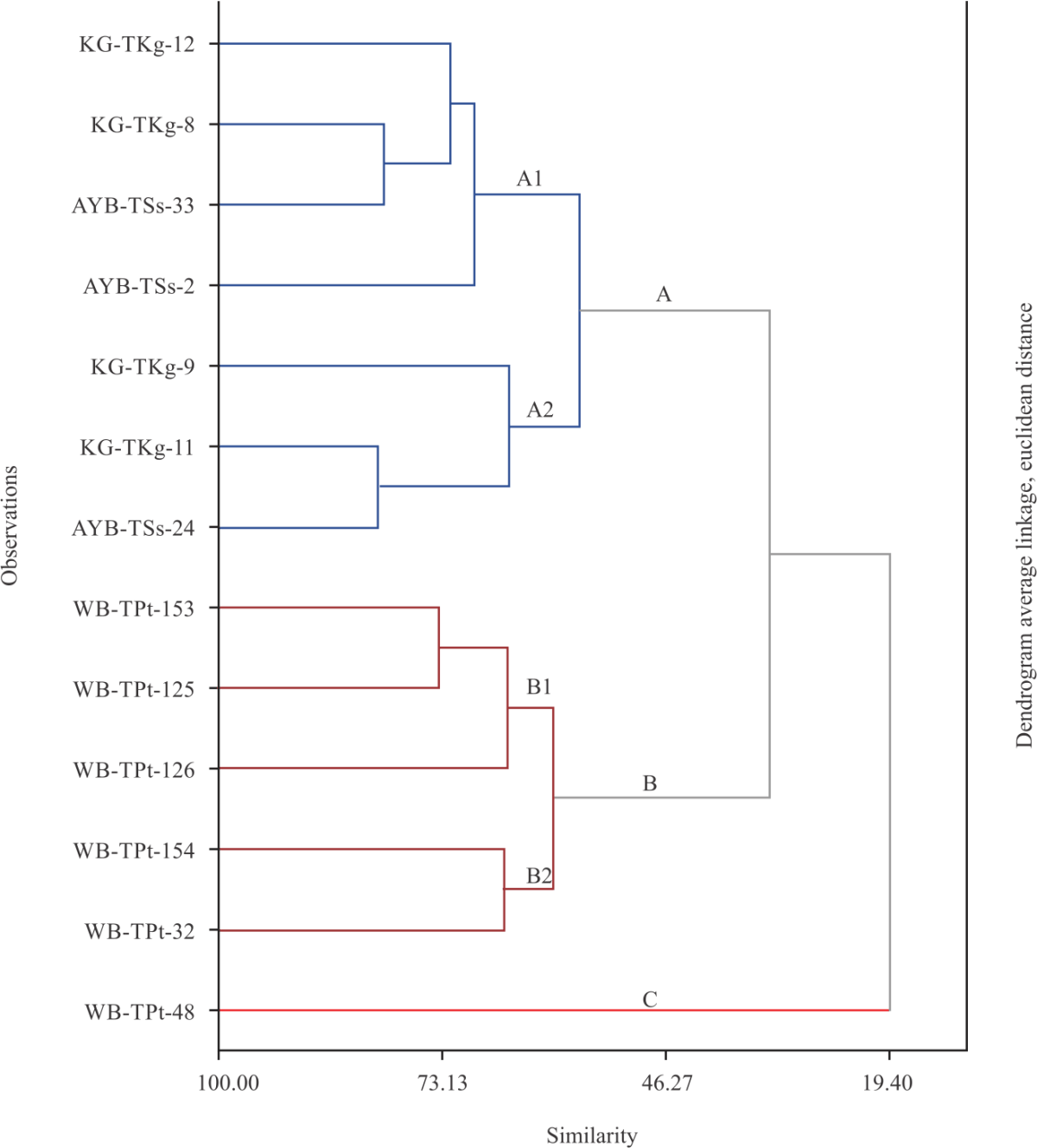
Cluster analysis: The average linkage Euclidean distance segregated the thirteen accessions into three major cluster groups A, B and C, respectively (Fig. 1). Cluster group A comprised of seven accessions which are subdivided into two subcluster groups. The subcluster group A1 consisted of two accessions each of KG (TKg-12 and TKg-8) and AYB (TSs-33 and TSs-2) while A2 consisted of three accessions (TKg-9, TKg-11 and TSs-24). Cluster groups B and C are mainly Wing Beans (WB) accessions (Fig. 1). The cluster group B consisted of two subclusters B1 (Tpt-153, Tpt-125, Tpt-126) and B2 (Tpt-154 and Tpt-32). The cluster group C has only one accession (Tpt-48).
DISCUSSION
The present study investigated the phytochemical and proximate contents of three orphan legume species (African Yam Bean (AYB)-Sphenostylis stenocarpa), Kersting’s Groundnut (KG) (Macrotyloma geocarpum) and Winged Bean (WG) (Psophocarpus tetragonolobus). The study suggests that the three species can contribute to health care delivery and food security in tropical areas. The high carbohydrate and protein contents in all the samples of the three species indicate a high nutritional value of the seeds which can be exploited for food, animal feeds and breeding purposes. The presence of carbohydrates showed that the seeds are a veritable source of useable energy while protein contents have been variously linked to physical and mental growth and development12. Generally, legume carbohydrate is rich in starch (resistant starch), sugars such as fructooligosaccharides, raffinose and stachyose12,13. The biological role of these compounds as substrates to facilitate microbial ecology of the gastrointestinal tract and gut metabolism have been highlighted12,13. The seeds are considered as a cheap source of not only protein but also starch, which has the advantage of being resistant starch compared with root, cereal and tuber starch. Legumes are reportedly rich in polyphenols, saponins and alkaloids, betacyanins and anthocyanins amongst others. In this study, the crude solvent extracts indicated the presence of carbohydrates, saponins, betacyanin, terpenoids, quinones and coumarin obtained from the species investigated. In contrast, tannins, anthocyanins, glycosides, cardiac glycosides, phenols and steroids were not detected in all the samples. Terpenoids were found only in accessions of Kersting’s groundnut (Macrotyloma geocarpum) while alkaloids were found in all the accessions of winged bean (Psophocarpus tetragonolobus).
The presence of betacyanin, quinones and saponins in most of the accessions of the three species is an indication of the potential role the species can play in the medicine and pharmaceutical industry as sources of anti-cancer and anti-inflammatory agents12. Betacyanin is one of the pigment subclasses of flavonoids that give colour to plant parts. Quinones are strong oxidizing agents that exhibit antioxidant, antifungal, antibacterial, antiplasmodial and antitumor properties14-16. The conferment of red, blue and purple colours to fruits including legume seeds, vegetables and beverages (e.g., strawberry, cherry, cranberry, blueberry, red cabbage, eggplant, red wine) was made by the water-soluble pigments called anthocyanins17,18. Anthocyanin and betacyanin constitute two different types of natural pigments that possess diverse health benefits which include antioxidant, anti-cancer, anti-inflammatory, antimicrobial and neuro-protective properties17-19. A wide range of biological activities has been reported for anthocyanins, such as antioxidant, anti-allergic, anti-inflammatory, anti-viral, antiproliferative, anti-microbial, antimutagenic, anti-tumour activities, microcirculation improvement and peripheral capillary-fragility prevention18. Anthocyanins are associated with low prevalence or alleviation of some disorders that include cancer, cardiovascular diseases, diabetes, obesity and cognitive decline20,21. Shreds of evidence have shown a lower risk of suffering Cardiovascular Diseases (CVD) is associated with high consumption of legumes22,23. Differential health-promoting biological activities have been attributed to betanin and betalain-rich foods which include scavenging of free radicals/ reactive oxygen species, inhibition of lipid peroxidation and LDL oxidation, prevention of DNA damage, induction of antioxidant and phase II detoxifying enzymes, gene regulatory activity, anti-inflammatory, antiproliferative and antimicrobial properties24-26.
As earlier stated, legumes are rich in secondary metabolites, such as polyphenols, alkaloids and saponins, which are important defence compounds to protect against herbivores and pathogens and act as signalling molecules between the plant and its biotic environment27,28. In this study, alkaloids were detected only among the accessions of winged beans (Psophocarpus tetragonolobus). Alkaloids have innumerable applications in the pharmaceutical industry and their presence in all accessions of winged bean nominates the species as a potential source of anti-cancer drugs. The presence of terpenoids in Kersting’s groundnut is remarkable even though not detected among the two other species. Terpenoids in Kersting’s Groundnut (KG) (Macrotyloma geocarpum) can facilitate the rate of insect pollination to the species and hence, increased rate of cross-pollination and outbreeding variants. This has implications to enlarge the narrow genetic base of the species.
The p-values derived at a confidence level of 95%, showed that the variations in the resulting mean values of all the proximate were significantly different. The accession TPt-126 of winged bean is identified as a parental line for heterosis breeding for higher protein contents among the three species studied. Accession TPt-32 of winged bean had the highest crude fat extract (18.9%), which makes it a potential oilseed. Generally, the moisture contents were low among the species which indicate their better shelf-life and suitability for long term storage. The percentage of crude proteins was higher (52.70%) in accession TPt-126 of winged bean compared to other species (18.40% in TSs-33 of AYB and 44.20% in TPt-153 of WB) indicates the rich protein contents available in the species. The low crude protein content in accessions of AYB and that of Bambara groundnut (18-22%) are comparable to the findings of Ndidi et al.29 on AYB, James et al.10 on selected lesser-known legumes indigenous to Nigeria and on the whole to that of Vigna unguiculata and Glycine max23,30,31. The seeds of these legumes can serve as a source of animal and poultry feeds32. The proximate analysis results of the winged bean accessions are relatively consistent with that of unprocessed winged bean seeds as reported by Adegboyega et al.33, while that of Kersting’s groundnut correlates with the reports of Ayenan et al.34. The African yam bean accessions used in this study had a higher carbohydrate content and lower crude fibre content compared to that of reported values by Baiyeri et al.35.
The resultant cluster analysis of mixed accessions and a mono cluster of winged beans demonstrates relatedness in phytochemical and proximate contents of the three species. The cluster analysis segregated the 13 accessions of the three species into three major clusters of one mixed cluster consisting of AYB and KG accessions and two clusters of mainly winged beans. This indicates the extremities of proximate values and the need for further research. On the whole, the findings of this study indicate that the three orphan legumes are potential sources of nutrition, food, animal feeds which can also be exploited for nutritional, medicinal and breeding purposes.
CONCLUSION
The species are rich in carbohydrates, proteins, betacyanins, saponins, alkaloids, terpenoids, quinones and coumarin comparable to the mainstream legumes. Bringing these crops into the limelight and mainstream market via sustainable cultivation, utilization and incorporation into food and farming systems will not only promote nutrition and food security but can suit current agricultural systems. Traits such as high carbohydrate, protein and fat as well as low moisture contents can be selected for heterosis breeding to create better phenotypes among the orphan legumes.
SIGNIFICANCE STATEMENT
The rich phytochemical and proximate contents of the three orphan legumes, African Yam Bean (AYB) (Sphenostylis stenocarpa), Kersting’s Groundnut (KG) (Macrotyloma geocarpum) and Winged Bean (WG) (Psophocarpus tetragonolobus) are valuable for food, nutrition and health purposes. The study indicates that the species and the accessions are rich in proteins and essential proximate contents that can be explored as sources of food and feeds for both humans and animals.
ACKNOWLEDGMENTS
The authors are thankful to the Genetic Resources Center of the International Institute of Tropical Agriculture, IITA, Ibadan for making the seeds used for this study available. We also acknowledge the Covenant University Centre for Research Innovation and Discovery (CUCRID) for defraying the Article Processing Charge (APC) of this manuscript.
REFERENCES
- Cullis, C. and K.J. Kunert, 2017. Unlocking the potential of orphan legumes. J. Exp. Bot., 68: 1895-1903.
CrossRefDirect Link - Mabhaudhi, T., V.G.P. Chimonyo, S. Hlahla, F. Massawe, S. Mayes, L. Nhamo and A.T. Modi, 2019. Prospects of orphan crops in climate change. Planta, 250: 695-708.
CrossRefDirect Link - Popoola, J., O. Ojuederie, C. Omonhinmin and A. Adegbite, 2020. Neglected and Underutilized Legume Crops: Improvement and Future Prospects. In: Recent Advances in Grain Crops Research, Shah, F., Z. Khan, A. Iqbal, M. Turan and M. Olgun (Eds.)., BoD-Books on Demand, London, United Kingdom, ISBN: 978-1-78985-449-7, Pages: 156.
CrossRef - Aditya, J.P., A. Bhartiya, R.K. Chahota, D. Joshi, N. Chandra, L. Kant and A. Pattanayak, 2019. Ancient orphan legume horse gram: A potential food and forage crop of future. Planta, 250: 891-909.
CrossRefDirect Link - Raghu, R., R.L. Ravikumar and A.E.S. Subramanya, 2021. Cross transferability of chickpea genic SSR markers developed from Fusarium wilt resistance loci to orphan legumes. Legume Res. Int. J., 44: 388-400.
CrossRefDirect Link - Gulzar, M. and A. Minnaar, 2017. Underutilized Protein Resources From African Legumes. In: Sustainable Protein Sources, Nadathur, S.R., J.P.D. Wanasundara and L. Scanlin (Eds.)., Academic Press Elsevier Inc., United States, ISBN: 978-0-12-802778-3, pp: 197-208.
CrossRefDirect Link - Agbolade, J.O., J.O. Popoola, J.I. Kioko, B.D. Adewale, A.A. Ajiboye et al., 2019. Comparative genetic variability and traits’ heritability in vegetative and floral characters in accessions of two minor legumes. Indian J. Agric. Res., 53: 178-183.
CrossRefDirect Link - Oke, M.O., S.S. Sobowale and G.O. Ogunlakin, 2013. Evaluation of the effect of processing methods on the nutritional and anti-nutritional compositions of two under-utilized Nigerian grain legumes. Pak. J. Biol. Sci., 16: 2015-2020.
CrossRefDirect Link - AOAC International, 2005. Official Methods of Analysis of AOAC International. 18th Edn., AOAC International, Rockville, Maryland, ISBN: 9780935584752.
Direct Link - James, S., T.U. Nwabueze, G.I. Onwuka, J. Ndife and M.A. Usman, 2020. Chemical and nutritional composition of some selected lesser known legumes indigenous to Nigeria. Heliyon, Vol. 6.
CrossRefDirect Link - Fasoyiro, S.B., S.R. Ajibade, A.J. Omole, O.N. Adeniyan and E.O. Farinde, 2006. Proximate, minerals and antinutritional factors of some underutilized grain legumes in South-Western Nigeria. Nutr. Food Sci., 36: 18-23.
CrossRefDirect Link - Nwadike, C., A. Okere, D. Nwosu, C. Okoye, T. Vange and B. Apuyor, 2018. Proximate and nutrient composition of some common bean (Phaseolus vulgaris L.) and cowpea (Vigna unguiculata L. Walp.) accessions of Jos-plateau, Nigeria. J. Agric. Ecol. Res. Int., Vol. 15.
CrossRefDirect Link - Tayade, R., K.P. Kulkarni, H. Jo, J.T. Song and J.D. Lee, 2019. Insight into the prospects for the improvement of seed starch in legume-A review. Front. Plant Sci., Vol. 10.
CrossRefDirect Link - Parveen, I., M.D. Threadgill, J.M. Moorby and A. Winters, 2010. Oxidative phenols in forage crops containing polyphenol oxidase enzymes. J. Agric. Food Chem., 58: 1371-1382.
CrossRefDirect Link - Morris, J.B. and M.L. Wang, 2018. Updated review of potential medicinal genetic resources in the USDA, ARS, PGRCU industrial and legume crop germplasm collections.
Ind. Crops Prod., 123: 470-479.
CrossRefDirect Link - Li, Y., C.F. Tian, W.F. Chen, L. Wang, X.H. Sui and W.X. Chen, 2013. High-resolution transcriptomic analyses of Sinorhizobium sp. NGR234 bacteroids in determinate nodules of Vigna unguiculata and indeterminate nodules of Leucaena leucocephala. PLoS ONE, Vol. 8.
CrossRefDirect Link - Tămaş, M., G. Balica and C. Ştefănescu, 2018. Anthocyanins, betacyanins and the systematics of caryophyllids. Contribuţii Botanice, 53: 7-17.
CrossRefDirect Link - Sakuta, M., 2014. Diversity in plant red pigments: Anthocyanins and betacyanins. Plant Biotechnol. Rep., 8: 37-48.
CrossRefDirect Link - Qin, Y., F. Xu, L. Yuan, H. Hu, X. Yao and J. Liu, 2020. Comparison of the physical and functional properties of starch/polyvinyl alcohol films containing anthocyanins and/or betacyanins. Int. J. Biol. Macromol., 163: 898-909.
CrossRefDirect Link - He, J. and M.M. Giusti, 2010. Anthocyanins: Natural colorants with health-promoting properties. Annu. Rev. Food Sci. Technol., 1: 163-187.
CrossRefDirect Link - Watanabe, S., Y. Ohtani, W. Aoki, Y. Uno, Y. Sukekiyo, S. Kubokawa and M. Ueda, 2018. Detection of betacyanin in red-tube spinach (Spinacia oleracea) and its biofortification by strategic hydroponics. PLoS ONE, Vol. 2018.
CrossRefDirect Link - Bouchenak, M. and M. Lamri-Senhadji, 2013. Nutritional quality of legumes and their role in cardiometabolic risk prevention: A review. J. Med. Food, 16: 185-198.
CrossRefPubMedDirect Link - Aune, D., 2019. Plant foods, antioxidant biomarkers and the risk of cardiovascular disease, cancer and mortality: A review of the evidence. Adv. Nutr., 10: S404-S421.
CrossRefDirect Link - Gengatharan, A., G.A. Dykes and W.S. Choo, 2015. Betalains: Natural plant pigments with potential application in functional foods. LWT Food Sci. Technol., 64: 645-649.
CrossRefDirect Link - Esatbeyoglu, T., A.E. Wagner, V.B. Schini-Kerth and G. Rimbach, 2015. Betanin-a food colorant with biological activity. Mol. Nutr. Food Res., 59: 36-47.
CrossRefDirect Link - Gandía-Herrero, F., J. Escribano and F. García-Carmona, 2016. Biological activities of plant pigments betalains. Crit. Rev. Food Sci. Nutr., 56: 937-945.
CrossRefDirect Link - Ku, Y.S., C.A. Contador, M.S. Ng, J. Yu, G. Chung and H.M. Lam, 2020. The effects of domestication on secondary metabolite composition in legumes. Front. Genet., Vol. 11.
CrossRefDirect Link - Mbugua, D.M., E.M. Kiruiro and A.N. Pell, 2013. In vitro fermentation of intact and fractionated tropical herbaceous and tree legumes containing tannins and alkaloids. Anim. Feed Sci. Technol., 146: 1-20.
Direct Link - Ndidi, U.S., C.U. Ndidi, A. Olagunju, A. Muhammad, F.G. Billy and O. Okpe, 2014. Proximate, antinutrients and mineral composition of raw and processed (boiled and roasted) Sphenostylis stenocarpa seeds from Southern Kaduna, Northwest Nigeria. ISRN Nutr., Vol. 2014.
CrossRefDirect Link - Kulkarni, K.P., R. Tayade, S. Asekova, J.T. Song, J.G. Shannon and J.D. Lee, 2018. Harnessing the potential of forage legumes, alfalfa, soybean and cowpea for sustainable agriculture and global food security. Front. Plant Sci., Vol. 9.
CrossRefDirect Link - Gondwe, T.M., E.O. Alamu, P. Mdziniso and B. Maziya-Dixon, 2019. Cowpea (Vigna unguiculata (L.) Walp) for food security: An evaluation of end-user traits of improved varieties in Swaziland. Sci. Rep., Vol. 9.
CrossRefDirect Link - Armstead, I., L. Huang, A. Ravagnani, P. Robson and H. Ougham, 2009. Bioinformatics in the orphan crops. Briefings Bioinf., 10: 645-653.
CrossRefDirect Link - Adegboyega, T.T., M.T. Abberton, A.H. AbdelGadir, M. Dianda and B. Maziya-Dixon et al., 2019. Nutrient and antinutrient composition of winged bean (Psophocarpus tetragonolobus (L.) DC.) seeds and tubers. J. Food Qual., Vol. 2019.
CrossRefDirect Link - Ayenan, M.A.T. and V.A. Ezin, 2016. Potential of Kersting's groundnut [Macrotyloma geocarpum (Harms) Marechal & Baudet] and prospects for its promotion. Agric. Food Secur., Vol. 5.
CrossRefDirect Link - Baiyeri, S.O., M.I. Uguru, P.E. Ogbonna, C.C.A. Samuel-Baiyeri, R. Okechukwu, F.K. Kumaga and C. Amoatey, 2018. Evaluation of the nutritional composition of the seeds of some selected African yam bean (Sphenostylis stenocarpa hochst EX. A. Rich (Harms)) accessions. Agro-Sci., 17: 37-44.
CrossRefDirect Link