

A.R. Firooz
Center for Research and Training in Skin Diseases and Leprosy, Tehran University of Medical Sciences, Tehran, Iran
D.F. Fouladi
Drug Applied Research Center, Tabriz University of Medical Sciences, Tabriz, Iran
American Journal of Drug Discovery and Development
Year: 2013 | Volume: 3 | Issue: 3 | Page No.: 188-193





ABSTRACT
Alopecia areata is a chronic disease that may respond poorly to treatment. This study aimed to examine the efficacy of methotrexate plus prednisolone in severe alopecia areata. A total of 10 patients with long-lasting extensive alopecia areata were studied. These patients were recruited from two private dermatological clinics in Tehran (Iran) from September 2011 through December 2012. Oral prednisolone (initial: 0.5 mg kg day-1) and oral methotrexate (5-10 mg week-1) were administered and tapered when a full hair regrowth was achieved. A total regrowth of the terminal hair was regarded “success”. Descriptive analysis was used in this study. Success was achieved in 80% of the patients. Within a mean follow-up of 14.40 months after treatment, relapse occurred in 4 patients (patchy loss = 2, patchy and succeeding diffuse loss = 1, diffuse loss = 1). Relapse resolved using local corticosteroid/dose increase in all 4 patients. Complications were minor and resolved spontaneously. This study showed that oral methotrexate plus oral prednisolone is effective and safe in severe alopecia areata.
PDF Abstract XML References Citation
Article History
Received: November 29, 2013;
Accepted: December 21, 2013;
Published: March 10, 2014
How to cite this article
A.R. Firooz and D.F. Fouladi, 2013. Methotrexate Plus Prednisolone in Severe Alopecia Areata. American Journal of Drug Discovery and Development, 3: 188-193.
DOI: 10.3923/ajdd.2013.188.193
URL: https://scialert.net/abstract/?doi=ajdd.2013.188.193
DOI: 10.3923/ajdd.2013.188.193
URL: https://scialert.net/abstract/?doi=ajdd.2013.188.193
INTRODUCTION
Alopecia Areata (AA) is a noncicatricial, autoimmune variety of hair loss that occurs in all ages and both sexes, with a reported incidence rate of 0.1-0.2% and an estimated lifetime risk of 1.7% among general population (McDonagh and Tazi-Ahnini, 2002).
The natural history of AA, as well as the possible factors influencing its course and extent remains unknown, making the outcome of the disease as often as not unpredictable on presentation (Alexis et al., 2004).
It is estimated that 34-50% of the patients with AA recover in 1 year, while 14-25% progress to total hair loss on the scalp (alopecia totalis, AT) or even on the entire body (alopecia universalis, AU). In the latter two groups, spontaneous full recovery is rare (Gip et al., 1969).
Hitherto various treatments have been tried in patients with AA but their results remain rather disappointing, questionable and temporary (Misery et al., 2007).
Treatment with systemic corticosteroids is relatively common in patients with AA; however, a required maintenance dose is often unacceptably high (Shapiro, 2011).
On the other hand, it has been shown that methotrexate (MTX) can be employed as a safe and effective corticosteroid-sparing agent in several autoimmune disorders (Gurcan and Ahmed, 2009; Perez et al., 2010).
In addition, MTX alone or in combination with oral corticosteroids has been claimed to be efficacious, safe and well tolerated in patients with severe AA in a few recent retrospective studies (Joly, 2006; Chartaux and Joly, 2010; Royer et al., 2011).
In the present prospective study, we aimed to evaluate the efficacy of MTX in combination with oral corticosteroid (prednisolone) in treating a group of patients with severe AA.
MATERIALS AND METHODS
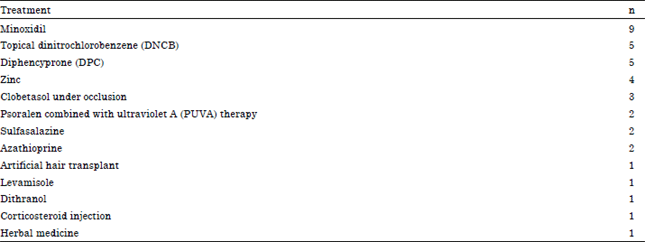
Study design and patients: In this prospective, consecutive case-series study, 10 patients with intractable extensive alopecia areata (9 patients with AU, 1 patient with ophiasis; Table 1) with no/poor response to conventional treatments (Table 2) were recruited from two private dermatology clinics.
These patients were 8 females and 2 males with a mean age of 29.60 (standard error of mean, SEM = 2.43, range: 21-47) years at the time of presentation. Mean duration of the disease was 8.05 (SEM = 1.57, range: 0.5-15) years (Table 1).
Pregnant or breastfeeding women, patients who were planning to have a child, patients with renal or hepatic insufficiency, immunodeficiency, ulcerative colitis, chronic/active infections, or body dysmorphic disorders were not enrolled in this study.
The ethics committee of a local university approved this study. Informed written consents were obtained from all the participants.
Treatment regimen: Oral prednisolone was given daily at an initial dose of 0.5 mg kg-1. The dose was gradually tapered after full hair regrowth and continued at lowest possible maintenance dose (Table 1).
Oral MTX was also initiated as weekly dose of 5-10 mg (after a test dose of 5 mg in the first week) and continued until prednisolone had been successfully tapered to the lowest maintenance dose. MTX was again tapered gradually to the lowest effective dose (Table 1).
Follow-up and assessment of efficacy: Complete blood cell count, as well as the indicators of hepatic and renal function, fasting blood glucose, serum lipid profile and serum electrolytes were obtained at baseline, every other week for 3 months, monthly for 6 months and every 3 months thereafter. Photographs were employed for clinical evaluation of the therapy on the scalp.
The final clinical response was rated according to a grading system proposed by Hull and Norris (1988):
| Grade I: | Regrowth of vellus hair |
| Grade II: | Regrowth of sparse pigmented terminal hair |
| Grade III: | Regrowth of terminal hair with patches of alopecia |
| Grade IV: | Regrowth of terminal hair on scalp |
Only a total regrowth of the scalp terminal hair (grade IV) was considered “success” (Joly, 2006).
RESULTS
The patients’ characteristics, dose of MTX/prednisolone and outcome/complications of treatment are summarized in Table 1.
| Table 1: | Demographics and the results of treatment with methotrexate plus prednisolone in the studied patients with severe alopecia areata |
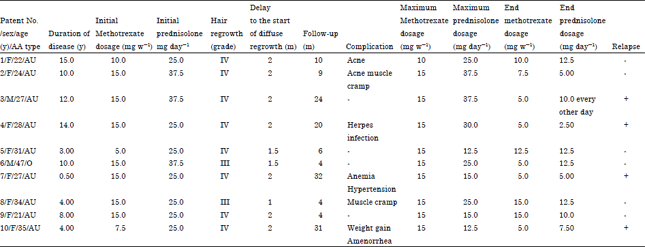 | |
AA: Alopecia areata, AU: Alopecia universalis, O: Ophiasis | |
| Table 2: | Previous treatments in the studied |
 | |
Hair regrowth began in all patients after a mean period of 1.80 (SEM = 0.11, range: 1-2) months. Eight out of 10 patients (80%) achieved total hair regrowth (grade = IV), while in 2 patients the grade of hair regrowth was III.
Within a mean follow-up of 14.40 (SEM = 3.58, range: 4-32) months after treatment, relapse was encountered in 4 patients (40%). In 3 cases (patients No. 3, 4 and 10, Table 1) the relapse was in the form of patchy loss, which resolved after local corticosteroid injection with or without application of topical clobetasol was performed. In one of these 3 patients (patient No. 10, Table 1) a diffuse hair loss was reported again immediately after a jaw surgery. After doubling the dosage of MTX and prednisolone, this severe relapse receded uneventfully. Another instance of diffuse hair loss was showed up after commencement of medication tapering (patient No. 7, Table 1). Restoring to the previous dosage of medications led to a full recovery in this case. Minor complications were reported in 6 patients (60%), including acne (n = 2), muscle cramp (n = 2), herpes infection (n = 1), anemia (n = 1), hypertension (n = 1), weight gain (n = 1) and amenorrhea (n = 1). None of these complications contributed to the cessation of treatment nor did affected patients’ adherence. The results of laboratory tests were all in normal range.
DISCUSSION
In this study we showed that a treatment regimen including MTX plus prednisolone is effective in severe AA. It is previously shown that spontaneous regression of severe AA is rare, particularly in those with longstanding disease (Price, 1999). In the present study, the mean duration of AA was 8.05 years and conventional or nonconventional therapies were previously tried in vain (Table 2). After a mean duration of 1.80 months hair regrowth began in all patients, ending up a striking rate of success (80%). It should be noted that “success” was defined strictly in this study, i.e., a total hair regrowth of grade IV according to a grading system proposed by Hull and Norris (1988). Interestingly, the remaining 20% of the patients achieved a hair growth of grade III that is also a clinically noteworthy outcome. This rate of efficacy is far more than the rate of total hair regrowth (64%) reported in a similar study by Joly (2006) who used MTX with or without low doses of oral corticosteroids in severe types of AA. It is also definitely better than the efficacy of other available treatments in patients with AA (Behrens-Williams et al., 2001; Yoshizawa et al., 2002; Tosti et al., 2003; Kar et al., 2005; Farshi et al., 2010). This high rate of success can not be attributed to chance, because it is shown that at best only 10% of patients with long-term severe AA may be associated with spontaneous regrowth (Gip et al., 1969). During a mean follow-up of 14.40 months after starting the treatment, relapse took place in 40% of the patients (patchy loss = 2, patchy and succeeding diffuse loss = 1, diffuse loss = 1). Although this rate may seem high, it should be born in mind that a full recovery was retrieved simply after using intralesional corticosteroid in the patchy cases and more interestingly, higher doses of oral MTX plus prednisolone in more widespread hair losses. Minor complications were reported by 60% of the patients in this study. These unserious, self-limiting complications did interfere with neither the protocol of treatment nor the patients’ compliance. It is not known whether MTX plays just a corticosteroid-sparing role, or it can be used individually as a single reliable treatment in patients with severe AA (Chartaux and Joly, 2010; Royer et al., 2011). According to available data, however, systemic corticosteroid therapy alone seems not effective against occurrence, spread or relapse of severe AA and, when complete regrowth is obtained, it rarely remains effective sufficiently (Alabdulkareem et al., 1998).
To the best of our knowledge, this is the first study that examines the effects of treatment with MTX and oral corticosteroid in patients with extensive AA in a prospective manner, quite unlike to two similar available retrospective reports which used MTX with or without corticosteroid in these cases (Joly, 2006; Chartaux and Joly, 2010).
It is acknowledged that the current study is a noncontrolled one with limited number of patients and intermediate follow-up; however, the results are worthy of attention. Likewise, apparently maintenance doses of MTX and prednisolone are inevitable in these patients. However, appropriate recommendations regarding the duration of maintenance therapy should be made in further studies.
It deserves to underline that the quality of life of the patients with severe forms of AA is almost as much devastated as that in patients with other chronic autoimmune dermatoses such as psoriasis and eczema, which usually receive MTX and/or corticosteroids usually for their lifetime (Firooz et al., 2005; Tosti et al., 2006).
Thus, even though the need of further studies in terms of elucidating the long-term consequences of using MTX-corticosteroid combination in the patients with severe AA cannot be trivialized, the results of the present study could not be sold short.
Further studies with emphasis on the patients’ age, gender, skin type, etc., are also recommended in this regard (Babaeinejad et al., 2011; Navali et al., 2011; Khodaeiani et al., 2012; 2013).
CONCLUSION
Oral methotrexate in combination with prednisolone is an efficacious, safe and well-tolerated treatment in severe alopecia areata.
REFERENCES
- Alexis, A.F., R. Dudda-Subramanya and A.A. Sinha, 2004. Alopecia areata: Autoimmune basis of hair loss. Eur. J. Dermatol., 14: 364-370.
PubMed - Behrens-Williams, S.C., U. Leiter, R. Schiener, M. Weidmann, R.U. Peter and M. Kerscher, 2001. The PUVA-turban as a new option of applying a dilute psoralen solution selectively to the scalp of patients with alopecia areata. J. Am. Acad. Dermatol., 44: 248-252.
CrossRef - Chartaux, E. and P. Joly, 2010. Long-term follow-up of the efficacy of methotrexate alone or in combination with low doses of oral corticosteroids in the treatment of alopecia areata totalis or universalis. Ann. Dermatol. Venereol., 137: 507-513.
CrossRef - Farshi, S., P. Mansouri, F. Safar and S.R. Khiabanloo, 2010. Could azathioprine be considered as a therapeutic alternative in the treatment of alopecia areata? A pilot study. Int. J. Dermatol., 49: 1188-1193.
CrossRef - Firooz, A., M.R. Firoozabadi, B. Ghazisaidi and Y. Dowlati, 2005. Concepts of patients with alopecia areata about their disease. BMC Dermatol., Vol. 5.
CrossRef - Gip, L., A. Lodin, and L. Molin, 1969. Alopecia areata. A follow-up investigation of outpatient material. Acta Derm. Venereol., 49: 180-188.
PubMed - Hull, S.M. and J.F. Norris, 1988. Diphencyprone in the treatment of long-standing alopecia areata. Br. J. Dermatol., 119: 367-374.
CrossRef - Joly, P., 2006. The use of methotrexate alone or in combination with low doses of oral corticosteroids in the treatment of alopecia totalis or universalis. J. Am. Acad. Dermatol., 55: 632-636.
CrossRef - Kar, B.R., S. Handa, S. Dogra and B. Kumar, 2005. Placebo-controlled oral pulse prednisolone therapy in alopecia areata. J. Am. Acad. Dermatol., 52: 287-290.
CrossRef - McDonagh, A.J. and R. Tazi-Ahnini, 2002. Epidemiology and genetics of alopecia areata. Clin. Exp. Dermatol., 27: 405-409.
CrossRef - Misery, L., K. Sannier, M. Chastaing and G. Le Gallic, 2007. Treatment of alopecia areata with sulfasalazine. J. Eur. Acad. Dermatol. Venereol., 21: 547-548.
CrossRef - Perez, A., A. Woods and C.E.H. Grattan, 2010. Methotrexate: A useful steroid-sparing agent in recalcitrant chronic urticaria. Br. J. Dermatol., 162: 191-194.
CrossRef - Royer, M., C. Bodemer, P. Vabres, C. Pajot, S. Barbarot, C. Paul and J. Mazereeuw, 2011. Efficacy and tolerability of methotrexate in severe childhood alopecia areata. Br. J. Dermatol., 165: 407-410.
CrossRef - Tosti, A., S. Bellavista and M. Iorizzo, 2006. Alopecia areata: A long term follow-up study of 191 patients. J. Am. Acad. Dermatol., 55: 438-441.
CrossRef - Tosti, A., B.M. Piraccini, M. Pazzaglia and C. Vincenzi, 2003. Clobetasol propionate 0.05% under occlusion in the treatment of alopecia totalis/universalis. J. Am. Acad. Dermatol., 49: 96- 98.
CrossRef - Yoshizawa, Y., S. Izaki, K. Kitamura and S. Kawana, 2002. Systemic immunotherapy with topical dinitrochlorobenzene as additional treatment of alopecia areata. Acta Dermato Venereol., 82: 136-138.
PubMed - Babaeinejad, S., E. Khodaeiani and R.F. Fouladi, 2011. Comparison of therapeutic effects of oral doxycycline and azithromycin in patients with moderate acne vulgaris: What is the role of age? J. Dermatol. Treat., 22: 206-210.
CrossRefPubMedDirect Link - Khodaeiani, E., R.F. Fouladi, M. Amirnia, M. Saeidi and E.R. Karimi, 2013. Topical 4% nicotinamide vs. 1% clindamycin in moderate inflammatory acne vulgaris. Int. J. Dermatol., 52: 999-1004.
CrossRefPubMedDirect Link - Khodaeiani, E., R.F Fouladi, N. Yousefi, M. Amirnia, S. Babaeinejad and J. Shokri, 2012. Efficacy of 2% metronidazole gel in moderate acne vulgaris. Indian J. Dermatol., 57: 279-281.
CrossRefPubMedDirect Link - Navali, N., S. Pourabolghasem, R.F. Fouladi and M.A. Nikpour, 2011. Therapeutic effects of biguanide vs. statin in polycystic ovary syndrome: A randomized clinical trial. Pak. J. Biol. Sci., 14: 658-663.
CrossRefPubMedDirect Link