

Ali Fathi-Ashtiani
Behavioral Sciences Research Center, Baqiyatallah University of Medical Sciences, Tehran, Islamic Republic of Iran
Javad Ejei
Not Available
Mohammad-Karim Khodapanahi
Not Available
Hamid Tarkhorani
Not Available
Journal of Applied Sciences
Year: 2007 | Volume: 7 | Issue: 7 | Page No.: 995-1000







ABSTRACT
This study is surveying some of personality characteristics of adolescents and their associations with academic achievement: Accordingly, 1314 randomly allocated students of Tehran’s high schools were assessed by Beck self-concept inventory, Coopersmith self-esteem inventory, Spielberger State-Trait anxiety inventory, Beck depression inventory. Results indicate that self-concept is correlated with self-esteem and these two have positive impacts on augment of academic achievement. Moreover, the increase of self-concept and self-esteem are related to the decrease of anxiety and a negative significant relation exists between self-concept, self-esteem and depression which will ensue decrease in academic achievement.
PDF Abstract XML References Citation
How to cite this article
Ali Fathi-Ashtiani, Javad Ejei, Mohammad-Karim Khodapanahi and Hamid Tarkhorani, 2007. Relationship Between Self-Concept, Self-esteem, Anxiety, Depression
and Academic Achievement in Adolescents. Journal of Applied Sciences, 7: 995-1000.
DOI: 10.3923/jas.2007.995.1000
URL: https://scialert.net/abstract/?doi=jas.2007.995.1000
DOI: 10.3923/jas.2007.995.1000
URL: https://scialert.net/abstract/?doi=jas.2007.995.1000
INTRODUCTION
It was Maslow (1954) who first hypothesized that esteem was one of the five sets of human needs. Self-respect, autonomy and achievement were seen as internal esteem factors, while status, recognition and attention were deemed to be external esteem factors. Esteem was classified as a higher-order need because it concerned the self of the individual. While esteem was others perception of the individual, self esteem was an opinion by the individual of himself. Rosenberg (1965) described self esteem as a favorable or unfavorable attitude towards the self. Self esteem is the product of two internal assessments or judgments, the global judgment and one's self-worth. The key to self esteem was the amount of discrepancy between what a person desired and what that person believed he/she had achieved and the overall sense of support that the person he/she felt from people around him/her.
Self esteem is an individual's sense of his or her value or worth, or the extent to which a person values, approves of, appreciates, prizes, or likes himself or herself (Blascovich and Tomaka, 1991). It is generally considered to be the evaluative component of the self-concept, a broader representation of the self that included cognitive and behavioral aspects as well as evaluative or affective ones. Related concepts such as self-confidence or body-esteem implied a narrower sense of self esteem. The relationship between self-esteem and psychological well-being in terms of depression, social anxiety, loneliness and alienation was well-established. It is believed that self esteem worked like a trait and was stable across time within individuals. Everyone's self esteem is influenced by many factors. Parents, teachers, co-workers, friends, fellow classmates and the environment were constantly influencing self esteem (Osborne, 1997). It has been related to virtually every other psychological concept or domain, including personality, task performance and similar behavior, cognitive (e.g., attribution bias) and clinical concepts such as anxiety and depression.
Baumeister et al. (2003) concluded from a review of the self esteem literature that the benefits of high self esteem fell into the categories of enhanced initiative and pleasant feelings. Bernard et al. (1996) found high correlations among self esteem, self-efficacy, ego strength, hardiness, optimism and maladjustment and all of these constructs were significantly related to health. Stamatakis et al. (2003) looked at the association of self esteem and mortality in a large sample of males in Finland. They report that lower self-esteem was found to be associated with many socioeconomic, behavioral, psychosocial and disease characteristics.
Past research has shown that self esteem and academic achievement correlated directly to a moderate degree (Wiggins and Schatz, 1994). Having one's academic achievement meet one's academic expectations and desires was a major support to most college students self-esteem. A high self esteem had many positive effects and benefits, especially among college students. Students who felt positive about themselves had fewer sleepless nights, succumbed less easily to pressures of conformity by peers, were less likely to use drugs and alcohol, were more persistent at difficult tasks, were happier and more sociable and tended to perform better, academically. On the other hand, college students with a low self esteem tended to be unhappy and less sociable, were more likely to use drugs and alcohol and were more vulnerable to depression, which were all correlated with lower academic achievement. Honors students demonstrated higher academic selfesteem and competency. For them, this academic self-esteem was a motivational factor (Moeller, 1994). For many college students, their self esteem was based or enforced by their academic success or achievements. Academic achievement was influenced by perceived competence, locus of control, autonomy and motivation (Wiest et al., 1998).
In a study 1250 girls were assessed by Dishman et al. (2006) there was a strong positive relation between global physical self-concept and self-esteem and a moderate inverse relation between self-esteem and depression symptoms. Trautwein et al. (2006) demonstrates that reciprocal effects were found between self-esteem, academic self-concept and academic achievement.
Researches of Knapen et al. (2005) showed the relationship between improvements in physical self-concept and enhancements in global self-esteem, depression and anxiety supports the potential role of the physical self-concept in the recovery process of depressed and anxious psychiatric inpatients. Heyman (1990) hypothesized that self-perception of one's learning disability would be related positively to both academic self-concept and self-esteem
Different studies have reached the conclusion that academic achievement and self-esteem are positively correlated (Bankston and Zhou, 2002; Lockett and Harrell, 2003; Ross and Broh, 2000; Schmidt and Padilla, 2003; Verkuyten and Brug, 2002; Wong and Watkins, 2001). Shavelson and his colleagues (quoted in Elshenawi and Badary, unpublished) proposed a hierarchical conception of self-esteem. It begins with general self-esteem, then two correlated dimensions stem out of it: the first one is related to academic achievement and the second one is related to its physical, emotional and social sides.
A fair number of previous studies have found a significant relationship between academic achievement and anxiety (Diaz et al., 2001).
Using an Egyptian sample, Mattar (1981) found that the relationship between anxiety and academic achievement was positive and statistically significant for scientific section students, whereas it was negative for literary section students. Soliman (1979) studied the acceptance of superior and retarded sons of their parents attitudes toward their academic achievement and its relationship to their anxiety level among 405 secondary school students in Cairo, Egypt. He found a statistically significant correlation between anxiety and academic achievement in males. For females, the correlation was not significant.
Generally, it could be concluded that there is a positive relationship between high degrees of academic achievement and low anxiety. There is a certain degree of anxiety that increases academic achievement, but if anxiety increases beyond that degree the opposite happens. On the basis of the Yerkes-Dodson law both the task difficulty and the level of anxiety must be taken into consideration. That is on difficult tasks low levels of arousal improve performance relative to high levels, but on easy tasks, the reverse is true (Reber, 1995).
According to the clinicians, skeptic people who are doubtful abut their merits, can’t achieve an Affectionately proportionate life, no account of fearing from declaration of their incompetence’s and being Secluded; Thus they evade and confrontation with serious affectionate relationships and eventually feel isolated (Coopersmith, 1967a; Kaplan et al., 1995).
Other clinical studies have shown that probably one major cause of anxiety is undergoing failure impression or lacking fitness in a person’s characteristics and whishes.
In fact, if one accepts that anxiety is a result of feeling being threatened or sensing hazard, it can be said that is in this territory which self-concept has been threatened (Coopersmith, 1967b; American Psychiatric Association, 2000).
Also several experimental and field researches have studied these parameters and confirmed clinical concepts.
Fite’s et al. (1992) research result show an invert correlation between anxiety and self-concept, indeed high anxiety is relevant with low self-concept and high self-concept is in relation with affirmative attitude toward school.
These results indicate that self-concept and self-esteem have a momentous role on mental health so that with a decline in these factors, symptoms and traits of anxiety, depression, loneliness, shyness and being reserved will be revealed and if persistent, serious problems will ensue (Kaplan et al., 1995).
On the other hand a close a significant negative association exists between self-esteem and depression. (Westavy et al., 1992). Also, there’s correlation between depression symptoms and academic and social failure; and these ineptitudes will increase depression symptoms (Cole, 1990); Besides accomplished students with better scores have less anxiety in comparison with unsuccessful and deficient students (Polansky, 1990).
There is a significant affirmative correlation between self-esteem and high scores, while depression is associated with serious negative and critical self evaluation (Alice, 1989).
People who have a low estimating rate of their self-concept are likely to show certain personality characteristics such as shyness, reserved state, seclusion and loneliness (Kaliopusks et al., 1991).
When some one underestimates his merits, will become less persistent against others facing and reverse ideas, however someone who is endowed with high self estimating rate has a fixed resolution about his capacities and cap abilities, these group of people actively take part in social collaboration and more literately and express what they want and wish This study’s end is to survey personality characteristic of adolescents including self-concept, self-esteem and their relation with academic achievement, as we believe that ignorance and illiteracy of parents, managers and instructors of society about these characteristics, lack of facilities in providing chances for blossom out, inadequate accommodations for these purpose, all are motives that will quench and stifle these qualifications and surely many are degenerated because of this know ledge deficiency which will terminate in physical and mental disorders most momentous of them known as anxiety and depression (Eccles et al., 1989; Ray et al., 1992).
Based on previous studies in this field we decide to study the relationship between self-concept, self-esteem, anxiety, depression and academic achievement in adolescents in Iran. And want determine whether the personality features have positive or negative effect on academic achievement or not.
MATERIALS AND METHODS
Our statistical society embraces all male and female students of Tehran’s high schools; from which 1314 students were chosen randomly in order to be the tests examines.
We did cluster sampling, to this end, from Tehran city’s different educational regions, region 4 was picked out at random then again 2 schools were selected in this region in the same way. The mean age in the specimen is 15 years and 8 month and the standard deviation (SD) is 1.06.
In this survey, evaluation of intended parameters occurred by earring out Beck (1985) self-concept inventory (1987) with mean of 86. 45 and SD of 9.99.
Coopersmith (1997a and b) self -esteem inventory mean: 34.67 SD: 8.47. The Coopersmith Self-Esteem Inventory was developed through research to assess attitude toward oneself in general and in specific contexts: peers, parents, school and personal interests. It was originally designed for use with children, drawing on items from scales that were previously used by Carl Rogers. Respondents state whether a set of 50 generally favorable or unfavorable aspects of a person are like me or not like me. There are two forms, a School Form (ages 8-15) and an Adult form (ages 16 and older) (Anastasi, 1988; Blascovich and Tomaka, 1991; Pervin, 1993). Acceptable reliability (internal consistency and test-retest) and validity (convergent and discriminant) information exists for the Self-Esteem Inventory (Blascovich and Tomaka, 1991).
Spielberger (1983) state-trait anxiety inventory mean the state score was 34.30±10.79 and the Trait score was 36.07±10.47. Among many instruments to assess anxiety, one stands out: the State-Trait Anxiety Inventory (STAI, Spielberger, 1983). This does not mean that it is an ideal measure but it is the most frequently used scale in research world-wide and no other measure has received as many foreign language adaptations and citations in the last three decades. Thus, it is the standard in the field. The self-report inventory consists of 20 items to assess state anxiety and another 20 items to assess trait anxiety. These two parts differ in the item wording, in the response format (intensity vs. frequency) and in the instructions for how to respond. An alternative to the STAI is the Endler Multidimensional Anxiety Scales (EMAS; Endler et al., 1991), based on Endler's theory of person-situation interactionism (Endler, 1997).
The procedure was to make arrangements with chosen schools and then after attendance, students were divided into groups, each containing 15-20 student which would receive informative explanation a bout aim, procedure and answering methods of these tests; then at the presence of researchers, the questionnaire would be filled out and it takes approximately two one -hour sessions to be completed.
For evaluating academicals achievement, the last two previous academic averages of the students was gathered and used as a mean of academic achievement. In the survey, data processing gained from statistical ways of Pearson’s correlation co-efficient.
RESULTS
For analyzing the data collected from this study the results were divided into 3 groups (low, intermediate, high) based on Mean±SD and then according to the variance analysis method (ANOVA) and their relation with other parameters, they have been explored. Results gained show a fair connection between self-concept and self-esteem; it means self-esteem will increase in as much as self-concept increase. And it can be said that a significant affirmative relation (p<0.0l) exists between self-concept and self-esteem. Additionally a negative significant relation (p<0.01) exists between self-concept and anxiety (state-trait) and depression. It means that the higher self-concept is the more anxiety (state-trait) and depression decrease.
In addition to all above, it can be inferred from the test result that academic achievement in students with low self-concept is comparatively less than students with high self-concept and it means that. Low self-concept will affect student’s academic functions and undermine it. (Table 1). In self-esteem alliance with other it can be inferred that there’s a negative significant relation between self-esteem and anxiety and depression as long as self-esteem increases, anxiety and depression will decrease. Further academic achievement in low self-esteem students is perceptibly less than average and high self-esteem students. it also expresses that low self-esteem affect educational function and decline academic achievement (Table 2). A summary of correlation test results among intended average variables are put in Table 3.
| Table 1: | Relation between self-concept and other variables |
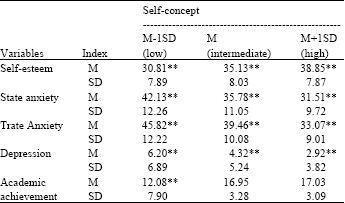 | |
| **p<0.01 | |
| Table 2: | Relation between self-esteem and other variables |
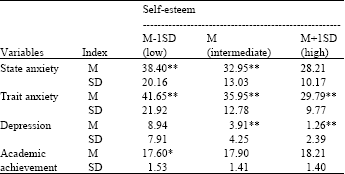 | |
| *p<0.05, **p<0.0 | |
| Table 3: | Correlation coefficient results |
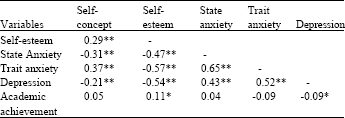 | |
| *p<0.05, **p<0.001 | |
DISCUSSION
The survey’s results have signified that self-concept and self-esteem are relevant; it means that any increase in self-concept will amplify self-esteem and these results are correspondent with the researches results of Kaplan et al. (1995) and Dishman et al. (2006). These two components have a momentous role in personality. Thus in terms of these survey’s result people with high self-concept and self-esteem respect and themselves, have high adaptability, are capable in initiating good motive relations with others, take part in creational works have an active role social groups and are endowed with high self confidence.
The research also indicates that, not only self-concept is it correlation with self esteem but also can play an important role in academic achievement and these results are correspondent with the researches results of Alice et al. (1989) and Wiggins and Schalz (1994).
According to these results a question can be here that what causes disturbance in this natural procedure? In other word, what cause a decrease in self concept and self esteem that will lead in to inclination of academic achievement? Conclusions inferred from the survey indicate that when anxiety increases apprehension, irritability, sensitivity distress, stimulation, sensibility against criticisms, feeling disdained and it will result in misevaluation of personality which is an out come of past or present experiments, feeling ineptitude sensitivity against others confirmation or contradictions over praising other people and generally decrease in self esteem like other researchers reported (Mattar, 1981; Polamsky, 1990; Reber, 1995; Diaz et al., 2001).
Also it is disclosed that beside these motives a significant source of self concept and self-esteem inclination is not only state anxiety, but also trait anxiety a behavior field which prepare one to feel in hazardous accomplishments. Anxiety traits are various stable differences and cause to perceive the world and surroundings in a different way.
The other significant result gained from the research is that increase in anxiety will ensue in depression increase and there is a significant negative relation between self-concept, self-esteem, depression and academic achievement and these results are correspondent with the researches results of Cole (1990), Kalio puska (1991), Knapen et al. (2005) and Dishman et al. (2006).
REFERENCES
- APA., 2000. Diagnostic and Statistical Manual of Mental Disorders (DSM-IV-Association). 4th Edn., American Psychiatric Press Inc., USA., ISBN-10: 0890420254.
Direct Link - Bankston, C.L. III and M. Zhou, 2002. Being well vs. doing well: Self-esteem and school performance among immigrant and non-immigrant racial and ethnic groups. Int. Migration Rev., 36: 389-415.
Direct Link - Bernard, L.C., S. Hutchison, A. Lavin and P. Pennington, 1996. Ego-strength, hardiness, self esteem, self-efficacy, optimism and maladjustment: Health-related personality constructs and the Big Five model of personality. Assessment, Psychol. Assessment Reso. Inc: US., 3: 115-131.
Direct Link - Diaz, R. J., C. R. Glass, D. B. Arnkoff and M. Tanofsky-Kraff, 2001. Cognition, anxiety and prediction of performance in 1st year law. J. Educat. Psychol., 93: 420-429.
Direct Link - Dishman, R.K., D.P. Hales, K.A. Pfeiffer, GA Felton and R. Saunders et al., 2006. Physical self-concept and self-esteem mediate cross-sectional relations of physical activity and sport participation with depression symptoms among adolescent girls. Health Psychol., 25: 396-407.
PubMedDirect Link - Kaliopusks, M. and M. Laitinen, 1991. Loneliness related to self-concept. Psychol. Report., 69: 27-34.
PubMed - Knapen, J., P. Van de Vliet, H. Van Coppenolle, A. David, J. Peuskens, G. Pieters and K. Knapen, 2005. Comparison of changes in physical self-concept, global self-esteem, depression and anxiety following 2 different psychomotor therapy programs in non psychotic psychiatric inpatients. Psychother. Psychosom., 74: 353-361.
CrossRefDirect Link - Lockett, C.T. and J.P. Harrell, 2003. Racial identity, self-esteem and academic achievement: Too much interpretation, too little supporting data. J. Black Psychol., 29: 325-336.
CrossRefDirect Link - Osborne, J., 1997. Identification with academics and academic success among community college students. Commu. College Rev., 25: 59-67.
Direct Link - Ross, C.E. and B.A. Broh, 2000. The roles of self-esteem and the sense of personal control in the academic achievement process. Soc. Educ., 73: 270-284.
Direct Link - Schmidt, J.A. and B. Padilla, 2003. Self-esteem and family challenge: An investigation of their effects on achievement. J. Youth Adolescence, 32: 37-46.
Direct Link - Trautwein, U., O. Ludtke, O. Koller and J. Baumert, 2006. Self-esteem, academic self-concept and achievement: How the learning environment moderates the dynamics of self-concept. J. Pers. Soc. Psychol., 90: 334-349.
Direct Link - Verkuyten, M. and P. Brug, 2002. Ethnic identity achievement, self-esteem and discrimination among Surinamese adolescents in the Netherlands. J. Black Psychol., 28: 122-141.
CrossRefDirect Link - Westaway, M.S. and L. Wolmarans, 1992. Depression and self-esteem: Rapid screening for depression in black, low literacy, hospitalized tuberculosis patients. Soc. Sci. Med., 35: 1311-1315.
PubMed - Wiest, D.J., E.H. Wong and D.A. Kreil, 1998. Predictors of global self-worth and academic performance among regular education, learning disabled and continuation high school students. Adolescence, 22: 601-618.
Direct Link - Wiggins, J. and E.L. Schatz, 1994. The relationship of self-esteem to grades, achievement scores and other factors critical to school success. School Counselor, 41: 239-244.
Direct Link - Wong, M.S.W. and D. Watkins, 2001. Self-esteem and ability grouping: A Hong Kong investigation of the big fish little pond effect. Educ. Psychol. Int. J. Exp. Educ. Psychol., 21: 79-87.
Direct Link