

A.R. Ommani
College of Agriculture, Islamic Azad University, Shoushtar Branch, Shoushtar, Iran
M. Chizari
College of Agriculture, Tarbiat Modares University, Tehran, Iran
C. Salmanzadeh
College of Agriculture, Chamran University, Ahwaz, Iran
J.F. Hossaini
College of Agriculture, Islamic Azad University, Science and Research Branch, Iran
Journal of Applied Sciences
Year: 2009 | Volume: 9 | Issue: 3 | Page No.: 567-572







ABSTRACT
The primary purpose of this research was to identify extension methods and organizational characteristics for supporting Sustainable Water Resource Management (SWRM) in agriculture of Iran. The total population of agricultural extension experts (N = 110) of Agricultural-Jihad Organization of Khuzestan Province of Iran considered as population of study. A mailed questionnaire was used to collect the data. The response rate of questionnaire was 78% (N = 86). Appropriate descriptive statistics such as mean scores, standard deviations and correlation coefficient were used. The findings show that extension experts had positive perceptions about SWRM in agriculture. Extension experts believed that among extension methods, on-farm education, problem solving methods and workshop had very high importance for supporting SWRM in agriculture. Also, ranking based on the perceptions of extension experts indicated that the three most important organizational characteristics of extension system for supporting SWRM in agriculture were: considering local groups, participatory management and considering job qualification. It is concluded that appropriate extension methods and organizational characteristics for supporting SWRM needs to be accurately implemented for the extension system development.
PDF Abstract XML References Citation
How to cite this article
A.R. Ommani, M. Chizari, C. Salmanzadeh and J.F. Hossaini, 2009. Extension Methods and Organizational Characteristics for Supporting Sustainable Water Resource Management in Agriculture of Iran. Journal of Applied Sciences, 9: 567-572.
DOI: 10.3923/jas.2009.567.572
URL: https://scialert.net/abstract/?doi=jas.2009.567.572
DOI: 10.3923/jas.2009.567.572
URL: https://scialert.net/abstract/?doi=jas.2009.567.572
INTRODUCTION
During the past fifty years, agricultural development policies have been remarkably successful at emphasizing external inputs as the means to increase food production. (Ommani and Chizari, 2008). This has led to growth in global consumption of pesticides, inorganic fertilizer, animal feed stuffs and tractor and other machinery (Roling and Pretty, 1997). The illustration of agricultural development of Iran indicates that agricultural development theory is in crisis. Since the rise of concern for the environmental consequences of agriculture and increasing criticism of conventional agriculture, there seems to be a lack of theoretical basis for sustainable agricultural development (Rezaei-Moghadam et al., 2005). Agricultural productivity reduces when ecosystems are changed and water resource decreased. Water is an essential component in agriculture. However, 70% of the total world water withdrawal is used for agriculture (Hasheminia, 2004). Placing emphasis on water conservation in agriculture is a critical step toward sustainability. Water is a finite resource and an essential element to our survival. Irresponsible agricultural practices decrease our supply.
Agricultural water conservation involves many components. It is important to take into account the added burden of poor water quality in our water system capacity. Water quality also, suffers as a result of unsustainable practices. Iran is located in arid and semiarid areas of the world. The average precipitation is less than one-third of the world average precipitation. Also, the evaporation in Iran is more than the world average and about 72% of total rainfall directly evaporates (Ommani et al., 2008). Therewith, spatial variation precipitation of the country is varied. Approximately, 50% of precipitation is raining at 24% of area of country and other 50% is raining at 76% of the country. Keshavarz et al. (2003) pointed that Iran in recent years faced with drought. Particularly in 1999, 2000 and 2001 the average annual precipitation was much lower than the 30 years annual precipitation. Overall irrigation efficiency in Iran ranges from 33 to 37%, which is lower than the average for both developing countries (45%) and developed countries (60%). Similarly Hasheminia (2004) in his recent study about the application of water in Iran states: apparently, the Iranian farmers apply a lot more water per hectare than what is done globally for different crops.
Availability of water is the most limiting factor for agricultural sector. More than 90% of the renewable water in the country is used for agriculture, but the sector still can not provide enough production to meet the demand of the population (Hasheminia, 2004).
Therefore, focus on efficient use of water through irrigation efficiency and improvements in management of water use will be the major challenges in the coming years. Recent events of drought in the country have resulted in the reduction of water productivity in farming. Sustainable water resources management in agriculture and increasing the water use efficiency in Iran has a vital role for conservation of water resources. A key to sustainable water resources management is the existence of sufficiently well trained personnel in all of the disciplines needed in the planning, development and management processes. Iran’s extension system does not pay enough attention to necessity characteristics of extension organization to accomplish environmentally sound agriculture and these attributes are not favorable situation (Allahyari and Chizari, 2008). These conditions necessitate reorganizing of extension institutions to accomplish sustainability. Considering unsustainable agricultural conditions of Iran (Ommani and Chizari, 2008), organizational recession and inability of current extension organizations (Allahyari and Chizari, 2008) to accomplish of sustainability, it seems that extension systems require a new structure and methods to achieve sustainability objectives. The primary purpose of this research was to identify extension methods and organizations for supporting Sustainable Water Resource Management (SWRM) in agriculture. The specific objectives of the research were as to determine perceptions of agricultural extension experts regarding SWRM dimensions in agriculture and identify correlation between extension methods and organizational characteristics with SWRM dimensions in agriculture.
For the purpose of statistical analysis, the research purpose was posed as the following hypotheses. Each hypothesis was tested at the 0.05 level of significance. These hypotheses include: (1) there is no significant relationship between the perceptions of extension experts regarding importance of extension methods and SWRM dimensions in agriculture. (2) there is no significant relationship between the perceptions of extension experts regarding importance of organizational characteristics and SWRM dimensions in agriculture.
MATERIALS AND METHODS
The research method was quantitative research. In quantitative research, the researcher identifies variables and may look for relationships among them, but does not manipulate the variables (Gay and Airasian, 2003). A major form of nonexperimental quantitative research that has been used in this research is correlation study. This method seeks to determine relationships among two or more variables (Creswell, 2008). The data were collected between January and April 2008 through a questionnaire mailed to the 110 agricultural extension experts of Khouzestan Province of Iran. The total population of agricultural extension experts (N = 110) of Agricultural-Jihad Organization of Khuzestan Province, Iran considered as population of study. The model of questionnaire derived from studies of Arellanes and Lee (2003), Boone et al. (2007), Keshavarz et al. (2003) and Ahmadvand and Karami (2007). To test the validity of a questionnaire, content-related evidence of validity by panel of experts was used. To test the content-related evidence, 20 copies were provided and distributed among faculty members of Islamic Azad University, Tarbiat Modares University, Chamran University, West Virginia University and Ph.D agricultural extension students. Their suggestions were incorporate in the final version of the instrument. Researchers examined reliability evidence by 30 copies of questionnaire of experts that provided and distributed among agricultural extension experts from Esfahan Province. Reliability of overall instrument was estimated at 0.87.
Extension experts were asked to rate their perceptions regarding SWRM in agriculture on a five point Likert- type scale: 1 = strongly disagree, 2 = disagree, 3 = unsure, 4 = agree, 5 = strongly agree. The 15 items were grouped in to three areas of the SWRM dimension. Five questionnaire items were included in the Economic Elements of SWRM (EcESWRM), four items were in the Social Elements of SWRM (ScESWRM) and six items were in the Environmental Elements of SWRM (EnESWRM). Also another section focused on perceptions of extension experts regarding importance of extension methods and organizational characteristics for supporting SWRM in agriculture. In this part, researchers used five point Likert- type scale: 1 = very low, 2 = low, 3 = moderate, 4 = high, 5 = very high.
In this research, two groups of variables existed. These two groups of variables were dependent and independent variables:
| • | Independent variables include extension methods and organizational characteristics for supporting SWRM in agriculture |
| • | Also, dependent variables in study of experts include dimensions of SWRM in agriculture |
Eighty six agricultural extension experts returned questionnaires yielding an overall response rate of 78%. Data collected were analyzed using the Statistical Package for Social Sciences (SPSS, 16). Appropriate descriptive statistics such as mean scores, standard deviations and correlation coefficient were used.
RESULTS AND DISCUSSION
Approximately, 38.2% of respondents were between 20 to 30 years of age and 41.6% of them between 31 to 40 years of age. The mean age was 37 (SD = 2.65, N = 86). Most respondents (52%) reported work experience, including inside of extension, 1 to 10 years and the vast majority of them were male (84.27%).
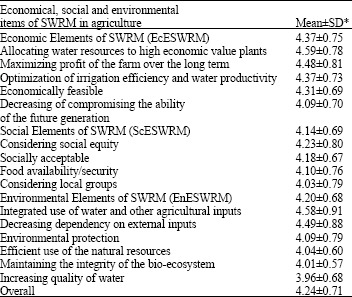
Participants were asked to give their perceptions about items of SWRM in agriculture on a five Likert scale (1 = strongly disagree, 2 = disagree, 3 = unsure, 4 = agree, 5 = strongly agree). Their answers to these items in combination led to the perceptions of agricultural extension experts about SWRM in agriculture. The mean value of the overall perceptions of the extension experts regarding SWRM in agriculture (Mean = 4.24, SD = 0.71) indicates that the extension experts had positive perceptions about SWRM in agriculture (Table 1).
| Table 1: | Means and standard deviation of respondents’ perceptions about SWRM items |
 | |
| Scale: 1 = Strongly Disagree, 2 = Disagree, 3 = Unsure, 4 = Agree, 5 = Strongly agree. *Standard deviation | |
EXTENSION METHODS FOR SUPPORTING SWRM IN AGRICULTURE
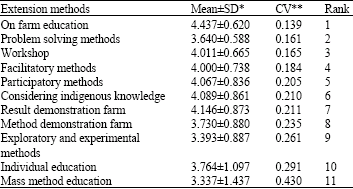
The major roles of agricultural extension are transferring information from the global knowledge base and from local research to farmers, enabling them to clarify their own goals and possibilities, educating them on how to make better decisions and stimulating desirable agricultural development (Van den Ban and Hawkins, 1996). In this research, the agricultural extension experts were questioned about the importance rate of different extension methods for supporting SWRM in agriculture by 5-point scale (1 = very low, 2 = low, 3 = moderate, 4 = high, 5 = very high). Extension experts believed that among extension methods, on-farm education (M = 4.43; SD = 0.62), problem solving methods (M = 3.640; SD = 0.588), workshop (M = 4.011; SD = 0.665), facilitatory methods (M = 4.000; SD = 0.738) and participatory methods (M = 4.067; 0.837) had very high importance for supporting SWRM in agriculture (Table 2). These findings are supported by Ommani and Chizari (2008). Also, claimed that for successful and sustainable introduction, use and improvement of water control techniques and technologies farmers should be encouraged to analyze their problems, search for solutions, monitor and evaluate the selected and implemented techniques and technologies and adjust them according to their constraints and opportunities. Participatory Training and Extension in Farmers’ Water Management (PT and E-FWM) aims to ensure a sustained support to farmers in this process. On the other hand, most important methods that identified at this research are essential for supporting water management; because on-farm education, problem solving, facilitatory and participatory methods (Kay, 2002) have proved to be an effective tools for this and to establish the appropriate support structure to assist and advise farmers in irrigation development and management. Therefore, findings of this study support the importance of these methods (Table 2).
| Table 2: | Importance of extension methods for supporting SWRM in agriculture |
 | |
| Scale: 1 = Very low, 2 = Low, 3 = Moderate, 4 = High, 5 = Very high, *Standard deviation, **Coefficient of variation | |
ORGANIZATIONAL CHARACTERISTICS OF EXTENSION FOR SUPPORTING SWRM IN AGRICULTURE
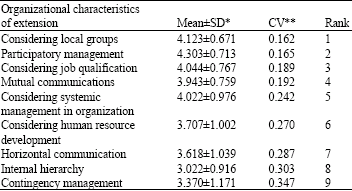
The new challenge is for extension organizations to become learning organizations (Fulton et al., 2003). To do this, they will have to promote experimentation, promote connectivity and group work based on roles rather than disciplines and develop monitoring and self-evaluation systems to improve learning and awareness (Qamar, 2005). In this section, agricultural extension experts were asked to mention importance rate of extension organization characteristics for supporting SWRM on a five point Likert- type scale: 1 = very low, 2 = low, 3 = moderate, 4 = high, 5 = very high. Ranking based on the perceptions of extension experts indicated that the six most important extension organization characteristics for supporting SWRM in agriculture were: considering local groups (M = 4.123; SD = 0.671), participatory management (M = 4.303 SD = 0.713), considering job qualification (M = 4.044; SD = 0.767), mutual communications (M = 3.943; SD = 0.759), considering systemic management in organization (M = 4.022; SD = 0.976) and considering human resource development (M = 3.707; SD = 1.002) (Table 3).
Based on the results, most effective characteristic of extension organization for supporting SWRM was considering local groups and participatory management. Roling and Pretty (1997) claimed that a necessary condition for sustainable agriculture is that large number of farmer must be motivated to use, their resource in a coordinated manner. Thus, the success of sustainable agriculture depends on motivations, skills, knowledge and action taken by groups or communities as a whole. Also, considering job qualification was necessary for extension organizations. Acquiring the necessary qualifications through on-the-job training should be possible at the local or regional level (Halim ).
| Table 3: | Importance of organizational characteristics for supporting SWRM in agriculture |
 | |
| Scale: 1 = Very low, 2 = Low, 3 = Moderate, 4 = High, 5 = Very high, *Standard deviation, ** Coefficient of variation | |
In addition, agricultural extension is a public service for human resource development (HRD) in the agricultural sector (van den Ban and Hawkins, 1996). Torraco (2005) indicated HRD is conceptualized as an investment in human resource capability rather than an employment cost, because one of the most important characteristics of extension organizations in the coming years is to create HRD therefore findings of this research support this characteristic of extension organizations.
CORRELATION STUDY
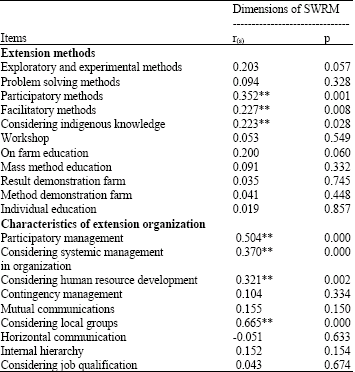
Based on the perceptions of agricultural extension experts were investigated correlations between extension methods and SWRM dimensions in agriculture (Table 4).
Participatory methods: The data showed that there was a significant positive correlations between agricultural extension experts’ perceptions regarding importance of participatory methods with SWRM dimensions (r = 0.352; sig. = 0.001).
Facilitatory methods: The relationship between agricultural extension experts’ perceptions about importance of facilitatory methods and SWRM dimensions was significantly positive (r = 0.227, sig. = 0.008).
| Table 4: | Relationships between perceptions of extension experts regarding importance of extension methods and organizational characteristics with SWRM dimensions |
 | |
| **: Highly significant | |
Pretty and Vodouhe (1997) pointed out, the facilitatory methods is concerned with the transformation of existing activities to try to bring about changes which people in the situation regard as improvements. According to Cristovao et al. (1997), as change facilitators, extensionists should then be concerned with the preparation of programs and projects that are responsive to the needs and interests of rural communities and farm families.
Considering indigenous knowledge: The data showed that there was a significant positive correlations between agricultural extension experts’ perceptions regarding importance indigenous knowledge with SWRM dimensions (r = 0.223, sig. = 0.028). The location-specific nature of sustainable agriculture implies that extension must make use of farmers’ knowledge and work together with farmers (Roling and Pretty, 1997).
Based on perceptions of agricultural extension experts was investigated correlation between extension organization characteristics with SWRM dimensions (Table 4).
Considering local groups: The results showed significant positive relationship between agricultural extension experts’ perceptions regarding importance of local groups with SWRM dimensions (r = 0.665, sig. = 0.000). Ommani et al. (2008) claimed that, the local farmer organizations could play an effective role in motivating farmers to become partners rather than mere participants in irrigation water management.
Participatory management: The results showed a significant positive relationship between the perceptions of extension experts about importance of participatory management with SWRM dimensions (r = 0.504, sig. = 0.000). Top-down management has been subject to strong criticism for various reasons. An important one is that it is too uniform, not talking into due account the sociocultural environment, the particular circumstances in which project implementation occurs and the characteristics of the different clientele groups (Cristovao et al., 1997).
Considering systemic management in organization: The data show that there was a significant positive correlation between the perceptions of agricultural extension experts regarding importance of systemic management in organization with SWRM dimensions (r = 0.370, sig. = 0.000).
Considering human resource development: Also, the correlation between the perceptions of agricultural extension experts regarding importance of Human Resource Development (HRD) with SWRM dimensions was significantly positive (r = 0.321, sig. = 0.002). Agricultural extension is a public service for Human Resource Development (HRD) in the agricultural sector (Van den Ban and Hawkins, 1996).
Multiple studies in Iran showed that, although extension services has played a positive role in agricultural development of Iran, but there are difficulties, barriers, misunderstandings and weaknesses in the transfer of new technology and information to farmers (Ommani and Chizari, 2008). Lacking the suitable extension methods and organizational characteristics has been a barrier for transfer of appropriate new technology to farmers. This problem exists in water sector of agriculture. The major consumer of water in Iran is the agriculture sector (Hasheminia, 2004). Identifying suitable extension mechanisms have important role to developing extension system. Therefore, identifying extension methods and organizational characteristics for supporting sustainable water resources management in agriculture of Iran, is the one of the major approaches needs to be carefully thought and accurately implemented for the extension system development.
REFERENCES
- Ahmadvand, M. and E. Karami, 2007. Sustainable agriculture: Toward a conflict, management based agricultural extension. J. Applied Sci., 7: 3880-3890.
CrossRefDirect Link - Allahyari, M.S. and M. Chizari, 2008. Supportive organizations regarding environmentally sound agriculture in Iran. Green Farm. J., 1: 1-5.
Direct Link - Arellanes, P. and D. Lee, 2003. The determinants of adoption of sustainable agriculture technologies: Evidence from the hillsides of Honduras. Proceedings of the Conference on Document Transformation Technologies, August 16-22, 2003, Technical Communications Ltd., pp: 693-699.
Direct Link - Boone, H., E.M. Hersman, D.A. Boone and A.A. Gartin, 2007. Knowledge of sustainable agriculture practices by extension agents in Ohio, Pennsylvania and West Virginia. J. Extension.
Direct Link - Kay, M., 2002. Training for irrigation water management transfer a case study review. Proceedings of the Irrigation Advisory Services and Participatory Extension in Irrigation Management Workshop, July 24, 2002, FAO, Montreal, Canada, pp: 2-6.
Direct Link - Keshavarz, A., N. Heydari and S. Ashrafi, 2003. Management of Agricultural Water Consumption, Drought and Supply of Water for Future Demands. In: Sustainable Development and Management of Drylands in the Twenty-first Century, Beltagi, A. and M.C. Saxena (Eds.). ICARDA, Tehran, Iran, ISBN: 92-9127-179-X.
- Ommani, A.R., M. Chizari, C. Salmanzadeh and J.F. Hossaini, 2008. The effective factors on technical knowledge of wheat farmers regarding sustainable water resource management in agriculture. Green Farm. J., 1: 1-5.
Direct Link - Ommani, A.R. and M. Chizari, 2008. The analysis of farming system sustainability of wheat farmers in Khuzestan province of Iran. Green Farm. J., 1: 5-9.
Direct Link - Qamar, K., 2005. Modernizing National Agricultural Extension Systems: A Practical Guide for Policy-Makers of Developing Countries. 1st Edn., FAO Rome.
Direct Link - Rezaei-Moghadam, K., E. Karami and J. Gibson, 2005. Conceptualizing sustainable agriculture: Iran as an illustrative case. J. Sustainable Agric., 27: 25-54.
CrossRef - Torraco, R.J., 2005. Human resource development transcends disciplinary boundaries. J. Human Resour. Dev. Rev., 4: 250-253.
Direct Link