

S. Saravanan
P.G. and Research Department of Chemistry, Sri Paramakalyani College, Alwarkurchi-627 412, India
P. Dhasarathan
Department of Biotechnology, Prathyusha Institute of Technology and Management Thiruvallur-602 025, India
V. Indira
Department of Biochemistry, Sri Parasakthi College, Courtallam-627 802, India
R. Venkatraman
P.G. and Research Department of Chemistry, Sri Paramakalyani College, Alwarkurchi-627 412, India
Research Journal of Immunology
Year: 2011 | Volume: 4 | Issue: 1 | Page No.: 1-11







ABSTRACT
Present study investigated gastroprotective and antioxidant activity of Solanum nigrum Linn. using aspirin and cold resistant stress induced ulcer rats. The collected plant leaves extracted with methanol by Soxhlet method for further analysis. Test animals were acclimatized in laboratory conditions and divided into six groups (Positive control (aspirin treated), negative control (normal), S. nigrum Extract (SNE) administered and aspirin, Cold Restraint Stress (CRS), S. nigrum with cold restraint stress and famotidine (standard drug) administered). The test animals were treated upto 20 days, after treatment gastric juice obtained from stomach used for biochemical and enzymatic analysis. The standard methodologies were adopted to found the parameters such as level of protein, carbohydrate, ulcer index, % of inhibition, ulcer severity, DPPH scavenging activity and reducing sugar etc. The gastric walls of all groups were used for histopathological studies. From the findings the groups that were treated to aspirin and CRS produced less gastric mucus secretion in gastric juice (101.39 and 91.67 mg g-1, respectively). The groups pretreated with S. nigrum extract exhibited a percentage inhibition of about 77.85% in aspirin and 66.67% in CRS-treated, groups, respectively. However, in groups that were pretreated with famotidine the percentage inhibition was 88.91%. Higher percentage of inhibition (88.91%) observed in groups pretreated with Famotidine. The reduction capability of DPPH radicals was determined from the decreasing absorbance values at 517 nm with increasing concentration, which is induced by anti oxidants present in the extracts. The plant extracts remarkably change all the parameters screening in test animals. Biochemical, antioxidants, histological and enzymological results also show the gastro protective and antioxidant efficiency of test plant. In nutshell the plant methanolic extracts have potential drug against gastro protective and Ulcer.
PDF Abstract XML References Citation
Received: October 02, 2010;
Accepted: January 07, 2011;
Published: July 09, 2011
How to cite this article
S. Saravanan, P. Dhasarathan, V. Indira and R. Venkatraman, 2011. Gastro Protective and Antioxidant Activity of Solanum nigrum Linn. against Aspirin and Cold Restraint Stress induced Ulcerated Rats. Research Journal of Immunology, 4: 1-11.
DOI: 10.3923/rji.2011.1.11
URL: https://scialert.net/abstract/?doi=rji.2011.1.11
DOI: 10.3923/rji.2011.1.11
URL: https://scialert.net/abstract/?doi=rji.2011.1.11
INTRODUCTION
Gastric ulcer disease is a chronic inflammation, raw eroded area in the lining of the stomach, where parietal cells are found that secrete hydrochloric acid and pepsin. The anatomic sites where ulcers, commonly found are stomach and duodenum, causing gastric and duodenal ulcer, respectively (Kanner and Lapidol, 2001). Pathophysiology of ulcer is due to an imbalance between aggressive factors (acid, pepsin, Helicobacter pylori and NSAIDs) and local mucosal defensive factors (mucin bicarbonate, blood flow and prostagladins). Integrity of gastric mucosa is maintained through a homeostatic balance between these factors (Hoogerwerf and Pasricha, 2001). One major cause of gastric ulceration in human and experimental animals is the chronic use of NSAIDs in the treatment of mild to moderate pain.
Aspirin is one of such NSAIDs and its main undesirable side effect is that it will induce gastrointestinal ulcers, stomach bleeding and tinnitus, especially in higher dosage. Several drugs are widely used to prevent or treat gastric ulcer, which include H2 receptor antagonists such as Cimetidine, Famotidine, Ranitidine and proton-pump inhibitors such as Sucralfate, Tetracycline and Pepto-Bismol. Due to problems associated with recurrence after treatment, there is the need to seek alternative drug sources against gastric ulcers.
Traditional systems of medicine continue to be widely practiced on many accounts. Population rise, inadequate supply of drugs, prohibitive cost of treatments, side effects of several allopathic drugs and development of resistance to currently used drugs for infectious diseases have led to increased emphasis on the use of plant materials as a source of medicines for a wide variety of human ailments (Arrieta et al., 2001; Manjula et al., 2009). Global estimates indicate that 80% of about 4 billion population cannot afford the products of the Western Pharmaceutical Industry and have to rely upon the use of traditional medicines, which are mainly derived from plant material (Brindha et al., 2008). There are scanty reports on its antibacterial activities of chosen test plant. In order to demonstrate the antibacterial efficacy, test were conducted against human pathogenic bacteria including those responsible for causing inflammation.
Solanum nigrum is an herbal plant which is distributed as a weed throughout dry parts of India. It has the properties such as emollient, diuretic and laxative (Al-Daihan, 2008). The leaves are used for the treatment of diabetes, heart problems and jaundice. This study was therefore undertaken to analyze gastro-protective effect and in vitro antioxidant activity of S. nigrum and its effect on acid-pepsin secretion mucus content, acidity in aspirin-induced ulcerogenesis and Cold Restraint Stress (CRS) induced ulcerated rats.
Plants also need to protect themselves from free radical damages with the help of their own metabolites, so they develop a number of different classes of antioxidants. In this study, those antioxidant activities of S. nigrum Linn. extracts were analyzed by various methods such as reducing power determination.
MATERIALS AND METHODS
Plant sample: In the present study, Solanum nigrum Linn. were selected as the plant sample and collected at Sri Paramakalyani Medicinal garden, Alwarkurichi (Tirunelveli district, Tamilnadu, India) in early morning during second week of January, 2010. The collected samples were immediately transported to the Chemistry Laboratory, Alwarkurichi for plant extraction and phytochemical screening. Animal study was carried out in Biotechnology Laboratory, Prathyusha Institute of Technology and Management, Tiruvallur using plant extracts. The leaves of S. nigrum were dried and coarsely powdered. It was then extracted using methanol as solvent in Soxhlet apparatus. The extract obtained was then filtered through Whatman filter paper No. 3 and was then evaporated at 40-50°C with reduced pressure. Dosage of about 500 mg kg-1 b.wt. S. nigrum extract was given to the rats of group III and group V animals. Dose was administered orally everyday for 20 consecutive days.
Animals: Albino wistar rats weighed about 140-150 g were used in the present investigation. The rats were fed with standard laboratory rat pellet feed (Lipton Ltd., Mumbai) and water provided to ad libitum. After acclimatization, the rats are divided into six groups (Each groups contains six animals) used for analysis.
| • | Group I: Serves as negative control, which was provided with normal feed with ad libitum water |
| • | Group II: Serves as positive control, which was fed with normal feed and on the last day, aspirin (200 mg kg-1 b.wt.) dissolved in 1% CMC was administered orally |
| • | Group III: Pretreated orally with S. nigrum Linn. Extract (500 mg kg-1 b.wt.) for consecutively 20 days and on the last day aspirin (200 mg kg-1 b.wt.) dissolved in 1% CMC was administered orally |
| • | Group IV: Provided with normal feed and on the last day, the animals were fasted for 6 h and then subjected to Cold Restraint Stress for 2 h |
| • | Group V: Pretreated orally with S. nigrum extract (500 mg kg-1 b.wt.) for consecutively 20 days and on the final day, the animals were fasted for 6 h and then subjected to Cold Restraint Stress for 2 h |
| • | Group VI: Pretreated orally with famotidine for 20 consecutive days and on the final day, aspirin (200 mg kg-1 b.wt.) dissolved in 1% CMC was administered orally |
By the next day, animals of all the groups were fasted and were sacrificed. The stomach was cut along the greater curvature and the contents were collected and centrifuged at 3000 rpm for 10 minutes and the supernatant (gastric juice) was used for biochemical and enzymatic analysis. The gastric walls of all groups were used for histopathological studies, like Ulcer index determination, percentage inhibition and Non-Protein Sulphydryl Group (NPSH) estimations.
The biochemical estimations of total proteins, total carbohydrates, gastric mucus determination (Corney et al., 1974), non-protein sulphydryl groups (Sedlak and Lindsay, 1968), total acidity (Cannon, 1969), volume and pH (Parmer and Desai, 1993), DPPH radical scavenging activity (0.0025 g of 2, 2-Diphenyl-1-picryl hydrazyl (DPPH) was dissolved in 25 mL of methanol. The content should be made and kept in dark condition, because DPPH is light sensitive and reducing sugar were analyzed by standard methods, ascorbic acid used as a standard for both tests.
The phytochemicals present in the extract was analyzed by Sofowara (1993), Ulcer index, percentage inhibition (Kaukmann and Grosmann, 1978) and ulcer severity (Varley et al., 1991) were carried out to screen the efficiency.
The enzymatic analysis was performed by using hemoglobin method and the enzymes analyzed include pepsin, trypsin and Cathepsin (Anson, 1938).
Histological studies: The gastric wall cut along the greater curvature from each group of rats was fixed in 10% formalin for 24 h. The formalin fixed specimen was embedded in paraffin, sectioned and stained with hematoxylin and eosin. The histochemical sections were evaluated by light microscopy.
RESULTS
The present study suggests that pretreatment with S. nigrum extract ameliorated the ulcer index, histological and biochemical changes induced by aspirin and cold restraint stress gastric ulceration in rats. The level of proteins and carbohydrates were found in the treated animals were 361.05 and 195.71 mg dL-1 in group I, 342.63 and 90.05 mg dL-1 in group II, 345.79 and 123.57 mg dL-1 in group III, 340.78 and 104.29 mg dL-1 in group IV, 347.63 and 138.57 mg dL-1 in group V, 354.21 and 167.86 mg dL-1 in group VI (Table 1). It is proved that there is a little effect in the amount of proteins and carbohydrates during ulceration.
| Table 1: | Effect of Solanum nigrum Linn extract on gastric mucosal factors in experimental gastric ulcer model |
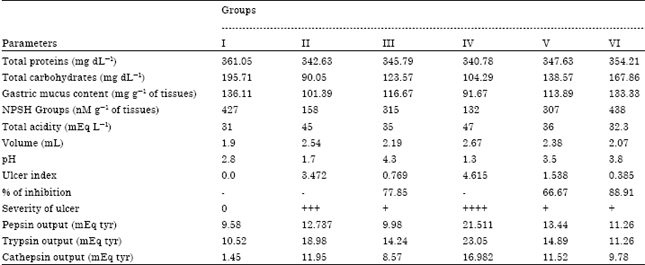 | |
| -: Nil value, +: Less severity of ulcer, +++: Moderate severity of ulcer, ++++: High severity of ulcer | |
Protein malnutrition results when the body’s needs for protein cannot be satisfied by the diet. Since all normal metabolic processes require proteins; all tissues will be affected by a state of protein deprivation. This protein deprivation due to stress and adequate usage of NSAIDs was overcome by an increase in protein level in the groups that were pretreated with S. nigrum Linn. extract.
The groups that were treated to induce ulcer produced less gastric mucus secretion in gastric juice, whereas the groups that were pretreated with plant extract and antiulcer drug showed an increase in gastric mucus secretion. The test animal secretion of gastric mucus was reduced in positive control aspirin treated group have 101.39 mg g-1 tissue and cold resistant stress exposed group show 91.67 mg g-1 compared with negative control group (136.11 mg g-1 tissue) and Famotidine treated group (133.33 mg g-1 tissue) (Table 1). Ulcer induced however, plant extract treated groups show moderate changes in between positive and negative control animal groups (116.67 and 113.89 mg g-1 tissue of gastric mucus obtained in group III and group V, respectively). It reported that the gastric mucosa consists of mucin-type glycoprotein, which can be detected by the amounts of Alcian blue. Mucin is a viscous glycoprotein, with physicochemical properties producing relatively resistant acid barrier. In pretreated groups, there is an increase in gastric mucosal secretion indicating the anti secretary effect of S. nigrum Linn. extract and famotidine.
There is a decrease in the concentration of NPSH group in pretreated groups such as group III (315 nM g-1), group V (307 nM g-1) and group VI (438 nM g-1) than that in ulcerated groups II (158 nM g-1) and group IV (132 nM g-1), when compared with normal animal (427 nM g-1) (Table 1). Gastric mucosal NPSH group was measured to analyze the oxidant/antioxidant balance. The basal gastric secretion and titratable acidity were suppressed in pretreated groups than the ulcerated group (Table 1). Therefore, it appears this extract is more effective and possesses cyto secretory capacity. Suppression in the total acidity and the pH of the gastric juice of pretreated groups was higher than the ulcerated group that was reported. The normal animal (Untreated) gastric juice total acidity was 31 mEq L-1 and pH was 2.8, aspirin administered animal gastric juice total acidity was 45 mEq L-1 and pH was 1.7, plant extract with aspirin administered animal gastric juice total acidity was 35 mEq L-1 and pH was 4.3, cold resistant stress induced animal gastric juice total acidity was 47 mEq L-1 and pH was 1.3, plant extract with cold resistant stress induced animal gastric juice total acidity was 47 mEq L-1 and pH was 1.3 and foamatidine administered animal gastric juice total acidity was 32.3 mEq L-1 and pH was 3.8 (Table 1). This is due to the fact that the increased amount of gastric mucus secretion gets combined with low acid content; hence the pH is high in pretreated groups.
Ulcer index is in one of the better confirmation test for ulceration, next to the endoscopy/histopathlogy studies. The pretreated rats showed significant reduction in the ulcer index values, which suggests that the S. nigrum extract posses’ cytoprotective activity. The groups pretreated with S. nigrum extract exhibited a percentage inhibition of about 77.85% in aspirin and 66.67% in CRS-treated, groups, respectively. However, in groups that were pretreated with famotidine the percentage inhibition was 88.91%. Higher percentage of inhibition (88.91%) observed in groups pretreated with Famotidine it cannot be used to arrive at a conclusion that famotidine has higher ulcer protection ability as many commercial drugs produced many side effects than the extract. Increase in the concentration of the extract may improve the percentage of inhibition without any side effects.
A histological study revealed that, the pretreatment with S. nigrum extract helped to preserve the cyto-architecture of the entire gastric mucosa of test animals. S. nigrum extract treatment not only maintenance of gastric mucosa helped but also the regeneration of gastric mucosa in the damaged regions. These findings confirmed the gastro protective activity of S. nigrum extract (Fig. 1-6). The normal animal gastric mucosa histological section was showed clear and proper arrangement of cells (Fig. 1). The cells were damaged and created opaque region in gastric mucosa of both (Aspirin and cold resistant stress) ulcer induced animal groups (Fig. 2, 3). The standard gastroprotective drug of formatidine effectively replaces damaged cells in ulcer induced animals gastric mucosa layer (Fig. 4). The plant extract administered animal shows replacement of ulcerative cells and moderately arrange proper layer in gastric mucosa (Fig. 5, 6).
The methanolic fraction of S. nigrum was found to contain 64.7 μg pyrocatechol equivalents of phenols. The phenolic compounds may contribute directly to the antioxidant actions. Oxidative stress plays a major role in the pathogenesis of various diseases including gastric ulcers. Oxidative stress can damage many biological molecules. Anti-oxidants have been found to play a significant role in preventing gastric ulcers.
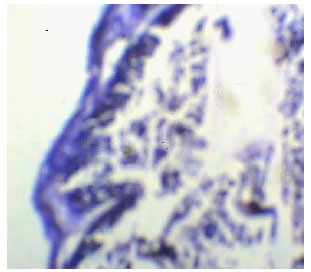 | |
| Fig. 1: | Histological section of gastric mucosa from negative control animals |
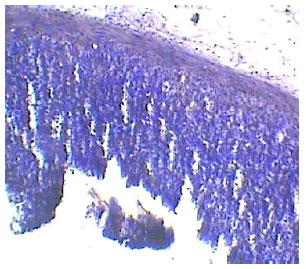 | |
| Fig. 2: | Histological section of gastric mucosa from aspirin treated animals |
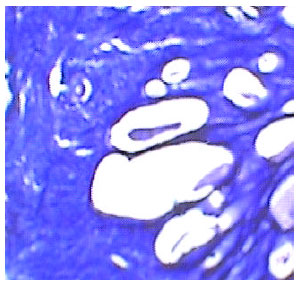 | |
| Fig. 3: | Histological section of gastric mucosa from CRS treated animals |
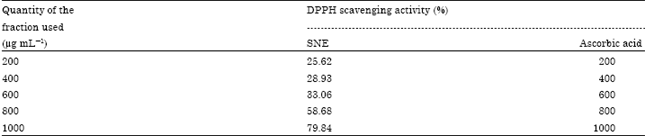
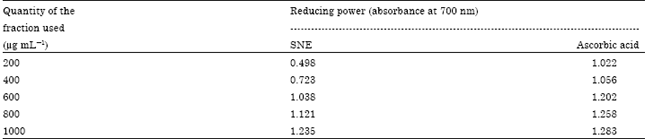
It has appeared that antioxidants may be an important contributory factor in the protection of gastric mucosa. DPPH is a stable free radical at room temperature that accepts an electron or H2 radical to become a stable diamagnetic molecule. The reduction capability of DPPH radicals was determined from the decreasing absorbance values at 517 nm with increasing concentration, which is induced by anti oxidants present in the extracts. The maximum (79.84%) percentage DPPH scavenging activity was obtained 1000 μg mL-1 plant extract administered animal, followed by 800 μg mL-1 (58.68%), 600 μg mL-1 (33.06%), 400 μg mL-1(28.93%) and 200 μg mL-1 (25.62%). The Fe3+-Fe2+ transformation has been investigated (Table 2). The reducing power of methanol extract of plant was increased with the increased amount of the sample. The predominant amount of reducing sugar obtained in 1000 μg mL-1 followed by 800, 600, 400 and 200 μg mL-1 concentrations of extracts (Table 3).
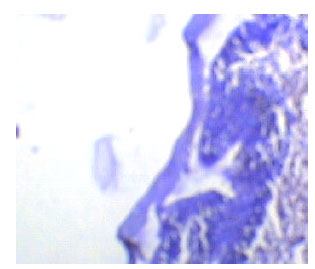 | |
| Fig. 4: | Histological section of gastric mucosa from Famotodine +ASP treated animals |
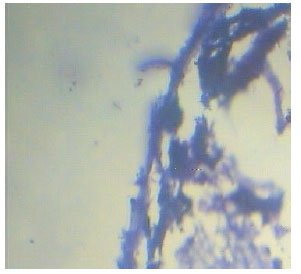 | |
| Fig. 5: | Histological section of gastric mucosa from Solanum nigrum linn, +ASP treated animals |
| Table 2: | DPPH scavenging activity of S. nigrum methanolic extract |
 | |
Phenolic compounds are known as powerful chain breaking anti oxidants, due to the presence of their hydroxyl groups. As a result of anti oxidant analysis, it was suggested that the increased amount of antioxidants present in the extract might be responsible for its gastro protective and antiulcer activity.
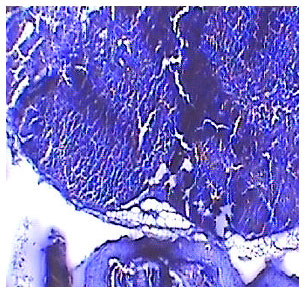 | |
| Fig. 6: | Histological section of gastric mucosa from Solanum nigrum linn, + CRS treated animals |
| Table 3: | Reducing power of S. nigrum methanolic extract |
 | |
DISCUSSION
Peptic Ulcer Disease (PUD) is one of the common diseases. The causes of peptic ulcer disease are increased gastric acid secretion and reduced gastric cytoplasm. PUD occurs mainly due to consumption of Non Steroidal Anti Inflammatory Drugs (NSAIDs), infection by Helicobacter pylori, stress or due to pathological conditions such as Zollinger-Ellison syndrome. Non steroidal Anti-inflammatory drugs associated gastric ulceration occurs in 30% of users that led to hospitalization and also associate with high mortality. Hence, there is a need for more effective and less toxic antiulcer agents, plants extract are some of the most attractive sources.
In this study, the methanolic extract of S. nigrum was used for the treatment of ulcer. The reducing power of methanol extract of plant was increased with the increased amount of sample. Phenolic compounds are known as powerful chain breaking anti oxidants, due to the presence of their hydroxyl groups. It was suggested that the increased amount of antioxidant present in the extract might be responsible for its gastro protective and anti ulcer activity. The similar results of the present study found in ethanolic extract of Amla have the capacity to significantly inhibit the basal gastric secretion and ulcerogenicity induced by pylorus ligation, indomethacin and noxious chemicals and by hypothermic restraint stress in rats (Jose and Kuttan, 2000; Yesilada et al., 2000). Pepsin is one of three principal protein-degrading, or proteolytic, enzymes in the digestive system, the other two being chymotrypsin and trypsin and HCl are important for the formation of pylorus ligated ulcers (John and Onabanjo, 1990; Tan et al., 2000). The gastric protective effect of the extract be related to an antacid effect or cytoprotective properties of the plants (Rifat-uz-Zaman et al., 2004; Naseri and Mard, 2007). It is possible that the inhibitory effect of the plants is due, at least partly, to the presence of tannins, terpenes and fatty acids since these compounds were associated with anti-ulcerogenic activity in other plants (Campos et al., 2003; Hiruma-Lima et al., 2001; Sehirli et al., 2008; Khanahmadi et al., 2010).
Our findings are supported with Bandyopadhyay et al. (2000), as our results showed a significant reduction in non-protein sulfhydryls (NP-SH) content of gastric mucosa after 80% ethanol administration. This result suggests that S. nigrum extract has active substance(s) that increase the mucosal sulfhydryl groups content. In another hypothesis, this activity could be attributed to antioxidant compounds found in the alcoholic extract (Dias et al., 2000; Mahmoud et al., 2006; Akah et al., 2007; Gill et al., 2009). The results on histopathological investigation on the gastric mucosa of rats revealed that the pretreatment with S. nigrum extract absolutely inhibited the ethanol-induced congestion, hemorrhage, edema, necrosis, inflammatory and dysplastic changes, erosions and ulceration. Present results are in corroboration with the antigastric ulcer activity of the extract observed under the studies on pharmacological and biochemical evaluation.
CONCLUSION
The extracts of the leaves of S. nigrum is potentially an anti ulcerogenic agent that protects and strengthens the gastric mucosa. The exact mechanism was not known, but it could be due to secretion of large quantity of mucous by the gastric mucosa that acts as a mechanical barrier. From the results, percentage of inhibitory effect and ulcer index, it is confirmed and concluded that S. nigrum has the anti-ulcer activity. Moreover, there is a need to conduct toxicity studies, using the plant extract on both laboratory and target animal species, to justify clinical investigation in other animals and in humans.
REFERENCES
- Akah, P.A., L. John-Africa and C.S. Nworu, 2007. Gastoprotective properties of the leaf extracts of Ocimum gratissimum L. against expermimental ulcers in rats. Int. J. Pharmacol., 3: 461-467.
Direct Link - Al-Daihan, S., 2008. Measurement of selected enzymatic activities in Solanum nigrum-Treated Biomphalaria arabica snails. J. Applied Sci., 8: 881-885.
CrossRefDirect Link - Arrieta, J., B. Reyes, F. Calzada, R. Cedillo-Riveva and A. Navarrete, 2001. Amoebicidal and giardicidal compound from the leaves of Zanthoxylum liebmannianum. Fitoterapia, 72: 295-297.
CrossRef - Bandyopadhyay, S.K., S.C. Pakrashi and A. Pakrashi, 2000. The role of antioxidant activity of Phyllanthus emblica fruits on prevention from indomethacin induced gastric ulcer. J. Ethnopharmacol., 70: 171-176.
CrossRefPubMedDirect Link - Campos, A.R., A.I. Barros, F.A. Santos and V.S. Rao, 2003. Guarana (Paullinia cupana Mart.) offers protection against gastric lesions induced by ethanol and indomethacin in rats. Phytother. Res., 17: 1199-1202.
PubMed - Dias, P.C., M.A. Foglio, A. Possenti and J.E. de Carvalho, 2000. Antiulcerogenic avtivity of crude hydroalcoholic extract of Rosmarinus officinalis L. J. Ethnopharmacol., 69: 57-62.
PubMed - Gill, N.S., M. Garg, R. Bansal, S. Sood, A. Muthuraman, M. Bali and P.D. Sharma, 2009. Evaluation of antioxidant and antiulcer potential of Cucumis sativum L. seed extract in rats. Asian J. Clin. Nutr., 1: 131-138.
CrossRef - Jose, J.K. and R. Kuttan, 2000. Hepatoprotective activity of Emblica officinalis and chyavanaprash. J. Ethnopharmacol., 72: 135-140.
CrossRefPubMedDirect Link - John, T.A. and A.O. Onabanjo, 1990. Gastroprotective effects of an aqueous extract of Entandrophragma utile bark in experimental ethanol-induced peptic ulceration in mice and rats. J. Ethnopharmacol., 29: 87-93.
Direct Link - Khanahmadi, M., S.H. Rezazadeh and M. Taran, 2010. In vitro antimicrobial and antioxidant properties of Smyrnium cordifolium Boiss. (Umbelliferae) extract. Asian J. Plant Sci., 9: 99-103.
CrossRef - Mahmoud, A.H., H.M. Motawa, H.E. Wahba and A.Y. Ebrahim, 2006. Study of some antioxidant parameters in mice livers affected with Urtica pilulifera extracts. Asian J. Biochem., 1: 67-74.
CrossRefDirect Link - Naseri, M.K.G. and S.A. Mard, 2007. Gastroprotective effect of alhagi maurorum on exprimental gastric ulcer in rats. Pak. J. Med. Sci., 23: 570-573.
Direct Link - Sehirli, O., E. Tatlidede, M. Yuksel, C. Erzik, S. Cetinel, B.C. Yegen and G. Sener, 2008. Antioxidant effect of alpha-lipoic acid against ethanol-induced gastric mucosal erosion in rats. Pharmacology, 81: 173-180.
CrossRefDirect Link - Tan, P.V., V.B. Penlap, B. Nyasse and J.D.B. Nguemo, 2000. Antiulcer actions of the bark methanol extract of Voacanga africana in different experimental ulcer models in rats. J. Ethnopharmacol., 73: 423-428.
CrossRef - Yesilada, E., Y. Takaishi, T. Fujita and E. Sezik, 2000. Anti-ulcerogenic effects of Spartium junceum flowers on in vivo test models in rats. J. Ethnopharmacol., 70: 219-226.
PubMed - Corne, S.J., S.M. Morrissey and R.J. Woods, 1974. Proceedings: A method for the quantitative estimation of gastric barrier mucus. J. Physiol., 242: 116-117.
PubMedDirect Link - Kanner, J. and T. Lapidol, 2001. The stomach as a bioreactor: Dietary lipid peroxidation in gastric fluid and effects of plant derived anti-oxidants. Free Rad. Biol. Med., 31: 1388-1395.
CrossRef - Kaukmann, G.L. and M.I. Grosmann, 1978. Prostaglandin and imetidine inhibits the formation of ulcer produced by parental salicylates. Gastroenterology, 75: 1099-1102.
PubMed - Sofowara, A., 1993. Recent trends in research into African Medicinal plants. J. Ethanopharmacol., 38: 209-214.
PubMed - Rifat-uz-Zaman, M.S. Akhtar and M.S. Khan, 2004. Gastroprotective and anti-secretory effect of Nigella sativa seed and its extracts in indomethacin-treated rats. Pak. J. Biol. Sci., 7: 995-1000.
CrossRefDirect Link - Sedlak, J. and R.H. Lindsay, 1968. Estimation of total, protein-bound, and nonprotein sulfhydryl groups in tissue with Ellman's reagent. Anal. Biochem., 25: 192-205.
CrossRefPubMedDirect Link