

O.J. Ilori
Department of Biology, Adeyemi College of Education, Ondo, Nigeria
O.O. Ilori
Department of Biology, Osun State College of Education, Ilesa, Nigeria
R.O. Sanni
Department of Biology, Adeyemi College of Education, Ondo, Nigeria
T.A. Adenegan-Alakinde
Department of Biology, Adeyemi College of Education, Ondo, Nigeria
Research Journal of Environmental Sciences
Year: 2011 | Volume: 5 | Issue: 2 | Page No.: 200-204







ABSTRACT
Chromolaena odorata (a weed in the family Asteraceae) has been shown to enhance the buildup of organic matter in fallow system in tropical soil. Therefore, the aim of this study was to investigate the effects of Chromolaena odorata on the growth of Celosia argentea. The shoots of C. odorata were extracted in distilled water after soaking for 12 h. The filtrate obtained served as treatment for the seedling in the aqueous extract regime (FSE). Results showed that the shoot height, leaf area, fresh and dry weight were enhanced by the application of aqueous extract prepared from the fresh shoot of Chromolaena odorata. The root length of the test plant in the aqueous extract regime was longer at the initial period of the experiment but was later lower than those of the control. Therefore, Chromolaena odorata might not be playing an inhibitory role on the growth and development of Celosia argentea. It was suggested that the weed should be soil incorporated to serve as green manure.
PDF Abstract XML References Citation
Received: February 07, 2010;
Accepted: April 26, 2010;
Published: August 13, 2010
How to cite this article
O.J. Ilori, O.O. Ilori, R.O. Sanni and T.A. Adenegan-Alakinde, 2011. Effect of Chromolaena odorata on the Growth and Biomass Accumulation of Celosia argentea. Research Journal of Environmental Sciences, 5: 200-204.
DOI: 10.3923/rjes.2011.200.204
URL: https://scialert.net/abstract/?doi=rjes.2011.200.204
DOI: 10.3923/rjes.2011.200.204
URL: https://scialert.net/abstract/?doi=rjes.2011.200.204
INTRODUCTION
Allelopathy is defined as the direct or indirect harmful or beneficial effect of one plant on another through the production of chemical compounds that escape into the environment (Rice, 1984). Secondary plant metabolites and their degradation products which have been known to be involved in this phenomenon are all important in all agro ecosystems (Chung et al., 2001). The phenomenon of allelopathy is known to play an important part in weed crop interaction (Colton and Einhellig, 1980). Weed crop interaction with the stand point of allelopathy has been explored (Lydon et al., 1997). Allelochemicals which include alkaloids, terpensids flavonoid, steroids, tannins, phenolic compounds and other compounds are known to produce toxic effects on some plants (Seigler, 1996). Once entered into the soil, the bioactive concentration of allelochemicals is determined through the sorption, fixation, leaching and chemical and microbial degradation (Blum, 1999). Soil chemical, physical and biological characteristic to a great extent are responsible for detoxification or further enhancement of the allelopathic activities of the plant diffusate (Cheng, 1995). Water extracts from several species of the family Asteraceae and the soil on which they were grown have been shown to inhibit germination and growth of other plant species (Kil and Yun, 1992; Macias et al., 1993; Indergit and Darkshimi, 1994). Otusanya et al. (2007) reported that the growth of Amaranthus cruentus was inhibited by aqueous extract of Tithonia diversifolia. Qasem (1995) observed that the dried shoot extract of Amaranthus gracilis increased shoot and root dry weights of wheat seedlings. He also stated that the addition of up to 16 g kg-1 of Amaranthus gracilis residues promoted shoot growth of wheat. Hall and Henderlong (1989) stated that allelochemicals have to accumulate in sufficiently high quantity in the soil to cause allelopathic effects. Also, Einhellig (1986) had earlier affirmed that low level of allelochemicals could enhance synthetic processes.
Chromolaena odorata is a member of the family Asteraceae. The plant has been shown to enhance the buildup of organic matter in fallow system in tropical soil (Agbim, 1987; Obatolu and Agboola, 1993). Celosia argentea is a vegetable crop grown in Nigeria. Vegetable production is characterized by the heavy use of fertilizer and this may cause future environmental problem in both water and soil ecosystems. Therefore, the objective of this study was to determine the effects of aqueous extract of Chromolaena odorata on Celosia argentea.
MATERIALS AND METHODS
The experiment was carried out at the Department of Biology, Adeyemi College of Education, Ondo, Ondo State, Nigeria in 2009. The seeds of Celosia argentea were collected from NIHORT (National Horticultural Research Institute), Ibadan. To prepare the extract, 110 g of the whole plants except the root of Chromolaena odorata were cut into small chips of about 4 cm length and later grated with mechanical grater. The ground plant was soaked in 1 L of water for 12 h. The filtrate obtained served as treatment for the seedling in the aqueous extract regime (FSE). Experimental pots were allocated randomly to the control (no application but water) and fresh plant aqueous extract treatment regime (FSE).
For growth, fresh and dry matter production, seeds of Celosia argentea were sown in pots (21x11) cm containing top soil . Seeds of Celosia argentea were watered with 200 mL of tap water every morning. At two weeks, the pots were allocated to the control and aqueous extract regimes and they were laid in a completely randomized design. Two hundred milliliter of the extract was applied to the pots in the aqueous extract regime while 200 mL of water was applied to the control every morning. Harvesting of the plants were on weekly intervals for a period of five weeks. Root length, shoot length, leaf area, fresh and dry weight of root and shoot were determined. For the shoot height, the distance between the base of the shoot at the soil level and upper part of the terminal bud of the seedling were measured using a meter rule. The leaf area was determined using the formula according to Pearcy et al. (1989). LA = 0.5 (LengthxBreadth of leaf). The root system was carefully excavated. The root was then washed free of soil and then measured at a distance between the base of plant and root tip. Measurements were carried out on five seedlings and mean value were calculated. Five seedlings were randomly harvested in each regime and each seedling was separated into roots and shoot. The plants parts were then packaged in envelop separately and dried plant parts were weighed at 80°C in a Gallen Kemp (model IH-150) incubator. The fresh and dry plant parts were weighed on Meltler Toledo balance to obtain fresh and dry weights of plant parts. All experiments were conducted in five replicates and the data obtained were subjected to Analysis of Variance (ANOVA) p<0.05.
RESULTS
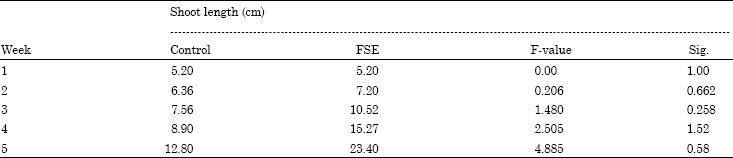
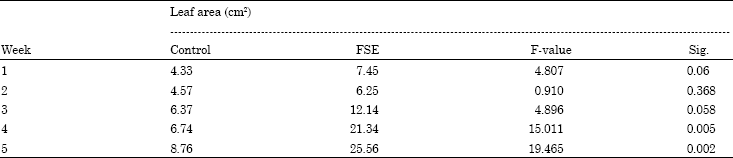
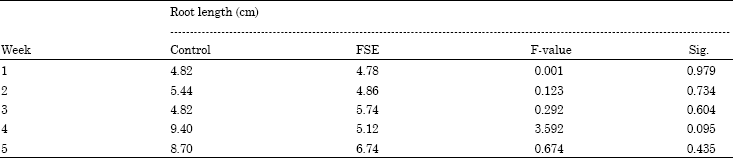
The shoot height of the plants in the aqueous extract treatment regime was higher than that of the plants in the control (Table 1). The leaf area of the plants in the aqueous extract treatment regime was significantly (p<0.05) higher than those of the plants in the control regime during week four and week five (Table 2). The root length of the plants in the control regime was longer than that of the plants in the aqueous extract treatments regime at the later part of the experiment (Table 3).
| Table 1: | Effects of aqueous extract of Chromolaena odorata on the shoot height of Celosia argentea |
 | |
| Table 2: | Effects of aqueous extract (FSE) of Chromolaena odorata on the leaf area of Celosia argentea |
 | |
| Table 3: | Effects of aqueous extract of Chromolaena odorata on the root length of Celosia argentea |
 | |
| Table 4: | Effect of fresh shoot aqueous extract (FSE) of Chromolaena odorata on the fresh weight of root and shoot of Celosia argentea |
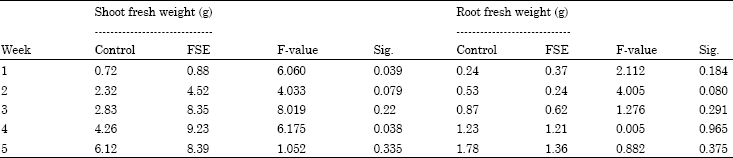 | |
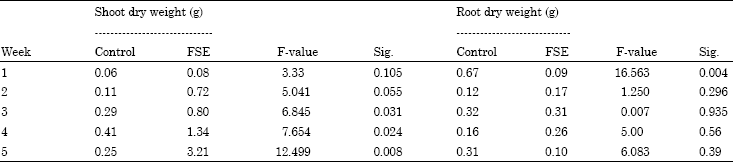
The shoot height and root length of seedlings treated with aqueous extract and those of the control were not statistically different (Table 1, 3). The fresh and dry weight of the shoot of the seedlings in the aqueous extract treatment regime were significantly (p<0.05) higher than those of the seedlings in the control regime from week three to the end of the experiment except week five for fresh weight of shoot where no statistical difference was observed (Table 4, 5). The fresh and dry weight of the root of the seedlings in the aqueous extract treatment regime were not significantly different from those of the seedlings in the control regime (Table 4, 5).
| Table 5: | Effect of fresh shoot aqueous extract (FSE) of Chromolaena odorata on the dry weight of root and shoot of Celosia argentea |
 | |
DISCUSSION
Allelochemicals have been reported to have a beneficial or harmful affect on the growth and development of plants (Rice, 1984). According to Armstrong et al. (1970) some of the biological processes that may respond to allelochemicals interference are: cell membrane permeability, cell division, seed germination, internodes elongation, leaf expansion, dry weight accumulation, respiration, nutrients absorption, slow development and low yields.
The results obtained from the study indicated that the shoot height, leaf area , fresh and dry weights of the plants treated with the aqueous were higher than those of the plants in the control regime. These showed that the aqueous extract of Chromolaena odorata enhanced these growth parameters of Celosia argentea.The result was contrary with the finding of Chengrong et al. (2005), who stated that allelochemicals from Wedelia troblabata reduced germination, plants height, fresh and dry weights root and shoot per plants of rice. Also, Daizy et al. (2006) finding that aqueous leachate of (Chenopodium album) plant parts (root, whole plant and leaf) inhibited the germination, plant height, growth and biomass of Cassia occidentalis was inconsistent with the result of this study. However, the result agreed with the study of Hussain et al. (2007), who stated that senna extract promoted the growth of Avena fatua, Dectyloctenium aegyptium and Echinocloa colona. This observation might be due to low concentration of allelochemical present in the aqueous extract. This was consistent with the observation of Einhellig et al. (1982) who stated that allelochemicals have to be present above a threshold concentration for impact. He was of the opinion that some plants processes might be stimulated below this threshold. The stimulatory effects on some growth parameter of Celosia argentea indicated that the weed could be used as green manure.
REFERENCES
- Agbim, N.N., 1987. Carbon cycling under Chromolaena odorata L. K. and R. Canopy. Biol. Agric. Hortic., 4: 203-212.
Direct Link - Armstrong, G.M., E.L. Rice and S.H. Wender, 1970. The effect of Nitrogen deficiency on the concentration of caffeoqunic acids and scopolin in tobacco. Phytochemistry, 9: 945-948.
CrossRef - Chung, I.M., J.K. Ahn and S.J. Yun, 2001. Identification of allelopathic compound from rice Oryza sativa L. straw and their biological activity. Can. J. Plant Sci., 81: 815-819.
Direct Link - Colton, C.E. and F.A. Einhellig, 1980. Allelopathic mechanisms of velvetleaf (Abutilon theophrasti Medic., Malvaceae) on soybean. Am. J. Bot., 67: 1407-1413.
Direct Link - Batish, D.R., H.P. Singh, N. Rana and R.K. Kohli, 2006. Assessment of allelopathic interference of Chenopodium album through its leachates, debris extracts, rhizophere and amended soil. Arch. Agron. Soil Sci., 52: 705-715.
CrossRefDirect Link - Hall, M.H. and P.R. Henderlong, 1989. Alfalfa autotoxic fraction characterization and initial separation. Crop Sci., 29: 425-428.
Direct Link - Kil, B.S. and K.W. Yun, 1992. Allelopathic effects of water extracts of Artemisia princeps var. orientalis on selected plant species. J. Chem. Ecol., 18: 39-51.
CrossRef - Macias, F.A., R.M. Varela, A. Torres and J.M.G. Molinillo, 1993. Potential allelopathic quaianolides from cultiver sunflower leaves var. Phytochemistry, 34: 669-674.
CrossRef - Obatolu, C.R. and A.A. Agboola, 1993. The Potential of Siam Weed Chromolaena odorata as a Source of Organic Matter for Soil in the Humid Tropics. In: Soils Organic Matter Dynamics and Sustainability of Tropical Agriculture, Mulongoy, K. and R. Merck (Eds.). John Willey and Sons, Chichester, pp: 87-93.
- Otusanya, O.O., O.J. Ilori and A.A. Adelusi, 2007. Allelopathic effect of Tithonia diversifolia on germination and growth of Amaranthus cruentus Linn. Res. J. Environ. Sci., 1: 285-293.
Direct Link - Hussain, S., S.U. Siddiqui, S. Khalid, A. Jamal, A. Qayyum and Z. Ahmad, 2007. Allelopathic potential of senna (Cassia angustifolia Vahl.) on germination and seedling characters of some major cereal crops and their associated grassy weeds. Pak. J. Bot., 39: 1145-1153.
Direct Link - Seigler, D.S., 1996. Chemistry and mechanisms of allelopathic interactions. Agron. J., 88: 876-885.
Direct Link