

H.E. Nonga
Department of Veterinary Medicine and Public Health, Sokoine University of Agriculture, Box 3021, Morogoro, Tanzania
M. Mariki
Department of Veterinary Medicine and Public Health, Sokoine University of Agriculture, Box 3021, Morogoro, Tanzania
E.D. Karimuribo
Department of Veterinary Medicine and Public Health, Sokoine University of Agriculture, Box 3021, Morogoro, Tanzania
R.H. Mdegela
Department of Veterinary Medicine and Public Health, Sokoine University of Agriculture, Box 3021, Morogoro, Tanzania
Pakistan Journal of Nutrition
Year: 2009 | Volume: 8 | Issue: 3 | Page No.: 203-207







ABSTRACT
Presence of antimicrobial residues in broiler meat was determined in a cross-sectional study conducted in Morogoro, Tanzania between January and February, 2007. Twenty smallholder broiler chicken farmers were interviewed on the types of antimicrobials used and their awareness on withdrawal period. In addition, 70 broiler chicken liver samples were collected for qualitative antimicrobial residues analysis by use of two parallel tests; agar well diffusion and Delvotest SP® assay. Ninety percent of the respondents frequently used tetracycline, amprolium, sulphonamides, trimethoprim, neomycine and flumequine to their chickens. Ninety percent of the respondents had knowledge on antimicrobial withdrawal period. However, 95% of farmers slaughtered their chicken before withdrawal period because were afraid of losses and were unaware of the effects of antimicrobial residues in humans. Laboratory results indicated that 70% (n = 14) of the farms were positive to antimicrobial residues. This shows a widespread misuse of antimicrobials by poultry farmers and reflecting lack of implementation of withdrawal times. It is stressed that stricter regulation for the use of antimicrobials in chicken and inspection of chicken for residues prior to marketing. However, poultry farmers need to be educated on the possible effects associated with use of food with antimicrobial residues.
PDF Abstract XML References Citation
How to cite this article
H.E. Nonga, M. Mariki, E.D. Karimuribo and R.H. Mdegela, 2009. Assessment of Antimicrobial Usage and Antimicrobial Residues in Broiler Chickens in Morogoro Municipality, Tanzania. Pakistan Journal of Nutrition, 8: 203-207.
DOI: 10.3923/pjn.2009.203.207
URL: https://scialert.net/abstract/?doi=pjn.2009.203.207
DOI: 10.3923/pjn.2009.203.207
URL: https://scialert.net/abstract/?doi=pjn.2009.203.207
INTRODUCTION
Poultry keeping in the developing countries generally follows the traditional lines whereby mostly involves local chicken. Like many other developing countries; chicken production in Tanzania largely depends on scavenging rural chickens constituting up to 94% of the total population (MoA, 1995). The intensive commercial system of chicken production that is based on improved breeds (layers and broilers) and is found in the urban and the peri urban areas. Currently, chicken production in Tanzania is increasing largely due to increased demand for chicken meat and eggs of which more people venture into the chicken projects (Mwalusanya et al., 2002). However, the per capita consumption of chicken meat in Tanzania is still very low which is 0.7kg per annum, while the world average is 6.8kg of meat (MoA, 1995).
In Tanzania commercial chicken industry, birds are frequently raised in conditions where there is high level of stress, diseases and poor nutrition (Msoffe, 2003). To overcome some of these, farmers excessively use antimicrobials in treatment and control of diseases. This might result in drug residues in meat of chicken. Because of luck of extension services and poor animal health delivery systems in the country, farmers buy chicken antimicrobials from veterinary shops and treat by themselves. When such drugs are administered by nonprofessionals correct dosages are unlikely to be observed as well as withdrawal period for products like meat. This misuse of antimicrobials is a potential hazard to human health.
Several studies on antimicrobial residues in foods of animal origin in Tanzania based on milk, beef and eggs (Mmbando, 2004, Karimuribo et al., 2005; Kurwijila et al., 2006, Simon, 2007).There is paucity of information on antibiotic residues in broiler chicken meat in Tanzania. Therefore the purpose of this study was to assess antimicrobial usage and antimicrobial residues in broiler chickens in Morogoro municipality.
Materials and Methods
Study areas and sample collection: A total of 70 liver samples were collected from 20 small scale broiler chicken farms located in eight different suburbs namely; Forest hill, Mazimbu, Kilakala, Kididimo, Miembeni, Kihonda, Mzinga and Kigurunyembe in Morogoro municipality. The study farms were purposively selected based on having broiler chickens at slaughter age (6-8 weeks) and willingness of farmers to participate in the study. Before going for sampling, prior arrangements were being made with the farmers on the specific days they had planned to slaughter their chickens. Before meat samples were collected, questionnaires were administered to the farmers in order to obtain information on the common antimicrobials used, awareness on withdrawal period, how, when and reasons of using antimicrobials. After slaughter and evisceration, the whole liver was sampled, placed into a clean plastic bag, labeled accordingly and immediately stored in a cool box ready for shipment to the laboratory.
Antimicrobial residues detection: Assessment of antimicrobial residues in collected liver samples was carried out in duplicate using two bacterial growth inhibition tests namely Delvotest® sp that used Bacillus stearhothermophulus var. colidolactis and agar well diffusion test that uses Bacillus subtilis as the test organism. Delvo SP® kit (SP mini kit, Netherland) was used. Oxytetracycline 10% (Laprovet®-France) was used in validation of agar well method for the zone of bacterial growth inhibition.
Five gram of liver was grinded with mortar and pasta and added with 5ml of sterile distilled water. For the Delvo SP® kit, the test was performed according to the manufacturers instructions. Briefly, 0.1ml of the crushed liver was added in the ampoule with a nutrient tablet and incubated at 64oC for 3 hours to check for colour development. A complete or partial yellow colour in the lower two third of the gel in the ampoule indicated a negative result while a complete purple colour indicated a positive result.
In agar well diffusion method, the nutrient agar with four wells was prepared and B. subtilis was uniformly streaked. Then 0.1ml of the crushed liver was added in the wells and incubated at 37oC for 24 hours. After the incubation period, the cultures were examined and the diameters of the inhibition zones were measured with slipping calipers in the positive samples.
RESULTS
Of the 20 broiler chicken keepers interviewed at in Morogoro municipality, 85% (n = 17) were females and 15% (n = 3) were males and their education ranged from primary to university level (Fig. 1).
The mean flock size of the broiler farms was 409±143.05 with a minimum number of birds being 200 and maximum of 800. All farmers admitted to use different drugs for their chickens. However, 90% (95% CI = 68.3-98.8, n = 18) of farmers reported to frequently use antibiotics in their birds. Seventy five percent reported to use antibiotics for treatment and prevention of diseases, 65% said that they use antibiotics as growth promoter while 25% said that they use antibiotics for treatment of birds when are sick. A higher number (90%, n = 18) of farmers reported to treat their chickens themselves after getting directives from the veterinary drug sellers. The common chicken diseases which necessitated the farmers to frequently use antibiotics were coccidiosis, infectious coryza, fowled typhoid, yolk sac infection, New castle disease, Gumboro and helminths in that order (Fig. 2).
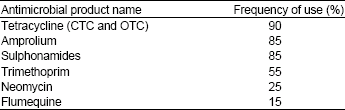
Several types of antimicrobial were reported to be commonly used by farmers of which most of them belonged in the group of tetracylines and sulphonamides as shown in Table 1.
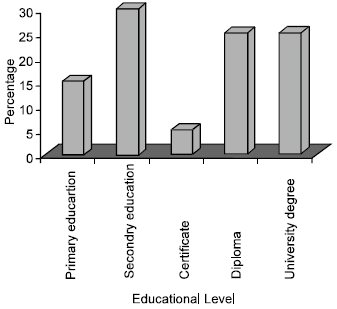 | |
| Fig. 1: | Level of education of the respondents |
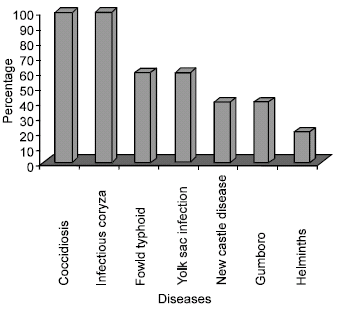 | |
| Fig. 2: | Common chicken diseases as reported by farmers in Morogoro |
Up to 95% of respondents admitted to slaughter chickens even before the withdrawal period. However, the means period from last antimicrobial treatment to slaughter as was mentioned by farmers was 10.9±7.2 (minimum of 2 days and maximum of 30 days). Ninety percent of the respondents admitted to have knowledge on antimicrobial withdrawal period but most of them (95%, n = 19) did not observe it because were afraid of losses. When were asked on the effects of antimicrobial residues to in humans, up to 75% were not aware.
Laboratory results indicated that with Delvo test, 50% (n=35) of the individual liver samples tested positive for antimicrobial residues while 70% (n = 14) of the 20 farms visited werepositive to antimicrobial residues. However, results from agar well diffusion test showed that 10% (n = 7) of the liver samples were found to contain antimicrobial residues with the mean inhibition zone of 21±9.6mm (minimum zone of inhibition was 10 mm and the maximum was 30mm).
| Table 1: | Common antimicrobials used in broiler chicken as reported by farmers |
 | |
DISCUSSION
The use of antimicrobial agents in food-producing animals has recently become a very important public health issue (Jafari et al., 2007). This is due to the fact that these agents are being increasingly used in farm animal production. These drugs are widely used to treat animals as well as to enhance feed efficiency, promote animal growth and improve productivity. In addition, antimicrobials are widely used for disease prophylaxis and treatment, an important measure when raising chickens under intensive husbandry methods of production (Gustafson and Bowen, 1997). This practice however, carries many disadvantages. Many reports have indicated that microbial resistance to these agents and the resistance may possibly be transferred to human pathogens (Soggard, 1973; Roberts, 1996). In addition human exposure to animal products containing significant level of antibiotic residues may prove immunological response in susceptible individuals and cause disorder of intestinal flora (Linton, 1977). Internationally recognized organizations like World Health Organizations (WHO) and Food and Agriculture Organizations (FAO) have set tolerance or Maximum residue limits (MRLs), acceptable daily intakes (ADIs) for humans and withholding times for pharmacologically active substances including antimicrobial agents prior to marketing (WHO/FAO, 1988).
In the present study we examined samples of liver of chicken for presence of antimicrobial residues. The results showed that up to 70% of the investigated broiler farms had detectable levels of antimicrobials at the time of marketing. Furthermore, the study has demonstrated that all poultry farmers frequently use different antimicrobial agents interchangeably for treatment and control of diseases. During this survey, broiler farmers reported to use different drugs to either treat or prevent diseases to their chickens. Because of frequent occurrences of different diseases in the farms and lack of proper veterinary extension services, farmers are forced to overcome the problem by indiscriminate use of antibiotics of which may associate with improper dosing and lack of advice on withdrawal period (Riviere and Spoo, 1995).
However, bacterial and protozoal diseases were the most common chicken diseases reported by farmers which their control through vaccination is not practiced. Specifically, coccidiosis, infectious coryza, fowl typhoid, helminthosis, yolk sac infection and fowl cholera were the major diseases mentioned by most farmers. Because of poor farming system practiced by the small scale farmers, such diseases are rampant which necessitates farmers to frequently use antimicrobial agents. Antimicrobials agents which, were frequently used were those in the groups of tetracycline and sulphonamides. These findings are in line with the published by Al-Ghamdi et al. (2000) who also found higher usage of tetracylines in chickens in Saudi Arabia. A study on antimicrobial residues in beef in Morogoro, Tanzania by Mmbando (2004) also found a higher percentage of tetracycline residues in the samples examined. Such drugs were commonly used probably because of their low cost, readiness availability in veterinary shops and easy access of the drugs by farmers themselves without any restrictions. Some of the antibiotics were sometimes incorporated into animal feed to improve growth rate and feed efficiency. Other drugs that were also reported to be commonly used by chicken keepers were amprolium and neomycin.
The use of these veterinary drugs went along with non-compliance to withdrawal periods. Apart from using antimicrobial agents, a significant number of farmers were knowledgeable on the withdrawal period. Significantly, low number of them reported to comply with the recommended drug withdrawal periods. These were further verified by a higher number of the farms (70%) found to have antimicrobial residues in the meat sampled. The findings are comparable to those of Al-Ghamdi et al. (2000) but lower than that reported by Salehzadeh et al., 2006 in Iran. The non-compliance to withdrawal period by farmers could be associated with many reasons including fear of losses. Most of the poultry keepers are subsistence farmers and since there is frequent occurrence of diseases which needs regular uses of drugs, observing withdrawal period could lead to more losses. The other reason which could be considered is lack of awareness to farmers on the possible side effects of antimicrobials and other drugs to humans. This was verified by the finding that most of the farmers were also using broiler meat from their chickens, which were under treatment as food at their homes. Therefore administration of drugs to food-producing animals requires not only consideration of effects on the animal but also the effects on humans who ingest food from these animals.
In the present study, the 70% detection of antimicrobial residues in chicken meat suggests that the public has been ingesting low level of antibiotics continuously in the animal products. Studies by Mmbando (2004), Karimuribo et al. (2005), Kurwijila et al. (2006) and Simon (2007) showed also that there was higher level of antimicrobial agents in milk, beef and eggs. This implies that the Morogoro community ingests small doses of antimicrobials from different foods of animal origin. This practice may contribute significantly to the development of antimicrobial resistance. Indeed, our own results (unpublished data) showed that up to 65% of thermophilic Campylobacter isolated from ducks in 2007 were resistant to different types of commonly used antibiotics in veterinary and humans practices. Many reports indicated that microbial resistance to antimicrobial agents with the resistance being possibly transferred to human pathogens (Mercer, 1977; Holmberg et al., 1984; Al-Ghamdi et al., 1999). In addition, human exposure to animal products containing significant levels of antimicrobiotic residues may provoke immunological responses in susceptible individuals (Woodward, 1991) and cause disorders of intestinal flora (Holmberg et al., 1984).
It is concluded that this study suggested widespread misuse of antimicrobial agents by poultry farmers in Morogoro, Tanzania, possibly reflecting a general lack of implementation of recommended withdrawal times. This study therefore stresses the need for stricter regulation for the use of antimicrobial drugs in the poultry industry as well as the inspection of chicken for residues prior to marketing in organs especially the liver. However, poultry farmers need to be educated on the possible effects associated with use of food with antimicrobial residues.
ACKNOWLEDGMENTS
The authors highly acknowledge the support by the International Foundation for Science, for financial support. The support and cooperation we received from the chicken farmers in the study areas is highly appreciated. Technical support rendered by Mr. Kitime, A., Mkuchu, P. and Chambo, F. in the course of the work is highly acknowledged.
REFERENCES
- Al-Ghamdi, M.S., Z.H. Al-Mustafa, F. El-Morsy, A. Al-Faky, I. Haider and H. Essa, 2000. Residues of tetracycline compounds in poultry products in the Eastern Province of Saudi Arabia. Public Health, 114: 300-304.
CrossRefDirect Link - Al-Ghamdi, M.S., F. El-Morsy, Z.H. Al-Mstafa, M. Al-Ramadhani and M. Hanif, 1999. Antibiotic resistance of Escherichia col isolated from poultry workers, patients and chicken in the eastern province of Soudi Aarbia. Trop. Med. Int. Health, 4: 278-283.
Direct Link - Gustafson, R.H. and R.E. Bowen, 1997. Antibiotic use in animal agriculture. J. Applied Microbiol., 83: 531-541.
CrossRefDirect Link - Holmberg, S.D., M.T. Osterholm, K.A. Senger and M.L. Cohen, 1984. Drug-resistant Salmonella from animals fed antimicrobials. N. Engl. J. Med., 311: 617-622.
CrossRefPubMedDirect Link - Jafari, M.T., T. Khayamian, V. Shaer and N. Zarei, 2007. Determination of veterinary drugs residues in chicken meat using corona discharge ion mobility spectrometry. Anal. Chem. Acta, 581: 147-153.
CrossRef - Karimuribo, E.D., R.H. Mdegela, L.J.M. Kusiluka and D.M. Kambarage, 2005. Assessment of antimicrobial usage and antimicrobial residues in milk on small holder farms in Morogoro Tanzania. Bull. Anim. Health Prod. Afr., 53: 234-241.
Direct Link - Kurwijila, L.R., A. Omore, S. Staal and N.S.Y. Mdoe, 2006. Investigation of the risk of exposure to antimicrobial residues present in marketed milk in Tanzania. J. Food Prot., 69: 2487-2492.
Direct Link - Roberts, M.C., 1996. Tetracycline resistance determinants: Mechanisms of action, regulations of expression, genetic mobility and distribution. FEMSI Microbiol. Rev., 19: 1-24.
PubMedDirect Link - Salehzadeh, F., R. Madani, A. Salehzadeh, N. Rokni and F. Golchinefar, 2006. Oxytetracycline residue in chicken tissues from Tehran slaughterhouses in Iran. Pak. J. Nutr., 5: 377-381.
CrossRefDirect Link - Soggard, H., 1973. Incidence of drug resistance and transmissible R factor in strains of E. coli isolated from faeces of healthy pigs. Acta Vet. Scandinavica, 14: 381-391.
PubMedDirect Link - Woodward, K.N., 1991. Hypersensitivity in humans and exposure to veterinary drugs. Vet. Hum. Toxicol., 33: 168-172.
PubMedDirect Link - Simon, C., 2007. Assessment of antimicrobial usage and antimicrobial residues in layer chickens in Morogoro municipality, Tanzania. A Special Project Report Submitted in Partial Fulfilment for the Degree of Bachelor of Veterinary Medicine of the Sokoine University of Agriculture, Morogoro, Tanzania, pp: 32.