

N. Bilan
Tuberculosis and Lung Diseases Research Center, Tabriz University of Medical Sciences, Tabriz, Islamic Republic of Iran
B.A. Galehgolab
Tuberculosis and Lung Diseases Research Center, Tabriz University of Medical Sciences, Tabriz, Islamic Republic of Iran
M. Shoaran
Tuberculosis and Lung Diseases Research Center, Tabriz University of Medical Sciences, Tabriz, Islamic Republic of Iran
Pakistan Journal of Biological Sciences
Year: 2009 | Volume: 12 | Issue: 5 | Page No.: 467-469







ABSTRACT
This study was aimed to establish non-invasive (medical) treatment of lung collapse for children who are admitted to PICU of Tabriz Children’s Hospital. During a period of 48 months (from March 2004 to February 2008), an interventional pre-experimental study carried out on 90 children suffering from lung collapse who received non-invasive treatment; which mainly consists of postural drainage, chest physiotherapy and inhalation of aerosols (fluid as floating droplets in air) and bronchodilators. Eighty six out of 90 studied patients (94.5%) with the average age of 22 months, responded to this treatment within the average duration of 3.4 days, as collapsed area of lung reexpanded. Because of simplicity and easy availability of this method of treatment and also its efficacy and scientific base; it can substitute bronchoscopic treatment and its usage be generalized to small hospitals.
PDF Abstract XML References Citation
How to cite this article
N. Bilan, B.A. Galehgolab and M. Shoaran, 2009. Medical Treatment of Lung Collapse in Children. Pakistan Journal of Biological Sciences, 12: 467-469.
DOI: 10.3923/pjbs.2009.467.469
URL: https://scialert.net/abstract/?doi=pjbs.2009.467.469
DOI: 10.3923/pjbs.2009.467.469
URL: https://scialert.net/abstract/?doi=pjbs.2009.467.469
INTRODUCTION
Atelectasis or lung Collapse is defined as incomplete expansion of lung and also referred to non-aerated lung parenchyma which is otherwise normal. It is called acquired when a segment, a lobe or lobes collapse(s) after birth (Hazinsk, 1998).
This condition which is commonly seen in patients admitted to Pediatric Intensive Care Unit (PICU) develops as a non-specific complication of many pulmonary diseases. Lung collapse can deteriorate the general condition of every patient by increased work of breathing (due to decreased lung compliance), hypoxemia and hypercapnia (caused by ventilation/perfusion mismatch) and may finally result in acute respiratory failure. Concern over prolonged atelectasis is that it may worsen hypoxemia through shunting and may predispose the patient to nosocomial pneumonia (Kreider and Lipson, 2004).
Treatment of lung collapse may be a major part of general management in a significant proportion of PICU patients, which can reduce their length of stay in this ward if it is carried out perfectly (Rozenfeld, 2004) Although correction of underlying pulmonary disorder is the best treatment of lung collapse, it is seldom possible; therefore other therapeutic measures and supportive care are necessary to induce pulmonary re expansion. To gain a perfect clinical response, one can use invasive (bronchoscopy) or non-invasive medical treatment. Based on systematic review of Johnston there is No clinical trials to identify the most efficient treatment for atelectasis in the pediatric patient (Johnston and Carvalho, 2008). Although bronchoscopy may help to remove mucous plugs from lower airways in all cases, even more rapidly than non-invasive measures but that technique is dependent on expensive instruments and highly specialized human resources which usually are not widely available, therefore we designed this study to try the efficacy of an incorporated collection of non-invasive measures as a simple and inexpensive alternative way to re-expand atelectasis, whether it achieves the same therapeutic results.
MATERIALS AND METHODS
An interventional pre-experimental study was done on 90 patients with lung collapse who were consecutively admitted to PICU of Tabriz Children’s Hospital within a period of 48 months (from March 2004 to February 2008). The followings were inclusion criteria:
| • | Lack of any clinical evidence for foreign body aspiration |
| • | Presence of clinical evidence for hyper secretion or mucous plug in respiratory tract |
The occurrence of lung collapse and recovery from it was diagnosed upon clinical and radiographic findings. All chest radiograms were reported by the same radiologist who was not aware of this study.
We explained the benefits of this therapeutic method for parents and they permitted us to use it. This method of treatment is consisted of following parts (all ordered as a uniform therapeutic program).
Postural drainage: It means to keep the patient in such a position that places his or her affected lung in the highest part of the chest. Every patient was placed in a proper position by a trained nurse for 90 min, then it was changed into another position for 30 min, therefore the patients’ position was changing every 2 h to prevent complications of fixed position and restored if changed inappropriately by him or herself.
Chest physiotherapy: This was carried out by a physiotherapist (a technician) using an electrical vibrator or by parents or nurses using chest percussion with a hand for 10-20 min once or twice daily.
Continuous aerosol therapy: We connected a pressurized oxygen reservoir to the fluid chamber of a jet nebulizer, blowing pure O2 as a jet flow of at least 6 litter/minute through that chamber and put them under a hood placed over the patient’s head. A thin catheter inserted into the fluid chamber of nebulizer which provided it with normal saline, as a continuous refilling line supported by a syringe pump. Therefore every patient continuously (24 h a day) breathes oxygen and aerosol (fluid as floating droplets in air) under hood. Of course, humidification for patients under mechanical ventilation was provided by a humidifier apparatus which vaporized sterile water into inspiratory arm of ventilator tubing set.
Bronchodilator therapy: Because inhalation of every kind of aerosol can induce bronchospasm, salbutamol or epinephrine solution was added to fluid in nebulizer chamber, administered to all patients at a dose of 0.15 mg kg-1 every 4 h. We used salbutamol spray (2 puffs every 4 h) for patients under mechanical ventilation administered through a spacer connected to endotracheal tube.
RESULTS
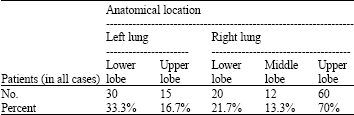
Ninety patients were studied (47 males and 43 females) with the average age of 22 months. Nine patients were under mechanical ventilation but the others (81 patients) didn’t need it. Anatomical location of atelectasis has been shown in Table 1, multiple lobes have been involved in some instances; however, right upper lobe was the most common involved part of the lung, which was affected in 73% of all cases. Underlying disorders which caused lung collapse and their response to treatment by non-invasive methods are showed in Table 2. The total re expansion rate was 94.5% and average needed time for relief was 3.4 days, (3.6 days for patients under mechanical ventilation and 3.2 days for the others).
| Table 1: | Anatomical location of lung involvement |
 | |
| Table 2: | Underlying disorders which caused lung collapse and re-expansion rate |
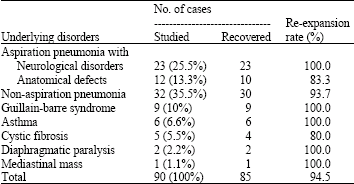 | |
Five out of our 90 patients (4.5%) did not respond to non-invasive treatment of lung collapse, one due to congenital anomaly (stenosis) of bronchus and four because of incomplete treatment due to severe agitation of patient after placing him under hood, both managed by bronchoscopy.
DISCUSSION
The depth and composition of the airway surface fluid depend on secretion from the mucous cells and sub mucosal glands and active ion transport across the surface epithelium as a mechanism for altering the hydration of secretions. The composition and physical characteristics of airway surface fluid allow for normal ciliary function and airway hygiene (Fuloria and Rubin, 2000) and protect the airway from drying. Mucus is transported from the lower respiratory tract into the pharynx by air flow and mucociliary clearance. Disruption of normal secretion or mucociliary clearance results in impaired pulmonary function and lung defense and increased risk of infection (Wanner et al., 1996). Abnormal respiratory secretions can cause mucus inspissation, postobstructive atelectasis and airway and parenchymal lung injury with bronchiectasis and pulmonary fibrosis, leading to severe pulmonary dysfunction.
Lung collapse can be treated in two discrete ways: Medical (non-invasive) and Bronchoscopy or surgical (invasive) treatment. Although bronchoscopy can remove nearly all mucous plugs and re-expand related lung collapse rapidly, but it is not always practical because bronchoscopy or surgical operations are not only invasive but also need trained medical staff and expensive equipments which are not available every where, therefore medical treatment is preferable; as mentioned before about 95.5% of patients recovered completely.
Re-expansion was documented by findings of physical and radiographic examinations). Bland aerosol administration, which is transference of sterile water or hypotonic, isotonic or hypertonic saline into airways in the form of aerosol; can be used not only for treatment of upper respiratory tract disorders, such as laryngotracheobronchitis, subglottic edema and so on, but also for sputum induction and mobilization of secretions (Kallstrom, 2003; Dolovich, 1976). Bland water aerosol administration has been used conventionally as mucolytic and expectorant, although this treatment diminishes the viscosity of thick secretion in airways and humidifies there, but it has some adverse effects including bronchospasm and intense cough, therefore bronchodilator inhalation must be used concomitant therefore Use of inhaled epinephrine for relief of it will be useful as in asthma (Rau, 2005).
Our international literature review was not very informative because no article was found in which all components of non-invasive treatment has been studied as a single protocol. Only in one study, done by Dr. Amirav, who reported that aerosols are better transferred by hood nebulizer in treatment of 14 infants (with average age of 8 months) who had wheezing (Amirav et al., 2003, 2005). According to the results of our study, aspiration pneumonia with the background of neurological impairment was the underlying cause of lung collapse in 6 patients; the following mechanisms may play some role in this process: respiratory muscles weakness, ineffective cough, accumulation of secretions, chronic aspiration due to convulsion, dysphagia or reflux and hypo activity or being bed ridden. These mean that neurologically impaired patients are highly susceptible to lung collapse and need a special medical attention (Seddon and Khan, 2003).
CONCLUSION
This study shows that non-invasive medical treatment of lung collapse which mainly consists of postural drainage, chest physiotherapy, aerosol therapy and inhaled bronchodilators administration, is not only scientific and effective but also simple. It can be generalized and substituted for bronchoscopy.
REFERENCES
- Amirav, I., A. Oron, G. Tal, K. Cesar, A. Ballin, S. Houri and L. Naugolny, 2005. Aerosol delivery in respiratory syncytial virus bronchiolitis: hood or face mask? J. Pediatr., 147: 627-631.
PubMedDirect Link - Amirav, I., I. Balanov, M. Gorenberg, D. Groshar and A.S. Luder, 2003. Nebuliser hood compared to mask in wheezy infants: Aerosol therapy without tears. Arch. Dis. Child., 88: 719-723.
PubMedDirect Link - Dolovich, M.B., J. Sanchis, C. Rossman and M.T. Newhouse, 1976. Aerosol penetrance: A sensitive index of peripheral airways obstruction. J. Applied Physiol., 40: 468-471.
PubMed - Fuloria, M. and B.K. Rubin, 2000. Evaluating the efficacy of mucoactive aerosol therapy. Respir. Care, 45: 868-873.
PubMed - Kallstrom, T.J., 2003. AARC clinical practice guideline (revision and update). Respir. Care, 48: 529-533.
PubMed - Seddon, P.C. and Y. Khan, 2003. Respiratory problems in children with neurological impairment. Arch. Dis. Child., 88: 75-78.
PubMed - Wanner, A., M. Salathe and T.G. O’Riordan, 1996. Mucociliary clearance in the airways (review). Am. J. Respir. Crit. Care, Med., 154: 1868-1902.
PubMed - Johnston, C. and W.B. de Carvalho, 2008. Atelectasis: Mechanisms, diagnosis and treatment in the pediatric patient. Rev. Assoc. Med. Bras., 54: 455-460.
PubMed - Kreider, M.E. and D.A. Lipson, 2003. Bronchoscopy for atelectasis in the ICU: A case report and review of the literature. Chest, 124: 344-350.
PubMed