

R. Moniri
Department of Microbiology and Immunology, Kashan University of Medical Sciences, Kashan, Iran
K. Dastehgoli
Kashan Veterinary Network, Kashan, Iran
Pakistan Journal of Biological Sciences
Year: 2007 | Volume: 10 | Issue: 17 | Page No.: 2984-2987







ABSTRACT
There is a clear association between heavy antimicrobial consumption in poultry industry and the recovery of resistant bacteria. This was a case-control study of 396 E. coli strains isolated from clinically affected broiler chickens and 132 strains from healthy controls to compare the antimicrobial resistance rates. Antimicrobial resistance testing of 525 avian E. coli strains isolated in Kashan-Iran showed very high levels of resistance to 11 antimicrobials tested, especially to trimethoprim-sulfamethoxazole (98.7%) and to ciprofloxacin (69.7%). The prevalence rate of resistant E. coli to ciprofloxacin and erythromycin in the samples isolated from chickens with colibacillosis was significantly higher than healthy controls. In addition, to prevent the emergence of cross-resistance with human enteric pathogens, controlled use of these antimicrobial agents in veterinary practice is recommended.
PDF Abstract XML References Citation
How to cite this article
R. Moniri and K. Dastehgoli, 2007. Antimicrobial Resistance among Escherichia coli Strains Isolated from Healthy and Septicemic Chickens. Pakistan Journal of Biological Sciences, 10: 2984-2987.
DOI: 10.3923/pjbs.2007.2984.2987
URL: https://scialert.net/abstract/?doi=pjbs.2007.2984.2987
DOI: 10.3923/pjbs.2007.2984.2987
URL: https://scialert.net/abstract/?doi=pjbs.2007.2984.2987
INTRODUCTION
Colibacillosis in chickens is frequently manifested as a septicemia resulting in a subacute serositis characterized by fibrinoheterophilic infiltration producing a fibrinous pericarditis, perihepatitis, airsacculitis and pneumonia. It is one of the most serious threats to broiler chicken flock between 4 and 5 weeks of age with respiratory signs, omphalitis and septicemia in baby chicks causing high mortality rates. It is trasmitted through contamination of egg shellwith pathogenic E. coli from poultry house orhatcher environment (AAAPG, 2005).
Antibiotics have been used on poultry husbandry farms to treat and control diseases in chickens and to improve chicken productivity (Peter, 1999). This practice is reported to have caused high resistance to antimicrobial agents in normal intestinal flora and pathogenic organisms of chickens (Tollefson et al., 1997; Manie et al., 1998). E. coli is commonly found in the intestinal tracts of animals, but only pathogenic serotypes cause avian collibacillosis (Aarestrup and Wegener, 1999; Gorbach, 2001). The transfer of resistant E. coli from chickens to humans is a common event, as has been demonstrated by several groups of researchers (Kanai et al., 1983; Van den Bogaard and Stobberingh, 1999). Antimicrobial agents are widely used in poultry husbandry in Iran as therapy for an infection or, in the absence of disease, in sub-therapeutic doses with the goals of growth promotion and enhanced feed efficiency. Multidrug-resistant strains of E. coli are prevalent in both human and animal isolates in different parts of the world and Iran, too (Nazer, 1980; Blanco Jesus et al., 1997; Al-Ghamdi Mastour et al., 1999). To look into these issues with more details, the current study was designed to evaluate the frequency of resistant E. coli isolated from septicemic broiler chickens and healthy controls.
MATERIALS AND METHODS
This was a case-control study of 396 E. coli strains isolated from clinically affected broiler chickens and 132 strains from healthy controls were collected in 20 commercial poultry husbandry fields in province of Isfahan (Kashan, Iran) in 2004. All strains isolated from diseased chickens came from confirmed cases of collibacillosis in which bacteria were obtained in culture from liver and heart tissues. Fecal strains were isolated from the cloacal contents of healthy chickens. Antimicrobial susceptibilities were assessed for amikacin, ampicillin, chloramphenicol, ciprofloxacin, gentamicin, tobramicin, doxycycline, nalidixic acid, erythromycin, nitrofurantoin and trimethoprim/sulfamethoxazole by the standard disk diffusion method in Muller-Hinton agar with disks provided by Difco and Biomerieux according to standards developed by the National Committee for Clinical Laboratory Standards (NCCLS, 1999), which its name recently changed to CLSI (Clinical Laboratory Standards Institute), guidelines. E. coli ATCC 25922 and E. coli ATCC 35218 were quality-control organisms. Three samples of healthy controls were excluded from the study. The statistical procedures were: Fischer’s exact test and Chi-square. We considered differences significant at p<0.05. The ethical committee of the Kashan University of Medical Sciences approved the study.
RESULTS AND DISCUSSION
The resistance frequencies for 11 antimicrobial agents tested are shown in Table 1. As the Table 1 indicates, resistance frequency rates were very high. The resistance rates for 525 E. coli isolates were very high to amikacin and doxycycline (99.4%), nalidixic acid (99%), followed by ampicillin, trimethoprim-sulfamethoxazole (SXT), erythromycin and chloramphenicol. Ciprofloxacin showed high level of resistance rates (69.7%). The antibiotic resistance rates to tobramycin and gentamicin were at moderate level (11.6 to 12.6%). The resistant rates of E. coli to ciprofloxacin (p<0.00002) and erythromycin (p<0.014) in the samples from chickens with collibacillosis was significantly higher than healthy controls.
We have investigated the resistance of the large proportion of E. coli isolated with reduced susceptibility to antimicrobials could be the frequent exposure of chicken to abundant use and misuse of these drugs in commercial poultry production and colonized the resistant E. coli to 11 antimicrobial agents commonly used in the poultry industry and/or for human medicine in Kashan, Iran. The isolated E. coli from chickens clearly demonstrated high resistance rates to all tested antibiotics commonly used in the poultry industry.
In vitro antibiotic sensitivity results obtained in this study agreed with several various reports (Blanco Jesus et al., 1997; Al-Ghamdi Mastour et al., 1999), which have indicated increasing incidence rates of antibiotic resistant E. coli strains isolated from healthy controls and diseased chickens (Blanco Jesus et al., 1997). However, the high percentage of E. coli strains that were resistant to amikacin, doxycyline, nalidixic acid, trimethoprim/sulfamethoxazole and erythromycin in present study was surprising. An interesting finding in this study was that the percentage of E. coli resistant strains to erythromycin and ciprofloxacin (69.7%) in diseased group were significantly higher than in control. Lee et al. (2005), reported high resistance to ciprofloxacin (CIP; 60.2%), enrofloxacin (ENO; 73.4%) and norfloxacin (NOR; 60.2%) in one hundred and twenty-eight isolated E. coli from chicken.
The existence of high resistant E. coli in this study, like other results of other researches is alarming and aware us to use these drugs according to results of antibiogram tests and use the narrow spectrum instead of broad spectrum antibiotics (Blanco Jesus et al., 1997; Al-Ghamdi Mastour et al., 1999). Kijima-Tanaka et al. (2003), reported higher resistance rates in Escherichia coli isolated from food-producing animals in Japan against oxytetracycline and dihydrostreptomycin, followed by ampicillin and kanamycin. Resistance was more frequently showed among broiler isolates, followed by isolates from pigs. Almost 10% of broiler isolates were resistant to fluoroquinolones and extremely high MICs (100 mg L‾1) were observed. As Asai et al. (2005), mentioned the antimicrobial susceptibility of the isolates was examined against 7 classes of 11 antimicrobials. The rates of antimicrobial resistance among the isolates were found to correlate significantly with the usage of antimicrobial agents in cattle, pigs and broiler and layer chickens. Therefore, the overall usage of veterinary antimicrobials appears to contribute to the appearance of antimicrobial resistance in E. coli isolates from apparently healthy food-producing animals. In other study isolated E. coli from diseased piglets (n = 89) and chickens (n = 71) in China were characterized for antimicrobial susceptibility. The isolates displayed resistance to nalidixic acid (100%), tetracycline (98%), sulfamethoxazole (84%), ampicillin (79%), streptomycin (77%) and trimethoprim-sulfamethoxazoole (76%).
| Table 1: | Antimicrobials resistance among Escherichia coli strains isolated from healthy and septicemic chickens in Kashan-Iran in 2004 |
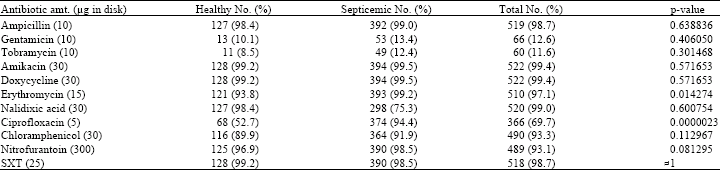 | |
| Total incidences of resistance of strains from healthy (n = 129) and septicemic (n = 396) chickens were 1092 and 3490, respectively (total for both groups, 4582). Incidences of resistance per strain were 8.46 and 8.8 for healthy and septicemic groups, respectively (average for both groups, 8.6) | |
Multiple-antimicrobial-resistant E. coli isolates, including fluoroquinolone-resistant variants, are commonly present among diseased swine and chickens in China (Yang et al., 2004).
Ninety-five avian pathogenic E. coli (APEC) isolates recovered from diagnosed cases of avian colibacillosis from North Georgia. Multiple antimicrobial-resistant phenotypes (> or = 3 antimicrobials) were observed in 92% of E. coli isolates, with the majority of isolates displaying resistance to sulfamethoxazole (93%), tetracycline (87%), streptomycin (86%), gentamicin (69%) and nalidixic acid (59%) (Zaho et al., 2005).
In present study the large proportion of E. coli isolated with reduced susceptibility to antimicrobials could be result of the frequent exposure of chicken to abundant use and misuse of these drugs in commercial poultry production and colonized the resistant E. coli. The high recovery rate of antimicrobial resistant E. coli from broilers in Iran was troubling, but not surprising. Given the routine application of the antimicrobials at subtherapeutic doses for prophylactic and therapeutic purposes by farmers, without prescription and for treatment by veterinary prescription in absence of documented laboratory findings.
In this study, current frequent usage of particular antibiotics in chickens seemed to correlate not only with high prevalence of resistance to those antibiotics, but also with a higher prevalence rates of drug resistance in the population of chickens. Frequent usage of an antibiotic in the past was also associated with relatively high prevalence of resistance in this population.
In conclusion, the increasing problem of bacterial resistance due to rational usage of antibiotics including the implementation of a veterinary antibiotic policy is of utmost importance to safegurad the efficacy of veterinary antibiotic therapy for the future and to minimize the public health risks from veterinary practice. Surveillance is an essential part of antibiotic administration policy and should consist of the regular or continuous monitoring of antimicrobial resistance.
ACKNOWLEDGMENTS
This study was financially supported by a research grant from Deputy for Researches, Kashan University of Medical Sciences and Health Services, Kashan, Iran. We thank Dr. Mohsen Shafiee for his assistance with the preparation of the samples used in this study.
REFERENCES
- Al-Ghamdi, M.S., F. El-Morsey, Z.H. Al-Mustafa, M. Al-Ramadhan and M. Hanif, 1999. Antibiotic resistance of Escherichia coli isolated from poultry workers, patients and chicken in the eastern province of Saudi Arabia. Trop. Med. Int. Health, 4: 278-283.
PubMed - Asai, T., A. Kojima, K. Harada, K. Ishihara, T. Takahashi and Y. Tamura, 2005. Correlation between the usage volume of veterinary therapeutic antimicrobials and resistance in Escherichia coli isolated from the feces of food-producing animals in Japan. Jpn. J. Infect. Dis., 58: 369-372.
Direct Link - Blanco, J.E., M. Blanco, A. Mora and J. Blanco, 1997. Prevalence of bacterial resistance to quinolones and other antimicrobials among avian Escherichia coli strains isolated from septicemic and healthy chickens in Spain. J. Clin. Microbiol., 35: 2184-2185.
PubMedDirect Link - Kijima-Tanaka, M., K. Ishihara, A. Morioka, A. Kojima and T. Ohzono et al., 2003. A national surveillance of antimicrobial resistance in Escherichia coli isolated from food-producing animals in Japan. J. Antimicrob Chemother., 51: 447-451.
Direct Link - Lee, Y., J.K. Cho, K. Kim, R. Tak, A. Kim, J. Kim, S. Im and B. Kim, 2005. Fluoroquinolone resistance and gyrA and parC mutations of Escherichia coli isolated from chicken. J. Microbiol., 43: 391-397.
PubMed - Manie, T., S. Khan, V.S. Brozel, W.J. Veith and P.A. Gouws, 1998. Antimicrobial resistance of bacteria isolated from slaughtered and retail chickens in South Africa. Lett. Applied Microbiol., 26: 253-258.
CrossRefPubMedDirect Link - Collignon, P.J., 1999. Vancomycin-resistant Enterococci and use of avoparcin in animal feed: Is there a link? Med. J. Aust., 171: 144-146.
PubMed - Van den Bogaard, A.E. and E.E. Stobberingh, 1999. Antibiotic usage in animals: Impact on bacterial resistance and public health. Drugs, 58: 589-607.
PubMedDirect Link - Yang, H., S. Chen, D.G. White, S. Zhao, P. McDermott, R. Walker and J. Meng, 2004. Characterization of multiple-antimicrobial-resistant Escherichia coli isolates from diseased chickens and swine in China. J. Clin. Microbiol., 42: 3483-3489.
CrossRefDirect Link - Zhao, S., J.J. Maurer, S. Hubert, J.F. De Villena and P.F. McDermott et al., 2005. Antimicrobial susceptibility and molecular characterization of avian pathogenic Escherichia coli isolates. Vet. Microbiol., 107: 215-224.
CrossRefDirect Link