

Muhammad Jalal Arif
Department of Agriculture Entomology, University of Agriculture, Faisalabad, Punjab, Pakistan
Muhammad Dildar Gogi
Department of Agriculture Entomology, University of Agriculture, Faisalabad, Punjab, Pakistan
Mansoor Mirza
Department of Agriculture Entomology, University of Agriculture, Faisalabad, Punjab, Pakistan
Khuram Zia
Department of Agriculture Entomology, University of Agriculture, Faisalabad, Punjab, Pakistan
Faisal Hafeez
Department of Agriculture Entomology, University of Agriculture, Faisalabad, Punjab, Pakistan
Pakistan Journal of Biological Sciences
Year: 2006 | Volume: 9 | Issue: 7 | Page No.: 1364-1369







ABSTRACT
The present study deals with the impact of different spacing viz., 12.5,18.5, 23.5, 30 and 38.5 cm and abiotic factors (temperature, relative humidity and precipitation) on the population dynamics of sucking insect pests of cotton viz., Bemisia tabaci, Amrasca devastans and Thrips tabaci under unsprayed conditions. The period of abundance of jassid (Amrasca devastans) and thrips showed 1st (1.75, 11.43), 2nd (1.85, 10.44) and 3rd peak (1.66, 12.83) during 3rd, 2nd and 2nd week of July, August and September respectively. Where as peek population of whitefly was observed during 4th weak of August and 1st weak of September. The population of jassid, whitefly and thrips was significantly effected by plant spacing and decreased with the increase in plant spacing. The minimum population of jassid (0.96), thrips (8.45) and whitefly (2.82) was observed in plots laid out at 38cm plant spacing. Simple correlation analysis revealed that the rainfall and temperature showed significant and positive effect on jassid population where as relative humidity showed non-significant effect. Similarly effect of temperature was also significant and positive on the thrips and whitefly population. Relative humidity and rainfall did not show significant effect on thrips population where as significant and positive correlation was found to exist between relative humanity and whitefly population. Rainfall did not show significant correlation with Whitfly population. However R2 value computed through Multivariate Regression Analysis showed that temperature humidity and rainfall collectively showed 53, 36.8 and 66.4% influence on population fluctuation of jassid, thrips and whitefly respectively.
PDF Abstract XML References Citation
How to cite this article
Muhammad Jalal Arif, Muhammad Dildar Gogi, Mansoor Mirza, Khuram Zia and Faisal Hafeez, 2006. Impact of Plant Spacing and Abiotic Factors on Population Dynamics of Sucking Insect Pests of Cotton. Pakistan Journal of Biological Sciences, 9: 1364-1369.
DOI: 10.3923/pjbs.2006.1364.1369
URL: https://scialert.net/abstract/?doi=pjbs.2006.1364.1369
DOI: 10.3923/pjbs.2006.1364.1369
URL: https://scialert.net/abstract/?doi=pjbs.2006.1364.1369
INTRODUCTION
Cotton has a pivotal role in the agro-based economy of Pakistan. The importance of its agricultural development and achievement is highly dependent upon cotton crop. Pakistan is an important cotton and Yarn producing country with potential to become a key force in the global cotton and textile market. It contributes 60% in export and 85% in domestic edible oil production. It provides raw material to domestic cotton industry comprising 503 textile mills, 1139 ginning factories and 5000 oil expelling units (Mehmood, 1999). Cotton seedcake, an important by product of cotton, is a valuable source of protein for ruminant cattle. In addition, 40% labour of our country is employed in cotton fields and cotton processing mills (Mehmood, 1999). Cotton contributes lion’s share of 10% to GDP and 62.3% to foreign exchange earnings of the country with annual exports of US $.8 billion (Anonymous, 2003).
During growth period, 148 insect pests have been recorded on cotton crop, out of which only 17 species have been recorded as major insect pests of cotton crop (Abbas, 2001). Among a number of factors, high population of piercing sucking insect pests and bollworms that survive every year, despite extensive and intensive insecticidal application on the cotton and do colossal losses to the crop, as high as 45% in certain areas of the country (Ahmad, 1991).
Among these insect pests whitefly (Bemisia tabaci Genn.), jassid (Amrasca devastans Dist.), thrips (Thrips tabaci Lind.) and aphid (Aphis gossypii Clov.) are very serious sucking insect pests. The magnitude of insect pests, which damage the cotton crop from sowing to maturity, play an important role, causes heavy qualitative and quantitative losses varying from 40-50% (Naqvi, 1976).
The incidence and development of these insect pests is very much dependent upon the prevailing physical environmental factors and crop stand. These insets multiply tremendously during the favourable weather conditions and take huge toll. The role of temperature and relative humidity is likely to affect the occurrence (Aheer et al., 1994).
For averting losses due to insect pests, whole reliance has been on pesticides as a tool of pest control and foreign exchange worth millions of rupees is being spent every year. The expenditure increased from 2294 million rupees in 1985 to 9904 million rupees in 1997 and is likely to increase year after year (Anonymous, 2001).
The continuous and indiscriminate use of large quantities of synthetic insecticides, besides creating health hazards to human and animal life, as well as environmental population has also resulted in the crop failure in different parts of the world, out break of secondary pests and development of resistance against insecticides in large number of insects.
In view of existing situation and importance of cotton for Pakistan, it is necessary prerequisite for developing effective pest management programme to know the proper and appropriate plant spacing and ecological requirements, particularly weather factors like temperature, relative humidity and precipitation, which play the key role in multiplication and distribution of insect pests. The effect of these factors on the incidence and development of insect pests has given a great momentum to research approach. However, this area remained a subject of slow progress with entomologists in Pakistan.
Owing to lack of information, the present study has been initiated not only to study an overall population situation of sucking insect pests of cotton in different plant spacing, but also to sort out the exact nature/degree of relationship between pest population and weather factors, with ultimate aim to help the entomologist to develop the best IPM strategy for the control of the notorious insect pests of cotton.
MATERIALS AND METHODS
The research employed for these investigations comprised the impact of plant spacing and abiotic factors viz., mean temperature, relative humidity and precipitation, on population dynamics of sucking insect pests of cotton, viz., cotton whitefly (Bemisia tabaci), cotton jassid (Amrasca devastans) and cotton thrips (Thrips tabaci) under unsprayed conditions.
The trial was laid out at Post Graduate Agricultural Research Station (PARS), University of Agriculture, Faisalabad, during crop season 2003-2004.
| Variety FH-1000 | SP1 = 12.5 cm |
| Design R.C.B.D. | SP2 = 18.5 cm |
| Plot size 7x3 m | SP3 = 23.5 cm |
| RxR Distance 75 cm | SP4 = 30 cm |
| Treatments 5 | SP5 = 38.5cm |
| Replications 4 (SP = Plant Spacing) |
Experiment was conducted on variety FH-1000 with five treatments of plant spacing viz., 12.5, 18.5, 23.5, 30 and 38.5 cm. The plot size for each treatment was 7x3 m. The row to row distance was 75 cm having 5 rows in each treatment. The experiment was laid out in Randomized Complete Block Design (RCBD) with four replications.
The Data on abiotic factors i.e. temperature, relative humidity and precipitation were taken from Department of Crop Physiology, University of Agriculture, Faisalabad. Data on sucking pests i.e. Whitefly, Jassid and Thrips was recorded at weekly intervals starting from July to October. The layout plan for the trial is given below:
The data for the population of insect pests were recorded in following manner:
Sucking pests were counted as adult/nymph per leaf basis. Ten plants were taken from each treatment. The population of insects was counted from upper leaf of first plant, middle leaf of second plant, lower leaf of third plant and so on.
At the end of season, the data were subjected for proper statistical analysis and Duncan’s Multiple Range (DMR) test at 5% probability was applied to see impact of plant spacing and correlation between cotton insect pest population and weather factors was also estimated.
RESULTS AND DISCUSSION
Jassid population
Period of abundance of jassid population: The results (Fig. 1) showed that maximum population of jassid was recorded to be 1.85 per leaf during second week of August which did not differ significantly from 1.75, 1.66, 1.64 and 1.55 per leaf during third week of July, 3rd and 2nd week of September and fourth week of August, respectively.
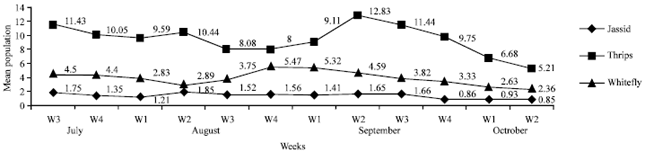 | |
| Fig. 1: | Mean population of jassid, thrips and whitefly at various weeks of observation on cotton |
In general, the population of jassid was recorded to be above the economic threshold level throughout the crop season up to third week of September. Figure 1 shows that there were three peaks during the season 1st peak was recorded during 3rd week of July. The population decreased thereafter and reached down to 1.21 per leaf during 1st week of August. A tremendous increase was observed on the subsequent date that 1.84 per leaf during second week of August. This was the highest peak of the season. The jassid population fluctuated on the later dates of observations with a third peak of 1.66 per leaf during third week of September.
Plant spacing effect on jassid population: Plant spacing showed a significant effect on the jassid population (Fig. 2). It is clear from the results that maximum population of jassid was recorded to be 1.66 per leaf from those plots where minimum plant spacing (12.5 cm) was maintained. The population of jassid was decreased as the plant to plant distance was increased. The population of jassid decreased significantly i.e., 0.96 per leaf where 38 cm plant to plant distance was maintained. The population of jassid did not show significant difference where plant spacing was maintained as 18.5, 23.5 and 30 cm with 1.39, 1.50 and 1.39 jassid per leaf, respectively.
Thrips population
Period of abundance of thrips population: The observation regarding thrips population (Fig. 1), recorded on 3rd week of July showed a peak with 11.43 per leaf. Thrips population was declined thereafter on the 4th week of July and 1st week of August with gradual decline of 10.05 and 9.59 per leaf, respectively. The population of thrips again increased for 2nd peak i.e., 10.44 per leaf on 2nd week of August. A declining trend was again observed thereafter on the subsequent weeks. This population reduced to 9.11 per leaf on 1st week of September. The highest peak was observed thereafter with 12.83 thrips per leaf on 2nd week of September. A decreasing trend was observed thereafter on the subsequent dates of observation. This population declined to a level of 5.21 per leaf on 2nd week of October.
Plant spacing effect on thrips population: Figure 2 revealed that less spacing of plants showed significantly high population of thrips i.e., 10.00 per leaf which did not differ from 10.069 thrips per leaf in those plots where plant spacing of 23.5 cm was maintained. The later figure showed higher plant spacing and higher population of thrips which showed uncontrolled variations in recording data. However, in other plant spacing treatments the trend in population fluctuation showed indirect correlation.
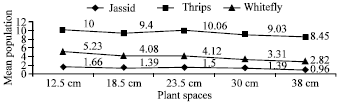 | |
| Fig. 2: | Mean population of jassid, thrips and whitefly at various plant spacing in cotton |
| Table 1: | Effect of abiotic factors on the population of jassid, thrips and whitefly of cotton |
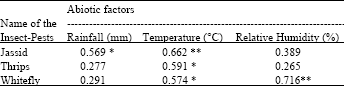 | |
| *** Significant at p≥0.05, ** Significant at p≥0.01 | |
More plant spacing i.e., 38.5 cm showed less population of thrips i.e., 8.44 per leaf. The plant spacing treatments viz., 18.5 and 30.00 cm showed non-significant difference having 9.40 and 9.03 per leaf thrips population, respectively.
Role of abiotic factors in population fluctuation of sucking insect pests
Simple correlation: The results regarding the correlation between abiotic factors and population of jassid, thrips and whitefly are given in Table 1. The results revealed that rainfall and temperature showed significant and positive correlation with the jassid population whereas, relative humidity showed non-significant effect. The effect of temperature was also significant and positive on the thrips and whitefly population. Relative humidity and rainfall did not show significant effect on thrips population, whereas, significant and positive correlation was found to exist in between relative humidity and whitefly population. Rainfall did not have significant correlation with whitefly population.
Multivariate regression models
Multiple effect of abiotic factors on jassid population: The results regarding multiple effect of abiotic factors on the jassid population are given in Table 2 (A1). It is evident from the results that rainfall exerted 32.4% effect on the population fluctuation of jassid. The effect was increased up to 48.4%. The role of abiotic factors was further increased and reached up to 53.00% when the effect of relative humidity was added to the above factors.
Multiple effect of abiotic factors on the thrips population: The results regarding multiple effect of abiotic factors on the thrips population are given in Table 2 (A2).
| Table 2: | Multiple linear regression models alongwith coefficient of determination between jassid (A1), thrips (A2) and whitefly (A3) population per leaf and abiotic factor |
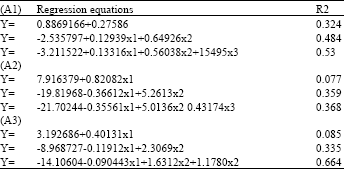 | |
It is evident from the results that rainfall showed 7.7% role in population fluctuation of thrips while with the addition of influence of temperature, the effect was increased and reached up to 36.8%.
Multiple Effect of Abiotic Factors on the Whitefly Population: The results regarding multiple effect of abiotic factors on population fluctuation of whitefly are given in Table 2 (A3). The results revealed that rainfall showed 8.5% influence in population fluctuation of whitefly. This influence was increased and reached up to 33.5% when the influence of temperature was added. Rainfall, temperature and relative humidity showed 66.4% influence on the population fluctuation of whitefly when the data of all the above three factors were computed together.
DISCUSSION
Effect of plant spacing on jassid population: The present findings are in conformity with those of Butter et al. (1992), Mohite and Uthamasamy (1997) who also reported that the population of jassid was higher at lower plant spacing. Furthermore, the present findings are not in agreement with those of Sohi et al. (1995) who reported that incidence of jassid was less significant with different spacing. The present findings are not in agreement with those of Joginder et al. (1998) and Gogoi et al. (2000) who reported different periods of peak population of jassid as those of observed in the present study. This variation was due to different ecological condition and study period.
Effect of plant spacing on thrips population: The present findings are not in agreement with those of Al-Faisal and Kardu (1986) who reported two population peaks, one in early May and one in end of June or early July.
Effect of plant spacing on whitefly population: The present findings are in conformity with those of Seif (1980), Isler and Ozgur (1992), Majeed et al. (1995), Sohi et al. (1995) and Mohite and Uthamasamy (1997). Furthermore, the results are not in conformity with those of Enkegaard (1993), Jagdev and Butter (1988), Khan and Ullah (1994) Wagner (1995) Wagner and Willers (1995), due to differences in their materials and methods.
Role of abiotic factors on the population fluctuation of sucking insect pests of cotton: The present findings are in partial agreement with those of Bishnol et al. (1996) who reported that mean air temperature and relative humidity showed significant relationship with jassid population. Similarly Ei-Mezayyen et al. (1997) found that temperature and relative humidity greatly effected the population of insect pest. Gogoi et al. (2000) also reported that meteorological parameters played a important role in the population build up of cotton jassid. In the present study temperature played a significant correlation with positive response for population fluctuation of thrips. In case of whitefly population, temperature and relative humidity played a significant and positive contribution.
The present findings are in conformity with those of Seif (1980), Majeed et al. (1995) and Umar et al. (2003).
The present study is in partial agreement with those of Rote and Puri (1991), Gupta et al. (1998), Murugan and Uthamasamy (2001), Panickar and Patel (2001) who reported that weather factors showed a significant role in population fluctuation of insect pests.
CONCLUSIONS
The population of jassid was recorded to be maximum i.e., 1.85 per leaf during second week of August. Minimum plant spacing (12.5 cm) showed maximum jassid population (1.66 per leaf) as compared to maximum plant spacing (38 cm) with 0.96 per leaf jassid population.
| • | More plant spacing showed less population of thrips as compared to less plant spacing. |
| • | Temperature played a significant and positive role toward population fluctuation of jassid, thrips and whitefly population. |
| • | Rainfall and relative humidity showed positive and significant response towards population fluctuation of jassid and whitefly respectively. |
ACKNOWLEDGMENTS
The author pays a token of gratitude to the Chairman of the Department of Agriculture Entomology, University of Agriculture, Faisalabad, Dr. Anjum Suhail, for providing the research area and other inputs badly required for the completion of this research project.
REFERENCES
- Bishnol, O.P., M. Singh, V.U.M. Raq, R. Niwas and P.D. Sharma, 1996. Population dynamics of cotton pests in relation to weather parameters. Indian J. Entomol., 58: 103-107.
Direct Link - Enkegaard, A., 1993. The poinsettia strain of cotton whitefly (Bemisia tabaci), biological and demographic parameters on poinsettia in relation to temperature. Bull. Entomol., Res., 83: 535-546.
Direct Link - Gupta, G.P., G.K. Mahaputro, S.K. Kundu, L. Roshan and R. Lal, 1998. Impact of abiotic factors on population dynamics of cotton whitefly. Indian J. Entomol., 60: 207-296.
Direct Link - Murugan, M. and S. Uthamasamy, 2001. Dispersal behaviour of cotton whitefly Bemisia tabaci under cotton based garden land agroecosystem of Coimbatore. Madras Agric. J., 88: 1-6.
Direct Link - Umar, M.S., M.J. Arif, M.A. Murtaza, M.D. Gogi and M. Salman, 2003. Effect of abiotic factors on the population fluctuation of whitefly, Bemisia tabaci (Gen.) in nectaried and nectariless genotypes of cotton. Int. J. Agric. Biol., 5: 362-363.
Direct Link - Wagner, T.L., 1995. Temperature development, mortality and adult size of sweet potato whitefly biotype-B on cotton. Environ. Entomol., 24: 1179-1188.
Direct Link