

M.A. Adewolu
Department of Fisheries, Lagos State University, Ojo, Lagos, Nigeria
A.J. Adoti
Department of Fisheries, Lagos State University, Ojo, Lagos, Nigeria
Journal of Fisheries and Aquatic Science
Year: 2010 | Volume: 5 | Issue: 4 | Page No.: 304-310







ABSTRACT
A-56 day growth trial was conducted to investigate the effect of mixed feeding schedules with different dietary crude protein levels on growth and feed utilization of fingerlings of Clarias gariepinus. Three experimental diets of 25, 30 and 35% crude protein designated as Low Protein (LP), Medium Protein (MP) and High Protein (HP) diets, respectively were prepared using locally available feed ingredients. Four different feeding schedules of high-protein diet continuously (HP), medium-protein diet continuously (MP), low-protein diet continuously (LP) and mixed feeding of 1-day low-protein/1-day high-protein (1LP/1HP) were tested. Fingerlings of mean weight 1.24±0.11 g were stocked in 12 plastic aquaria tanks of 65 L in capacity at 10 fish tank-1. Fish were fed twice daily at 3% b.wt. day-1. Fish fed continuously on HP had significantly (p<0.05) highest growth rate and feed utilization among treatments. However, there were no significant differences (p>0.05) in the growth rates and feed utilization of fish fed 1-day low-protein/1-day high-protein (1LP/1HP) and those fed continuously on MP. Fish fed continuously on LP had the least growth and feed utilization. This study showed that feeding C. gariepinus continuously with 35% CP diet is more economical than the mixed feeding schedule with LP and HP diets.
PDF Abstract XML References Citation
How to cite this article
M.A. Adewolu and A.J. Adoti, 2010. Effect of Mixed Feeding Schedules with Varying Dietary Crude Protein Levels on the Growth and Feed Utilization of Clarias gariepinus (Burchell, 1822) Fingerlings. Journal of Fisheries and Aquatic Science, 5: 304-310.
DOI: 10.3923/jfas.2010.304.310
URL: https://scialert.net/abstract/?doi=jfas.2010.304.310
DOI: 10.3923/jfas.2010.304.310
URL: https://scialert.net/abstract/?doi=jfas.2010.304.310
INTRODUCTION
One of the major problems faced by aquaculture industry today is the high cost of fish feed and this constitutes more than 50% of the total cost of production in intensified culture systems (Ali et al., 2005). This problem has been attributed to the high cost of fish meal. One approach to reduce feed cost is by the substitution of fishmeal with alternative cheaper protein sources, however, the research findings are rarely translated into practice because of the irregular supplies of some of these ingredients, some ingredients could affect the feed plant machinery and ingredient may affect pellet stability (De Silva, 2007). This suggests that fishmeal substitution with low cost ingredient may not be easily adopted by fish feed millers. Another approach is to develop appropriate feeding management strategies to improve the utilization of feed. This approach has led to the concept of mixed feeding schedules. De Silva (2007) defined mixed feeding schedules as feeding the fish on a high protein diet alternatively with a low protein diet, over a predetermined period of time. This concept was based on the observation that the digestibility of feed varies from day to day, following an apparent cyclic pattern (Ali et al., 2005). The use of mixed feeding schedules have been proved effective as means of reducing feed cost and nitrogenous input into aquaculture systems (Nandeesha et al., 2002). In support to the effective use of mixed feeding, El-Sayed (2008) reported that mixed feeding resulted in significant improvements in protein utilization efficiency, without any significant decline in growth rate of Nile tilapia. This feeding strategy according to De Silva (2007), does not involve a third party such as a feed manufacturer and its adoption is entirely in the hands of the fish culturists, which should make it easier to be translated into practice.
Several studies have been carried out on the adoption of mixed feeding schedules with a number of fish species which include, catla, Catla catla; rohu, Labeo rohita and common carp, Cyprinus carpio (Nandeesha et al., 2002); Nile tilapia (Santiago and Laron, 2002; Patel and Yakupitiyage, 2003; Bolivar et al., 2006) and Channa striata (Arun and Yakupitiyage, 2003). To date, there have been no reports on the adoption of mixed feeding schedules on the semi intensive culture of Clarias gariepinus, a widely cultured fish species in Africa. Hence, the objective of present study was to determine if the adoption of mixed feeding schedules would improve the growth performance and the feed utilization of Clarias gariepinus fingerlings with a view to minimize feed cost.
MATERIALS AND METHODS
Formulation and Preparation of Experimental Diets
Diets formulated were low protein (25%), medium protein (30%) and high protein (35%) and the formulation is shown in Table 1. Feed ingredients used for the preparation of the diets were purchased from a reputable commercial feed mill (Act Feed Mill, Agbara-Lagos) where the feed ingredients were ground in a hammer mill, mixed by a mixer and steam pelleted before the feeds were sun dried and packaged.
Experimental Set-Up
The experiment was carried out in Lagos State University Hatchery, Ojo, Lagos Nigeria, between the periods of April to June 2009. Twelve plastic aquaria tanks of black colour were used for the experiment; each having a 65 L capacity and depth of 52 cm. An electric aquarium aerator (Shining Beach model; horse power 50 Hz) was used to aerate water in the tanks through air stones.
| Table 1: | Percentage composition of experimental diets |
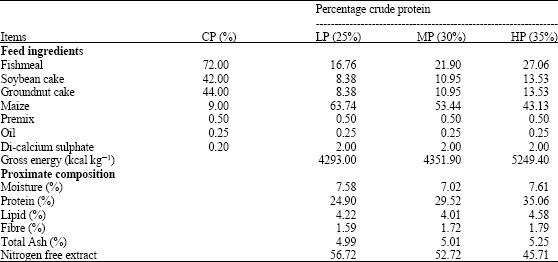 | |
LP, MP and HP are low protein (25%), medium protein (30%), high protein (35%). Gross energy = Caloric value of protein 5.65, NFE 4.1 and lipid 9.45 kcal kg-1 (Brett, 1973) | |
The experimental tanks were covered with mosquito nets to prevent fingerlings from jumping out of water.
Collection and Acclimatization of Experimental Fish
Clarias gariepinus fingerlings of mean weight 1.24±0.11 g were collected from Sej Farms, Badagry, Lagos, Nigeria and were transported by means of black bowl half filled with water. On getting to Lagos State University Hatchery, where the experiment was carried out, fish were sorted into uniform size range and were allotted randomly into 12 plastic aquaria tanks of 65 L in capacity and 52 cm depth at a rate of 10 fish per bowl. The fish were allowed to acclimate for seven days during this period they were fed on commercial diet (Copens). At the end of the acclimatization period, fish were starved for 24 h prior the commencement of the experiment to enable the fish empties their guts.
Feeding Trial
Fingerlings were fed twice daily at the rate of 3% of their body weight on daily basis with three experimental diets for 56 days. There were four treatments in triplicate. The triplicate of each treatment was fed low protein (25%, LP), medium protein (30%, MP), high protein (35%, HP) and mixed feeding schedule of one-day low-protein/one-day high-protein (1LP/1HP). Although the medium protein diet was not used in the mixed feeding schedule, it was used in this trial to compare its results on growth and feed utilization of the fingerling with the mixed feeding schedules. The fish were collectively weighed per tank at the commencement of the experiment and mean weight was calculated and recorded. Fish were reweighed biweekly and feed weights were adjusted accordingly.
Water Maintenance and Quality
The source of the water used for the experiment was from a bore hole. The water in the experimental tanks was aerated by an electric air pump (Shining model; horsepower 50 Hz). On daily basis, 50% of the water in each bowl was gently exchanged for fresh water every morning and 10% of the water was siphoned every evening. This was done to get rid of left over feed and fecal matter. Water temperature was taken by mercury-in-glass thermometer and pH by a pH meter (Jenway model 9060). Dissolved oxygen and ammonia concentration were determined according to the method of APHA (1985).
The water temperature varied between 26-28°C, pH ranged from 6.8 to 7.5, dissolved oxygen levels varied from 4.0-5.5 mg L-1, while ammonia concentration in water was between 0.03-0.05 mg L-1 throughout the experimental period.
Chemical Evaluation of Experimental Fish
Samples of the experimental fish at start and end of the experiment and the experimental diets were analyzed for their proximate composition, according to the methods of AOAC (1995). Moisture was obtained by drying the sample at 105°C in an oven until constant weight was obtained. Crude protein was determined by using the microkjeldah digestion method (N x 6.25). Crude lipid by soxhlet-extraction method. Ash content by combustion in muffle furnance to constant weight at 600°C. Crude fiber was done by using the acid/base digestion process. Nitrogen free extract was calculated by taking the sum values for crude protein, crude lipid, crude fiber, total ash and moisture and subtracting these from 100.
Evaluation of Growth and Feed Utilization Parameters
The weight gained by fish was calculated as: Final Mean Weight of fish-Initial Mean Weight of fish. The percentage weight gain was calculated from the formula:
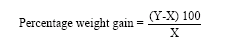 |
Where:
| Y | = | Final mean body weight (g) |
| X | = | Initial mean body weight (g) |
Specific Growth Rate (SGR) was calculated as:
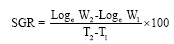 |
Where:
| W2 | = | Weight of fish at time T2 in days |
| W1 | = | Weight of fish at time T1 in days |
| Loge | = | Natural log of base e |
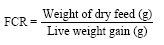
The Food Conversion Ratio (FCR) is expressed as the proportion of dry food fed per unit live weight gain of fish calculated as:
 |
Feed intake was calculated as:
 |
The protein intake was calculated according to the formula:
 |
Protein efficiency ratio was calculated as:
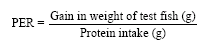 |
Gross Energy was calculated according to the caloric value of protein 5.65, NFE 4.1 and lipid 9.45 kcal kg-1 (Brett, 1973).
All growth data were subjected to one-way Analysis of Variance (ANOVA). The significance of difference between means was determined by Duncan’s multiple range test (p = 0.05) using SPSS for Windows (Version 11). Values are expressed as Means±SD.
RESULTS
The results of growth and feed utilization of Clarias gariepinus fingerlings fed continuously with High Protein (HP), Medium Protein (MP), Low Protein (LP) and alternate mixed protein diets (1LP/1HP) are presented in Table 2. Fish fed high-protein diet continuously performed significantly better than other diets (p<0.05), while those on low-protein diet continuously showed poorest growth.
| Table 2: | Growth and feed utilization of Clarias gariepinus fingerlings fed with experimental diets |
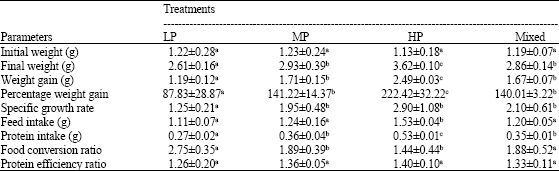 | |
LP, MP, HP and mixed are low protein (25%), medium protein (30%), high protein (35%) and mixed feeding (25% and 35% alternate), respectively. Values in the same row having different superscripts are significantly different (p<0.05) | |
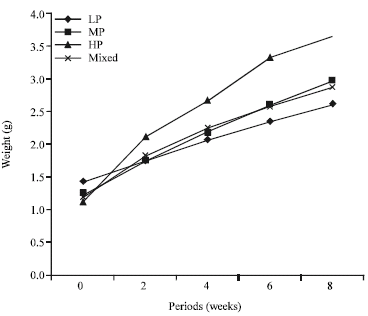 | |
| Fig. 1: | Weight changes of fingerlings of Clarias gariepinus fed with different feeding schedules. LP, MP, HP and mixed are low protein (25%), medium protein (30%), high protein (35%) and mixed feeding (25 and 35% alternate), respectively |
The SGR (2.90±1.08) of fish fed continuously with a high-protein diet was significantly higher (p<0.05) than other treatments. The FCR also followed the same trend among the treatments. Fish fed continuously with low-protein diet had lowest PER (1.26±0.20) than other treatments. There were no significant differences in the results of growth and feed utilization of fish fed with medium-protein diet and those with mixed feeding (1LP/1HP).
The biweekly weight changes of fish fed on different feeding schedules are graphically shown in Fig. 1. Fish fed with HP had the best growth followed by mixed feeding and MP and the least with LP.
The results of the proximate composition of fish fed on various feeding schedules are shown in Table 3. Fish fed continuously with LP had the lowest percentage body fat (4%) while fish fed with HP had the highest fat deposition of 4.8%. The final body protein was not affected by the different treatments.
| Table 3: | Proximate composition of fish carcass (%) |
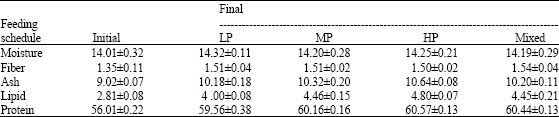 | |
LP, MP, HP and mixed are low protein (25%), medium protein (30%), high protein (35%) and mixed feeding (25% and 35% alternate), respectively | |
DISCUSSION
The results of the current study demonstrated that fish fed continuously on a high protein diet grew significantly better than those fed on mixed feeding of one-day low-protein/one-day high-protein diets. Fish fed continuously on low-protein diet had the least growth rate. This trend is consistent with other growth and feed utilization parameters. This finding is similar with the work of Sevgili et al. (2006), who reported that rainbow trout, Oncorhynchus mykiss fed on a high protein diet significantly grew better than those on various mixed feeding schedules. The result is also in line with the work of Hashim (1994) who found that best growth performance was observed in Channa striata fry maintained at 35% crude protein diet. Fingerlings fed on alternating protein levels did not improve growth rate. This work was, however, in contradiction with the work of Nandeesha et al. (2002) in Cyprinus carpio; Arun and Yakupitiyage (2003) in Oreochromis niloticus and Ali et al. (2005) in Pangasius hypophthalmichthys. These workers observed that mixed feeding schedule of low protein diet alternated with high protein diet resulted in best growth or similar growth with those fed continuously on high protein diet.
The results of the present finding did not support the hypothesis of De Silva and Perera (1983, 1984) that, when fish are provided a high protein throughout the rearing period, feed utilization efficiency could be reduced with time. This hypothesis was first tested with Nile tilapia, Oreochromis niloticus and in Asian Cichlid, Etroplus suratensis. De Silva (2001) suggested that alternating high protein diet with low protein diet could be a possible solution to reducing feed and production costs. In the present investigation, C. gariepinus fingerlings (1.14 g) might not exhibit daily variation during the course of this work, thus did not support the hypothesis of mixed feeding schedule. However, a number of experimental works had been conducted on the adoption of mixed feeding schedule with a number of fish species, some of these have been summarized by El-Sayed (2008). The conflicting report of the present study with some earlier and recent workers might be due to the different quality of the diets used, different experimental conditions and differences in the physiological state of the different fish species.
On the basis of the results of this study, it may be necessary to feed C. gariepinus fingerlings continuously on high protein diet in order to maintain maximum growth and feed utilization. There is, however, the need to intensify research into using a number of mixed feeding schedule with alternating protein levels rather than the one used in the present investigation.
In conclusion, Clarias gariepinus fingerlings performed best in terms of growth and nutrient utilization when fed continuously on high protein diet. The concept of mixed feeding on alternating low protein with high protein diet may not be an economical feeding strategy for C. gariepinus fingerlings.
REFERENCES
- Ali, Z., A. Hossain and A. Mazid, 2005. Effect of mixed feeding schedules with varying dietary protein levels on the growth of sutchi catfish, Pangasius hypophthalmus (Sauvage) with silver carp, Hypophthalmichthys molitrix (Valenciennes) in ponds. Aquacult. Res., 36: 627-634.
CrossRefDirect Link - Arun, B.P. and A. Yakupitiyage, 2003. Mixed feeding schedules in semi-intensive pond culture of Nile tilapia, Oreochromis niloticus, L.: Is it necessary to have two diets of differing protein contents? Aquacult. Res., 34: 1343-1352.
CrossRefDirect Link - Bolivar, R.B., E.B.T. Jimenez and C.L. Brown, 2006. Alternate-day feeding strategy for Nile tilapia grow-out in the Philippines: Marginal cost revenue analysis. N. Am. J. Aquac., 68: 192-197.
CrossRefDirect Link - Brett, J.R., 1973. Energy expenditure of Sockeye salmon Oncorhynchus nerka, during sustained performance. J. Fish. Res. Board Can., 30: 1799-1809.
CrossRefDirect Link - De Silva, S.S. and M.K. Perera, 1983. Digestibility of aquatic macrophyte by cichlid Etroplus suratensis with observations on the relative merits of three indigenous components as markers and daily changes in protein digestibility. J. Fish Biol., 23: 675-684.
CrossRefDirect Link - De Silva, S.S. and M.K. Perera, 1984. Digestibility in Sarotherodon niloticus fry: Effects of dietary protein level and salinity with further observation on variability in digestibility. Aquaculture, 38: 293-306.
Direct Link - De Silva, S.S., 2007. Reducing feed costs in aquaculture: Is the use of mixed feeding schedules the answer for semi-intensive practices?. Int. Aqua. Feed, 10: 18-22.
Direct Link - Nandeesha, M.C., B. Gangadhara and J.K. Manissery, 2002. Further studies on the use of mixed feeding schedules with plant and animal-based diets for common carp Cyprinus carpio (Linnaeus). Aquac. Res., 33: 1157-1162.
CrossRefDirect Link - Santiago, C.B. and M.A. Laron, 2002. Growth and fry production of Nile tilapia, Oreochromis niloticus (L.) on different feeding schedules. Aquac. Res., 33: 129-136.
CrossRefDirect Link - Sevgili, H., Y. Emre, M. Kanyilmaz, I. Diler and B. Hossu, 2006. Effects of mixed feeding schedules on growth performance, body composition, and nitrogen- and phosphorus balance in rainbow trout, Oncorhynchus mykiss. Acta Ichthyologica et Piscatoria, 36: 49-55.
Direct Link - Arun, B.P. and A. Yakupitiyage, 2003. Mixed feeding schedules in semi-intensive pond culture of Nile tilapia, Oreochromis niloticus, L.: Is it necessary to have two diets of differing protein contents? Aquacult. Res., 34: 1343-1352.
CrossRefDirect Link