

R. Kumar
Central Tasar Research and Training Institute, Central Silk Board, Government of India, Piskanagri PO, RANCHI-835 303, Jharkhand, India
R.M. Reddy
Central Tasar Research and Training Institute, Central Silk Board, Government of India, Piskanagri PO, RANCHI-835 303, Jharkhand, India
P.S. Sinha
Central Tasar Research and Training Institute, Central Silk Board, Government of India, Piskanagri PO, RANCHI-835 303, Jharkhand, India
J. Tirkey
Central Tasar Research and Training Institute, Central Silk Board, Government of India, Piskanagri PO, RANCHI-835 303, Jharkhand, India
M.K. Singh
Central Tasar Research and Training Institute, Central Silk Board, Government of India, Piskanagri PO, RANCHI-835 303, Jharkhand, India
B.C. Prasad
Central Tasar Research and Training Institute, Central Silk Board, Government of India, Piskanagri PO, RANCHI-835 303, Jharkhand, India
Journal of Entomology
Year: 2010 | Volume: 7 | Issue: 4 | Page No.: 219-226







ABSTRACT
The continuous exploitation of tropical tasar food-plant, Terminalia tomentosa (W and A) rose on wastelands under the rain-fed conditions by rearing its economic insect pest; Antheraea mylitta (D) needs soil management for sustainable yields. To asses the feasibility, legumes like Sun hemp (Crotalaria juncea), Daincha (Sesbania aculeata), Green gram (Vigna radiatus) and Black gram (Vigna mungo) were raised during monsoon (June) season in the inter space of T. tomentosa economic plantation for biomulching. The Sun hemp has yielded highest biomass of 39.0 q ha -1, followed by Daincha, Green gram and Black gram with 26.6, 25.3 and 17.7 q ha -1, respectively after 45 to 50 days of sowing, has been mulched for soil fortification. The water holding capacity, electrical conductivity and organic carbon have been improved with reduced pore space and bulk density of the soil and enhanced leaf yield of tasar food-plant after legume biomulching. The superior Effective Rate of Rearing (ERR), higher cocoon and shell weights, better silk ratio and longer silk filament length of tasar silkworm in biomulch treatments have contributed to increase silk yield. Among the biomulches, Sun hemp has shown improved water holding capacity (56.9%) and moisture (68.5 and 37.9%) at 30 and 45 cm depth with electrical conductivity (0.30 mhos cm -1), bulk density (1.12 g cm -3), pore space (50.4%), organic carbon (0.61%) of soil, leaf yield (24.8 MT ha -1) of food plant and ERR (80.1%), cocoon weight (12.25 g), shell weight (1.90 g), silk ratio (14.03%) and silk filament length (724 m) specify its suitability in making tropical tasarculture sustainable under rain-fed conditions.
PDF Abstract XML References Citation
How to cite this article
R. Kumar, R.M. Reddy, P.S. Sinha, J. Tirkey, M.K. Singh and B.C. Prasad, 2010. Impact of Leguminous Biomulching on Soil Properties, Leaf Yield and Cocoon Productivity of Tropical Tasarculture under Rain-Fed Conditions. Journal of Entomology, 7: 219-226.
DOI: 10.3923/je.2010.219.226
URL: https://scialert.net/abstract/?doi=je.2010.219.226
DOI: 10.3923/je.2010.219.226
URL: https://scialert.net/abstract/?doi=je.2010.219.226
INTRODUCTION
The naturally grown and agronomically maintained (economic plantation) tropical tasar food plants, Terminalia tomentosa and Terminalia arjuna are mostly available in wasteland and degraded soils under the rain-fed conditions (Suryanarayana et al., 2005). The soil available under tasar food plants is primarily deficient in organic matter, nitrogen, phosphorous, potash and micronutrients. The constant exploitation of these food plants for rearing tasar silkworm, Antheraea mylitta and soil erosion due to sloppy fields, the land is getting further depleted in nutrients day by day affecting the leaf and cocoon yields.
However, the maintenance of soil health to retain the leaf productivity and quality needs an alternative approach to make tropical sericulture sustainable (Sinha et al., 2000; Reddy et al., 2001; Shashidhar et al., 2009), besides controlling the weed growth (Teasdale and Mohler, 2005) and soil erosion (Chaplot et al., 2009). In dry areas with inadequate precipitation, annual legumes grown for 6-7 weeks are incorporated before full bloom not to deplete soil moisture reserves for the subsequent crop (Mohankumar and Sadanandan, 1988). Current day’s inadequacy of bulk organic manure availability can be solved with the leguminous green mulching as they can be grown within short time, even under low soil moisture and fertility (Leihner et al., 1996; Tarfia et al., 2006; Malecka and Blecharczyk, 2008) and several legume crops like Sun hemp, Daincha, Berseem and even pulses like Black gram, Green gram, Guar, Labia and Moth bean are recommended for such green manuring (Becker et al., 1995; Chakravarti et al., 2005; Muhammad et al., 2007; Sultani et al., 2007; Rafael et al., 2009). Further, the application of green manure supplies nutrients easily to the soil and increases its moisture retention capacity compared to organic manure (Ossom and Matsenjwa, 2007; Kone et al., 2008; Pervaiz et al., 2009). The legumes can generate considerable quantity of organic matter (up to 80.0 q ha-1) possessing about 40 kg of nitrogen ha-1, of which about 2/3 is being fixed from atmosphere by the bacteria (Choudhury et al., 1990; Drinkwater et al., 1998; Duda et al., 2003). Hence, an attempt has been made to utilize the interspace available in between the tasar host plant economic plantation for raising legume crops and mulching their green biomass into the soil and to study its impact on soil properties, leaf yield of host plant (T. tomentosa) and cocoon productivity of tropical tasar silkworm (A. mylitta).
MATERIALS AND METHODS
The present investigation was conducted during the rainy seasons (June to September) of 2003 to 2005 using tasar food plant economic plantation maintained by the agronomy section of Central Tasar Research and Training Institute, Ranchi, India to evaluate the potential of various leguminous mulches on soil fertility status, leaf yield and bioassay test under rain-fed conditions. The experiment was laid out in a randomized block design with four replications and five treatments with legumes viz., Green gram (Vigna radiatus), Black gram (Vigna mungo), Sun hemp (Crotalaria juncea) and Daincha (Sesbania aculeata) including the control i.e., without legume mulching for comparison. The other agronomical practices were carried out uniformly for all the treatments. The legume crops were sown in between the rows of T. tomentosa plantation during first week of June of the respective year with onset of monsoon rains. The raised legume inter-crops were allowed to grow till it reaches flowering stage for optimal generation of green biomass up to 45 to 50 days. The leguminous green manuring crops were cut to ground level, weighed and were mulched at 60 to 75 cm depth in to the trenches of the field made in between the rows of T. tomentosa plants. The season was very ideal for mulching with good soil moisture and continued rains in the area till end of September of every year. The samples of soil before initiation of the experiment as well as each year there on during the investigations were taken to analyze its physical and chemical properties in addition to moisture levels at 30 and 45 cm depth. The observations on yield of biomass of different legumes upon their harvest during July, leaf yield of T. tomentosa and bioassay test as rearing performance of tasar silkworm, A. mylitta (Narain et al., 2004) for ERR, single cocoon and shell weights, silk ratio and silk filament length during commercial crop season (September-December) for three years have been recorded and the data were subjected to statistical analysis.
RESULTS
Biomass of Legumes, Water Holding of Soil and Leaf Yield of Tasar Food-Plant
The data presented in Table 1 indicates the biomass production of different legumes, the water holding capacity and average soil moisture at 30 and 45 cm depth, leaf yield of tasar food-plant T. tomentosa in control and different biomulch applications. Among the four legumes studied, the Sun hemp has recorded highest average production of 39 quintals of biomass per hectare, while Daincha, Green gram and Black gram have recorded 26.6, 25.3 and 17.7 quintals of biomass per hectare. The Water Holding Capacity (WHC) and soil moisture percentage were also recorded maximum in Sun hemp treatment among the biomulch treatments. The Sun hemp treatment has recorded 56.4% WHC with an increase of 5.2% over control, while the soil moisture percentage of 68.5 and 37.9 with an increase of 22.9 and 20.3% at 30 and 45 cm depth, respectively. However, the WHC of Daincha, Green gram and Black gram treatments was lesser than Sun hemp, though they are better over control. The soil moisture has shown same trend in respect of Daincha, Green gram and Black gram treatments with an increase over the control but less than Sun hemp. The leaf yield of tasar food-plant was 24.8 MTs per hectare in Sun hemp treatment was highest among all the treatments with an increase of 34.0% over the control. The leaf yield of 23.0, 22.6 and 21.6 MTs was recorded in Daincha, Black gram and Green gram treatments were better over the control but lesser than Sun hemp.
Physical and Chemical Properties of Soil on Biomulching
The data presented in Table 2 indicates the soil physical and chemical characters like pH, Electrical Conductivity (EC), Bulk Density (BD), Pore Space (PS) and Organic Carbon (OC) in the control and biomulch treatments. Though, the pH got tilted slightly towards acidic side in biomulch treatments over the control but was not significant. The electrical conductivity was increased in all the biomulch treatments with highest of 42.8% in Sun hemp followed by Daincha and Black gram treatments with 9.5 and 4.8% over the control, while it remained unchanged in Black gram. The bulk density of the soils was reduced in the biomulch treatments over the control with highest of 14.5% in Sun hemp followed by Daincha, Green gram and Black gram respectively over the control.
| Table 1: | Particulars of biomass production of different legumes and their mulching impact on moisture content of soil and leaf yield of tasar food-plant, T. tomentosa |
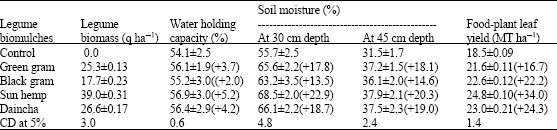 | |
Values are Mean±SE. Values in brackets i.e., + or – are the % change over control | |
| Table 2: | Impact of leguminous biomulching on the properties of soil |
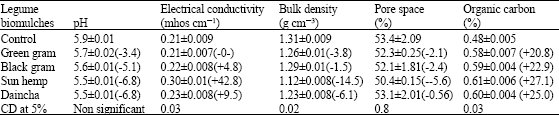 | |
Values are Mean±SE. Values in brackets i.e., + and – are the % change over control | |
| Table 3: | Impact of leguminous biomulching on the cocoon productivity of A. mylitta |
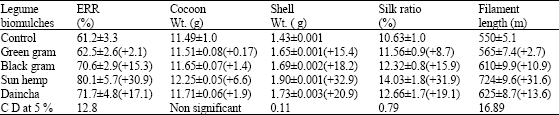 | |
Values are Mean±SE. Values in brackets i.e., + or – are the % change over control | |
The pore space recorded decrease in all the biomulch treatments with highest of 5.6% in Sun hemp followed by Black gram, Green gram and Daincha treatments, respectively over the control. Though, the organic carbon has been increased in all biomulch treatments over the control, with highest of 27.1% in Sun hemp followed by Daincha, Black gram and Green gram.
Bio assay Studies Applying Tasar Insect, Antheraea mylitta
The data presented in Table 3 indicates the bioassay studies of tasar silkworm, A. mylitta like Effective Rate of Rearing (ERR), single cocoon weight, single shell weight, silk ratio percentage and silk filament length among different treatments and control. The highest ERR of 80.1% with an increase of 30.9% over the control was recorded in Sun hemp treatment, while it was less in other leguminous biomulches. However, the change in average single cocoon weight was non significant in spite of improvement in biomulch treatments over the control with highest of 12.25 g weight and increase of 6.6% in Sun hemp treatment. The increase in average shell weight was significant with highest of 1.90 g with 32.9% increase over the control in Sun hemp followed by Daincha, Black gram and Green gram treatments, respectively. The trends of silk ratio and silk filament length are similar like shell weights with highest silk ratio of 14.03% and 724 m of silk filament in Sun hemp treatment with an increase of 31.9 and 31.6%, respectively over the control. Though, the silk ratio and silk filament length are better in Daincha, Black gram and Green gram treatments over control, they were inferior to Sun hemp.
DISCUSSION
The growing and incorporation of legume crops are recommended as green manure in rain-fed areas to sustain soil moisture reserves for subsequent crops (Becker et al., 1995; Chakravarti et al., 2005; Rafael et al., 2009), as they can be grown within the short time (Tarfia et al., 2006; Malecka and Blecharczyk, 2008). The tropical tasarculture being the seasonal rearing of tasar silk insect, the cultural practices of its economic food-plantation needs to be attended suitably. The time available to grow and mulch legumes in the inter-space of food-plants is limited and hence the selection of legume variety play a key role in generating maximum biomass and to enhance the soil fertility levels optimally. The better biomass production by Sun hemp (39.0 q ha-1), which is about 2 to 3 fold better production than Daincha (26.6 q ha-1), Green gram (25.3 q ha-1) and Black gram (17.7 q ha-1) legumes raised parallel under similar conditions suggests its suitability as biomulch for rain-fed tasar food-plant economic plantation.
The soil is an important resource and habitat for plant growth and it bears physical, chemical and biological properties influencing the crop productivity, quality and returns. Further, the soil being a storehouse of water for land plants, it influences the rate of evaporation, infiltration and drainage of water, diffusion of gases, conduction of heat and movement of salts and nutrients. The optimal application of agricultural inputs such as seed, irrigation and fertilizer over a given field can not yield uniformly and the soil texture, organic matter, salinity, subsoil characteristics and water holding capacity are the factors that can cause changes in yield. The growing of leguminous inter-crop helps to intercept and break the impact of rain drops preventing from surface sealing which facilitates better water infiltration (Mohankumar and Sadanandan, 1998) resulting to higher soil moisture content (Duda et al., 2003; Muhammad et al., 2007). The physical capacities of soil are influenced by the size, proportion and arrangement on mineral composition of the soil particles (Salako et al., 2006). The soil Electrical Conductivity (EC) is a measure of how easily an electric current flow through the soil and it responds to the amount of salt in the soil as well as sand, clay, organic matter and water content (Corwin and Lesch, 2003; Jung et al., 2005). The improved EC with legume biomulching in general and with highest of 42.8% in Sun hemp mulching indicate its role in enhancing the soil fertility with higher organic matter. This confirmed the suitability of Sun hemp mulching in attaining the optimal growth of tasar food-plant with higher leaf productivity and quality over other legumes.
The decrease in bulk density of soil is another desirable feature as it is an indication of greater pore space within the soil mass. The increase in soil porosity would be advantageous in the sense, that it would permit more of aeration, percolation and storage capacity of water. The soil bulk density being the ratio of mass of dry solids to bulk volume of the soil occupied by those dry solids and it changes for a given soil with structural condition, mineral make up and the degree of compaction. The bulk density of quartz is around 2.65 g cm¯3 and the soils high in clay matter with organics is below 1 g cm¯3 indicates the correlation of bulk density of soil with its physical condition, texture and structure (Assouline, 2006). Though, the bulk density of soil got reduced on biomulching and the least being with Sun hemp (1.12 g cm-3), which is nearer to clay and far away from quartz and with significant decrease of 14.5% over the control indicates its advantage and better impact among the studied leguminous mulches. Similarly, the empty space between the soil particles occupied by air and water is termed as pore space, which is more in sandy soils over clayey soils allowing water to percolate down so rapidly makes crops suffer due to lesser soil moisture. The reduction of pore space can be maintained by appropriate cultivation and mulching of legume biomass as organic matter and makes the crop neither suffers from shortage or excess of water (Seneviratne et al., 2009). The reduction in soil pore spacing on biomulching and better with Sun hemp mulch over other legumes is an added advantage to enhance soil properties and to support the productivity of tasar food-plant by providing required water and essential soil nutrients for longer duration under rain-fed conditions.
The organic matter accumulation in the soil is a result of balance between the loss by decomposition processes and the gain from synthesis of humus from crop residues. The soils contain carbon (C) in both organic and inorganic forms and most soils held C as Organic Carbon (OC) and the term organic carbon refers to the C occurring in the soil in Soil Organic Matter (SOM). The term soil organic matter is used to describe the organic constituents available in the soil such as tissues from dead plants and animals, the products produced on their decomposition and the soil microbial population (Amelung et al., 2002). The incorporation of Sun hemp biomass has improved the organic carbon content of soil better over the control, but the improvement was marginal over Daincha, Green gram and Black gram. Further, the benefit of using a legume as green manure is to fix atmospheric nitrogen and made it available as biological source of nitrogen required for the following crop (Chakravarti et al., 2005; Pervaiz et al., 2009). The amount of nitrogen fixed by a legume depends on the legume variety, the effectiveness of the legume-bacteria association in root nodules, soil fertility and climatic conditions under which the legumes grown and mulched. When, legume biomass mulching reaches the soil, its immobilization is not fast but the mineralization gradually increases depending upon temperature, oxygen supply, water content, hydrogen ion concentration, inorganic nutrients, C/N ratio of the mulched organic matter. The leguminous plant residues which have high nitrogen encourage the growth of microorganisms by supplying readily available nitrogen and hence accelerate the decomposition and soil nutrition. The biomulching of legumes in rain-fed tasar food-plant field can have such impact of enhancing the soil fertility with better organic constituents and microbial population to augment the leaf yield and quality of tasar food-plant.
Though, the application of required organic manure play a vital role in conservation of soil nutrient status, water retention capacity and building up the micro-flora population, the tentative returns in rain-fed tropical tasarculture can not afford such practices. The green manuring in mulberry and tasar food-plant has reported to enhance soil fertility and leaf yield and quality (Sinha et al., 2000; Reddy et al., 2001; Shashidhar et al., 2009), while the mulching of Sun hemp has shown better mulberry leaf yield over Daincha and Cowpea. The green mulching can conserve the moisture, builds up organic matter and improves the properties of soil and activity of microbes supporting the mineralization rate and release of N, P and K in greater proportion (Sultani et al., 2007). The enhanced soil fertility with better moisture and organic matter under Sun hemp mulching are the contributory factors as its biomass production is higher than other legumes. This might be the reason for better leaf yield of T. tomentosa in Sun hemp mulch treatment over other legumes suggesting its application suitability for tropical tasar food-plant economic plantation under rain-fed conditions.
The economics of tropical tasarculture depends on the yields and quality of cocoons produced by its economic insect pest, A. mylitta which being grown on its food-plant, T. tomentosa during particular seasons of the year. For the sustenance of this forest and agro based industry, an optimal leaf productivity and quality is essential to grow more tasar insect larvae and harvest more cocoons with better silk yield (Sinha et al., 2000). The main commercial parameters of tasar silkworm rearing like Effective Rate of Rearing (ERR), single cocoon and shell weights, silk ratio and most importantly the silk filament length decides the crop returns (Reddy et al., 2008). Among these, the ERR play an important role as it accounts for the number of cocoons harvested irrespective of the brushed larvae (Sinha et al., 2001). The ERR is influenced by several other factors as the tropical tasarculture being an out-door practice and the manipulation of rearing environment is not under control. However, the quality feed through its food-plant can enhance the ERR with robust health and growth of tasar silkworm and better crop yields as the feed has direct impact on cocoon and shell weights, silk ratio and silk filament length. Even for other reasons, if the harvested cocoons are less in number, their healthier quantity and quality of silk can compensate the crop economics. The ERR though was better in all the biomulch treatments, the highest of 80.1% with an increase of 30.9% over the control has recorded in Sun hemp mulch treatment. In support of these results, the highest single cocoon and shell weights were recorded in Sun hemp compared to other legume mulches indicating the influence of the quantum of mulched biomass on cocoon quality via leaf quality. The other commercial factors like silk ratio and silk filament length have shown improvement in biomulch treatments with highest in Sun hemp over other legumes indicating the direct correlation among the quality of feed and silk yield. The cocoon quality of tasar insect during commercial crop season (September-December) records better as the climate being very congenial for silkworm besides the availability of quality leaf (Reddy et al., 2009). However, the improved tasar leaf productivity and silk yields upon legume biomulching over the respective controls even under rain-fed conditions indicates the application scope of green manure for tropical tasarculture. The advantage of having better ERR along with silk quantity and filament length in the Sun hemp treatment among the studied legumes indicates its better suitability for the better sustenance of tropical tasarculture under rain-fed conditions.
CONCLUSION
The incorporation of leguminous biomulches not only conserves the soil moisture and fertility status, but also controls the weed growth and soil erosion under rain-fed conditions. Among the studied legumes, Sun hemp has shown highest biomass production and its mulching has improved soil properties of tasar field, leaf yield of tasar food-plant, T. tomentosa and cocoon and silk productivity of tasar silk insect, A. mylitta to make tasarculture more sustainable.
REFERENCES
- Amelung, W., K. Kaiser, G. Kammerer and G. Sauer, 2002. carbon at soil particle surfaces-evidence from x-ray photoelectron spectroscopy and surface abrasion. Soil Sci. Socie. America J., 66: 1526-1530.
Direct Link - Assouline, S., 2006. Modeling the relationship between soil bulk density and the water retention curve. Vadose Zone J., 5: 554-563.
Direct Link - Becker, M., J.K. Ladha and M. Ali, 1995. Green manure technology: Potential, usage and limitations. A case study for lowland rice. Plant Soil, 174: 181-194.
CrossRef - Chakravarti, A.K., P.K. Chakraborty and A. Chakraborty, 2005. Study on the efficacy of some bio resources as mulch for soil moisture conservation and yield of rain fed groundnut (Arachis hypogaea). Archi. Agron. Soil Sci., 51: 247-252.
CrossRef - Chaplot, V., P. Podwojewski, K. Phachomphon and C. Valentin, 2009. Soil erosion impact on soil organic carbon spatial variability on steep tropical slopes. Soil Sci. Socie. Am. J., 73: 769-779.
CrossRef - Corwin, D.L. and S.M. Lesch, 2003. Application of soil electrical conductivity to precision agriculture: Theory, principles and guidelines. Agron. J., 95: 455-471.
Direct Link - Drinkwater, L.E., P. Wagoner and M. Sarrantonio, 1998. Legume-based cropping systems have reduced carbon and nitrogen losses. Nature, 396: 262-265.
Direct Link - Duda, G.P., J.G.M. Guerra, M.T. Monteiro, H. De-Polli and M.G. Teixeira, 2003. Perennial herbaceous legumes as live soil mulches and their effects on C, N and P of the microbial biomass. Scientia Agricola., 60: 139-147.
CrossRef - Jung, W.K., N.R. Kitchen, K.A. Sudduth, R.J. Kremer and P.P. Motavalli, 2005. Relationship of apparent soil electrical conductivity to clay pan soil properties, soil and water management and conservation. Soil Sci. Socie. Am. J., 69: 883-892.
CrossRef - Kone, A.W., J.E. Tondoh, F.B. Reversat, G.L. Merciris, D. Brunet and Y. Tano, 2008. Changes in soil biological quality under legume and maize-based farming systems in a humid savanna zone of C�te d`Ivoire. Biotechnol. Agron. Soc. Environ., 12: 147-155.
Direct Link - Leihner, D.E., M. Ruppenthal, T.H. Hilger and J.A. Castillo, 1996. Soil conservation effectiveness and crop productivity of forage legume intercropping, contour grass barriers and contour ridging in Cassava on Andean hillsides. Exp. Agric., 32: 327-338.
CrossRef - Małecka, I. and A. Blecharczyk, 2008. Effect of tillage systems, mulches and nitrogen fertilization on spring barley (Hordeum vulgare). Agron. Res., 6: 517-529.
Direct Link - Muhammad, S., R.G. Joergensen, T. Mueller and T.S. Muhammad, 2007. Priming mechanism: Soil amended with crop residue. Pak. J. Bot., 39: 1155-1160.
Direct Link - Pervaiz, M.A., M. Iqbal, K. Shahzad and A. Hassan, 2009. Effect of mulch on soil physical properties and N, P, K concentration in maize (Zea mays) shoots under two tillage systems. Int. J. Agric. Biol., 11: 119-124.
Direct Link - Rafael, M., C. Navarro, D. Ariza, L. Gonzalez, A. Campo, M. Arjona and C. Ceacero, 2009. Legume living mulch for afforestation in agricultural land in Southern Spain. Soil Tillage Res., 102: 38-44.
CrossRefDirect Link - Reddy, R.M., N. Suryanarayana, N.G. Ojha, G. Hansda, S. Rai and N.B.V. Prakash, 2009. Basic seed stock maintenance and multiplication in Indian tropical tasar silkworm Antheraea mylitta Drury: A strategic approach. Int. J. Ind. Entomol., 18: 69-75.
Direct Link - Reddy, R.M., N. Suryanarayana and N.B.V. Prakash, 2008. Heterosis potential in selective parental F1 hybrids of divergent geographic ecoraces of tropical tasar silkworm, Antheraea mylitta D (Lepidoptera: Saturniidae). Acad. J. Entomol., 1: 32-35.
Direct Link - Salako, F.K., G. Kirchhof and G. Tian, 2006. Management of a previously eroded tropical Alfisol with herbaceous legumes: Soil loss and physical properties under mound tillage. Soil Tillage Res., 89: 185-195.
CrossRef - Seneviratne, G., M. Henakaarchchi, M. Weerasekara and K. Nandasena, 2009. Soil organic carbon and nitrogen pools as influenced by polyphenols in different particle size fractions under tropical conditions. J. Nat. Sci. Found. Sri Lanka, 37: 67-70.
CrossRef - Sultani, M.I., M.A. Gill, M.M. Anwar and M. Athar, 2007. Evaluation of soil physical properties as influenced by various green manuring legumes and phosphorus fertilization under rain fed conditions. Int. J. Environ. Sci. Technol., 4: 109-118.
CrossRefDirect Link - Shashidhar, K.R., R.N. Bhaskar, P. Priyadharshini and H.L. Chandrakumar, 2009. Effect of different organic mulches on pH, organic carbon content and microbial status of soil and its influence on leaf yield of M5 mulberry (Morus indica L.) under rainfed condition. Curr. Biotica, 2: 405-413.
Direct Link