

Sayed Mehdi Dehdashti
Department of Agronomy, Islamic Azad University of Khorasgan Branch, Iran
Shahram Riahinia
Department of Agronomy, Ferdowsi University of Mashhad, Mashhad, Iran
Journal of Biological Sciences
Year: 2008 | Volume: 8 | Issue: 5 | Page No.: 908-913







ABSTRACT
We studied the effect of different row spacing and density of corn on Radiation Interception (RI), Total Day Weight (TDW), Leaf Area Index (LAI), Next Assimilation Rate (NAR), Crop Growth Rate (CGR) and grain yield. The experiment was conducted in the field at research station of Isfahan, Iran on loamy clay to compare row spacing and to determine optimum plant density for maize hybrid K704. The experimental design was a randomized complete block in a split-plot arrangement with four replicates. Plot treatments were row spacing (60, 75 and 90 cm). Split-plot treatments were within-row spacing (12, 14, 16 and 18 cm). An increase of PP from 10.5 to 13.9 plants m2 increased LAI, TDW, CGR, RI and grain yield on average by 0.205 m, 48.4 g m1, 1.14 g m2 day1, 0.89% and 222.7 kg ha1 for each 1 plant per m2 added .but decreased NAR by 0.205 g m2 day1 for each 1 plant per m2 added. Moreover, when row spacing was reduced, RI, TDW, LAI, CGR and grain yield increased. But by reducing row spacing, NAR was decreased. The results show that the row spacing 60 cm, within-row spacing 12 cm and density 11.9 plant m2 for conditions of Isfahan is suitable for maize hybrid K704.
PDF Abstract XML References Citation
How to cite this article
Sayed Mehdi Dehdashti and Shahram Riahinia, 2008. Effect of Plant Density on Some Growth Indexes, Radiation Interception and Grain Yield in Maize (Zea mays L.). Journal of Biological Sciences, 8: 908-913.
DOI: 10.3923/jbs.2008.908.913
URL: https://scialert.net/abstract/?doi=jbs.2008.908.913
DOI: 10.3923/jbs.2008.908.913
URL: https://scialert.net/abstract/?doi=jbs.2008.908.913
INTRODUCTION
Plant density and ordination cropping has been recognized as a major factor determining the degree of competition between plants. In order to obtain maximum crop growth rate and operation, plant density and ordination cropping shall be selected in a manner that maximum leaf area index during flowering to be within the limits that attract the highest rate of sun light which irradiates on canopy and also during this time the rate of producing dry material in leaf area unit to be in its maximum rate. In this state the most rate of operation will be obtained (Bavec and Bavec, 2002).
Some researchers reported grain yield increases with increase the row spacing in the same density (Porter et al., 1997; Egli, 1994), but others have not (Cox and Cherney, 2001; Cox, 1996; Blamey and Zollinger, 1997). The rate of yield decrease is in response to decreasing light and other environmental resources available to each plant (Maddonni et al., 2006). Yield per plant is also affected by soil fertility (Katsvairo et al., 2002), planting date (Cirilo and Andrade, 1994), level of water availability (Schussler and Westgate, 1995) and genotype (Hashemi-Dezfouli and Herbert, 1992; Widdicombe and Thelen, 2002).
Leaf area is influenced by genotype, Plant Population (PP) (Murphy et al., 1996), climate and soil fertility. Some experiments have shown that a LAI between 3 and 4 may be optimal for achieving maximum yield ( Lindquist et al., 1998). Also, Increase in PP and increase in row spacing at the same density reduce the leaf area index required to intercept 95% of the incident radiation due to an increase in the light extinction coefficient (Flenet et al., 1996). Crop growth rate is directly related to the amount of RI (radiation intercepted) by the crop (Jeffrey et al., 2005). Therefore, the response of grain yield to increasing PP can be analyzed in terms of the effect on the amount of RI at the critical periods for kernel set; also increasing PP may accelerate leaf senescence (Bavec and Bavec, 2002), increase the shading of leaves (Hashemi-Dezfouli and Herbert, 1992) and reduce the net assimilation of individual plants. An increase in PP of 2-13 plants m2 decreased net assimilation per plant from 0.85 to 0.11 mg CO2 m2 sec1, but increased grain yield per area (Dwyer et al., 1991). This increase in grain yield can be explained by the increase in LAI and net crop assimilation. Under high PP of 130000 plants per ha, grain yield lost due to missing plants was poorly compensated by the increased yield of surrounding plants, when two or three adjacent plants were missing, compensation for missing plants was only 16 and 34%, respectively (Pommel and Bonhomme, 1998). Nafziger (1996) found that the two plants on either side of a missing plant compensate 47% of the yield lost because of the missing plant at 44,478 plants per ha.
In Ithaca, the low PP (45,000 plants ha1) averaged 15% lower grain yields than the high PP (90,000 plants ha1). Cultivars with lowest (higher) dry matter and grain yield in low PP showed linear (quadratic) responses to increases in PP, respectively (Cox, 1996), however, early maturing cultivars showed more linear responses than late maturing cultivars (Bavec and Bavec, 2002).
The objective of this study was to obtain the best ordination cropping and plant density for obtaining maximum operation through leaf area Index which attracts the most rate of irradiated sun light on canopy and also during this time the rate of producing dry mater in leaf area unit to be in its maximum rate, in this state the most rate of operation will be obtained.
MATERIALS AND METHODS
The experiment was conducted in 2006 at research station of Isfahan (32° 30`N, 51° 49`W). Before planting 100 kg N ha1 and 50 kg P ha1 were applied. Weeds were controlled by herbicides. No problems occurred with diseases or insects. Corn hybrid SC-704, with 1000-kernel weight of 250 g, emergence rating of 87% and purity of 92% was planted 5 cm deep on 5 May 2006 in north-south rows. The experimental design was a randomized complete block in a split-plot arrangement with four replicates. Each plot was 6 m long and 10.5 m wide. Plot treatments were row spacing (60, 75 and 90 cm). Split-plot treatments were within-row spacing (12, 14, 16 and 18 cm). Population densities are reported for each row spacing and within-row spacing in Table 1.
All measurements in the field experiments were taken from the center three rows of each plot at once time in every 10 days. At Plant Growth, each plot was divided into subplots for determination of aboveground DM production and grain yield. Leaf area was estimated by passing leaves from 20% of the fresh weight of the plants through an area meter (LI-COR .Lincoln, NE, model 3000). The leaf area estimated by measuring a sub sample and the leaf areas of the whole sample were highly correlated (r2 = 0.991 slop = 0.988).
From these predicted plant growth parameters, equations provided by Hunt (1982) were used to examine plant growth rates, growth efficiencies and morphological patterns. In this paper we examine LAI (Leaf Area Index), which describes leaf surface area on a unit ground area basis; CGR (Crop Growth Rate), which describes the rate of DM (Dry Matter) accumulation on a unit ground area basis; NAR (Net Assimilation Rate), which is a measure of how efficiently the crop produces new DM with its leaf area. The following equations describe these variables:
 | (1) |
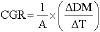 | (2) |
 | (3) |
| Where: |
| A | = | Area unit of field |
| ?T | = | Time variations as day |
Fraction of PAR intercepted above the canopy (I0) and below the canopy (It) was measured under clear skies using a luxmeter (model Lx101 Lotran) at once time in every 10 days. Five measurements were taken above the canopy and 15 below on a 1 m section of row. There were two such readings in each split plot. Light interception measurements were measured on the same section of row and on the same date as Leaf area. Radiation interception was calculated as (1 _ It/I0) _ 100, where It is incident Photosynthetically Active Radiation (PAR) just below the lowest layer of photosynthetically active leaves and I0 is incident PAR at the top of the canopy.
| Table 1: | Population density in different ordination cropping |
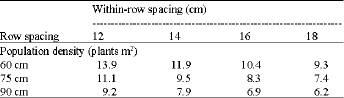 | |
Corn in grain yield subplots was harvested with a combine equipped with a weigh tank and an on-board moisture meter. For ease of comparison, both grain yields and DM are reported on a 0 g kg1 moisture concentration basis.
Differences among treatments were tested by analysis of variance and were compared using Duncan`s (1958) multiple range tests at the 0.05 Level of significance.
RESULTS AND DISCUSSION
Row spacing affected on LAI (Leaf Area Index) was more significant at the 1% probability level (Table 2).As increasing row spacing levels reduced significantly LAI (Table 3). Decreasing row spacing at equal plant densities decreases plant-to-plant competition for available water, nutrient and light and increases Radiation Interception (RI) and biomass production, therefore LAI increases too (Bullock et al., 1988; Fernando et al., 2002).
| Table 2: | ANOVA analysis Leaf Area Index (LAI), Total Dry Weight (TDW), Net Assimilation Rate (NAR), Crop Growth Rate (CGR) radiation interception increase (RI) and grain yield |
 | |
| *, **Significant at the 5 and 1% probability levels, respectively | |
| Table 3: | Means comparison row spacing and within-row spacing on Leaf Area Index (LAI), Total Dry Weight (TDW), Net Assimilation Rate (NAR), Crop Growth Rate (CGR), radiation interception (RI) increase and grain yield |
 | |
| All means followed by the same letter(s) in column are not significantly different at the 5% probability level | |
The contrast of between within-row spacing was more significant at the 1% probability level with LAI (Table 2), as highest mount of LAI was in spaces 12 and 14 cm, there were not any difference significantly between these spaces, the lowest was in space 18 cm (Table 3).
Reaction of row spacing and within-row spacing were not significant on the LAI.
An increase of PP from 6.2 to 9.5 plants m2 increased LAI on average by 0.365 m m1 for each 1 plant m2 added, but by 0.205 m m1 from 10.5 to 13.9 plants m2 (Fig. 1).
In general, increasing density in a proper amount causes to increase photosynthesis area in cultivated plant and regarding the case that LAI is the ratio of green area or photosynthesis area on the ground, as a result with increasing green area LAI is increased as well. Present results are consistent with data (Dwyer et al., 1991; Bavec and Bavec, 2002) that show that higher PP may increase maize LAI to more than 5.
Row spacing affected on TDW (Total Dry Weight) was more significant at the 1% probability level (Table 2), as increasing row spacing levels reduced significantly TDW (Table 3). Decreasing row spacing at equal plant densities produces a more equidistant plant distribution. This distribution decreases plant-to-plant competition for available water, nutrient and light and increases Radiation Interception (RI) and biomass production (Bullock et al., 1988; Fernando et al., 2002).
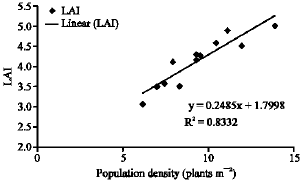 | |
| Fig. 1: | Relationship between population density (plants m2) with Leaf Area Index (LAI) |
The contrast of between within-row spacing was more significant at the 1% probability level with TDW (Table 2), as highest mount of TDW was in spaces 12 and 14 cm, there were not any difference significantly between these spaces, the lowest was in space 18 cm (Table 3).
Reaction of row spacing and within-row spacing were more significant on the TDW where as, the greatest depended on 60 cm row spacing in 12 and 14 cm space of between two plants and the lowest belonged to 90 cm row spacing in 18 cm space of between two plants (Fig. 2).
An increase of PP from 6.2 to 9.5 plants m2 increased TDW on average by 151.3 g m1 for each 1 plant m2 added, but only by 48.4 g m1 from 10.5 to 13.9 plants m2 (Fig. 3).
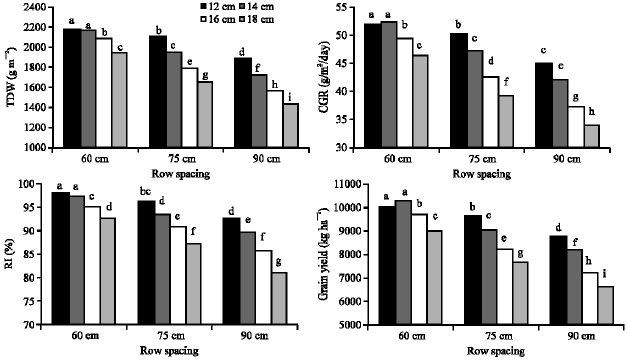 | |
| Fig. 2: | Means of comparison Total Dry Weight (TDW), Crop Growth Rate (CGR), radiation interception (RI) and grain yield on reaction of row spacing and within-row spacing |
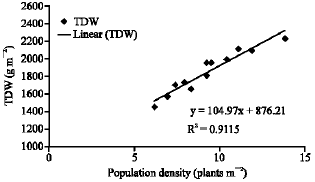 | |
| Fig. 3: | Relationship between population densities (plants m2) with Total Dry Weight (TDW) |
Row spacing affected on NAR (Net Assimilation Rate) was not significant (Table 2).
The contrast of between within-row spacing was more significant at the 1% probability level with NAR (Table 2), as highest mount of NAR was in spaces 18 and 16 cm, the lowest was in space 12 and 14 cm, there were not any difference significantly between these spaces (Table 3).
Reaction of row spacing and within-row spacing were not significant on the NAR (Table 2).
An increase of PP from 6.2 to 9.5 plants m2 decreased NAR on average by 0.118 g m2 day1 for each 1 plant per m2 added, but by 0.205 g m2 day1 from 10.5 to 13.9 plants m2 (Fig. 4).
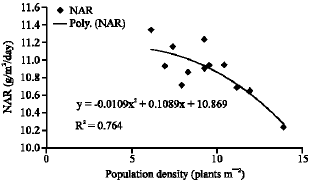 | |
| Fig. 4: | Relationship between population density (plants m2) with Net Assimilation Rate (NAR) |
NAR is mentioned as a standard for photosynthesis minus losses due to photosynthesis. Therefore increasing plant density or decreasing the distance on the cultivated row causes penetration of light to lower canopy decreases and this problem results in changing lower leaves to parasite leaves that these leaves principally have negative NAR (negative growth or weight reduction).
Row spacing affected on CGR (Crop Growth Rate) was more significant at the 1% probability level (Table 2), as increasing row spacing levels reduced significantly CGR (Table 3).
The contrast of between within-row spacing was more significant at the 1% probability level with CGR (Table 2), as highest mount of CGR was in spaces 12 and 14 cm, there were not any difference significantly between these spaces, the lowest was in space 18 cm (Table 3).
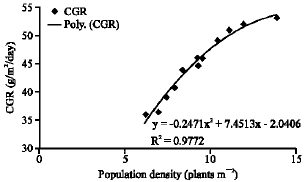 | |
| Fig. 5: | Relationship between population density (plants m2) with Crop Growth Rate (CGR) |
Reaction of row spacing and within-row spacing were more significant on the CGR where as, the greatest depended on 60 cm row spacing in 12 and 14 cm space of between two plants and the lowest belonged to 90 cm row spacing in 18 cm space of between two plants (Fig. 2).
An increase of PP from 6.2 to 9.5 plants m2 increased CGR on average by 3.57 g m2 day1 for each 1 plant m2 added, but only by 1.14 g m2 day1 from 10.5 to 13.9 plants m2 (Fig. 5).
Row spacing affected on RI (radiation interception) was more significant at the 1% probability level (Table 2), as increasing row spacing levels reduced significantly RI (Table 3). In maize, the largest increases in RI at flowering and in grain yield in response to narrow rows were observed by Fernando et al. (2002).
The contrast of between within-row spacing was more significant at the 1% probability level with RI (Table 2), as highest mount of RI was in spaces 12 cm, there were not any difference significantly between these spaces, the lowest was in space 18 cm (Table 3).
Reaction of row spacing and within-row spacing were more significant on the RI where as, the greatest depended on 60 cm row spacing in 12 and 14 cm space of between two plants and the lowest belonged to 90 cm row spacing in 18 cm space of between two plants (Fig. 2).
An increase of PP from 6.2 to 9.5 plants m2 increased RI on average by 3.66 % for each 1 plant m2 added, but only by 0.89 % from 10.5 to 13.9 plants m2 (Fig. 6).
Row spacing affected on grain yield was more significant at the 1% probability level (Table 2), as increasing row spacing levels reduced significantly grain yield (Table 3). Moreover, when row spacing was reduced, percentage yield increase was positively and directly related to percentage increase in RI. Therefore, the response of grain yield to narrow rows can be analyzed in terms of the effect on the amount of RI at the critical periods for kernel set (Fernando et al., 2002).
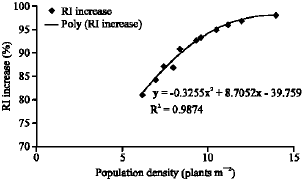 | |
| Fig. 6: | Relationship between population density (plants m2) with radiation interception (RI) |
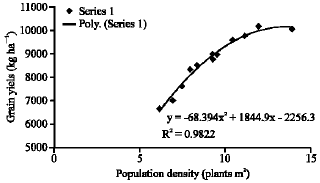 | |
| Fig. 7: | Relationship between population density (plants m2) with grain yield |
The contrast of between within-row spacing was more significant at the 1% probability level with grain yield (Table 2), as highest mount of grain yield was in spaces 12 and 14 cm, there were not any difference significantly between these spaces, the lowest was in space 18 cm (Table 3).
Reaction of row spacing and within-row spacing were more significant on the grain yield where as, the greatest depended on 60 cm row spacing in 12 and 14 cm space of between two plants and the lowest belonged to 90 cm row spacing in 18 cm space of between two plants (Fig. 2).
An increase of PP from 6.2 to 9.5 plants m2 increased grain yield on average by 696.1 kg ha1 for each 1 plant per m2 added, but only by 222.7 kg ha1 from 10.5 to 13.9 plants m2 (Fig. 7).
In Ithaca, the low PP (45,000 plants ha1) averaged 15% lower grain yields than the high PP (90 000 plants ha1). Cultivars with lowest (higher) dry matter and grain yield in low PP showed linear (quadratic) responses to increases in PP, respectively (Cox, 1996), however, early maturing cultivars showed more linear responses than late maturing cultivars (Bavec and Bavec, 2002).
An increase in PP of 2-13 plants m2 decreased net assimilation per plant from 0.85 to 0.11 mg CO2 m2 sec1, but increased grain yield per area (Dwyer et al., 1991). This increase in grain yield can be explained by the increase in LAI and net crop assimilation.
CONCLUSION
The results obtained by this experiment indicate that the row spacing 60 cm, within-row spacing 12 cm and density 11.9 plant m2 for conditions of Isfahan is suitable for maize hybrid K704. Of course considering the number of various hybrids of corns and variety in weather conditions of each region more researches in this field are deemed necessary.
REFERENCES
- Bavec, F. and M. Bavec, 2002. Effects of plant population on leaf area index, cob characteristics and grain yield of early maturing maize cultivars (FAO 100-400). Eur. J. Agron., 16: 151-159.
Direct Link - Bullock, D.G., R.L. Nielsen and W.E. Nyquist, 1988. A growth analysis comparison of corn grown in conventional and equidistant plant spacing. Crop Sci., 28: 254-258.
CrossRefDirect Link - Cirilo, A.G. and F.H. Andrade, 1994. Sowing date and maize productivity: II. Kernel number determination. Crop Sci., 34: 1044-1046.
Direct Link - Wiliam, J.C., 1996. Whole-plant physiological and yield responses of maize to flant density. Agron. J., 88: 489-496.
Direct Link - Cox, W.J. and D.J.R. Cherney, 2001. Row spacing, plant density and nitrogen effects on corn silage. Agron. J., 93: 597-602.
Direct Link - Duncan, W.G., 1957. The relationship between corn population and yield. Agron. J., 50: 82-84.
Direct Link - Dwyer, L.M., D.W. Stewart and M. Tollenaar, 1991. Changes in plant density dependence of leaf photosynthesis of maize (Zea mays L.) hybrids, 1959 to 1988. Can. J. Plant Sci., 71: 1-11.
CrossRefDirect Link - Egli, D.B., 1994. Mechanisms responsible for soybean yield response to equidistant planting patterns. Agron. J., 86: 1046-1049.
Direct Link - Andrade, F.H., P. Calvino, A. Cirilo and P. Barberi, 2002. Yield responses to narrow rows depend on increased radiation interception. Agron. J., 94: 975-980.
CrossRefDirect Link - Flenet, F., J.R. Kiniry, J.E. Board, M.E. Westgate and D.C. Reicosky, 1996. Row spacing effects on light extinction coefficients of corn, sorghum, soybean and sunflower. Agron. J., 88: 185-190.
Direct Link - Hashemi, D.A. and S.J. Herbert, 1992. Intensifying plant dnsity response of corn with artificial shade. Agron, J., 84: 547-551.
Direct Link - Jeffrey, T. Edwards, Larry C. Purcell and Earl D. Vories, 2005. Light interception and yield potential of short-season maize (Zea mays L.) Hybrids in the midsouth. Agron. J., 97: 225-234.
Direct Link - Lindquist, J.L., D.A. Mortensen and B.E. Johnson, 1998. Mechanisms of corn tolerance and velvetleaf suppressive ability. Agron. J., 90: 787-792.
CrossRefDirect Link - Maddonni, G.A., G.C. Alfredo and M.E. Otegui, 2006. Row width and maize grain yield. Agron. J., 98: 1532-1543.
CrossRefDirect Link - Murphy, S.D., Y. Takubu, S.F. Weise and C.J. Swanton, 1996. Effect of planting patterns and inter-row cultivation on competition between corn (Zea mays) and late emerging weeds. Weed Sci., 44: 865-870.
Direct Link - Nafziger, E.D., 1996. Effects of missing and two-plant hills on corn grain yield. J. Prod. Agric., 9: 238-240.
Direct Link - Pommel, B. and R. Bonhomme, 1998. Variations in the vegetative and reproductive systems in individual plants of a heterogeneous maize crop. Eur. J. Agron., 8: 39-49.
CrossRef - Porter, P.M., D.R. Hicks, W.E. Lueschen, J.H. Ford, D.D. Warnes and T.R. Hoverstad, 1997. Corn response to row width and plant populations in the Northern Corn Belt. J. Prod. Agric., 10: 293-300.
Direct Link - Schussler, J.R. and M.E. Westgate, 1995. Assimilate flux determines kernel set at low water potential in maize. Crop Sci., 35: 1074-1080.
Direct Link - Widdicombe, W.D. and K.D. Thelen, 2002. Row width and plant density effects on corn grain production in the Northern Corn Belt. Agron. J., 94: 1020-1023.
Direct Link