

D. S. Rajput
Rungta College of Pharmaceutical Sciences and Research, Kokha-kurud Road, Bhilai, Chhattisgarh, India
Amit Alexander
Rungta College of Pharmaceutical Sciences and Research, Kokha-kurud Road, Bhilai, Chhattisgarh, India
Vishal Jain
University Institute of Pharmacy, Pt. Ravishankar Shukla University, Raipur, Chhattisgarh, India
T. K. Giri
Rungta College of Pharmaceutical Sciences and Research, Kokha-kurud Road, Bhilai, Chhattisgarh, India
D. K. Tripathi
Rungta College of Pharmaceutical Sciences and Research, Kokha-kurud Road, Bhilai, Chhattisgarh, India
Ajazuddin
Rungta College of Pharmaceutical Sciences and Research, Kokha-kurud Road, Bhilai, Chhattisgarh, India
Journal of Applied Sciences
Year: 2012 | Volume: 12 | Issue: 6 | Page No.: 502-517







ABSTRACT
The oral delivery of hydrophobic drugs faces a major challenge because of the low aqueous solubility of such compounds. Approximately, 40% of new chemical entities exhibit poor aqueous solubility and present a major challenge to modern drug delivery system because of their low bioavailability. The availability of the drug for absorption can be enhanced by presentation of the drug as a solubilizer within a colloidal dispersion. Self-emulsifying Drug Delivery Systems (SEDDS), which are isotropic mixtures of oils, surfactants, solvents and co-solvents/surfactants, can be used for the design of formulations in order to improve the oral absorption of highly lipophilic drug compounds. The principal characteristic of these systems is their ability to form fine oil-in-water (o/w) emulsions or microemulsions upon mild agitation following dilution by an aqueous phase through the gastrointestinal tract for lipophilic drugs, which display dissolution rate-limited absorption. SEDDS may be a promising strategy to improve the rate and extent of oral absorption. This article gives an overview of the recent advances in the study of SEDDS and improvement of pharmacokinetic parameters of bioactives through SEDDS.
PDF Abstract XML References Citation
Received: March 27, 2012;
Accepted: April 20, 2012;
Published: June 19, 2012
How to cite this article
D. S. Rajput, Amit Alexander, Vishal Jain, T. K. Giri, D. K. Tripathi and Ajazuddin, 2012. Novel Integrated Approach for the Strategic Delivery of Hydrophobic Drugs by the Use of Self Emulsifying Drug Delivery System. Journal of Applied Sciences, 12: 502-517.
DOI: 10.3923/jas.2012.502.517
URL: https://scialert.net/abstract/?doi=jas.2012.502.517
DOI: 10.3923/jas.2012.502.517
URL: https://scialert.net/abstract/?doi=jas.2012.502.517
INTRODUCTION
Oral route has been the major route of drug delivery for the chronic treatment of many diseases (Gursoy and Benita, 2004; Katteboina et al., 2009). Since, most of the orally delivered drugs (40-50%) either synthetic or herbal are vulnerable because of the poor water solubility of the drug itself, which results in poor oral bioavailability, high intra- and inter-subject variability and lack of dose proportionality (Ajazuddin, 2010; Gursoy and Benita, 2004; Robinson, 1996).
To bypass the associated problems as discussed above, a number of technologies have been applied, such as the use of surfactants, lipids, permeation enhancers, micronization, salt formulation, cyclodextrins, nanoparticles and solid dispersions (Fig. 1) (Giri et al., 2010a; 2008; Kohli et al., 2010; Pouton, 2000; Aungst, 1993; Stegemann et al., 2007). Hence, producing suitable formulations is essential to improve the solubility and bioavailability of such drugs. SEDDS is being used by the formulation scientists as a reliable method for increasing oral bioavailability of poorly soluble drugs. So, we have prepared this review to describe a number of aspects of self-emulsifying drug delivery systems (Wakerly et al., 1987; Charman et al., 1992; Shah et al., 1994; Constantinides, 1995). Self-emulsifying Drug Delivery Systems (SEDDS) (Fig. 2) or self-emulsifying oil formulations (SEOF) are defined as, isotropic mixtures of natural or synthetic oils, Solid or liquid surfactants or alternatively, one or more hydrophilic solvent and cosolvent (Craig, 1993; Hussain et al., 2004; Shukla et al., 2010; Patel et al., 2010a).
SEDDS emulsify spontaneously to produce, fine oil in-water emulsions when introduced into an aqueous phase under gentle agitation in GIT (Mahesh et al., 2011; Patel et al., 2010b; Tang et al., 2007; Kommuru et al., 2001).
Potential advantages of these systems include: Protection of sensitive drug substances, more steady drug absorption, selective targeting of drug(s) toward specific absorption window in GIT, safety of drug(s) from the gut environment, manage of delivery profiles, reduced changeability including food effects and better oral bioavailability enabling reduction in dose (Patel et al., 2008; Amidon et al., 1995; Giri and Tripathi, 2010).
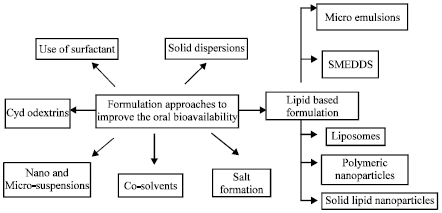 | |
| Fig. 1: | Some of the formulation approaches to improve the oral bioavailability of poorly water soluble drugs |
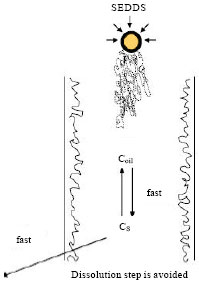 | |
| Fig. 2: | Self Emulsifying drug Delivery System |
Advantages of SEDDS over conventional drug delivery system (DDS): Emulsions are sensitive and metastable dispersed forms while SEDDS are physically stable formulation that are easy to manufacture, as compared with oily solutions, they provide a large interfacial area for partitioning of the drug between oil and water (Oviawe et al., 2006; Nidhi and Srivastava, 2009; Gursoy and Benita, 2004).
Need of SEDDS: Poor water solubility sometimes become a constraint for required absorption of a drug from its oral delivery system. Particulate dissolution is observed as rate limiting step. For this the drug is predissolved in a suitable solvent and dispersed in the form of capsule (Obitte et al., 2008; Bajaj et al., 2011).
Lipid formulation classification system (LFCS): Lipid Formulation Classification System (LFCS). Table 1 showing typical compositions and properties of lipid-based drug delivery systems.
Components of SEDDS: There is large variety of liquid or waxy excipients existing, ranging from oils through biological lipids, lipophilic and hydrophilic surfactants, water soluble cosolvents, or many different combinations which could be used for encapsulation in hard or soft gelatin (Shanmugam et al., 2011). List of various components which are used for the formulation of SEDDS are listed into Table 2. The self-emulsifying process is depends on the nature of the oil-surfactant pair, the surfactant concentration, the temperature at which self-emulsification occurs (Reddy et al., 2011; Mallikarjun and Rajesh Babu, 2011).
Oils: For development of a SEDDS formulation oil play an important role because lipophilic drug are dissolved in oil, it facilitate the emulsification and it can transport a fraction of dissolved drug through the intestinal lymphatic system, thereby can improve the absorption of drug depending on the nature of triglyceride. In general long to medium chain triglycerides with variable degree of unsaturation are used for preparation of SEDDS (Lindmark et al., 1995; Charman and Stella, 1991; Holm et al., 2002; Gupta et al., 2009). Unmodified edible oils provide the most `natural' basis for lipid vehicles, but having poor capacity to dissolve large amounts of hydrophobic drugs and comparatively not produce efficient self-emulsification markedly diminish their use in SEDDS (Kimura et al., 1994; Hauss et al., 1998; Farah et al., 1994; Tripathi et al., 1994).
Surfactants: A number of compounds exhibiting surfactant properties may be employed for the design of self-emulsifying systems, the most widely suggested ones being the non-ionic surfactants with a relatively high Hydrophilic Lipophilic Balance (HLB).
| Table 1: | Lipid formulation and classification system |
 | |
| Table 2: | Examples of oils, surfactants, co-surfactant and co-solvents used |
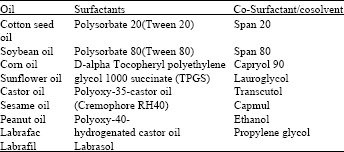 | |
The frequently used emulsifiers are a variety of solid or liquid ethoxylated polyglycolyzed glycerides and Tween 80 (Patel et al., 2011a; Kyatanwar et al., 2010a). Emulsifiers of natural origin are selected since they are better than the synthetic surfactants (Yuasa et al., 1994; Georgakopoulos et al., 1992; Crison and Amidon, 1999; Reiss, 1975) (Fig. 3).
Surfactants are amphiphilic in nature and they can dissolve or solubilize relatively high amounts of hydrophobic drug compounds (Sen et al., 2011). The precipitation of drug in the lumen of GI tract can be arrested by the surfactant present. Surfactant can also increase the residence time in GI tract. However, due to excess of surfactant permeability of intestinal wall can reversibly change to a moderate extent. Thus, it is very necessary and important to optimize the concentration of surfactant (Gupta et al., 2009; Belur et al., 2011).
Co-solvents: Generally high surfactant concentrations (more than 30% w/w) are used in order to produce an effective self-emulsifying formulation. Organic solvents are suitable for oral administration Propylene Glycol (PG), ethanol, polyethylene glycol (PEG), etc. may be help to dissolve large quantity of the hydrophilic surfactant in the drug which is the lipid base and can act as co-surfactant in the self emulsifying drug system (Panesar et al., 2011; Alexander et al., 2011; Solanki et al., 2011).
Recent researches and rationales of SEDDS in various category of drug: Kim and Ku (2000) enhanced absorption of indomethacin after oral or rectal administration in rats by self emulsifying system and he was observed that, the SES (30% of Tween 85 and 70% of Ethyl Oleate) was selected as an optimized formulation (high drug loading, low surfactant concentration and small particle size) for IDM, a poorly water-soluble drug.
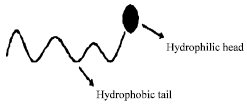 | |
| Fig. 3: | Surfactant molecule containing hydrophilic head and hydrophobic tail group |
Julianto et al. (2000) work on improved bioavailability of vitamin E with a self emulsifying formulation and on the basis of the result obtained, he was concluded that it is apparent that the self-emulsifying preparation achieved a higher rate and extent of absorption compared to the soft gelatin capsule under fasted condition.
Attama (2003) use solid self emulsifying system in the delivery of diclofenac and he concluded that the tablets showed good release profile, as well as acceptable tablet properties the batches with higher tween 65: goat fat content ratios gave better release rate.
Hong et al. (2006) formed a new self emulsifying formulation of Itraconazole with improved dissolution and oral absorption and he was concluded that Itraconazole is a representative poorly water-soluble drug. Thus, the marketed formulation Sporanox\ capsule showed great differences between post and pre-prandial state in human. Self-emulsifying formulation developed in this study, shows constant absorption after oral administration with no effect of dietary condition. Since SEDDS rapidly formed fine particles sized 100-1000 nm, the dissolution problems were solved and the absorption was improved.
Agarwal et al. (2009) studied dissolution and powder flow characterization of solid self emulsifying drug delivery system (SEDDS) of griseofulvin could be readily adsorbed on silica and silicates. He was found that the effect of SEDDS on the flow behavior of the adsorbent is similar to that observed in wet granulation process. Adsorption of SEDDS, however, exhibits a lag or critical phase during which no change in flow is observed. During this phase, the SEDDS formulation is embedded within the carrier and entrapped in the intraparticular pores. Therefore, the duration of the lag phase depends on the adsorbing capacity, size and specific surface area of the adsorbent. This phase could be used as a guide in formulation development to determine the extent of SEDDS addition without impacting flow. In addition, it could be used as a measure of the critical point after which further SEDDS addition would cause particle agglomeration.
Zvonar et al. (2010) formed microencapsulation of self microemulsifying system for improving solubility and permeability of furosemide. At last he was explained that the permeability of furosemide was enhanced by its implementing into SMES; most probably by altering apical membrane fluidity, opening tight junctions and inhibiting efflux transporters involved in the intestinal secretion of furosemide (Soliman et al., 2007). Also the dissolution rate of furosemide from microcapsules was considerably faster than from reference microsphere (Zvonar et al., 2010).
Setthacheewakul et al. (2010) work on development and evaluation of self-microemulsifying liquid and pellet formulations of curcumin and absorption study on rats, he concluded that the optimal formulations of the curcumin-SMEDDS liquid (F6) and curcumin-SMEDDS pellets (P3) were successfully developed in this study. The SMEDDS and SMEDDS pellets readily released the lipid phase to form a fine oil-in-water micro emulsion, with a narrow distribution size. The release of about 80% of curcumin from curcumin-SMEDDS in liquid and pellet forms was considerably greater compared to only 5% in aqueous solution from the unformulated curcumin. Pharmacokinetic studies in rats revealed that both liquid and pellet SMEDDS showed 14- and 10-fold greater absorption, respectively, of curcumin, compared to the same oral dose (50 mg kg-1) of the curcumin aqueous suspension. The capsules filled with SMEDDS liquid and pellets were found to be stable over a period of 6 months under intermediate and accelerated conditions. Our studies illustrated the potential use of new self-microemulsifying systems in liquid and pellet forms for oral delivery of poorly water-soluble drug such as curcumin.
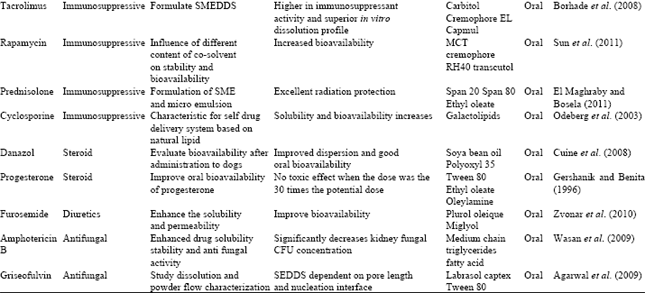
Iosio et al. ( 2011) formulated self emulsifying pellets for increase oral bioavailability of silymarin. At last he concluded that, extrusion/spheronization is a viable technology to produce self-emulsifying pellets of good quality and able to improve in vivo oral bioavailability of main components of a phytotherapeutic extract of more than 100 times by enhancing the lymphatic route of absorption (Iosio et al., 2011; Amarji et al., 2007). Similarly, various categories of drugs that are formulated as SEDDS are discussed in the given Table 3 with their purpose of making, excipient use, route and advances. (Fig. 4, 5).
Formulation: Various studies are performed for choice of oil, which is an important and important requisite for development of SEDDS and SMEDDS. It is mixture of oil, a surfactant and a co-surfactant. Solubility of drug is determined in various oils and surfactants. A series of SEDDS and SMEDDS system containing drug, various oil and surfactants are prepared. Then, studied in vitro selfemulsification properties and droplet size analysis of these formulations upon their addition to water under mild agitation conditions. Pseudo-ternary phase diagram is constructed, identifying the efficient selfemulsification region. From these studies, an optimized formulation is selected and its bioavailability is compared with a reference formulation (Saifuddin and Chua, 2006; Giri et al., 2010b).
The process of making self-emulsion drug delivery system for increasing the bioavailability of a drug and/or pharmaceutical ingredient by emulsifying the drug with the self-emulsifying excipient consists of various steps as Solubilizing a poorly water-soluble drug and/or pharmaceutical ingredient in a mixture of surfactant, cosurfactant and solvent (Craig et al., 1995; Dabros et al., 1999;Venkatesh et al., 2010). Now mix the oil phase if necessary, by heating or other elementary means, to the solubilized drug formulation and thoroughly mixed. The formed emulsion can then be poured to a suitable dosage form such as soft or hard-filled gelatin capsules and allowed to cool (Porter and Charman, 2001a; Kyatanwar et al., 2010b).
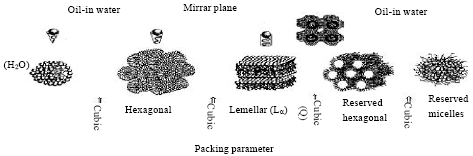 | |
| Fig. 4: | Representation of the most commonly encountered phases upon addition of water to an oil surfactant combination |
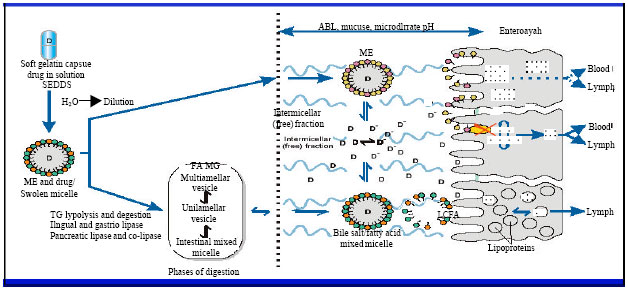 | |
| Fig. 5: | Potential mechanism for absorption enhancement |
| Table 3: | Various examples of SEDDS |
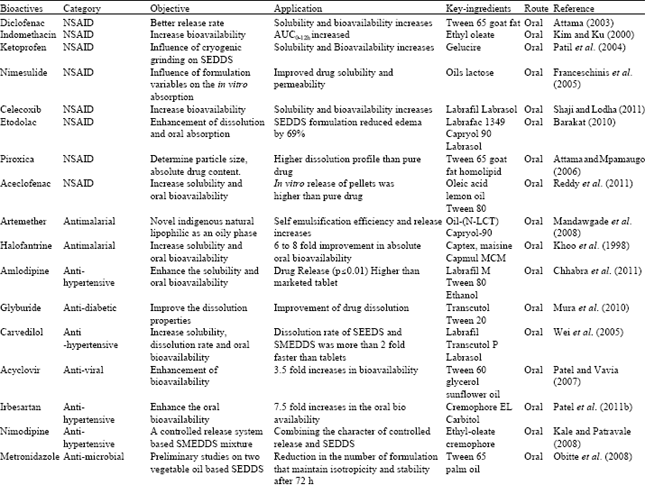 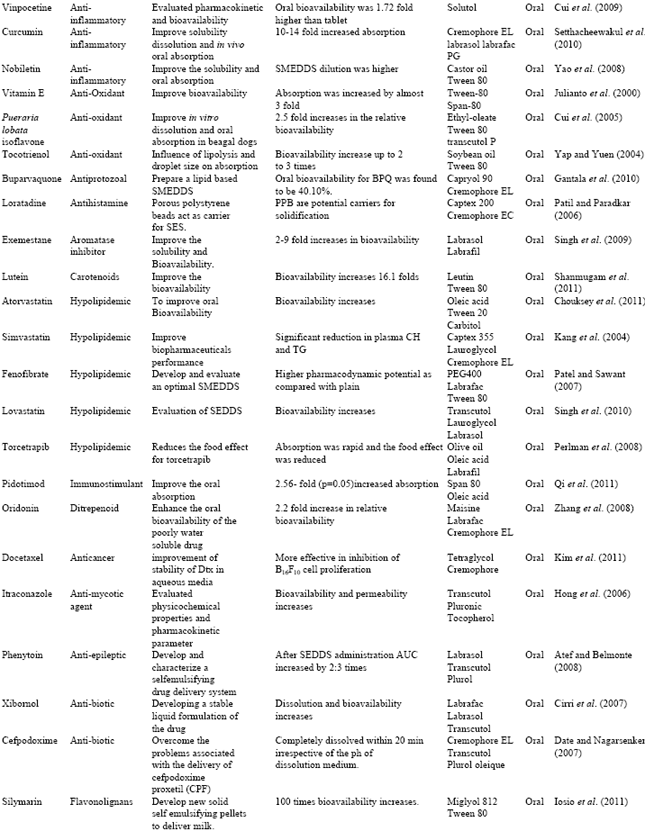  | |
The addition of a drug to a SEDDS is vital because the drug obstructs with the self emulsification process to a certain extent, which leads to a change in the optimal oil-surfactant ratio. So, the design of an optimal SEDDS requires Preformulation-solubility and phase-diagram studies (Crison and Amidon, 1999; Farah et al., 1994).
Biopharmaceutical aspects: According to some reviewers certain poorly soluble drug becomes more bioavailable due to the presence of some lipids either alone or in combination with food. The reason is not completely known. Currently certain possible explanation has been given:
Alterations (reduction) in gastric transit: the lipid and/or food reduce the transit time of the drug and thus, increase the time available for dissolution and there by absorption (Karthikeyan et al., 2007).
Increase in effective luminal drug solubility: The presence of lipids in the GI tract stimulates an increase in the secretion of bile salts (BS) and endogenous biliary lipids including phospholipid (PL) and cholesterol (CH), leading to the formation of BS/PL/CH intestinal mixed micelles and an increase in the solubilization capacity of the GI tract. The cholesterol content was expressed as mg g-1 (Farvin et al., 2009).
However, intercalation of administered (exogenous) lipids into these BS structures either directly (if sufficiently polar), or secondary to digestion, leads to swelling of the micellar structures and a further increase in solubilization capacity.
Changes in the biochemical barrier function of the GI tract: It is understood that the activity of intestinal efflux transporters may be reduced by the lipids and surfactants this may be indicated by the glycoprotein’s efflux pump. Thus lipids and surfactants can diminish the enterocyte-base metabolism.
Changes in the physical barrier function of the GI tract: This has been observed that the permeability of drug can be increased by some lipids, lipid metabolism and surfactants. Although, the bioavailability of most of the poorly soluble drugs do not find problem with passive intestine permeability (Humberstone and Charman, 1997; Muranishi, 1991; Benet and Cummins, 2001; Dintaman and Silverman, 1999).
Effect of oils on the absorption: Such formulations form a fine oil-in-water emulsion with gentile agitation, which may be provided by gastrointestinal motility. A SES also improves the reproducibility of the plasma level-time profile (Kommuru et al., 2001; Porter and Charman., 1997; Nerurkar et al., 1996). Various physiological mechanisms have been planned to explain the effect of oils on the absorption of water-insoluble compounds, including altered gastrointestinal motility, increased bile flow and drug solubilization (Aungst, 2000; Mistry and Sheth, 2011).
Characterization of SEDDS: The primary means of self-emulsification assessment is visual evaluation. The efficiency of self-emulsification could be estimated by determining the rate of emulsification, droplet-size distribution and turbidity measurements.
Visual assessment: This may provide important information about the self emulsifying and micro emulsifying property of the mixture and about the resulting dispersion.
Thermodynamic stability studies: Stability factor like physical stability of a lipid based formulation can be hindered in various ways, precipitation of drug in excipient matrix can be on of them (Al-Haj and Rasedee, 2009). In addition, poor formulation physical stability can lead to phase separation of the excipient, affecting not only formulation performance, but visual appearance as well (Prasong, 2010). The primary packaging material e.g., Capsule shell can affect the stability of the formulation. Incompatibility between the product and gelatin capsule shell make the shell can make the shell brittle deformed resulting delayed disintegration or incomplete release of drug. The stability of the formulation can be assessed by expressing it to heating cooling cycles of 4 and 45°C for six times and storing for 48 h at each temperature If the formulation does not indicated any sign of instability it is subjected to centrifugation at 3500 rpm for 30 min (Uchegbu and Florence, 1995; Rajesh et al., 2010).
Freeze thaw test: Three freeze for the formulations. Those formulations passed this test showed good stability with no phase separation, creaming or cracking (Shafiq et al., 2007; Patil et al., 2007; Patel et al., 2011b).
Turbidity measurement: This identifies efficient self-emulsification by establishing whether the dispersion reaches equilibrium rapidly and in a reproducible time (Paul and Maulik, 1997; Venkatesh et al., 2010). These measurements are performed on turbidity meters, most commonly the Hach turbidity meter and the Orbeco-Helle turbidity meter. Nepheloturbidimetric evaluation is done to monitor the growth of emulsification. A definite amount of the formulation is added to fixed quantity of suitable medium (0.1 N HCL) under continuous stirring (50 rpm) using magnetic stirrer at ambient temperature. Any change in turbidity is measured using a turbidity meter (Maulik and Paul, 1998).
Droplet size analysis particle size measurements: This determines the rate and extent of drug release along with the stability of the emulsion. Photon correlation spectroscopy using Zetasizer (which analyses the fluctuations in light scattering due to Brownian motion of the particles) is generally used to determine the droplet size of emulsion in the size range between 10 and 5000 nm (Wangcharoenrung and Warisnocharoen, 2011). Scattering of light is monitored at 90° angle at 25°C, after external standardization with spherical polystyrene beads. The nanometric size range of the particle is also observed even after 100 times dilution with water which proves the system’s compatibility with excess water (Serajuddin et al., 1988; Wakerly et al., 1986).
Drug content: Drug from pre-weighed SEDDS is extracted by dissolving in suitable solvent. Drug content in the sol-vent extract was analyzed by suitable analytical method against the standard solvent solution drug (Reddy et al., 2011; Wasan, 2001).
Emulsification time: Porter and Charman (2001b) measured the emulsification time by using a rotating paddle to promote emulsification in a crude nephelometer. This enabled an estimation of the time taken for emulsification (Bajaj et al., 2011; Pouton, 1997; Kamble et al., 2010).
Emulsification rate: The rate of self- emulsification system is usually determined by adding a dose of the SEDDS pre-concentrate, preferably in a capsule, to a relevant amount of water or biorelevant media. Rate of dispersion is determined by visual observation or by monitoring the change of turbidity of dispersion using a UV spectrophotometer or nephelometer (Sarpal et al., 2010).
Dispersibility test: The efficiency of self-emulsification of oral nano or micro emulsion can be assessed using a standard USP XXII dissolution apparatus 2. One millilitre of each formulation to be added to 500 mL of water at 37±0.5°C. A standard stainless steel dissolution paddle rotating at 50 rpm can be used to provide. The emulsion can be graded as follows on the basis of their Dispersibility.
Grade A: Rapidly forming (within 1 min) nanoemulsion, having a clear or bluish appearance.
Grade B: Rapidly forming, slightly less clear emulsion, having a bluish white appearance.
Grade C: Fine milky emulsion that formed within 2 min.
Grade D: Dull, greyish white emulsion having slightly oily appearance that is slow to emulsify (longer than 2 min)
Grade E: Formulation, exhibiting either poor or minimal emulsification with large oil globules present on the surface. Grade A and Grade B formulation will remain as nanoemulsion when dispersed in GIT. While formulation falling in Grade C could be recommend for SEDDS formulation (Sachan et al., 2010; Shafiq et al., 2007).
Liquefaction time: This test is designed to estimate the time required by solid SEDDS to melt in vivo in the absence of agitation to simulated GI conditions. One dosage form is covered in a transparent polyethylene film and tied to the bulb of a thermometer by means of a thread. The thermometer with attached tablets is placed in a round bottom flask containing 250 mL of simulated gastric fluid without pepsin maintained at 37±18°C. The time taken for liquefaction is subsequently noted (Bajaj et al., 2011; Attama, 2003; Kohli et al., 2010).
Zeta potential measurement: This is used to identify the charge of the droplets. In conventional SEDDS, the charge on an oil droplet is negative because of the presence of free fatty acids (Bajaj et al., 2011; Gershanik and Benita, 1996).
Equilibrium phase diagram: Although self-emulsification is a dynamic no equilibrium process involving interfacial phenomena, information can be obtained about self-emulsification using equilibrium phase behavior (Nour and Yunus, 2006). There seems to be a correlation between emulsification efficiency and region of enhanced water solubilization and phase inversion region, formation of lamellar liquid crystalline dispersion phase on further incorporation of water (Anisa et al., 2010). An equilibrium phase diagram enables comparison of different of different surfactants and their synergy with co solvent or co surfactant. The boundaries of one phase region can easily be assessed visually. The phase behavior of a three component system can be represented by a ternary phase diagram (Pouton, 1987).
Viscosity determination: The SEDDS system is generally administered in soft gelatin or hard gelatin capsules. So, it can be easily pourable into capsules and such system should not too thick to create a problem. The rheological properties of the micro emulsion are evaluated by Brookfield viscometer. This viscosities determination conform whether the system is w/o or o/w. If system has low viscosity then it is o/w type of the system and if high viscosities then it is w/o type of the system (Patel et al., 2011c).
Refractive index and percent transmittance: Refractive index and percent transmittance proved the transparency of formulation. The refractive index of the system is measured by refractometer by placing drop of solution on slide and it compare with water (1.333). The percent transmittance of the system is measured at particular wavelength using UV-spectrophotometer keeping distilled water as blank. If refractive index of system is similar to the refractive index of water (1.333) and formulation have percent transmittance >99%, then formulation have transparent nature (Strickley, 1998; Lowell, 2008; Wang et al., 2009).
Electro conductivity study: The SEDD system contains ionic or non-ionic surfactant, oil and water. So this test is used to measure the electro conductive nature of system. The electro conductivity of resultant system is measured by electro-conductometer.
In vitro diffusion study: In vitro diffusion studies is performed to study the release behavior of formulation from liquid crystal-line phase around the droplet using dialysis technique (Reddy et al., 2011; Patil et al., 2004).
Application
Improvement in solubility and bioavailability: If drug is added in SEDDS, it increases the solubility because it by passes the dissolution step in case of Class-II drug (Low solubility/high permeability). e.g. Ketoprofen, a moderately hydrophobic (log P 0.979) Nonsteroidal anti-inflammatory drug (El-Kamel et al., 2001; Vergote et al., 2001), is also a drug of choice for SEDDS, but it has high potential for gastric irritation during chronic therapy. Because of its low solubility, ketoprofen shows incomplete release characteristic from different formulations (Kreuter, 1994; Patel et al., 2008). By formulating ketoprofen in form of SEDDS these problem can be overcome rather increased bioavailability of the drug can be achieved. (Daud et al., 2011; Ymada et al., 2001; Roda et al., 2002).
Protection against biodegradation: Many drugs are degraded in physiological system, may be because of acidic pH in stomach, enzymatic degradation or hydrolytic degradation etc. Such drugs when presented in the form of SEDDS can be well protected against these degradation processes as liquid crystalline phase in SEDDS might be an act as barrier between degradating environment and the drug (Rhee et al., 2001; Patel et al., 2010a, 2011c, 2008).
Controlling the release of drug: Preparation and stabilization of nano-crystalline or improved solubility forms of drug may pose processing, stability and economic problems. This problem can be successfully overcome when Ketoprofen is presented in SEDDS formulation.
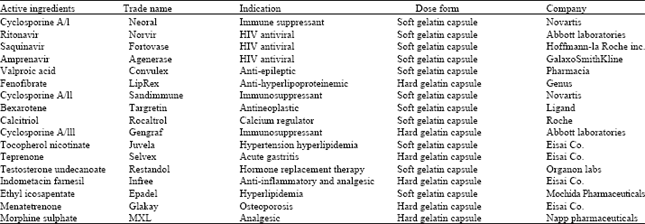
| Table 4: | Some example of marketed pharmaceutical SEDDS formulation are as shown below |
 | |
This formulation enhanced bioavailability due to increase the solubility of drug and minimizes the gastric irritation. (Vergote et al., 2001; El-Kamel et al., 2001; Rhee et al., 2001).
Solid SEDDS: SEDDS are usually a liquid dosage form packed in a soft gelatin capsules which have certain limitations. Do combat these short comings solid SEDDS in the form of tablet, capsule and powders have also been prepared (Woo and Suh, 2001; Bajaj et al., 2011).
Supersaturable SEDDS (S-SEDDS): The high surfactant level in SEDDS formulations can cause GI side-effect. So that, a new class of supersaturable formulations, as well as the supersaturable SEDDS (S-SEDDS) formulations, have been introduced and developed to overcome the surfactant side-effects and reach rapid absorption of poorly soluble drugs. (Gao et al., 2003, 2004; Kararli et al., 1992). It is shows that the significantly reduced amount of surfactant used in the S-SEDDS formulation approach provides a better toxicity/safety profile than the traditional SEDDS formulations (Raghavan et al., 1986; Pellett et al., 1997; Hasegawa et al., 1988) (Table 4).
ACKNOWLEDGEMENT
The Author would like to acknowledge assistance provided by the library of Rungta College of Pharmaceutical Science and Research Kokha-Kurud Road, Bhilai, Chhattisgarh, India for collection of literature.
REFERENCES
- Nour, A.H. and R.M. Yunus, 2006. Stability investigation of water-in-crude oil emulsion. J. Applied Sci., 6: 2895-2900.
CrossRefDirect Link - Agarwal, V., A. Siddiqui, H. Ali and S. Nazzal, 2009. Dissolution and powder flow characterization of solid self-emulsified drug delivery systeam (SEDDS). Int. J. Pharm., 366: 44-52.
PubMed - Alexander, A., M. Ajazuddin, M. Swarna, M. Sharma and D.K. Tripathi, 2011. Polymers and permeation enhancers: Specialized components of mucoadhesives. Stamford J. Pharm. Sci., 4: 91-95.
CrossRefDirect Link - Amarji, B., Ajazuddin, D. Raghuwanshi, S.P. Vyas and P. Kanaujia, 2007. Lipid Nano Spheres (LNSs) for enhanced oral bioavailability of amphotericin B: Development and characterization. J. Biomed. Nanotechnol., 3: 264-269.
Direct Link - Amidon, G.L., H. Lennernas, V.P. Shah and J.R. Crison, 1995. A theoretical basis for a biopharmaceutical drug classification: The correlation of in vitro drug product dissolution and in vivo bioavailability. Pharm. Res., 12: 413-420.
Direct Link - Atef, E. and A.A. Belmonte, 2008. Formulation and in vitro and in vivo characterization of a phenytoin self-emulsifying drug delivery system (SEDDS). Eur. J. Pharm. Sci., 35: 257-263.
PubMed - Attama, A.A., 2003. The use of solid self-emulsifying systems in the delivery of diclofenac. Int. J. Pharm., 262: 23-28.
PubMed - Attama, A.A. and V.E. Mpamaugo, 2006. Pharmacodynamics of piroxicam from self-emulsifying lipospheres formulated with homolipids extracted from Capra hircus. Drug Deliv., 13: 133-137.
PubMed - Aungst, B.J., 1993. Novel formulation strategies for improving oral bioavailability of drugs with poor membrane permeation or presystemic metabolism. J. Pharm. Sci., 82: 979-987.
CrossRef - Belur, P.D., G. Mugeraya and B. Nainegali, 2011. Release of cell-associated Tannase of Serratia ficaria DTC by Sonication and solvents. Asian J. Biotechnol., 3: 91-97.
Direct Link - Benet, L.Z. and C.L. Cummins, 2001. The drug efflux‐metabolism alliance: Biochemical aspects. Adv. Drug Deliv. Rev., 50: S3-S11.
CrossRefDirect Link - Borhade, V., H. Nair and D. Hegde, 2008. Design and evaluation of self-microemulsifying drug delivery system (SMEDDS) of tacrolimus. AAPS Pharm. Sci. Tech., 9: 13-21.
CrossRefDirect Link - Barakat, N.S., 2010. Self-emulsifying system for improving drug dissolution and bioavailability: In vitro/in vivo evaluation. Drug Dev. Res., 71: 149-158.
CrossRef - Charman, S.A., W.N. Charman, M.C. Rogge, T.D. Wilson, F.J. Dutko and C.W. Pouton, 1992. Self emulsifying drug delivery systems: Formulation and biopharmaceutic evaluation of an investigational lipophilic compound. Pharm. Res., 9: 87-93.
PubMed - Charman, W.N. and V.J. Stella, 1991. Transport of lipophilic molecules by the intestinal lymphatic system. Adv. Drug Delivery Rev., 7: 1-14.
Direct Link - Humberstone, A.J. and W.N. Charman, 1997. Lipid‐based vehicles for the oral delivery of poorly water soluble drugs. Adv. Drug Delivery Rev., 25: 103-128.
CrossRef - Chhabra, G., K. Chuttani, A.K. Mishra and K. Pathak, 2011. Design and development of nanoemulsion drug delivery system of amlodipine besilate for improvement of oral bioavailability. Drug Dev. Ind. Pharm., 37: 907-916.
PubMed - Chouksey, R. H. Pandey, A.K. Jain, H. Soni and G.K. Saraogi, 2011. Preparation and evaluation of the self emulsifying drug delivery system containing atorvastatin HMG COA inhibitor. Int. J. Pharm. Pharm. Sci., 3: 147-152.
Direct Link - Cirri, M., P. Mura and P.C. Mora, 2007. Liquid spray formulations of xibornol by using self-microemulsifying drug delivery systems. Int. J. Pharm., 340: 84-91.
Direct Link - Constantinides, P.P., 1995. Lipid microemulsions for improving drug dissolution and oral absorption: Physical and biopharmaceutical aspects. Pharm. Res., 12: 1561-1572.
CrossRefDirect Link - Craig, D.Q.M., S.A. Barker, D. Banning and S.W. Booth, 1995. An investigation into the mechanisms of self-emulsification using particle size analysis and low frequency dielectric spectroscopy. Int. J. Pharm., 114: 103-110.
CrossRef - Cui, J., B. Yu, Y. Zhao, W. Zhu, H. Li, H. Lou and G. Zhai, 2009. Enhancement of oral absorption of curcumin by self-microemulsifying drug delivery systems. Int. J. Pharm., 371: 148-155.
CrossRefDirect Link - Cuine, J.F., C.L. McEvoy, W.N. Charman, C.W. Pouton, G.A. Edwards, H. Benameur and C.J. Porter. 2008. Evaluation of the impact of surfactant digestion on the bioavailability of danazol after oral administration of lipidic self-emulsifying formulations to dogs. J. Pharm. Sci., 97: 995-1012.
CrossRefDirect Link - Dabros, T., A. Yeung, J. Masliyah and J. Czarnecki, 1999. Emulsification through area contraction. J. Colloids Interface Sci., 210: 222-224.
PubMed - Daud, N., R.M. Taha, N.N.M. Noor and H. Alimon, 2011. Potential of alternative gelling agents in media for the in vitro Micro-propagation of Celosia sp. Int. J. Bot., 7: 183-188.
CrossRefDirect Link - Dintaman, J.M. and J.A. Silverman, 1999. Inhibition of P‐glycoprotein by Dalpha‐tocopheryl polyethylene glycol 1000 succinate (TPGS). Pharm. Res., 16: 1550-1556.
PubMed - Soliman, E.A., M.S. Tawfik, H. El-Sayed and Y.G. Moharram, 2007. Preparation and characterization of soy protein based edible/biodegradable films. Am. J. Food Technol., 2: 462-476.
CrossRefDirect Link - Franceschinis, E., D. Voinovich, M. Grassi, B. Perissutti, J. Filipovic-Grcic, A. Martinac and F. Meriani-Merlo, 2005. Self-emulsifying pellets prepared by wet granulation in high-shear mixer: Influence of formulation variables and preliminary study on the in vitro absorption. Int. J. Pharm., 291: 87-97.
Direct Link - Farvin, K.H.S., A. Surendraraj and R. Anandan, 2009. Synergestic effect of squalene and simvastatin on fecal cholesterol excretion in rats. Asian J. Clin. Nutr., 1: 102-106.
CrossRefDirect Link - Gao, P., M.E. Guyton, T. Huang, J.M. Bauer, K.J. Stefanski and Q. Lu, 2004. Enhanced oral bioavailability of a poorly water soluble drug PNU-91325 by supersaturatable formulations. Drug Dev. Ind. Pharm., 30: 221-229.
PubMed - Gershanik, T. and S. Benita, 1996. Positively charged self-emulsifying oil formulation for improving oral bioavailability of progesterone. Pharm. Dev. Technol., 1: 147-157.
PubMed - Giri, T.K., H. Badwaik, A. Alexander and D.K. Tripathi, 2010. Solubility enhancement of ibuprofen in the presence of hydrophilic polymer and surfactant. Int. J. Applied Biol. Pharm. Technol., 1: 793-800.
Direct Link - Giri, T.K (b)., P. Jana and B. Sa, 2008. Rapidly disintegration fast release tablets of diazepam using solid dispersion: Development and evaluation. J. Sci. Ind. Res., 67: 436-439.
Direct Link - Gursoy, N.R. and S. Benita, 2004. Self-emulsifying drug delivery systems (SEDDS) for improved oral delivery of lipophylic drugs. J. Biomed. Pharmacother., 58: 173-182.
PubMedDirect Link - Kim, G.H., J.Y. Lee, Y. Kang, K.N. Kang and E.S. Kim et al., 2011. Preparation and characterization of self-emulsified docetaxel. J. Nanomater.
CrossRef - Al-Haj, N. and A. Rasedee, 2009. Solid lipid nanoparticles preparation and characterization. Int. J. Pharmacol., 5: 90-93.
CrossRefDirect Link - Hasegawa, A., M. Taguchi, R. Suzuki, T. Miyata, H. Nakagawa and I. Sugimoto, 1988. Supersaturation mechanism of drugs from solid dispersions with enteric coating agents. Chem. Pharm. Bull., 36: 4941-4950.
PubMed - Hauss, D.J., S.E. Fogal, J.V. Ficorilli, C.A. Price, T. Roy, A.A. Jayaraj and J.J. Keirns, 1998. Lipid-based delivery systems for improving the bioavailability and lymphatic transport of a poorly water-soluble LTB4 inhibitor. J. Pharmaceut. Sci., 87: 164-169.
CrossRefPubMedDirect Link - Holm, R., C.J.H. Porter, A. Mullertz, H.G. Kristensen and W.N. Charman, 2002. Structured triglyceride vehicles for oral delivery of halofantrine: Examination of intestinal lymphatic transport and boiavailability in conscious rats. Pharm. Res., 19: 1354-1361.
PubMed - Hong, J.Y., J.K. Kim, Y.K. Song, J.S. Park and C.K. Kim, 2006. A new self-emulsifying formulation of itraconazole with improved dissolution and oral absorption. J. Control Release, 110: 332-338.
Direct Link - Anisa, A.N.I., A.H. Nour and A.H. Nour, 2010. Catastrophic and transitional phase inversion of water-in-oil emulsion for heavy and light crude oil. J. Applied Sci., 10: 3076-3083.
CrossRefDirect Link - Iosio, T., D. Voinovich, B. Perissutti, F. Serdoz and D. Hasa et al., 2011. Oral bioavailability of silymarin phytocomplex formulated as self-emulsifying pellets. Phytomedicine, 18: 505-512.
PubMed - Julianto, T., K.H. Yuen and A.M. Noor, 2000. Improved bioavailability of vitamin E with a self emulsifying formulation. Int. J. Pharm., 2: 53-57.
PubMed - Kararli, T.T., T.E. Needham, M. Griffin, G. Schoenhard, L.J. Ferro and L. Alcorn, 1992. Oral delivery of a renin inhibitor compound using emulsion formulations. Pharm. Res., 9: 888-893.
CrossRefPubMedDirect Link - Kang, B.K., J.S. Lee, S.K. Chon, S.Y. Jeong and S.H. Yuk et al., 2004. Development of Self-Microemulsifying Drug Delivery Systems (SMEDDS) for oral bioavailability enhancement of simvastatin in beagle dogs. Int. J. Pharmaceut., 274: 65-73.
CrossRefPubMedDirect Link - Karthikeyan, C. S.S. kumar, P. Chandrasekar, A. Heber, S.J.H. Robert and N.S.H.N. Moorthy, 2007. Pharmacological evaluation of different extract of Asclepias daemia leaves. J. Pharmacol. Toxicol., 2: 391-395.
CrossRefDirect Link - Khoo, S.M., A.J. Humberstone, C.J.H. Porter, G.A. Edwards and W.N. Charman, 1998. Formulation design and bioavailability assessment of lipid self emulsifying formulations of halofantrin. Int. J. Pharm., 167: 155-164.
CrossRef - Kimura, M., M. Shizuki, K. Miyoshi, T. Sakai, H. Hidaka, H. Takamura and T. Matoba, 1994. Relationship between the molecular structures and emulsification properties of edible oils. Biosci. Biotech. Biochem., 58: 1258-1261.
Direct Link - Kohli, K., S. Chopra, D. Dhar, S. Arora and K.R. Khar, 2010. Self-emulsifying drug delivery system: An approach to enhance oral bioavailability. Drug Dis. Today, 15: 21-22.
PubMed - Kommuru, T.R., B. Gurley, M.A. Khan and I.K. Reddy, 2001. Self-emulsifying drug delivery systems (SEDDS) of coenzyme Q10: Formulation development and bioavailability assessment. Int. J. Pharm., 212: 233-246.
PubMed - Wang, L., J. Dong, J. Chen, J. Eastoe and X. Li, 2009. Design and optimization of a new self-nanoemulsifying drug delivery system. J. Colloid Interface Sci., 330: 443-448.
CrossRef - Lindmark, T., T. Nikkila and P. Artursson, 1995. Mechanisms of absorption enhancement by medium chain fatty acids in intestinal epithelial Caco-2 monolayers. J. Pharm. Exp. Ther., 275: 958-964.
Direct Link - El Maghraby, G.M. and A.A. Bosela, 2011. Investigation of self-microemulsifying and microemulsion systems for protection of prednisolone from gamma radiation. Pharm. Dev. Technol., 16: 237-242.
CrossRefDirect Link - Mandawgade, S.D., S. Sharma, S. Pathak and V.B. Patravale, 2008. Development of SMEDDS using natural lipophile: Application to β-Artemether delivery. Int. J. Pharm., 362: 179-183.
CrossRef - Maulik, S.P. and B.K. Paul, 1998. Structure dynamics and transport properties of microemulsion. Adv. Coll Int. Sci., 78: 99-195.
CrossRef - Mistry, R.B. and N.S. Sheth, 2011. A review: Self emulsifying drug delivery system. Int. J. Pharm. Pharmaceut. Sci., 3: 23-28.
Direct Link - Obitte, N.C., H. Ezeiruaku and V.I. Onyishi, 2008. Preliminary studies on two vegetable oil based self emulsifying drug delivery system (SEDDS) for the delivery of metronidazole, a poorly water soluble drug. J. Applied Sci., 8: 1950-1955.
CrossRefDirect Link - Odeberg, J.M., P. Kaufmann, K.G. Kroon and P. Hoglund, 2003. Lipid drug delivery and rational formulation design for lipophylic drugs with low oral bioavailability applied to cyclosporine. Eur. J. Pharm. Sci., 20: 375-382.
Direct Link - Oviawe, A.P., D.O. Ukponmwan and F.C. Okei, 2006. Physiochemical studies of neutralizers and their effects on stability of cosmetic emulsion. Trends Applied Sci. Res., 1: 327-333.
CrossRefDirect Link - Mura, P., M. Valleri , M. Cirri and N. Mennini, 2010. New solid self-microemulsifying systems to enhance dissolution rate of poorly water soluble drugs. Pharm. Dev. Technol.
CrossRef - Panesar, R., P.S. Panesar and M.B. Bera, 2011. Development of low cost medium for the production of biosurfactants. Asian J. Biotechnol., 3: 388-396.
CrossRefDirect Link - Patel, A.R. and P.R. Vavia, 2007. Preparation and in vivo evaluation of SMEDDS (self-microemulsifying drug delivery system) containing fenofibrate. AAPS J., 9: E344-E352.
CrossRef - Patel, J., A. Patel, M. Raval and N. Sheth, 2011. Formulation and development of a self-nanoemulsifying drug delivery system of Irbesartan. J. Adv. Pharm. Technol. Res., 2: 101-102.
Direct Link - Patel, N.D., K.V. Patel, L.A. Panchal, A.K. Shukla and P.K. Shelat, 2011. An emerging technique for poorly soluble drugs: Self emulsifying drug delivery system. Int. J. Pharm. Biol. Arch., 2: 621-629.
Direct Link - Patel, P.A., G.M. Chaulang, A. Akolkotkar, S.S. Mutha, S.R. Hardikar and A.V. Bhosale, 2008. Self emulsifying drug delivery system: A review. Res. J. Pharm. Tech., 1: 313-323.
Direct Link - Patil, P. and A. Paradkar, 2006. Porous polystyrene beads as carriers for self-emulsifying system containing loratadine. AAPS Pharm. Sci. Tech., 7: 842-859.
PubMed - Patil, P., P. Joshi and A. Paradkar, 2004. Effect of formulation variables on preparation and evaluation of gelled Self-Emulsifying Drug Delivery System (SEDDS) of ketoprofen. AAPS Pharm. Sci. Tech., 5: 43-50.
CrossRef - Patil, P., V. Patil and A. Paradkar, 2007. Formulation of a self-emulsifying system for oral delivery of simvastatin: In vitro and In vivo evaluation. Acta Pharm., 57: 111-122.
Direct Link - Paul, B.K. and S.P. Maulik, 1997. Microemulsion: An overview. J. Dispersion Sci. Technol., 18: 301-367.
Direct Link - Pellett, M.A., S. Castellano, J. Hadgraft and A.F. Davis, 1997. The penetration of supersaturated solutions of piroxicam across silicone membranes and human skin in vitro. J. Controlled Release, 46: 205-214.
CrossRef - Prasong, S., 2010. Characterization of tetracycline-loaded thai silk fibroin/gelatin blend films. J. Applied Sci., 10: 2893-2898.
CrossRef - Porter, C.J.H. and W.N. Charman, 2001. In vitro assessment of oral lipid based formulations. Adv. Drug Delivery Rev., 50: S127-S147.
CrossRef - Porter, C.J.H. and W.N. Charman, 1997. Uptake of drugs into the intestinal lymphatics after oral administration. Adv. Drug Delivery Rev., 25: 71-89.
CrossRef - Pouton, C.W., 1997. Formulation of self-emulsifying drug delivery systems. Adv. Drug Deliv. Rev., 25: 47-58.
CrossRef - Pouton, C.W., 2000. Lipid formulations for oral administration of drugs nonemulsifying, self-emulsifying and self-microemulsifying drug delivery systems. Eur. J. Pharm. Sci., 11: S93-S98.
PubMed - Raghavan, S.L., B. Kiepfer, A.F. Davis, S.G. Kazarian and J. Hadgraft, 1986. Membrane transport of hydrocortisone acetate from supersaturated solutions: The role of polymers. Int. J. Pharm., 19: 95-105.
CrossRef - Rhee, Y.S., J.C. Choi, E.S. Park and S.C. Chi, 2001. Transdermal delivery of ketoprofen using microemulsion. Int. J. Pharm., 228: 161-170.
CrossRef - Reiss, H., 1975. Entropy-induced dispersion of bulk liquids. J. Colloids Interface Sci., 53: 61-70.
CrossRef - Saifuddin, N. and K.H. Chua, 2006. Treatment of oily waste water emulsions from metallurgical industries using microwave irradiation. Biotechnology, 5: 308-314.
CrossRefDirect Link - Setthacheewakul, S., S. Mahattanadul, N. Phadoongsombut, W. Pichayakorna and R. Wiwattanapatapee, 2010. Development and evaluation of self-microemulsifying liquid and pellet formulations of curcumin and absorption studies in rats. Eur. J. Pharm. Biopharm., 76: 475-485.
CrossRef - Sachan, R., K. Khatri and S.B. Kasture, 2010. Self-Eumlsifying drug delivery system a novel approach for enhancement of bioavalibility. Int. J. PharmTech. Res., 2: 1738-1745.
Direct Link - Serajuddin, A.T., P.C. Sheen, D. Mufson, D.F. Bernstein and M.A. Augustine, 1988. Effect of vehicle amphiphilicity on the dissolution and bioavailability of a poorly water-soluble drug from solid dispersion. J. Pharm. Sci., 77: 414-417.
PubMed - Shafiq, S., F. Shakeel, S. Talegaonkar, F.J. Ahmad, R.K. Khar and M. Ali, 2007. Development and bioavailability assessment of ramipril nanoemulsion formulation. Eur. J. Pharm. Biopharm., 66: 227-243.
CrossRefDirect Link - Shah, N.H., M.T. Carvajal, C.I. Patel, M.H. Infeld and A.W. Malick, 1994. Self-emulsifying drug delivery systems (SEDDS) with polyglycolyzed glycerides for improving in vitro dissolution and oral absorption of lipophilic drugs. Int. J. Pharm., 106: 15-23.
CrossRefDirect Link - Singh, A.K., A. Chaurasiya, A. Awasthi, G. Mishra, D. Asati, R.K. Khar and R. Mukherjee, 2009. Oral bioavailability enhancement of exemestane from self-microemulsifying drug delivery system (SMEDDS). AAPS Pharm. Sci. Tech., 10: 906-916.
PubMed - Singh, S.K., P.R. Verma and B. Razdan, 2010. Development and characterization of a lovastatin-loaded self-microemulsifying drug delivery system. Pharm. Dev. Technol., 15: 469-483.
PubMed - Solanki, T.B., D.M. Thakar, P.D. Bharadia, V.M. Pandya and D.A. Modi, 2011. Self-emulsifying drug delivery system: An alternative approach for poorly water soluble drugs. J. Pharm. Cosmetol., 1: 98-109.
Direct Link - Tang, J.L., J. Sun and Z.G. He, 2007. Self-emulsifying drug delivery systems: Strategy for improving oral delivery of poorly soluble drugs. Curr. Drug Ther., 2: 85-93.
Direct Link - Uchegbu, I.F. and A.T. Florence, 1995. Non-ionic surfactant vesicles(niosomes): Physical and pharmaceutical chemistry. Adv. Coll. Interface Sci., 58: 1-55.
Direct Link - Vergote, G.J., C. Vervaet, D.I. van, S. Hoste and S. de Smedt et al., 2001. An oral controlled release matrix pellet formulation containing nanocrystalline ketoprofen. Int. J. Pharm., 219: 81-87.
PubMed - Wangcharoenrung, L. and W. Warisnoicharoen, 2011. Change in mRNA expression of human cytochrome P450 by gold nanoparticles. J. Biol. Sci., 11: 173-180.
CrossRefDirect Link - Wasan, K.M., 2001. Formulation and physiological and biopharmaceutical issues in the development of oral lipid based drug delivery systems. Drug Dev. Ind. Pharm., 27: 267-276.
PubMed - Wasan, E.K., K. Bartlett, P. Gershkovich, O. Sivak and B. Banno et al., 2009. Development and characterization of oral lipid-based amphotericin B formulations with enhanced drug solubility, stability and antifungal activity in rats infected with Aspergillus fumigatus or Candida albicans. Int. J. Pharm., 372: 76-84.
CrossRefPubMed - Wei, L., P. Sun, S. Nie and W. Pan, 2005. Preparation and evaluation of SEDDS and SMEDDS containing carvedilol. Drug. Dev. Ind. Pharm., 31: 785-794.
CrossRefPubMedDirect Link - Yamada, T.,H.Onishi and Y. Machida, 2001. Sustained release ketoprofen microparticles with ethylcellulose and carboxymethylethylcellulose. J. Controlled Release, 75: 271-282.
CrossRefDirect Link - Yao, J., Y. Lu and J.P. Zhou, 2008. Preparation of nobiletin in self-microemulsifying systems and its intestinal permeability in rats. J. Pharm. Pharmaceut. Sci., 11: 22-29.
PubMed - Yuasa, H., M. Sekiya, S. Ozeki and J. Watanabe, 1994. Evaluation of milk fatglobule membrane (MFGM) emulsion for oral administration; absorption of a-linolenic acid in rats and the effect of emulsion droplet size. Biol. Pharm. Bull., 17: 756-758.
PubMed - Zhang, P., Y. Liu, N. Feng and J. Xu, 2008. Preparation and evaluation of self-microemulsifying drug delivery system of oridonin. Int. J. Pharm., 355: 269-276.
CrossRefPubMedDirect Link - Zvonar, A., K. Berginc, A. Kristl and M. Gasperlin, 2010. Microencapsulation of self-microemulsifying system: Improving solubility and permeability of furosemide. Int. J. Pharm., 388: 151-158.
CrossRef - Date, A.A. and M.S. Nagarsenker, 2007. Design and evaluation of Self-Nanoemulsifying Drug Delivery Systems (SNEDDS) for cefpodoxime proxetil. Int. J. Pharm., 329: 166-172.
CrossRefDirect Link - Patel, D. and K.K. Sawant, 2007. Oral bioavailability enhancement of acyclovir by self-microemulsifying drug delivery systems (SMEDDS). Drug Dev. Ind. Pharm., 33: 1318-1326.
PubMed - Venkatesh, G., M.I.A. Majid, S.M. Mansor, N.K. Nair, S.L. Croft and V. Navaratnam, 2010. In vitro and in vivo evaluation of self-microemulsifying drug delivery system of buparvaquone. Drug Dev. Indust. Pharmacy, 36: 735-743.
CrossRefPubMedDirect Link - Porter, C.H.J. and W.N. Charman, 2001. Intestinal lymphatic drug transport: An update. Adv. Drug Delivery Rev., 50: 61-80.
CrossRef