

Jun Seok Kim
Sensor and Display Engineering, Graduate School, Kyungpook National University, Daegu, Korea
Sang Lak Jeon
Danotech Co. Ltd., Daegu 702-815, Korea
Dong Wook Le
Phoenix pde Co. Ltd., Gumi-si Kyeongsangbuk-do 730-030, Korea
Jung Hyun Son
Dongjin Semichem Co. Ltd., Korea
Sang Mun Lee
Mobile Display Research Center, Kyungpook National University, Daegu, Korea
Young-Gu Joo
Department of Physics Education, Kyungpook National University, Daegu, Korea
Lee Soon Park
Mobile Display Research Center, Kyungpook National University, Daegu, Korea
Journal of Applied Sciences
Year: 2010 | Volume: 10 | Issue: 24 | Page No.: 3388-3391







ABSTRACT
High power and high brightness light emitting diodes are penetrating into a number of lighting applications due to their excellent color saturation and long life characteristics. In this study, we used Aluminum Oxide (Al2O3) and Aluminum Nitride (AlN) as submount of LED chips and made Chip On Board (COB) type LED module utilizing eutectic bonder. The COB type LED module was made by using metal core printed circuit board and the flipchip on which metal solder was coated. We also fabricated COB type LED modules with epoxy and silicone resins as encapsulant, Al2O3 and AlN as substrates utilizing eutectic and epoxy die bonding methods. In these experiments the effect of AlN substrate was larger than other parameters for high power operation of LED modules.
PDF Abstract XML References Citation
Received: April 28, 2010;
Accepted: May 17, 2010;
Published: October 19, 2010
How to cite this article
Jun Seok Kim, Sang Lak Jeon, Dong Wook Le, Jung Hyun Son, Sang Mun Lee, Young-Gu Joo and Lee Soon Park, 2010. Thermal and Optical Properties of COB Type LED Module Based on Al2O3 and AlN Ceramic Submounts. Journal of Applied Sciences, 10: 3388-3391.
DOI: 10.3923/jas.2010.3388.3391
URL: https://scialert.net/abstract/?doi=jas.2010.3388.3391
DOI: 10.3923/jas.2010.3388.3391
URL: https://scialert.net/abstract/?doi=jas.2010.3388.3391
INTRODUCTION
High Efficiency Light Emitting Diodes (LEDs) have been used successfully as the LED Back Light Unit (BLU) in the TFT-LCD industry and currently investigated actively for general lighting applications. Efficient thermal management of LEDs has become a critical issue in order to ensure both high efficiency and long lifetime of LED lightings operated with high input power (Biber, 2008; Liu et al., 2007).
High power and high brightness light emitting diodes are penetrating into a number of lighting applications due to their excellent color saturation and long life characteristics. However, the ability to prevent LEDs from overheating is a challenging task for thermal engineering designers. In order to ensure long lifetime and stable light output of LEDs the thermal performance parameters need to be designed in the LED chip package and module level, which include such items as heat sink structure and materials, interface materials and substrates.
Hu et al. (2008) presented the thermal and mechanical analysis of high power LEDs with ceramic packages. High level of thermo-mechanical stress was found in the LED chips made with ceramic packages although the mismatch of coefficient of thermal expansion was less than that with plastic packages. Hon et al. (2008) investigated high-power GaN LED chip and proposed a cheaper way to make a high power LED with lower thermal resistance. A new thermal management method was also proposed on silicone thermoelectric cooler integrated with high power LED. Chau et al. (2007) investigated the cooling enhancement design of LED through an electro-hydrodynamic approach in which the forced convection of air was achieved by the ion wind due to gas discharge phenomenon. Biber (2008) also showed that the efficiency and reliability of the solid state lighting devices were strongly dependent on the successful management of heat evolved in the LED lighting systems.
In this study we used aluminum oxide (Al2O3) and Aluminum Nitride (AlN) as submount of LED chips and made Chip On Board (COB) type LED module utilizing eutectic bonder. The COB type LED module was made by using metal core printed circuit board and the flipchip on which metal solder was coated. The effects of these process parameters were investigated from the view point of heat management and high power operation of LED modules.
EXPERIMENTAL
Ceramic substrates: A key to high thermal conductivity substrate for LED is providing highly pure and dense ceramic material. For this purpose highly pure raw powder with total cation impurities less than 250 ppm and uniform particle size less than 1 pm was used. The hot press sintering technique was used for the fabrication of dense ceramic material with high thermal conductivity. The hot press sintering was carried out under a pressure of 100 kg cm-2 at 1800°C for 2 h under 1 atm N2. The hot pressed AlN ceramic substrate was found to have about 0.3 wt.% oxygen during the sintering process.
Figure 1 shows AlN and Al2O3 ceramic substrates made for LED packaging.
Packaging process: The structure of the LED module was specially designed to enhance the thermal performance as shown in Fig. 2.
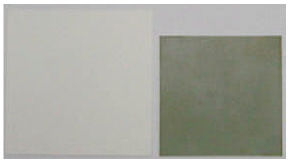 | |
| Fig. 1: | Al2O3 (left, white) and AlN (right, gray) ceramic substrates for LED |
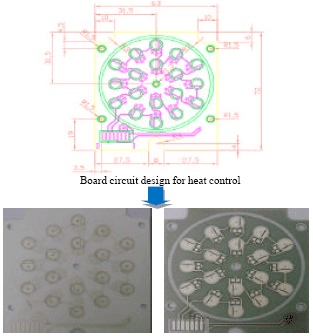 | |
| Fig. 2: | The circuit design of LED modules made with Al2O3 (left) and AlN (right) ceramic submount |
The junction pad was made as 5 mm circle in consideration of the effective heat release and the wire-bonding interval of chip-pad. Each LED chip was placed at center of junction pad and each module was completed by wire bonding and cap sealing. The emission peak and dominant wavelength of LED chip used (Cree Co. Ltd.,) were 455 nm and 460 nm, respectively. The half bandwidth of chip was in the range of 22-24 nm. The total radiant flux of chip was in the range of 280-300 mW@350mA. Electrode had interval of 0.5 mm and line width of 1 mm to provide current to LED.
RESULTS AND DISCUSSION
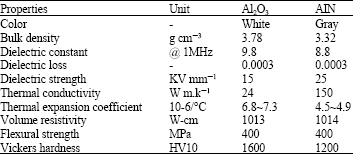
Comparison of ceramic substrates: The AlN substrate has high thermal conductivity of 150 W/m.K at room temperature, which is seven times as high as that of Al2O3 substrate. The thermal expansion coefficient of the AlN is 4.5x10⁻⁶/°C, which is very close to that of the silicon semiconductor chip (3.4x10⁻⁶/°C) and much smaller than that of Al2O3 (Huang et al., 2007). This difference can reduce the stress problem induced by thermal expansion mismatches between the LED chip and ceramic submount in case of AlN substrate and also make it advantageous for mounting large size LED modules. The AlN substrate also has good electrical properties, that is, the electrical resistivity is 1x10¹⁴ Ω-cm and low dielectric constant almost as good as Al2O3 substrate. The AlN substrate shows not only higher mechanical strength but also easier machinable property than Al2O3 as shown in Table 1.
The eutectic bonding of LED chip was carried out at various temperatures. Figure 3 shows bonding strength between chip and substrate with time at various temperatures. From Fig. 3, it was noted that higher junction temperature induced stronger bonding between chip and substrate. However eutectic bonding temperature was set up at 320°C in this work from the view point of reducing thermal damage to LED chip.
Figure 4a-d and 5a-d show heat distribution of LED module with time. The thermal image maps were obtained with the thermographic camera (Flir Co. Ltd., T400). As shown in Fig. 4 and 5 AlN substrate showed better thermal conduction than Al2O3 substrate after driving the LED modules for 1 h.
| Table 1: | Comparison of Al2O3 and AIN substrates |
 | |
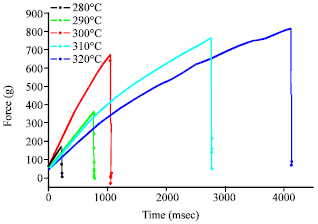 | |
| Fig. 3: | Die bonding shear force between chip and substrate with time and temperature |
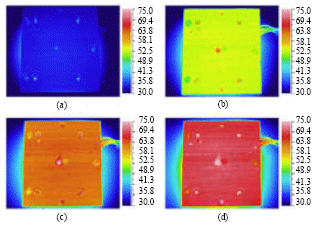 | |
| Fig. 4: | (a-d) Heat distribution of LED module with Al2O3 substrate with time. (a) 10 min, (b) 30 min, (c) 50 min and (d) 60 min |
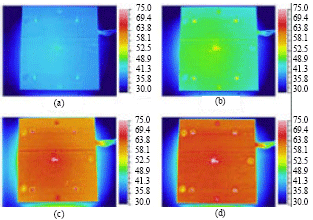 | |
| Fig. 5: | (a-d) Heat distribution of LED module with AlN substrate with time. (a) 10 min, (b) 30 min, (c) 50 min and (d) 60 min |
Effect of encapsulation materials: The heat dissipation is an important issue in the LED module as discussed in the AlN and Al2O3 substrates.
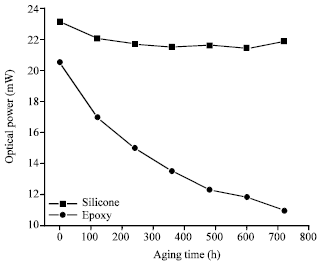 | |
| Fig. 6: | Change of relative light power of the LEDs at 20 mA drive current over time |
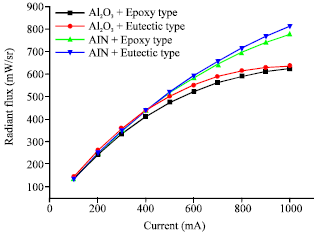 | |
| Fig. 7: | Optical power of LED modules with current, die bonding type and substrate parameters |
The choice of encapsulation material has also attracted much attention recently from the researchers of LED lighting from the view point of LED life time and efficiency.
The epoxy and silicone resins have been used as encapsulant in the packaging of LED module. In this study LED modules were packaged under optimum condition and process by using two different encapsulants, epoxy (DC-5260/DH-5260) and silicone (OE-6635) resins. The resulting LED modules were operated at a steady current 20 mA in the aging tests and total radiant flux was measured with time. The time when the light intensity attenuation reached 50% of the initial value was taken as the lifetime of the LED. It is seen from Fig. 5 that the lifetime of the LED module encapsulated with epoxy resin is about 720 h in this experiment which was conducted with UV LED as light source (Touloukian et al., 1970). This relatively short life time can be attributed to the yellowing of epoxy encapsulant under continuous exposure to the UV light. The silicone resin, however, had much less damage compared to epoxy resin, which could be explained by the presence of phenyl rings in the epoxy resin with high UV absorption property.
The optical power of LED modules on Al2O3 and AlN substrates was also studied according to the die bonding type with increasing current as shown in Fig. 7. The optical power was not dependant on the bonding type (Epoxy or Eutectic) to a large extent. However the effect of ceramic substrate was quite high, showing again the importance of the heat management in the LED module.
CONCLUSIONS
It was noted that the suitable thermal management is very important to achieve and guarantee optimal performance and reliability of the LED module. When LED modules were fabricated on aluminum oxide (Al2O3) and Aluminum Nitride (AlN) as submount, the latter exhibited much better thermal flow than the former as observed with the thermal imaging camera. We also fabricated COB type LED modules with epoxy and silicone resins as encapsulant, Al2O3 and AlN as substrates utilizing eutectic and epoxy die bonding methods. In these experiments the effect of AlN substrate was larger than other parameters for high power operation of LED modules.
REFERENCES
- Biber, C., 2008. LED light emission as a function of thermal conditions. Proceedings of the 24th Annual IEEE Symposium on Semiconductor Thermal Measurement and Management, March 16-20, San Jose, CA., pp: 180-184.
CrossRefDirect Link - Liu, C.K., M.J. Dai, C.K. Yu and S.L. Kuo, 2007. High efficiency silicon-based high power LED package integrated with micro- thermoelectric device. Proceedings of Technical Papers International Conference on Microsystems, Packaging, Assembly and Circuits Technology, Oct. 1-3, Taipei, Taiwan, pp: 29-33.
CrossRefDirect Link - Hu, J., L. Yang and M.W. Shin, 2008. Electrical, optical and thermal degradation of high power GaN/InGaN light-emitting diodes. Phys. D Applied Phys., 41: 035-107.
CrossRef - Hon, S.J., C.T. Kuo, T.P. Chen and M.H. Hsieh, 2008. High power GaN LED chip with low thermal resistance. Proceedings of SPIE the International Society for Optical Engineering, Jan. 21-24, San Jose, California, USA., pp: 689411.1-689411.10.
CrossRefDirect Link - Chau, S.W., C.H. Lin, C.H. Yeh and C. Yang, 2007. Study on the cooling enhancement of LED heat sources via an electrohydrodynamic approach. Proceedings of the 33rd Annual Conference on IEEE Industrial Electronics Society, Nov. 5-8, Chung Yuan Univ., Jhongli, pp: 2934-2937.
CrossRefDirect Link - Huang, W., Y. Zhang, Y. Yu and Y. Yuan, 2007. Studies on UV-stable silicone-epoxy resins. J. Applied Polym. Sci., 104: 3954-3959.
CrossRefDirect Link