

M.F. Mohamad
Department of Gas Engineering, Faculty of Chemical and Natural Resources Engineering, Universiti Teknologi Malaysia, 81310 UTM Skudai, Johor, Malaysia
K.S.N. Kamarudin
Department of Gas Engineering, Faculty of Chemical and Natural Resources Engineering, Universiti Teknologi Malaysia, 81310 UTM Skudai, Johor, Malaysia
N.N.F. Nik Mohamed Fathilah
Department of Gas Engineering, Faculty of Chemical and Natural Resources Engineering, Universiti Teknologi Malaysia, 81310 UTM Skudai, Johor, Malaysia
M.S. Mohamed
Ibnu Sina Institute for Fundamental Science Studies, Universiti Teknologi Malaysia, 81310 UTM Skudai, Johor, Malaysia
Journal of Applied Sciences
Year: 2010 | Volume: 10 | Issue: 24 | Page No.: 3374-3378







ABSTRACT
Mercury is a natural occurring element and present in various concentrations in natural gas. Mercury is not only hazardous to human health and the environment but could also attack equipment components resulting in mechanical failure and gas leakage. This paper describes the preparation of various sizes and shapes of Au nanoparticles for mercury adsorption by using a microwave (MW)-polyol method in the presence of different polyvinylpyrrolidone (PVP) concentrations (1.9, 3.8 and 5.7 mM) as a polymer surfactant. Mixtures of spherical, triangular, hexagonal, octahedral, decahedral and icosahedral particles were obtained using this rapid method. Sizes and shapes was found strongly depend on the concentrations of PVP. Large spherical particles were the major product of PVP concentrations (1.9 and 3.8 mM), whereas small spherical particles were preferentially produced at the highest PVP concentration (5.7 mM). It should be noted that the polygonal particles also increases with increasing PVP concentrations. The amount of mercury adsorbed using 10 ppm mercury solution is the highest (7.2%) for PVP concentration of 5.7 mM. It is concluded that PVP concentrations affects the formation of sizes and shapes of Au nanoparticles thus affects the mercury adsorption. The present result provides new information about mercury adsorption on Au nanoparticles.
PDF Abstract XML References Citation
Received: June 06, 2010;
Accepted: July 06, 2010;
Published: October 19, 2010
How to cite this article
M.F. Mohamad, K.S.N. Kamarudin, N.N.F. Nik Mohamed Fathilah and M.S. Mohamed, 2010. Effects of PVP Concentration on the Formation of Size and Shape of Gold (Au) Nanoparticles for Mercury Adsorption. Journal of Applied Sciences, 10: 3374-3378.
DOI: 10.3923/jas.2010.3374.3378
URL: https://scialert.net/abstract/?doi=jas.2010.3374.3378
DOI: 10.3923/jas.2010.3374.3378
URL: https://scialert.net/abstract/?doi=jas.2010.3374.3378
INTRODUCTION
Mercury is present in nature and in most natural gas and natural gas condensate at varying levels (Ebinghaus et al., 1999). In Malaysia, the typical mercury concentration in natural gas and natural gas condensate are between 1 and 200 μg Nm-3 and 10 and 100 μg Nm-3 of gas, respectively (Shafawi et al., 1999). Mercury in natural gas condensate could be present in various forms (elemental, organometallic and inorganic salt), depending on the origin of the condensates. Although, the concentrations of mercury in a given natural gas may be considered very low, the effect is cumulative as it amalgamates. In the gas processing plant, mercury accumulates in quantities sufficient to cause severe attack and failure of cryogenic aluminum heat exchangers resulting in a mechanical failure and gas leakage (Wilhelm and Bloom, 2000). Another reason for removing mercury is that mercury is a very volatile element. Its vapors can be a dangerous source of air pollution, thus representing a serious risk for human health (Ebinghaus et al., 1999). Exposure to high mercury levels can be harmful to the brain, heart, kidneys, lungs and immune system of humans of all ages (Darbha et al., 2007).
The ability of gold (Au) to adsorb and amalgamate mercury is well known. Since the reactions strongly depend on sizes and shapes, the polyol method is a typical technique to prepare Au nanoparticles of different sizes and shapes by reducing their ionic salts. In general, a mixture of reagent and polymer surfactant in ethylene glycol (EG) is heated in an oil bath for several hours and spherical nanoparticles are prepared. Recently microwave (MW) heating has been coupled with the polyol method for rapid preparation of Au nanoparticles (Tsuji et al., 2003). When Au3+ in AuCl¯ ions is reduced in EG in the presence of polyvinylpyrrolidone (PVP) under MW heating for 2-3 min, mixtures of triangular, square, rhombic and hexagonal nanoparticles are produced. In addition, small numbers of one-dimensional (1-D) nanorods and nanowires are produced. This study describes the effects of various sizes and shapes of Au nanoparticles produced using various PVP concentrations on mercury adsorption.
MATERIALS AND METHODS
Hydrogen tetrachloroaurate (III) hydrate (HAuCl4.3H2O) as a source of Au nanoparticles, polyvinylpyrrolidone (PVP) as a protecting agent or capping agent and ethylene glycol (EG) as both solvent and reductant. Mercury chloride (HgCl2) is used as a source of mercury.
Preparation of Au nanoparticles: The MW-polyol method used in this study was similar to that reported previously (Tsuji et al., 2003, 2004). Au nanoparticles solutions were prepared by reduction of HAuCl4.3H2O (0.02 g: 0.0559 mmol) in 20 mL ethylene glycol in the presence of various concentrations of PVP (average molecular weight: 58,000, 2.22-6.66 g: corresponding to 0.038-0.115 mmol). The solution was rapidly heated by MW irradiation from room temperature to the boiling point of EG (198°C) for 3 min. PVP acts as a stabilizer of small Au nanoparticles.
Preparation of mercury solution: The initial mercury standard solution was prepared by dissolving 0.01354 g of HgCl2 in 1 L deionized water. This solution was further diluted whenever necessary for the analysis.
Characterization of Au nanoparticles: After MW irradiation, products solutions of Au nanoparticles were centrifuged at 10,000 rpm for 2 h. The relative centrifugal force was 9503 G in the centrifugal separation. The centrifugal step was carried out twice. The precipitate was collected and dispersed on ethanol for transmission electron microscopy (JEOL JEM-2010 TEM) observation. Absorption spectra of reagent and product solutions were measured in ultra violet-visible (UV-Vis) absorption spectroscopy using Jenway 6305 spectrometer. Original product solutions were diluted in ethanol by factor of 25 before the spectral measurements.
Mercury adsorption measurement: After Au nanoparticles solution was centrifuged, the precipitate (0.001 g) was added in 10 mL mercury solution. The percentage Au nanoparticles to adsorb mercury were determined by analyzing the concentration mercury solution before and after the contacts with Au nanoparticles. The absorbance measurements were carried out by the atomic absorption spectrophotometer (AAS, AAnalyst 400).
RESULTS AND DISCUSSION
Synthesis of Au nanoparticles: Figure 1a-c show TEM images of Au nanoparticles obtained at three different PVP concentrations (1.9, 3.8 and 5.7 mM) along with product distribution diagram of each particle that indicate the effect of PVP concentration on the formation of size and shape of Au nanoparticles. It was found that sizes and shapes of products depend strongly on the PVP concentrations. Various mixtures of spherical, triangular, hexagonal, octahedral, decahedral and icosahedral particles were produced. In addition, small amount of 1D rods was also present (not shown in Fig. 1). It should be noted that not only sizes but also yields of each product change with increasing PVP concentration in Fig. 1. The definition of sizes of each particles in this study is shown in Fig. 2 (Supplementary data). The average sizes of polygonal particles were measured from diameters and edge length of particles, while the average lengths were measured for 1D nanorods and nanowires. The average sizes were estimated by measuring more than 100 particles.
At the lowest PVP concentration of 1.9 mM, mixtures of the following particles were produced: spherical particles (yield 60%, size ranges between 22-65 nm), triangular plates (7%, 39-65 nm), hexagonal plates (4%, 37-65 nm), octahedral (21%, 35-63 nm), decahedral (6%, 35-52 nm) and icosahedral (2%, 39-41 nm). At the medium PVP concentration of 3.8 mM, mixtures of following nanoparticles were produced: spherical particles (yield 78%, size ranges between 17-78 nm), triangular (3%, 22-41 nm) and hexagonal plates (1%, 52 nm), octahedral (11%, 20-70 nm), decahedral (5%, 30-50 nm), icosahedral (1%, 39 nm) and 1 D product (1%, 57-70 nm). It should be noted that the yield of spherical particles increase by factor 1.3, while the yield of triangular, hexagonal, octahedral, decahedral and icosahedral decrease by factor 1.2-4 in comparison with the result obtained at the lower PVP concentration of 1.8 mM.
At the higher PVP concentration (5.7 mM), a mixture of following nanoparticles was obtained: spherical particles (yield 74%, size ranges between 17-59 nm), triangular plates (2%, 30-39 nm), hexagonal plates (3%, 24-33 nm), octahedral (17%, 15-50 nm), decahedral (3%, 28-39 nm) and 1 D product (1%, 50 nm). The yield of spherical particles decrease by factor 1.1, while the yield of hexagonal and octahedral increase by factor 1.5-3 in comparison with the result obtained at the medium PVP concentration of 3.8 mM.
Figure 3 shows that the average size distribution of each product. The hexagonal plates increase by factor of about 1.1 with increasing the PVP concentration from 1.9-3.8 mM.
On the other hand, sizes of spherical, octahedral, decahedral, icosahedral particles and 1 D products decrease by factors of 0.7-1 with increasing PVP concentration from 1.9 to 5.7 mM.
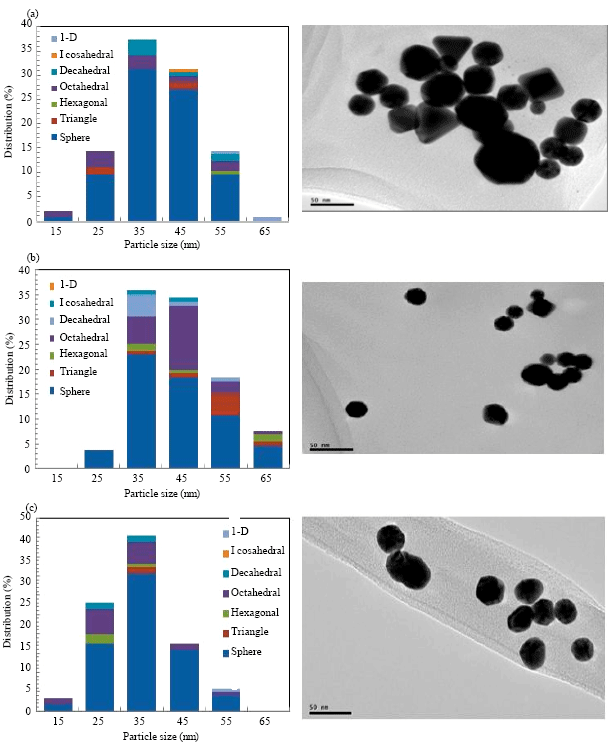 | |
| Fig. 1: | TEM photographs of Au nanoparticles obtained from three different PVP concentrations, (a) 1.9, (b) 3.8 and (c) 5.7 mM along with product distribution diagram of each particle |
The sizes of triangular plates increase by factor of 1 in the 3.8-5.7 mM. Based on the above findings, it is shown that the size of Au products generally decreased with increasing the PVP concentration.
The product solutions of Au nanoparticles were measured using UV-vis spectrometer. It is known that the wavelengths and absorbance of surface plasmon resonance (SPR) bands depend on their sizes and shapes of Au nanoparticles. In the product spectra (Fig. 4), SPR bands of Au nanoparticles appear in 500-700 nm regions. It is known that a SPR band of spherical Au nanoparticles appears in the 500-600 nm regions with a sharp peak at about 520 nm (Henglein, 1999; Pastoriza-Santos and Liz-Marzan, 2002; Malikova et al., 2002) while SPR bands of polygonal Au nanoparticles are observed in the 550-800 nm region (Tsuji et al., 2003).
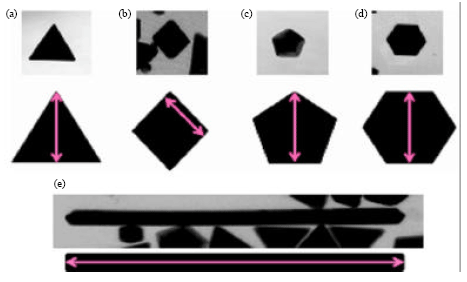 | |
| Fig. 2: | Definition of size of each particle (Tsuji et al., 2004) |
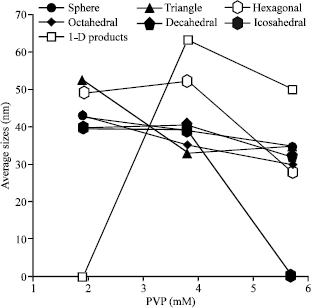 | |
| Fig. 3: | Dependence of average size distribution of Au nanoparticles prepared from three different PVP concentrations, (a) 1.9, (b) 3.8 and (c) 5.7 mM |
Thus, strong band in the 500-600 nm region observed in spectra product solutions are ascribed to a SPR band of spherical Au nanoparticles while the longer wavelength bands above 600 nm is attributed to SPR band of polygonal Au nanoparticles. At the low lowest PVP concentration of 1.9 mM, a strong SPR band with a peak at ~540 nm and a very weak shoulder peak at 680 nm are observed. By the addition 3.8 mM of PVP concentration, the SPR band becomes broad and the main peak and a shoulder peak shift to 540 nm and 650 nm, respectively.
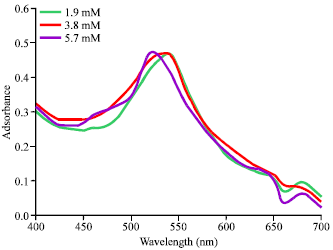 | |
| Fig. 4: | Absorption spectra of product solutions with different PVP concentration |
At the highest PVP concentration of 5.7 mM, the SPR band with a peak ~520 nm and a very weak shoulder peak at 680 nm are observed. These observation data are consistent with the sizes and shape changes observed in TEM images of Au nanoparticles (Fig. 1).
Mercury adsorption: The concentration of mercury solutions were measured before and after the contacts with Au nanoparticles in order to determine the performance mercury adsorbed with different sizes and shapes of Au nanoparticles. Equation 1 was used to determine the percentage amount of mercury adsorbed:
 | (1) |
where, Ci is initial mercury concentration (ppm) and Ce is equilibrium mercury concentration (ppm).
| Table 1: | AAS results of mercury adsorption on Au product solution with different PVP concentrations |
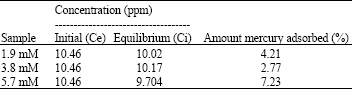 | |
Table 1 summarizes the AAS result of mercury adsorbed on Au nanoparticles using 10 ppm mercury solution. At the lower PVP concentration (1.9 mM), only 4.21% mercury was adsorbed. The adsorption of mercury reduced at 3.8 mM of PVP concentration but increase to 7.23% using 5.7 mM. The variation is due to the sizes and shapes of the Au nanoparticles produced. As discussed earlier, high PVP concentration produced small Au nanoparticles. In addition, the yields of octahedral particles are also increased as PVP concentration increased. Thus, at the lower PVP concentration, the size of Au nanoparticles is relatively larger especially the spherical particles. At the higher PVP concentration the size of octahedral shape is mainly 35 nm or less.
CONCLUSION
In this study, MW-polyol method was applied for fast synthesis of Au nanoparticles. It was found that from TEM observation, sizes and shapes of Au products depend strongly on the concentrations of PVP. The sizes of Au products generally decreased with increasing PVP concentration. Spherical particles produced as a dominant products but the yield of polygonal particles increases with increasing PVP concentration especially octahedral shape. The spectral observations from UV-visible absorption spectra are consistent with the TEM observation of sizes and shapes of products solution. From the mercury adsorption results, the high yield of polygonal particles adsorbed more mercury but the amount of mercury adsorbed is inversely proportional to the sizes of Au nanoparticles. It was concluded that PVP concentrations affects the formation of sizes and shapes of Au nanoparticles thus affect the mercury adsorption. The present result provides new information about mercury adsorption on Au nanoparticles and further studies will be carried out to control the sizes and shapes of Au nanoparticles for optimum mercury adsorption.
ACKNOWLEDGMENTS
We kindly thank Prof M. Tsuji of Institute for Materials Chemistry and Engineering in Japan for his guidance on the preparation of Au nanoparticles by MW-polyol method. This work was supported by Ministry of Higher Education (MOHE), Malaysia under Fundamental Research Grant Scheme (FRGS) and Universiti Teknologi Malaysia.
REFERENCES
- Darbha, G.K., A. Ray and P.C. Ray, 2007. Gold nanoparticle-based miniaturized nanomaterial surface energy transfer probe for rapid and ultrasensitive detection of mercury in soil, water and fish. J. Am. Chem. Soc., 1: 208-214.
CrossRefDirect Link - Ebinghaus, R., R.M. Tripathi, D. Wallschlager and S.E. Lindberg, 1999. Natural and Anthropogenic Mercury Sources and their Impact on the Air-Surface Exchange of Mercury on Regional and Global Scales. In: Mercury Contaminated Sites-Characterization, Risk Assessment and Remediation. Ebinghaus, R., R.R. Turner, L.D. de Lacerda, O. Vasiliev and W. Solomons (Eds.). Springer, Heidelberg, pp: 3-50.
- Henglein, A., 1999. Radiolytic preparation of ultrafine colloidal gold particles in aqueous solution: Optical spectrum, controlled growth and some chemical reactions. Langmuir, 15: 6738-6744.
CrossRefDirect Link - Malikova, N., I. Pastoriza-Santos, M. Schierhorn, N.A. Kotov and L.M. Liz-Marzan, 2002. Layer-by-layer assembled mixed spherical and planar gold nanoparticles: Control of interparticle interactions. Langmuir, 18: 3694-3697.
CrossRefDirect Link - Pastoriza-Santos, I. and L.M. Liz-Marzan, 2002. Formation of PVP-protected metal nanoparticles in DMF. Langmuir, 18: 2888-2894.
CrossRefDirect Link - Shafawi, A., L. Ebdon, M. Foulkes, P. Stockwell and W. Corns, 1999. Determination of total mercury in hydrocarbons and natural gas condensate by atomic fluorescence spectrometry. Analyst, 124: 788-796.
CrossRefDirect Link - Tsuji, M., M. Hashimoto, Y. Nishizawa and T. Tsuji, 2003. Preparation of gold nanoplates by a microwave-polyol method. Chem. Lett., 32: 1114-1115.
CrossRef - Tsuji, M., M. Hashimoto, Y. Nishizawa and T. Tsuji, 2004. Synthesis of gold nanorods and nanowires by microwave-polyol method. Mater. Lett., 58: 2326-2330.
CrossRef