

K. Shahbaz
Department of Chemical Engineering, University of Malaya, 50603, Kuala Lumpur, Malaysia
Farouq. S. Mjalli
Department of Petroleum and Chemical Engineering, Sultan Qaboos University, Oman
M.A. Hashim
Department of Chemical Engineering, University of Malaya, 50603, Kuala Lumpur, Malaysia
Inas. M. ALNashef
Department of Chemical Engineering, King Saud University, Riyadh, Saudi Arabia
Journal of Applied Sciences
Year: 2010 | Volume: 10 | Issue: 24 | Page No.: 3349-3354







ABSTRACT
One of the essential steps in the manufacture of biodiesel is its purification from the glycerol by-product. The produced biodiesel should have a low glycerol content which is regarded as one of the important needed pointers for passing the international biodiesel standards. Low cost Deep Eutectic Solvents (DES) have been tested for their solvation properties. In this work, DESs were used to remove all free glycerol and reduce total glycerol from palm oil-based biodiesel. Liquid-liquid extraction experiments were conducted to explore the effect of DES structure on the glycerol separation. All synthesized DESs were able to remove all free glycerol, successfully. The optimum molar ratio of DES to biodiesel was found to be 1:1 for all DESs.
PDF Abstract XML References Citation
Received: June 14, 2010;
Accepted: July 14, 2010;
Published: October 19, 2010
How to cite this article
K. Shahbaz, Farouq. S. Mjalli, M.A. Hashim and Inas. M. ALNashef, 2010. Using Deep Eutectic Solvents for the Removal of Glycerol from Palm Oil-Based Biodiesel. Journal of Applied Sciences, 10: 3349-3354.
DOI: 10.3923/jas.2010.3349.3354
URL: https://scialert.net/abstract/?doi=jas.2010.3349.3354
DOI: 10.3923/jas.2010.3349.3354
URL: https://scialert.net/abstract/?doi=jas.2010.3349.3354
INTRODUCTION
Biodiesel is a renewable energy source which can be produced from vegetable oils and animal fats. Biodiesel as an alternative fuel has numerous advantages over conventional fossil fuels such as, biodegradability, renewability, high combustion efficiency, low sulfur and aromatic content (Ma and Hanna, 1999) and high Cetane number and flash point as high as fossil-based diesel (Mudge and Pereira, 1999). In addition, being of domestic origin reduces the dependency on imported petroleum which is another advantage of biodiesel (Mittelbach and Remschmidt, 2004).
The processes used for biodiesel production are well known. Among the available methods to produce biodiesel, transesterification is the method of choice. In this method, triglycerides which are the main components of vegetable oils, react with an alcohol (e.g., methanol or ethanol) in presence of a catalyst (e.g., alkali, Acid or enzyme) to produce Fatty Acid Alkyl Esters (FAAE) and glycerol as by-product.
Methanol is the most common alcohol used in transesterification reactions because of its low price compared to other alcohols. The stoichiometry of the reaction demands three moles of methanol and one mol of triglyceride to produce three moles of fatty acid methyl ester and one mole of glycerol. This reaction consists of three consecutive reversible reactions with intermediate formation of diglycerides and monoglycerides as shown in Fig. 1. At the end of reaction, glycerol is separated by settling or centrifuging.
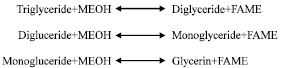 | |
| Fig. 1: | Three consecutive reversible reactions to produce FAAM |
The glycerol obtained is further purified before using it for its traditional applications or for new applications (Vicente et al., 2007).
However, the produced biodiesel contains a significant quantity of glycerol and another purification stage of biodiesel is necessary before using it as an automobile fuel.
As indicated in Fig. 1, the triglyceride molecule loses three FAME molecules in a complete reaction. However, this reaction does not go to completion and the product will be contaminated with un-reacted triglycerides from the parent vegetable oil and the intermediates mono- and diglycerides (acylglycerols). These are referred to as bound glycerol. Another source of glycerol found in the final biodiesel is the remaining glycerol that has not been removed from the biodiesel during the purification step. The latter is referred to as free glycerol. The sum of the bound and the free glycerol is referred to as total glycerol.
The presence of total glycerol initiates engine corrosion and on the long term affects human or animal health by emission of hazardous acrolein into the environment. Moreover, the quality of the final biodiesel depends on its glycerol content. The viscosity of the glycerol present in the mixture hinders the high-pressure injection system of a modern diesel engine and may cause damage (Abbott et al., 2007). Accordingly, maximum allowable amounts of free and total glycerol are included in the biodiesel specification of most countries. The finally produced biodiesel should fulfill EN 14214 and ASTM D6751 standard specifications.
There are several methods for removing glycerol from biodiesel including, wet and dry washing of the biodiesel product (Berrios and Skelton, 2008), adsorption over silica (Yori et al., 2007), using membrane reactors (Dube et al., 2007) and the addition of lime and phosphoric acid to the biodiesel product (Chiu et al., 2006). However, using these methods, the final production cost is increased due to materials expenses and process complications. Moreover, the above-mentioned methods are not environmentally benign because of a massive discharge of wastewater.
Ionic Liquids (ILs) are composed of discrete cations and anions which are liquid at or below 100°C. In recent years, because of ILs unusual properties, they have attracted more attention and became interesting for many applications. Thus, they have great potential as green solvents for industrial processes (Rogers and Seddon, 2002). Ionic liquids have been described as designer solvents (Freemantle, 1998) and this means that their properties can be tuned to suit the requirements of a particular process. Properties such as melting point, viscosity, density and hydrophobicity can be varied by simple changes to the structure of the ions (Martyn and Kenneth, 2000). ILs do not evaporate due to their very low vapor pressures and they have great ability to dissolve many different organic, inorganic and organometallic materials. In addition to all these properties, they are immiscible with many organic solvents and are highly polar.
Due to the high costs of ILs, Deep Eutectic Solvent (DES) can be utilized as a low cost alternative. Currently, DESs are being used in research as well as in industry because of their potential as environmentally benign solvents and advantages such as non-toxicity, non-reactivity with water and being biodegradable (Abbott et al., 2004). In fact, DESs represent common solvation properties with ionic liquids. They are formed by mixing two or more components and they have low melting point compared to their compounds. In other words, they are created from mixtures of organic halide salts with an organic compound which is a Hydrogen Bond Donor (HBD) able to form a hydrogen bond with the halide ion (Liu et al., 2008). Freezing point depression causes the liquid state of DES, whereby hydrogen-bonding interactions between an anion and an HBD are more energetically favored relative to the lattice energies of the pure constituents (Nkuku and LeSuer, 2007).
Abbott et al. (2004 and 2003) have shown that ILs created from eutectic mixture of quaternary ammonium salts and hydrogen bond donors is an efficacious technique of producing inexpensive, non-toxic and environmentally benign solvents systems. These deep eutectic solvents have practical uses in some applications like electropolishing and metal oxide processing (Abbott et al., 2005, 2006). Moreover, they have shown that a glycerol based DES can be used successfully as an extraction media for glycerol from biodiesel product (Abbott et al., 2007).
Recently, Hayyan et al. (2010) showed that ionic liquid based on a low cost quaternary ammonium salt (choline chloride) and glycerol can be used as a solvent for extracting glycerol from palm oil-based biodiesel in a continuous separation process. The effect of DES to biodiesel ratio and the composition of DES on the efficiency of extraction process were investigated. The best ratio of DES:biodiesel was (1:1) and the DES composition was (1:1, Salt:HBD).
In an attempt to improve the abovementioned work, we present two new successful deep eutectic solvents to remove all free glycerol from palm oil-based biodiesel. The ratios of DES composition and DES to biodiesel were optimized for maximum removal of total glycerol.
MATERIALS AND METHODS
Chemicals: Palm oil (FFM Sdn Bhd), methanol (CH3OH, Merck 99%), potassium hydroxide (KOH, HMGM Chemicals > 98%), choline chloride (C5H14ClNO, Merck 99%), ethylene glycol (HOCH2CH2OH, Merck 99%) and 2,2,2-trifluracetamide (C2H2F3NO, Merck 99%) were obtained from commercial sources and used in synthesis of biodiesel and DESs without further purification.
Synthesis: To synthesize biodiesel, potassium hydroxide as a catalyst (1 wt% of palm oil) was suspended in methanol and shaken until potassium hydroxide was dissolved in methanol to form potassium methoxide. Afterwards, potassium methoxide was added to palm oil with 1:10 molar ratio (Cheng et al., 2004) of palm oil to methanol in a batch reactor with 400 rpm mixing speed at 50°C for 2 h. The products were transferred to a separation funnel and after overnight settling, biodiesel phase (upper layer) was separated from glycerol-rich phase (lower layer).
| Table 1: | Different DESs synthesized for removal of glycerol |
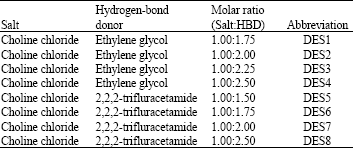 | |
In this study two DESs were utilized for extraction of glycerol, in the first a combination of choline chloride (ChCl) with ethylene glycol (as an HDB) was used whereas 2,2,2-trifluracetamide was used as the HBD in second. After drying Choline chloride under vacuum, it was mixed with ethylene glycol in different Salt: Ethylene glycol molar ratios (1:1.75, 1:2, 1:2.25 and 1:2.5) at 60°C and 300 rpm agitation until a homogenous transparent liquid appeared. For the synthesis of the 2,2,2-trifluracetamide based DES, ChCl was mixed with 2,2,2-trifluracetamide in different molar ratio (1:1.5, 1:1.75, 1:2 and 1:2.5) with mixing speed of 400 rpm at 90°C for 3 h followed by filtration of products. Table 1 shows the compositions of the different DESs synthesized in this study.
DESs characterization: Viscosities of the synthesized DESs were measured at 25°C using a rotary viscometer (Brookfield R/S plus Rheometer). Melting points of the DESs were determined by Mettler Toledo Differential Scanning Calorimetry (DSC).
Extraction method: To perform liquid-liquid extraction, each DES was added to the biodiesel phase separately in different molar ratios (ranging 0.75-3 molar units DES per 1 molar unit biodiesel) and then the samples were mixed for 1 h at room temperature with a shaking speed of 200 rpm using an orbital shaker. After two hours settling, the upper layers of samples were separated and analyzed for their free and total glycerol content by gas chromatography.
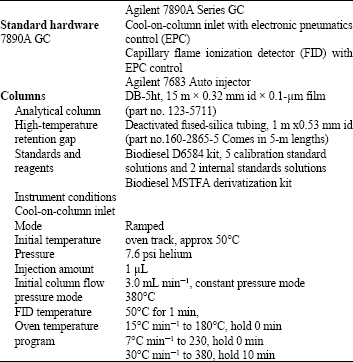
Gas chromatography analysis: The analysis of free and total glycerol in palm oil-based biodiesel was performed according to ASTM method of D6584 and CEN method of EN14105. The GC specifications and analysis conditions are given in Table 2. To prepare samples for GC analysis, butanetriol (internal standard#1) was used to identify free glycerol peak and then tricaprin (internal standard#2) was added to indentify the monoglycerides, diglycerides and triglycerides peaks. Also, N-Methyl-N-(trimethylsilyl) trifluoroacetamide (MSTFA) was used to improve volatility and reduce activity before injection into the GC. Finally the samples were injected into the gas chromatograph, once they were prepared.
| Table 2: | GC specifications and analysis conditions |
 | |
RESULTS AND DISCUSSION
DESs characterization: A quaternary ammonium based salts (choline chloride) and two different hydrogen-bond donors (ethylene glycol and 2,2,2-trifluracetamide) were selected for the synthesis of DESs in different salt to HBD molar ratios. The choline chloride was mixed with ethylene glycol as an HBD (DES1, DES2, DES3 and DES4). Figure 2 shows the melting points and viscosities of the different DESs as a function of ethylene glycol mole fraction. As this figure demonstrates, with the increase in ethylene glycol mole fraction, DESs viscosities declined gradually.
The decrease in viscosity can be attributed to the lower viscosity of ethylene glycol. Figure 2 also indicates that the minimum eutectic temperature was at 0.667 ethylene glycol mole fraction (DES2) corresponding to -66°C. In addition, this figure shows that DES1, DES2, DES3 and DES4 have very low freezing points which were congruous with physical properties of deep eutectic solvents. Low viscosity of DESs causes an increase in the mixing efficiency and using DESs that have lowest freezing point raises the amount of glycerol that can be extracted without causing the freezing point of the DES to increase above the process temperature. This in turn improves the solvent extractive capabilities.
The 2,2,2-trifluracetamide based DES was synthesized following the same procedure described above. The different synthesized ratios are coded DES5, DES6, DES7 and DES8. Figure 3 presents freezing points and viscosities of these DESs versus 2,2,2-trifluracetamide mole fraction.
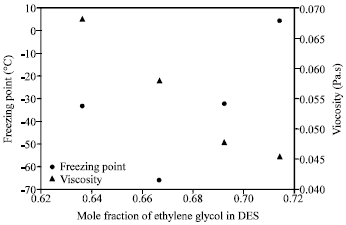 | |
| Fig. 2: | Freezing point and viscosity as a function of ethylene glycol mole fraction for DES1, DES2, DES3 and DES4 |
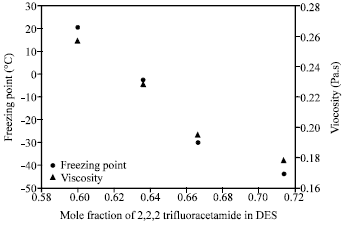 | |
| Fig. 3: | Freezing point and viscosity as a function of 2,2,2-trifluoroacetamide mole fraction for DES5, DES6, DES7 and DES8 |
As can be seen the freezing points of the above DESs were all below ambient temperature.
The eutectic point for the ChCl:2,2,2-trifluracetamide DES was not clear from Fig. 3 because mixing of any ratio above 1:2.5 resulted in a white precipitate, signifying that saturation had occurred and some of the salt or HBD is not contributing to the DES, thus the ratio of the resulting DES is not the same as intended to be. Nevertheless, the minimum freezing point attained was -45C with a corresponding viscosity of 0.178 Pa.s which makes it very convenient for use as solvent for liquid-liquid extraction separation, provided that the solute has reasonable mass transfer affinity to the DES.
Extraction of glycerol: Free Glycerol was extracted from palm oil-based biodiesel using liquid-liquid extraction with DES as a solvent.
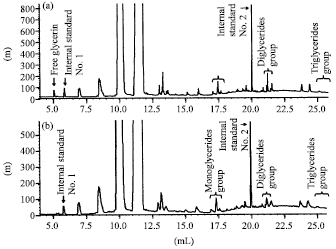 | |
| Fig. 4: | Gas chromatograms for biodiesel combinations: (a) before extraction and (b) after extraction |
For the extraction process, eight molar ratios of DES to biodiesel (0.75:1, 1:1, 1.25:1, 1.5:1, 1.75:1, 2:1, 2.5:1 and 3:1) were prepared for each of the synthesized DESs (DES1, DES2 … DES8). After mixing the DES with biodiesel and leaving it for about two hours for settling, two separate layers of biodiesel and DES were distinguished and the DES layer was separated completely.
Gas chromatography analysis of the biodiesel before extraction indicates that free glycerol content was 0.04093 (wt.%). This is higher than free glycerol content specified by the EN 14214 and ASTM D 6721 standards (0.02 mol% and 0.020 wt.%, respectively). However, the total glycerol content was 0.199 wt.%, which is in compliance with the standards (0.25 mol% and 0.24 wt.%, respectively).
The Gas chromatograms of the analyzed biodiesel before and after extraction are shown in Fig. 4a and b, respectively. To obtain a precise result from the GC analysis, each sample of biodiesel was injected three times and an average was taken as the representative value. The peaks of each component were identified using the relative retention times based on the retention times of the internal standards. As can be seen from the chromatograms in Fig. 4, there is no peak for free glycerol after extraction which means that the DES was successful in removing the free glycerol completely. GC analysis results revealed that all DESs (DES1 to DES8) were able to remove all free glycerol content.
After identifying the peaks of mono, di and triglycerides and measuring the areas of the peaks, the weight percentage of each glycerides was calculated. The total glycerol was calculated according to the ASTM D-6584 standard as shown in Eq. 1:
 | (1) |
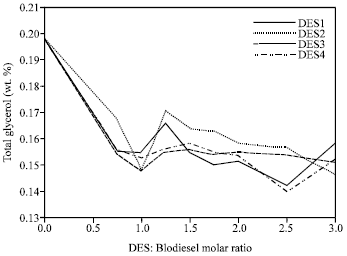 | |
| Fig. 5: | Total glycerol removed by ChCl:ethylene glycol DES |
where, G, MG, DG and TG are free glycerol, monoglycerides, diglycerides and triglycerides, respectively.
The effect of DES to biodiesel molar ratios on the removal of total glycerol was also studied. According to Eq. 1, removal of free glycerol reduces the value of the total glycerol. As indicated by Fig. 5, the ability of DES1, DES2, DES3 and DES4 to decrease the total glycerol content increased with the increase in the DES to biodiesel ratio for all DESs until the ratio of 1:1 is reached. After this ratio, the decrease in total glycerol content was not noticeable. The maximum removal of total glycerol (30 wt. %) occurred at the 2.5:1 DES4 to biodiesel ratio. However, based on the initial amount of solvent and total glycerol removal, DES to biodiesel ratio of 1:1 is chosen as the optimum ratio for the ethylene glycol based DES.
Figure 6, the 2,2,2-trifluracetamide DESs (DES5, DES6, DES7 and DES8) showed their ability to reduce total glycerol content. The figure indicates a considerable reduction in total glycerol at a DES: biodiesel molar ratio of 1:1. After that point no significant change was observed. The maximum removal of total glycerol took place at 3:1 molar ratio using DES6.
The optimum DES to biodiesel ratio for the removal of total glycerol occurs at 1:1 as well as 2.5:1 and 3:1 for the other two respective DES systems tested. Looking at the gain in removal between the 1:1 ratio and the other two ratios reveals that the change is 3.7 and 4.7%, respectively. From a practical point of view this gain is negligible compared to the difference in amount of solvent (DES) used for the two mentioned ratios. Hence, to minimize the amount of DES used in the separation, it was decided to regard the 1:1 ratio as the optimum separation ratio for both DES systems and neglect the little separation gain achieved using the other ratios.
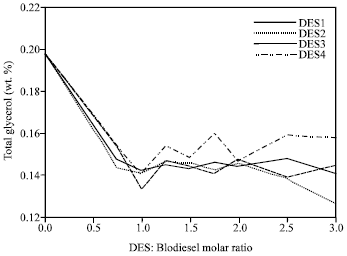 | |
| Fig. 6: | Total glycerol removed by ChCl: 2,2,2-trifluracetamide DES |
CONCLUSIONS
The current study presented a novel purification method for the removal of glycerol from palm oil based biodiesel. Both DES combination of ChCl:ethylene glycol and ChCl:2,2,2-trifluracetamide were found to be successful to remove all free glycerol from palm oil-based biodiesel. The most effective conditions for reducing total glycerol content for ChCl:ethylene glycol were 1:2.5 salt:HBD and of 2.5:1 DES to biodiesel molar ratios. While for ChCl:2,2,2-trifluracetamide DESs the most effective conditions for reducing total glycerol content were 1:1.75 salt:HBD and 3:1 DES to biodiesel mole ratios. The optimum molar ratio for all DESs (DES1 to DES8) was found to be 1:1 molar ratio of DES to biodiesel.
ACKNOWLEDGMENT
This study was supported by the University of Malaya IPPP grant number PS133/2009C.
REFERENCES
- Berrios, M. and R.L. Skelton, 2008. Comparison of purification methods for biodiesel. Chem. Eng., 144: 459-465.
CrossRef - Cheng, S.F., Y.M. Choo, A.N. Ma and C.H. Chuah, 2004. Kinetics study on transesterification of palm oil. J. Oil Palm Res., 16: 19-29.
Direct Link - Chiu, C.W., M.A. Dasari, W.R. Sutterlin and G.J. Suppes, 2006. Removal of residual catalyst from simulated biodiesel's crude glycerol for glycerol hydrogenolysis to propylene glycol. Ind. Eng. Chem. Res., 45: 791-795.
CrossRef - Dube, M.A., A.Y. Tremblay and J. Liu, 2007. Biodiesel production using a membrane reactor. J. Bioresour. Technol., 98: 639-647.
CrossRef - Hayyan, M., S.M. Farouq, M.A. Hashim and I.M. AlNashef, 2010. A novel technique for separating glycerol from palm oil-based biodiesel using ionic liquids. Fuel Process. Technol., 91: 116-120.
CrossRef - Liu, L., Y. Kong, H. Xu, J.P. Li, J.X. Dong and Z. Lin, 2008. Ionothermal synthesis of a three dimensional zinc phosphate with DFT topology using unstable deep-eutectic solvent as template-delivery agent. Microporous Mesoporous Mater., 115: 624-628.
CrossRef - Ma, F. and M.A. Hanna, 1999. Biodiesel production: A review. Bioresour. Technol., 70: 1-15.
CrossRefDirect Link - Earle, M. and K.R. Seddon, 2000. Ionic liquids: Green solvents for the future. Pure Appl. Chem., 72: 1391-1398.
Direct Link - Mudge, S.M. and G. Pereira, 1999. Stimulating the biodegradation of crude oil with biodiesel preliminary results. Spill Sci. Technol. Bull., 5: 353-355.
CrossRefDirect Link - Nkuku, C.A. and R.J. LeSuer, 2007. Electrochemistry in deep eutectic solvents. J. Phys. Chem., 111: 13271-13277.
CrossRef - Vicente, G., M. Martinez and J. Aracil, 2007. Optimisation of integrated biodiesel production. Part I. A study of the biodiesel purity and yield. Bioresour. Technol., 98: 1724-1733.
CrossRef - Yori, J.C., S.A. D`Ippolito, C.L. Pieck and C.R. Vera, 2007. Deglycerolization of biodiesel streams by adsorption over silica beds. Energy Fuels, 21: 347-353.
CrossRef - Abbott, A.P., P.M. Cullis, M.J. Gibson, R.C. Harris and E. Raven, 2007. Extraction of glycerol from biodiesel into a eutectic based ionic liquid. Green Chem., 9: 868-872.
Direct Link - Abbott, A.P., D. Boothby, G. Capper, D.L. Davies and R.K. Rasheed, 2004. Deep eutectic solvents formed between choline chloride and carboxylic acids: Versatile alternatives to ionic liquids. J. Am. Chem. Soc., 126: 9142-9147.
CrossRef - Abbott, A.P., G. Capper, K.J. McKenzie and K.S. Ryder, 2006. Voltammetric and impedance studies of the electropolishing of type 316 stainless steel in a choline chloride based ionic liquid. Electrochimica Acta, 51: 4420-4425.
CrossRefDirect Link - Abbott, A.P., G. Capper, D.L. Davies, R. Rasheed and P. Shikotra, 2005. Selective extraction of metals from mixed oxide matrixes using choline-based ionic liquids. Inorg. Chem., 44: 6497-6499.
CrossRefDirect Link - Abbott, A.P., G. Capper, D.L. Davies, R. Rasheed, V. Tambyrajah, 2003. Novel solvent properties of choline chloride/urea mixtures. Chem. Commun., pp: 70�71.
CrossRefDirect Link