

B. Raj Mohan
Department of Chemical Engineering, IIT Kharagpur 721302, India
B.C. Meikap
School of Chemical Engineering, Howard College, Faculty of Engineering, University of Kwazulu-Natal, Durban 4041, South Africa
Journal of Applied Sciences
Year: 2010 | Volume: 10 | Issue: 24 | Page No.: 3277-3282







ABSTRACT
Control of SO2 from industrial off gases need special attention to keen environment clean. In this study the results of scrubbing of sulfur dioxide gas a spray tower in combination with bubble column using a twin fluid air-assist atomizer has been presented. The removal efficiency is found to be a function of inlet SO2 concentration, the air flow rate and the liquid flow rate. Experimental investigation shows that a very high percentage removal of SO2 from 62.54 to 97.58 % can be achieved from a lean air-SO2 mixture (400 to 1200 ppm of SO2) without using any additives or pre-treatment. Increase in the efficiency with respect to concentration is mainly due to the increase in the concentration gradient between the liquid and gas phase SO2 concentrations, thus increasing the driving force for more absorption of SO2 into the liquid droplets. The results also indicate that, increase in liquid flow rates increases the SO2 removal efficiency where as increase in the gas flow rate decreases the removal efficiency. The efficiency of the spray column found to increase with increase spray liquid flow rate (8.35 to 33.34x10⁻⁶ m3 sec-1) and concentration of SO2 gas (400 to 1200 ppm). A maximum of almost 99.99% efficiency was observed for 1200 ppm at 3.354x10⁻³ m3 sec-1 gas flow rate and 33.34x10⁻⁶ m3 sec-1 of spray liquid flow rate.
PDF Abstract XML References Citation
Received: June 06, 2010;
Accepted: July 06, 2010;
Published: October 19, 2010
How to cite this article
B. Raj Mohan and B.C. Meikap, 2010. Control of SO2 from Industrial Effluents by a Spray-Cum Bubble Column Scrubber. Journal of Applied Sciences, 10: 3277-3282.
DOI: 10.3923/jas.2010.3277.3282
URL: https://scialert.net/abstract/?doi=jas.2010.3277.3282
DOI: 10.3923/jas.2010.3277.3282
URL: https://scialert.net/abstract/?doi=jas.2010.3277.3282
INTRODUCTION
Atmospheric pollution is considered to be most dangerous among pollutions of our ecosystem as it has direct influence over all living and nonliving things and its control by isolation and then cleaning becomes beyond man’s effort unless the pollutants are controlled at the source itself. A diverse variety of pollutants are emitted into the atmosphere by both natural and anthropogenic sources. They can be very broadly classified into primary and secondary air pollutants. Primary air pollutants are ash, smoke, dust, fumes, mist and spray; inorganic gases such as sulfur dioxide, ammonia, carbon monoxide, hydrogen sulfide, hydrogen fluoride and nitric acid; olefins and aromatic hydrocarbons. Secondary pollutants are the derivatives of the primary pollutants at atmospheric conditions in the atmosphere. Among these primary pollutants particulate matter emission was ignored initially as its acute effect on human is very less when compared to other air pollutants.
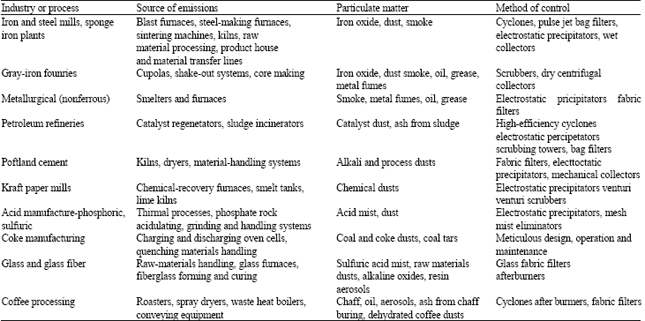
Effects of air pollutants: Particulates ranging in size from less than 0.1 to 50 μm are called Total Suspended Particulates (TSP). Particles larger than that range tend to settle out of the air. Particulate matter 10 μm in diameter and smaller is considered inhalable. This particulate matter is commonly called PM10. PM10 particulates are generally created during a burning process and include fly ash, carbon black and soot. A detail source of air pollutants specially particulates and their control methods are presented in Table 1. The PM10 particulates from these sources contain a large percentage of elemental and organic carbon, which plays a major role in haze phenomena and health effects. Air pollution has become a global problem because of its boundary less condition. Industries and many scale plants world wide have been practicing variety of control methods over years to meet the standards. Many of government and non-governmental organizations are involved in continual research to reduce and control particulate matter (air pollutants) at the source itself. The current National Ambient Air Quality Standard PM10, is 50 μg per cubic meter of air and need techno-economic control device to meet the pollution control standards.
Pollution potentiality of sponge iron plants in india: India is leading the global sponge iron production for last four years. There are 147 coal based units with a capacity of 11 million tones spread in all over India in states like Orissa, Jharkand, West Bengal, Chhattishgarh, Maharashtra, Goa andhra Pradesh, Karnataka, Tamil Nadu and Kerala.
| Table 1: | Sources of particulate matter and its control techniques |
 | |
Orissa alone has 82 units. Thirty percent of Ferro metallics input for steel making in our country is by secondary small and medium enterprises. Sponge Iron Plants have considered to be highly polluting industries in view of generation of substantial amount of air pollutants and solid wastes. During last five years there is mushrooming growth of coal based sponge iron plants in India. Huge amount of solid wastes in the form of char and fine dust are generated.
Rotary kilns are the major source of air pollution in sponge iron plants. The hot flue gas flowing counter currently to the materials in the rotary kiln is passed through After Burning Chamber (ABC) to convert residual CO into CO2 by burning with excess air at 1000° C. Then the flue gas containing high concentration of dust is passed through settling chamber, where heavy dust particles settle and high quantity of fine dust particles (30 g Nm-3) was released into the atmosphere at 900°C in the form of dense fume through a chimney of height above 35 m. Due to stringent emission standards (150 mg Nm3) laid by State and Central Pollution Control Boards almost all these units have installed electrostatic precipitators having almost 99% efficiency in removing the fine dust particles.
Particulate control methods: Particulates control methods can be broadly classified into dry methods and wet methods. All particulate matter control equipments either wet or dry, work based on any one or in combination of the following mechanisms.
Gravitational settling
| • | Centrifugal impaction |
| • | Inertial impaction |
| • | Direct interception |
| • | Diffusion |
| • | Electrostatic precipitation |
Particulate matter collecting equipments working using one or some of the above principles are classified under both wet and dry method. Due to certain major disadvantages of dry methods, wet methods are efficient for both removal of dust and gaseous pollutants.
Wet scrubbers: Wet scrubbers remove particles from gas streams by capturing the particles in liquid droplets or in sheets of scrubbing liquid (usually water) and then separating the droplets from the gas stream. Several process variables affect particle capture; they include particle size, the size of liquid droplets and the relative velocity of the particle and the liquid droplets, with particle size being the most important parameter (Keey and Pham, 1977). In general, larger particles are easier to collect than smaller ones. The key to effective particle capture in a wet scrubber is creating a mist of tiny droplets that act as collection targets: usually, the smaller the droplet and the more densely the droplets are packed, the better the ability to capture smaller-sized particles (Javed et al., 2005; Jin et al., 2006).
There are large varieties of wet scrubbers in use, the most important of which are spray towers and chambers, packed and plate columns, impingement type scrubbers and finally, the venturi scrubbers. These wet scrubbers used in practice offer a choice between the liquid dispersed and gas dispersed systems (Calvert et al., 1970, 1974; Burkholz, 1989; Pulley and Walters, 1992; Meikap and Biswas, 2004). Because of their intrinsic pressure drop and flow characteristics, the spray and bubble columns are more convenient than packed column in particulate control. The simplest, least expensive and lowest energy scrubber among the scrubbers is the simple counter-current spray scrubber. In this counter current spray tower, drops of liquid are introduced by spray nozzles and allowed to fall down through rising stream of dirty gas (Dullien, 1989). The advantage of using multistage two stage scrubbing process is to achieve high efficiency in scrubbing even very fine particles with high capacity (Meikap and Biswas, 2004).
Literature review on the control of particulate matter from industrial flue gases shows that out of the wet scrubbing processes, venturi scrubbers have been most widely used. However it is less applicable to gas than to particulate matter as they offer a relatively short contact time and require high pressure drop for greater than 40 to 50% efficiencies. Hence, multiple stages of venutri scrubbers are normally required. The revised standards of EPA in 1997 has restricted the maximum discharge limits for coal based thermal power plants emission of particulate matter less than 2.5 microns (PM2.5) is 150 mg m-3 (arithmetic mean) annually and 65 mg m-3 for 24 h. Calculations show that 76% removal of particulates less than 2 microns in size is essential to meet the stringent standards prescribed by US, EPA. The existing emission standard for particulate matter in India is higher (150 mg Nm-3) is not achievable and should be operated at least at 99.5% efficiency. Thus the equipment and process selected for control of particulate matter should have high efficiency. Large numbers of studies on removal of particulate matter by wet scrubbing have been reported. However, most of the processes developed are under patent protection. Because of the above-mentioned advantages of the modified and combined process of particulate scrubbing, a spray cum bubble column scrubber is designed and an attempt is made to scrub particulate matter from hot flue gas with high capacity and high efficiency. In the present study a detailed investigation on the hydrodynamics of spray column and spray column with bubble column over it has been planned. The spray column has no internal arrangements and the exit of the column is attached to a bubble column. The dusty flue gas is scrubbed in spray column with fine water droplets and bubbled through the water column in the bubble column, hence the pressure drop of the flue gas across spray column and along with the bubble column to be known as we need to know how much energy lost by the gas by passing through the scrubbers. The liquid and gas hold up are also have to be studied to be determine as they give information about the contact time of the particle in the gas with the liquid droplets and sheet of liquids that favors the collection efficiency of the spray column and bubble column.
EXPERIMENTAL SETUP AND PROCEDURE
The experimental setup consists of two main scrubbers, the spray scrubber and the bubble column scrubber. Spray scrubber is made up of a vertical Perspex column of 2. 41 m long and 0.125 m diameter, fitted with a frusto-conical top as an outlet as shown in Fig. 1. The maximum diameter of frusto conical outlet is 0.125 m and the minimum diameter is 0.0508 cm. The height of the frusto-conical section is 0.128 m. Around 0.565 m from the bottom of the column an antenna type diffuser of 0.12 m long and 0.0125 m diameter bearing 62 holes of 0.002 m form uniform distribution of dusty gas is fitted.
A twin-fluid, air-blast nozzle is fitted in the conical section at the top of the column for atomizing water into fine droplets.
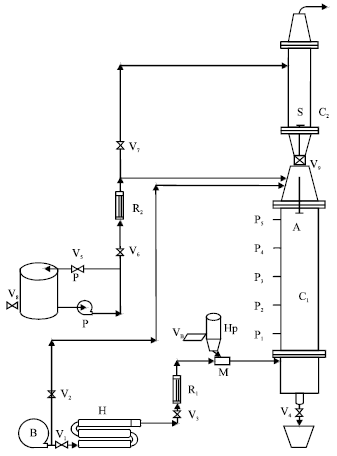 | |
| Fig. 1: | Novel two stage particulate matter scrubbing system for hot flue gas |
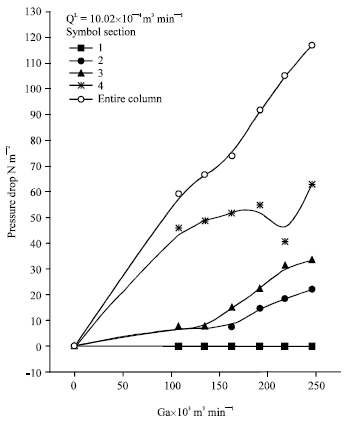 | |
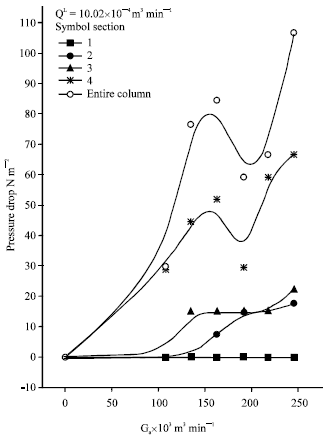
| Fig. 2: | Effect of gas flowrate on pressure drop at QL = 10.02x10⁻⁴ m3 min-1 |
The dimension of the atomizer is: 60 mm long and 15 mm out side diameter with a 15° angle tapering ending to the mouth of the nozzle of 10 mm diameter. The mouth has an integrated opening, 8 holes of 0.8 mm at the periphery for water jets and at the centre 1 hole of 1 mm diameter for air jet to atomize the liquid jet into fine droplets. The atomizing section is shown in Fig. 2. The spray column has five ports Pi (Pi, i = 1, 2, 3, 4, 5) in the scrubbing section made at an interval of 0.37 m each between to serve as pressure and temperature gradients in the column as shown in the Fig. 2. A demister is fitted at the outlet of the conical part. The outlet of the spray column is fixed to a bubble column made up of 0.609 m high and 0.0508 m diameter Perspex column with 0.024 m diameter as inlet and outlet.
 |
A blower of 2.2 kW with 1.8 mx3 long heater of 4.5kW is used to generate hot air stream. A steel hopper of 0.4 m tall and 0.25 m diameter holding fly ash attached with a electric vibrator feeder of 30 kg h-1 of maximum capacity controlled by a variable rheostat is used to feed flyash to a venturi-mixer. The venturi mixer mixes flyash with hot air and generates dust laden hot flue gas for scrubbing. The flyash brought from Kolaghat Thermal Power Plant is dried and de-moisturized in oven and kept in desiccator. Hot flue gas is prepared my blowing atmospheric air using 2.2 kW blower through an air-heater of 6x3 long with a capacity of 4.5 kW and the air stream is mixed with flyash through a venturi-mixer on its path to the scrubber. The flow rate of the hot flue gas is measure using a rotameter of range 0 to 296.62 LPM (Hot Air). The solids, flowrate feed to venturi mixer are varied using an electric vibrator set at different vibrations using a variable rheostat. The dusty laden gas is feed into the bottom of the column through the antenna type distributor.
The water used for scrubbing is pumped from the water tank through a 0.5HP pump and atomized at the top of the tower using an airblast nozzle. SO2 concentrations were measured at inlet and outlet by method described by Indian Standards of 1969.
RESULTS AND DISCUSSION
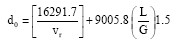
The hydrodynamic studies of the spray column have been carried out by measuring the pressure drop and holdup of both gas and liquid phase. The gas to liquid ratios are determined for gas flow rates ranging from 1.800 to 4.533 Nm3 sec-1 and for liquid rate ranging from 8.35 to 33.34 m3 sec-1 were found to range from 3.71 to 33.34 which is a fair agreement with the gas-liquid ratios mentioned in the literature as 4-20 gallons/1000 acfm for spray scrubbers. The droplets sizes predicted using Nukiyama and Tanasawa (1938) empirical equation. The droplet size ranges from 139 to 378 μm for the given gas liquid ratio in the atomizer and dust laden gas-liquid’s relative velocity.
Droplet distribution: Uniformity of the droplets size produced my various atomizers varies depending upon the design and operating conditions of the atomizers. The generation of fairly uniform and very fine spray at the cost of relatively little energy is difficult. Hence, determination of the droplet size distribution becomes necessary.
Droplets size: Nukiyama and tanasawa, 1938-empirical relationship taking standard conditions:
Where:| do | = | Average surface volume of droplet diameter; μm |
| vr | = | Relative velocity of gas to liquid, ft sec-1 |
| σ | = | Liquid surface tension, dyn cm-1. For H2O, σ = 72 dyn cm-1 |
| ρL | = | Liquid density, g cm-3, for water ρL = 1.0 g cm-3 |
| μL | = | Liquid velocity, Pa, for water μL = 0.00982 Pa |
 |
The results are found satisfactory. The pressure drop of gas with respect to different gas and liquid flow rates form each section of the spray column is shown in figures. The effect of gas flow rate on pressure drop at liquid flow rate at 5x10⁻³ m3 min-1 is shown in figure. In the spray column the pressure taps placed at equidistance creates four sections in the spray column in order to measure the trend of pressure drop with respect to the height of the column. The gas flow rate increases there is no significant change in the pressure drop. This reveals that at the bottom of the spray column where the flue gas is introduced, the pressure drop due to wall friction is negligible. The pressure drop seems to increase gradually above the gas flow rate of 100x10-3 m3 min-1 which may be due to the friction of gas with liquid droplets and the wall of the column which is wetted enough to offer friction due to the ripples formed by down flowing liquid. In section-3 the pressure drop also increases gradually above 50x10-3 m3 min-1, which is much early to the previous section proving the laws of pressure drop due change in the gas velocity. In Fig. 2 the pressure drop increases gradually as the gas the flow rate increases and decreases around 10 N m-2 at a flow rate around 180x10-3 m3 min-1 and again increases steadily. This significant decrease in the pressure drop at flow rate 180x10-3 m3 min-1 may be due to a compression zone being formed due to the down flowing air- water mixture (atomization) which stays intact with the force of up flowing gas. This trend affects the total pressure drop of the column markedly.
The pressure drop of the gas in the spray column is a measure of both wall friction and friction due to the down coming water droplets. The pressure drop of the dusty gas at different flow rates in absence of scrubbing liquid is measured and found to be negligible, i.e., pressure drop due to wall friction is almost found to be negligible for the range of gas flow rates operated in our spray column. The holdup studies reveal that as the gas flow rate increases the holdup of liquid in the form of droplets in the spray column increases. Similarly, the gas holdup decreases as the gas flow rate increases. Figures 3 and 4 show this trend for both liquid and gas holdups for three different liquid flow rates. As the liquid flow rate increases the holdup also increases.
This is due to increase in the size of the droplets. As the liquid flow rate increases, i.e., the liquid to gas ratio increases the droplet size also increases. Hence, the total drops cross-sectional area to sweep also increases.
 | |
| Fig. 3: | Effect of gas flowrate on pressure drop at QL = 5x10⁻⁴ m3 min-1 |
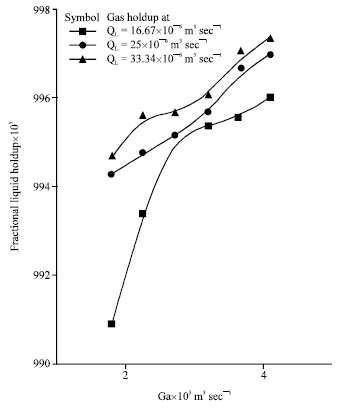 | |
| Fig. 4: | Effect of gas flow rate on gas holdup at different gas and liquid flowrates |
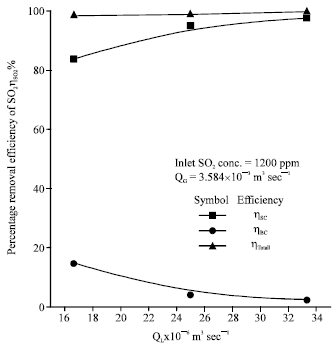 | |
| Fig. 5: | Effect of QL on the SO2% of spray bubble and apray-cum-bubble column at 1200 ppm SO2 and QG = 3.584x10³ m3 sec-1 |
Thus the holdup also increases with increase in the currently flowing gas, keeping the large sized droplets in suspension for more time.
Figure 5 shows effect of liquid flow rate on the percentage removal of SO2 at 1200 pm in the spray cum bubble column scrubber at 3.584x10⁻³ m3 sec-1 of the gas flow rate. Increase in the liquid flow rate increases the driving force by increasing more liquid droplets for the gas to be soluble in the liquid phase. Hence the efficiency of the spray section increases. A decrease in the efficiency of the bubble section is due to decrease in the inlet concentration of SO2 to the bubble section as major portion of SO2 has been scrubbed in the spray section. The overall efficiency of the scrubber increases with increase in the liquid flow rate due to the contribution of the spray section.
CONCLUSION
In the present investigation a spray-cum-bubble column has been developed, designed and fabricated for scrubbing of hot flue gas. Different types of atomizer were tried for good atomization of liquid throughout the column. A detailed study on pressure drop of the spray column has been carried out for design and characterization of scrubber. The effect of gas flow rate, liquid flow rate, atomization, scrubber height on pressure drop was carried out. Results indicate that the pressure drop increases as we go from bottom of the column to the top during scrubbing. The pressure drop increases with increase in gas and liquid flow rates. The loss of energy in the form of pressure drop in the spray column reaches a maximum of 130 N m-2, which is very low and an agreeable energy loss. Few experiments were conducted to measure the liquid holdup and indirectly gas hold-up across the tower. It has been observed that the liquid hold-up increases with increase in gas and liquid flow rates. Thus the performance of spray column developed for particulate scrubbing is found to be satisfactory with comparison to other wet scrubbers reported in the literature. A very high percentage removal of dust seem to be attainable within the physico-chemical variables used in present investigation, by using water as scrubbing medium. Thus the emission of dust and SO2 can be controlled to a level acceptable by pollution control standards.
REFERENCES
- Calvert, S., A.J. Engel and H.E. Hesketh, 1970. Atomization: A new type for better gas scrubbing. Atmospheric Environ., 4: 639-642.
CrossRef - Keey, R.B. and Q.T. Pham, 1977. Residence-time distribution of air in tall- form spray chamber. Chem. Eng. Sci., 32: 1219-1226.
CrossRef - Meikap, B.C. and M.N. Biswas, 2004. Fly-ash removal efficiency in a modified multi-stage bubble column scrubber. Separation Purification Technol., 36: 177-190.
CrossRef