

T. Tsutsui
Department of Chemical Engineering, Kagoshima University, 1-21-40 Korimoto, Kagoshima, 890-0065, Japan
Y. Ueda
Department of Chemical Engineering, Kagoshima University, 1-21-40 Korimoto, Kagoshima, 890-0065, Japan
K. Ijichi
Department of Chemical Engineering, Kagoshima University, 1-21-40 Korimoto, Kagoshima, 890-0065, Japan
K. Mizuta
Department of Chemical Engineering, Kagoshima University, 1-21-40 Korimoto, Kagoshima, 890-0065, Japan
Y. Uemura
Universiti Teknologi Petronas, Bandar Seri Iskandar, 31750 Tronoh, Perak, Malaysia
Journal of Applied Sciences
Year: 2010 | Volume: 10 | Issue: 24 | Page No.: 3215-3221







ABSTRACT
In order to find a suitable zeolite for improving FCC process, in which octane number and gasoline yield are highly enhanced, many types of zeolite were used in cracking reaction of 1-dodecene. From the product distribution, zeolites were classified into three types in FCC reaction. With the type I zeolites, such as SAPO-11, the product pattern was mono-peak distribution by carbon number with high content of olefins and very small content of aromatics. On the other hand, the type II zeolites such as ZSM-5 produced two-peak distribution with high content of aromatics and iso-paraffin in gasoline range. Beta and FCC equilibrium catalyst were classified as the type III zeolites, which showed the intermediate nature between type I and II. From these results, the three types of the zeolite reactivity for FCC could be shown schematically. Octane number of gasoline fraction was estimated from the product composition and it was found that the octane enhancement was attained by use of the type I or type II zeolites, but the simultaneous increase of gasoline yield was obtained by the type II zeolites.
PDF Abstract XML References Citation
Received: June 06, 2010;
Accepted: July 06, 2010;
Published: October 19, 2010
How to cite this article
T. Tsutsui, Y. Ueda, K. Ijichi, K. Mizuta and Y. Uemura, 2010. Evaluation of Catalytic Cracking Reactivity of Zeolites using 1-Dodecene as a Model Feedstock-Classification of Zeolites Based on Hydrogen Transfer Reactivity. Journal of Applied Sciences, 10: 3215-3221.
DOI: 10.3923/jas.2010.3215.3221
URL: https://scialert.net/abstract/?doi=jas.2010.3215.3221
DOI: 10.3923/jas.2010.3215.3221
URL: https://scialert.net/abstract/?doi=jas.2010.3215.3221
INTRODUCTION
Considering the effect of CO2 accumulation in the atmosphere on global warming and the recent rise in crude oil price, it seems necessary to utilize fossil resources more efficiently in future. Consequently, petroleum oil will be used for manufacturing high-value hydrocarbon products such as transportation fuels and chemicals because of its properties superior to those from alternative resources. Therefore, further improvement of petroleum refining technology should be still important.
Fluid Catalytic Cracking (FCC) has been one of the most important refining technologies and will be continuingly used to produce gasoline even from heavier crude. In FCC technologies, increase of gasoline yield and enhancement of gasoline octane number are still major issues to be pursued.
For enhancing octane number, various technologies such as utilization of an additive, an additional catalyst, which cracks low octane number fraction of long chain paraffin (Buchanan, 1998; Degnan et al., 2000) or combination with low-temperature isomerization of paraffin-rich fraction (Karthikeyan et al., 2008) have been applied. However, a decrease in gasoline yield or an increase in processing cost is inevitable in these technologies. To overcome this disadvantage and develop a new technology for enhancing the yield and the octane number simultaneously, more understanding on the reaction characteristics of zeolites under the FCC reaction conditions and the proper zeolite utilization in the process are thought necessary.
In this study, the reaction characteristics of various zeolites are investigated using 1-dodecene as a feedstock because it seems that 1-dodecene, an olefin of LCO range, can clearly show the difference of zeolite reaction characteristics and the primary and secondary reaction steps to gasoline products can be easily distinguished. As the zeolites, those which are considered stable and suitable to be used under FCC reaction conditions are used. Based on the reaction results, the zeolites used were classified from the view point of the hydrogen transfer and skeletal isomerization reactivity in FCC.
MATERIALS AND METHODS
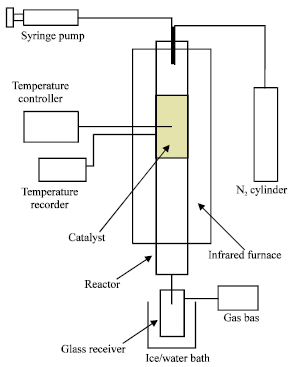
A fixed-bed reactor made of SUS-316 tube with 14 mm inner diameter and 360 mm length was used. Zeolite catalysts were packed in the reactor and the reactor tube was placed in an infrared furnace.
 | |
| Fig. 1: | Reaction system |
| Table 1: | Zeolites used for reaction |
 | |
Feed 1-dodecene and nitrogen were introduced to the vaporization and mixing zone at the top of the reactor tube and the reaction effluent was introduced to a glass receiver cooled with ice/water and then to a gas bag. Figure 1 shows the experimental system and flows.
The condensed product oil in the receiver was analyzed by GC-FID and GC-MS with 60 m DB-1 capillary column and the collected gas by three GC-TCD with molecular sieve 13X, Porapak-Q, VZ-10 and by a GC-FID with Shimalite SL-6.
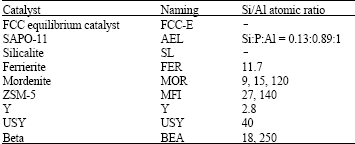
The reaction temperature for comparing the reactivity of the zeolites was selected as 450°C. This is about 50° lower than the temperature of industrial reactors, but it is assumed proper to take this temperature for evaluating the reactivity of a fresh zeolite as prepared. Residence time of the reactant vapor in the fixed-bed was 0.9s and zeolite/oil ratio 2.6-2.9 g g-1. Five grams of each zeolite shown in Table 1 was used for the reaction except that the amount of the FCC equilibrium catalyst used was 15 g. All the zeolites used in this study are of proton type. In this study, zeolite species are shown as zeolite abbreviation-Si/Al atomic ratio in the figures.
The octane number of the product gasoline fraction was calculated from the composition obtained with GC-FID (Anderson et al., 1972) in two ways: method A and B. In the method A, all-component method, the octane number was calculated as the summation of volumetric fraction times mixing octane number of the species specified by the ASTM. In the method B, representative-component method, representative 15 species were treated in the same manner as in the method A, the other species were grouped into 15 fractions in accordance with the boiling point range where the octane number of the fractions was determined experimentally so that the calculated octane number was equal to the measured octane number according to the JIS method using commercial FCC gasoline.
RESULTS AND DISCUSSION
Composition of reaction products by various zeolites: Figure 2a shows the composition of reaction product when SAPO-11(AEL) was used as the catalyst. The composition was shown against carbon number and type of hydrocarbon; P, O, N, A, NL denote paraffin, olefin, naphthene, aromatics, naphthalenes, respectively and I, II, III mono-, di-, tri-branch, respectively.
The composition of reaction products was grouped into three types as follows.
As shown in Fig. 2a, SAPO-11 gave a mono-peak distribution against the carbon number in which C4 was the maximum with olefin as the major product. Very small quantity of aromatics was found. In Fig. 2b-d, nearly the same distribution and product type was seen when Ferielite (FER), Silicalite (SL), Mordenite (MOR) were used. In the case of Mordenite, Si/Al ratio was adjusted from 9 to 120 by steaming, but no essential difference in product distribution was found. Although Ferielite shows another small peak with aromatics, the ratio of aromatics to C3+C4 was found relatively small like SAPO-11, as discussed later. Thus, these zeolites were grouped as the type I zeolite.
Figure 3a shows the result of ZSM-5 (MFI) with Si/Al = 27. Two-peak carbon number distribution was found, in which low carbon number paraffin rich fraction, i.e., propane rich C3 and isobutane and n-butane rich C4, formed one peak and C6-C9 aromatics rich fraction formed another. As shown in Fig. 3b, nearly the same result was obtained with ZSM-5 with Si/Al=140. Y and USY gave the distribution similar to those with ZSM-5, as shown in Fig. 3c and d. These zeolites were grouped as the type II.
Figure 4a shows the product distribution of FCC equilibrium catalyst (FCC-E), which is abundant of C4-C8 iso-paraffin, C3-C4 Olefin and C8-C9 aromatics.
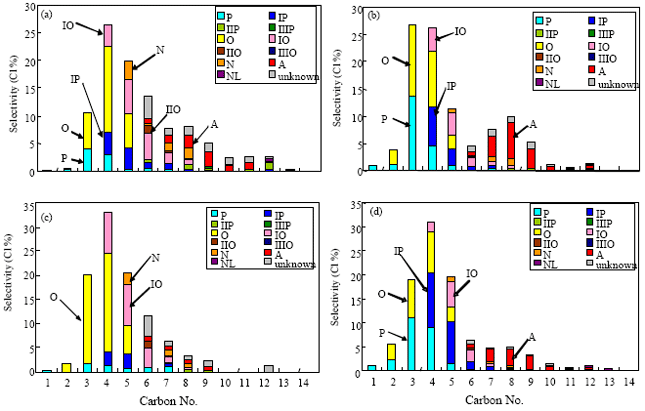 | |
| Fig. 2: | Product distribution by Type I zeolites. (a) SAPO-11, (b) Ferielite, (c) Silicalite and (d) Mordenite (Si/Al=15) |
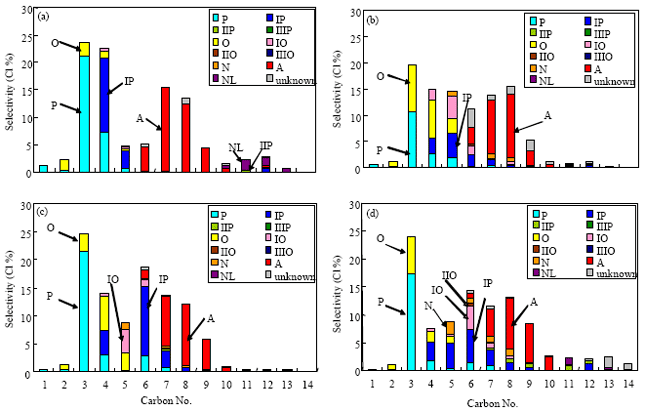 | |
| Fig. 3: | Product distribution by Type II zeolites. (a) ZSM-5(Si/Al=27), (b) ZSM-5(Si/Al=140), (c) Y(Si/Al=2.8) and (d) USY(Si/Al=40) |
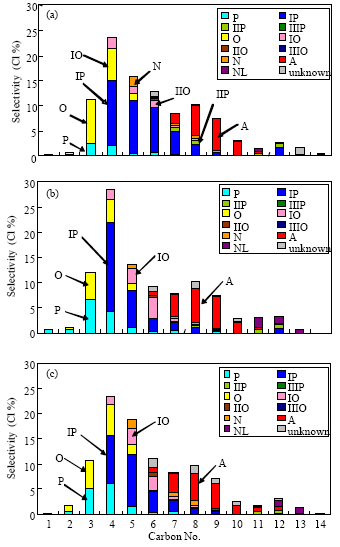 | |
| Fig. 4: | Product distribution by type III zeolites. (a) FCC Equilibrium catalyst, (b) Beta (Si/Al=18) and (c) Beta (Si/Al=250) |
Carbon number distribution and hydrocarbon type were the intermediate between type I and II. As seen in Fig. 4b and c, similar results were obtained when beta (BEA) with Si/Al = 18 and 250 were used. These zeolites were grouped as the type III.
The relationship between the aromatics yield and the degree of cracking is shown in Fig. 5. As the conversion of 1-dodecene with each zeolite was close to 100% under the reaction condition of this study, the yield of C3+C4 products, the final product of cracking was used as the index which expresses the degree of cracking. The result shown in Fig. 5 indicates that the aromatics yield depends not on the degree of cracking but on zeolite type.
From the results described above, the reaction characteristics of zeolites can be interpreted as follows. In the case of type I zeolites such as SAPO-11, the product is mainly composed of low carbon number olefins and iso-olefins and contains small amount of aromatics.
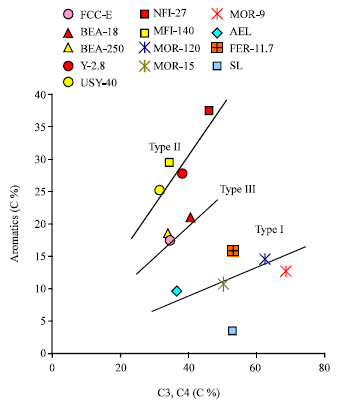 | |
| Fig. 5: | Relationship between aromatics and C3+C4 yields |
Therefore, the main reaction by the type I zeolite is successive cracking of olefins. To the contrary, in the case of type II zeolites such as ZSM-5, the product contains much aromatics and paraffins and small amount of olefins indicating a strong tendency of aromatization. As the feedstock is an olefin, the aromatization may proceed in the way that the feed or cracked product olefin is converted to naphthene and subsequently, aromatics and paraffin are formed by the hydrogen transfer reaction between the naphthene and olefin. Although, there is a possibility of aromatics formation by the dehydrogenation of naphthene, it is thought, in this case, that the aromatics are formed by the hydrogen transfer because the formation of molecular hydrogen was one tenth to one third of the quantity necessary for the dehydrogenation reaction. In the case of type III zeolites such as FCC-E and beta, the formation of aromatics is not so much as in the case of type II zeolites and it is thought that cracking and hydrogen transfer reaction proceed in a comparable extent.
Thus, it was shown from the reaction of 1-dodecene that the reaction product composition was strongly influenced by the extent of hydrogen transfer reaction of the zeolite used.
In Table 2, PONA distribution of cracked product for each zeolite type is shown.
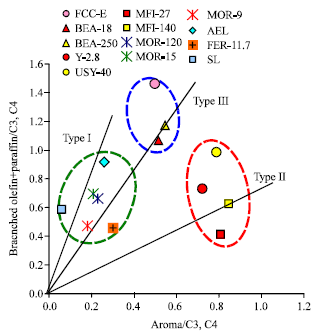 | |
| Fig. 6: | Relationship between the yield ratio of branched olefin and paraffin to C3+C4 and the ratio of aromatics to C3+C4 |
| Table 2: | PONA distribution of cracked products with three type zeolites |
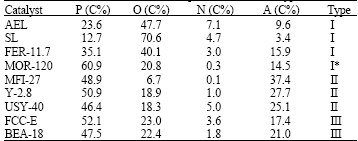 | |
| *MOR might also be classified as tpye II or III | |
When a series of experiment using the same type of zeolite with different Si/Al ratio was carried out, the product distribution was found nearly the same as that shown in Table 2. Mordenite was classified as the type I zeolite because of a low aromatics yield, but a high paraffin yield was obtained as shown in Table 2. Considering the high coke yield in the reaction with mordenite, it might mean that paraffins were produced by hydrogen transfer and aromatics were converted to coke. There still remains a possibility that mordenite should be classified as the type II or III zeolite.
Evaluation of reactivity and classification of zeolites under FCC reaction conditions: As it can be thought that cracking, skeletal isomerization and hydrogen transfer reaction have an important role in a FCC reaction, the relative contribution of these elemental reactions were investigated for the zeolites used.
Figure 6 shows the relationship between the yield ratio of branched olefin and paraffin to C3+C4 and the ratio of aromatics to C3+C4 for the zeolites, where the former indicates the reactivity ratio of skeletal isomerization to cracking and the latter that of hydrogen transfer to cracking. It is found that the regions for zeolite type I, II and III are separately shown in this plotting.
The slope of a line from the origin point indicates the extent of the hydrogen transfer reactivity. When the angle of the slope is small, the hydrogen transfer reactivity is strong. The distance from the origin point means the strength of cracking.
From Fig. 6, it can be understood the hydrogen transfer reactivity is in the order:
 |
It is said that the hydrogen transfer reactivity is strong for the zeolite with a high acidity, i.e., a low Si/Al atomic ratio because the hydrogen transfer is the reaction between two molecules. The same tendency can be seen in Fig. 6 for ZSM-5, Y and BEA. However, it is also found in Fig. 6 that the hydrogen transfer reactivity seems to depend more strongly on the acid strength of zeolites rather than Si/Al ratio because the order of the hydrogen transfer reactivity shown in Fig. 6 is consistent with the order of desorption temperature of H-peak in NH3 TPD measurement reported in literatures (Nakao et al., 2004; Niwa and Katada, 1997). Only exception is mordenite because mordenite is said to show H-peak at a higher temperature. The low reactivity of hydrogen transfer for mordenite can be due to the pore structure. Mordenite has two kinds of pore; one is 12 oxygen-member pore and the other is 8 oxygen-member pore which intersects with the former. If the 8 oxygen-member pore is too small and does not work for reaction of hydrocarbon of FCC reactant, mordenite can be regarded as having one dimensional 12 oxygen-member pore effectively. In such a narrow one dimensional pore, the two-molecular reaction may hardly proceed compared to three dimensional pore structures.
Gasoline yield and octane number: Figure 7 and 8 show the research octane number, RON, of the gasoline fraction produced with the zeolites used, which were calculated by the method A, all-component method and by the method B, representative-component method, respectively.
As seen in Fig. 7 and 8, the octane number was increased when the type I or the type II zeolite was used compared to the octane number obtained with the type III zeolite including FCC equilibrium catalyst. In the case of the type I zeolite, it is thought that the increase in the octane number was due to high content of iso-olefins of carbon number 5 and 6. In the case of the type II zeolite, the increment of the octane number seems to be due to the high aromatics content.
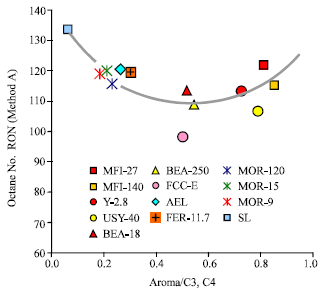 | |
| Fig. 7: | Octane number RON of gasoline fraction calculated by method A, all-component method |
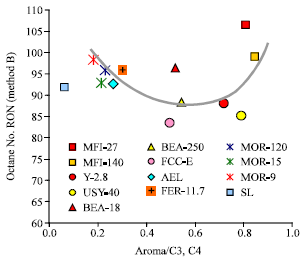 | |
| Fig. 8: | Octane number RON of gasoline fraction calculated by method B, representative-component method |
Figure 9 shows the gasoline yield with the zeolites used. It is seen that the gasoline yield increased in the order: type I < type III < type II. It means that the gasoline yield increases with the strength of hydrogen transfer reactivity of zeolite. When a type II zeolite is used, it is thought that the excessive cracking of olefins is suppressed due to the hydrogen transfer reaction, by which stable products such as aromatics and isoparaffins are formed and remain in the gasoline range under the FCC reaction condition.
From above results, it can be said that simul-taneous enhancement of gasoline yield and octane number is possible when the type II zeolite is used.
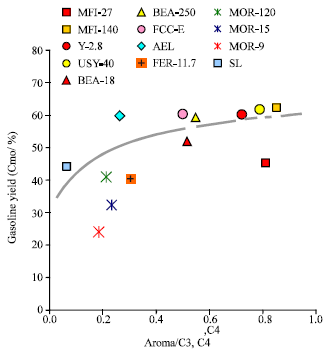 | |
| Fig. 9: | Gasoline yield |
With the type II zeolite, the FCC reaction should be controlled so as not to be proceeded to overcracking to avoid excess formation of C3 and C4 products and keep a high gasoline yield.
CONCLUSIONS
Reactivity of various zeolites for FCC reaction was investigated with 1-dodecene as a model feedstock and it is concluded as follows:
| • | Zeolites are classified into three types from the product composition. The type I zeolite is characterized by olefin rich product with mono-peak distribution of carbon number and SAPO-11, Ferrierite, Mordenite and Silicalite were found as type I. The type II zeolite is characterized by aromatics rich product with two-peak distribution of carbon number. ZSM-5 and Y were found as type II. The type III zeolite showed the intermediate composition between type I and II. FCC equilibrium catalyst and Beta were found as type III. These types depended on the strength of hydrogen transfer reactivity |
| • | The three zeolite types could be distinguished by the figure of relationship between branched olefin+paraffin / C3+C4 ratio and aromatics / C3+C4 ratio |
| • | It was found that the octane number of gasoline fraction increased when type I or type II zeolite was used and the gasoline yield increased only when type II zeolite was used |
ACKNOWLEDGMENT
This research was supported by the Japan Petroleum Energy Center (JPEC) as a technological development project supported financially by Ministry of Economy, Trade and Industry.
REFERENCES
- Buchanan, J.S., 1998. Gasoline selective ZSM-5 FCC additives: Model reactions of C6-C10 olefins over steamed 55:1 and 450:1 ZSM-5. Applied Cataly. A:Gen., 171: 57-64.
CrossRefDirect Link - Degnan, T.F., G.K. Chitnis and P.H. Schipper, 2000. History of ZSM-5 fluid catalytic cracking additive development at mobil. Micropor. Mesopor. Mater., 35-36: 245-252.
CrossRef - Karthikeyan, D., N. Lingappan, B. Sivasankar and N.J. Jabarathinam, 2008. Activity and selectivity for hydroiso,erization of n-decane over Ni impregnated Pd/H-mordenite catalysts. Applied Cataly. A: Gen., 345: 18-27.
CrossRef - Nakao, R., Y. Kubota, N. Katada, N. Nishiyama, K. Kunimori and K. Tomishige, 2004. Performance and characterization of BEA catalysts for catalytic cracking. Applied Cataly. A: Gen., 273: 63-73.
CrossRef - Niwa, M. and N. Katada, 1997. Measurement of acidic property of zeolites by temperature programmed desorption of ammonia. Cataly. Survay Asia, 1: 215-226.
Direct Link
mahmoud abdelaziz Reply
thank you
mahmoud abdelaziz Reply
thanks