

A. Inayat
Department of Chemical Engineering, Universiti Teknologi PETRONAS, Bandar Seri Iskandar, 31750 Tronoh, Perak, Malaysia
M.M. Ahmad
Department of Chemical Engineering, Universiti Teknologi PETRONAS, Bandar Seri Iskandar, 31750 Tronoh, Perak, Malaysia
M.I. Abdul Mutalib
Department of Chemical Engineering, Universiti Teknologi PETRONAS, Bandar Seri Iskandar, 31750 Tronoh, Perak, Malaysia
S. Yusup
Department of Chemical Engineering, Universiti Teknologi PETRONAS, Bandar Seri Iskandar, 31750 Tronoh, Perak, Malaysia
Journal of Applied Sciences
Year: 2010 | Volume: 10 | Issue: 24 | Page No.: 3183-3190







ABSTRACT
Hydrogen is considered as an attractive clean fuel for the future. Hydrogen production via biomass steam gasification is receiving attention due to its sustainability and zero net carbon emission. Coupled with in situ CO2 adsorption, this process has been proven to be environment friendly. The study reports on the impact of temperature, steam/biomass ratio and sorbent/biomass ratio on hydrogen production performance in a steam gasification process using a simulation model developed in MATLAB. In this study, biomass is assumed as char and gasification and CO2 adsorption occur in one gasifier. The model is used to predict the product gas composition, hydrogen yield and thermodynamic efficiency of the process. The results show that with the increase in temperature and steam/biomass ratio, the hydrogen concentration and yield increase, however, the thermodynamic efficiency decreases. Hydrogen yield increases from 78 to 97 g kg-1 of biomass with the increase in temperature and steam/biomass ratio within the range of 800 to 1300 K and 2.0 to 5.0, respectively. Maximum hydrogen efficiency of 87% is observed at 800 K and steam/biomass ratio of 2.0. At the sorbent/biomass of 1.52, hydrogen purity is predicted to reach 0.98 mole fraction with CO2 present in system absorbed. At 950 K with steam/biomass ratio of 3.0 and sorbent/biomass ratio of 1.0, a maximum hydrogen concentration of 0.81 mole fraction is obtained in the product gas. The steam feed rate is found to have the most impact on the hydrogen production and thermodynamic efficiency among the process parameters.
PDF Abstract XML References Citation
Received: June 06, 2010;
Accepted: July 06, 2010;
Published: October 19, 2010
How to cite this article
A. Inayat, M.M. Ahmad, M.I. Abdul Mutalib and S. Yusup, 2010. Effect of Process Parameters on Hydrogen Production and Efficiency in Biomass Gasification using Modelling Approach. Journal of Applied Sciences, 10: 3183-3190.
DOI: 10.3923/jas.2010.3183.3190
URL: https://scialert.net/abstract/?doi=jas.2010.3183.3190
DOI: 10.3923/jas.2010.3183.3190
URL: https://scialert.net/abstract/?doi=jas.2010.3183.3190
INTRODUCTION
The production of hydrogen as a clean and sustainable fuel is becoming attractive due to the energy crisis and increasing environmental issues associated with fossil fuels usage. Under the current scenario, the demand of hydrogen is significant due its increasing usage in refinery, fertilizer, chemical, food and aerospace industries (Holladay et al., 2009). Several production alternatives particularly from renewable sources are receiving increasing attention. Biomass gasification is considered as one of the potential alternatives for the production of hydrogen (Momirlan and Veziroglu, 2005). In 2006, the hydrogen world demand was 50 MT/year with 10% annual increment predicted (Levin and Chahine, 2010). The potential for hydrogen production from biomass in Malaysia is appealing due to the abundance of biomass availability such as from the palm oil industry waste since Malaysia is the world’s largest producer of palm oil (Sumathi et al., 2008; Kamarudin et al., 2009; Khan et al., 2010). Biomass gasification can be performed using different gasifying agents such as air-steam and oxygen-steam mixtures or pure steam. It is reported that the use of pure steam is more economical and in favor of producing more hydrogen yield compared to other conventional gasifying agents (Franco et al., 2003). The amount of hydrogen in the product gas from the gasification process can be further increased by combining the gasification reaction with CO2 adsorption step using CaO as sorbent (Mahishi and Goswami, 2007a). The general reaction taking place in a gasifier can be represented by Eq. 1:
 | (1) |
There are also other variables that influence the gasification process such as temperature, pressure, steam/biomass ratio, sorbent/biomass ratio, residence time biomass feed rate, biomass type, particle size and gasifier design e.g., fixed bed, fluidized bed or dual fluidized bed (Corella et al., 2008).
Several experimental and mathematical model studies have been reported in literature which looked at the effect of different variables on the concentration and yield of hydrogen in the product gas. Shen et al. (2008) simulated the air-steam gasification in an interconnected fluidized bed gasifier and obtained a hydrogen yield of more than 60 g kg-1 of biomass with a concentration of 60 mol% in the product gas at 850°C. They also discussed the effect of the gasifier temperature and steam/biomass ratio on the hydrogen yield and product gas composition. Meanwhile, Lv et al. (2007) performed an experimental work on biomass gasification using conventional air-steam gasifying agent along with the usage of catalyst and reported a hydrogen yield of 72 g kg-1 of biomass with 56.2 vol% concentration in the product gas.
There was also research work conducted on integrating CO2 adsorption using CaO into the gasification process. Mahishi and Goswami (2007a) conducted an experimental work using CaO as sorbent with pure steam in a microreactor and reported a hydrogen concentration of 66 vol% in the product gas. They highlighted the dual role of the CaO as the sorbent and as the catalyst, as the important factor leading to higher hydrogen production. In line with the above findings, Florin and Harris (2007) developed a thermodynamic equilibrium model for hydrogen production from biomass coupled with CO2 capture step in a dual fluidized bed gasifier. They investigated the effect of temperature, pressure, steam/biomass and sorbent/biomass ratios on the hydrogen concentration in the product gas. The model predicted that the hydrogen concentration could be increased from 50 to 80 vol% in the product gas by using CaO as sorbent. Florin and Harris (2008) also presented another equilibrium model for steam gasification of biomass using CaO as sorbent and investigated the effect of temperature, pressure, steam/biomass ratio and sorbent/biomass ratio on the hydrogen production. Using the model, they predicted a hydrogen yield of more than 2 mole H2/mole fuel is achievable. Guoxin and Hao (2009) proved experimentally that the CO2 adsorption step strongly favored the forward water gas shift reaction, thus increasing the hydrogen production. On the contrary, they found that high reactor temperature will not favor the CO2 adsorption and thus would have a negative effect on the hydrogen production. Proll and Hofbauer (2008) presented a model which included the mass and energy balances for a dual fluidized bed gasification process. Their model results showed high content of hydrogen in the product gas at lower gasification temperature. Moreover, the lower operating temperature in the gasifier would lead to higher efficiency for the energy conversion.
The study on thermodynamic efficiency of hydrogen production is however limited. Initially, Mahishi and Goswami (2007b) presented a thermodynamic equilibrium model for the prediction on product gas composition and hydrogen efficiency in air-steam gasification process using Stanjan (v 3.93 L) software. They applied the first law analysis on the gasifier and investigated the effect of temperature, steam/biomass ratio and equivalence ratio on hydrogen efficiency. They reported that hydrogen efficiency decreases with the increase in both temperature and steam/biomass ratio. In another work, Mahishi et al. (2008) developed an equilibrium model in ASPEN PLUS software for steam gasification of wood with CO2 adsorption using CaO. They reported that the concentration of hydrogen in the product gas was increased by more than 19% due to higher thermodynamic efficiency for the integrated gasification process compared to the conventional gasification.
The objective of the present research is to study the effect of process parameters, i.e., temperature, steam/biomass ratio and sorbent/biomass ratio on hydrogen concentration, yield and efficiency of the steam gasification process with CO2 adsorption using a model approach in MATLAB. This study has been carried out based on the reaction kinetics for a fluidized bed gasifier.
MATERIALS AND METHODS
The base reaction kinetic models and the preliminary results on the effect of different variables on the hydrogen concentration in the product gas were presented in an earlier work (Inayat et al., 2009). In the modeling framework, biomass (wood) is assumed as char and six major reactions, given as R1 to R6, are assumed to occur in the gasifier (Shen et al., 2008; Zhang et al., 2009). The biomass moisture is assumed to be has 10% moisture content which is an acceptable assumption used for tropical based biomass sources (Corella et al., 2008).
Char gasification reaction
C + H2O → CO + H2 | +131.5 kj mol-1 | (R1) |
Methanation reaction
C + 2H2 → CH4 | -74 kj mol-1 | (R2) |
Boudouard reaction
C + CO2 → 2CO | +172 kj mol-1(R3) | (R3) |
Methane steam reforming reaction
CH4 + H2O → CO + 3H2 | +206 kj mol-1(R4) | (R4) |
Water gas shift reaction
CO + H2O → CO2 + H2 | -41 kj mol-1(R5) | (R5) |
Carbonation reaction
CO2 + CaO → CaCO3 | -178.3 kj mol-1(R6) | (R6) |
The process diagram is illustrated in Fig. 1. The gasifier is equipped with a steam generator and a biomass dryer.
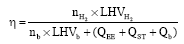
With the assumption that there is no heat loss and no work done by the system, the thermodynamic efficiency of the hydrogen can be calculated using Eq. 2-4 (Mahishi and Goswami, 2007b).
 | (2) |
 | (3) |
 | (4) |
The amount of hydrogen (in moles) in product gas and biomass are calculated using the kinetics model (Inayat et al., 2009) and the hydrogen yield is calculated using Eq. 5.
 | (5) |
LHV represents the lower heating value and is taken from literature for hydrogen (Kelly-Yong et al., 2007) and biomass, i.e., wood (Raveendran and Ganesh, 1996). The values of specific heat for water and steam are taken from the literature as well (Kelly-Yong et al., 2007). QEE is the energy supplied to the gasifier by an external source and is calculated based on the enthalpies of the reactions mentioned above. As steam gasification process is endothermic and consumes a lot of energy, QEE value is positive for this case. The zero value of QEE reflects self-sustained process and can be used as standard for comparison with actual gasifier (Mahishi and Goswami, 2007b).
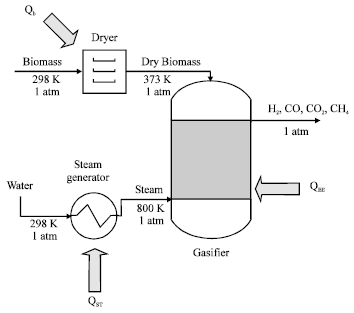 | |
| Fig. 1: | Process diagram |
Qb is the energy supplied to the dryer to remove the moisture content from the biomass.
The process is assumed to be steady state and biomass feed rate used in the modeling work is 0.072 kg h-1. The selected range of the main operating conditions is: temperature, from 800 to 1150 K for product gas composition and 800 to 1300 K for hydrogen yield; steam/biomass mass ratio, from 1 to 3.5 for product gas composition profile and from 2 to 5 for hydrogen yield and efficiency profiles; sorbent/biomass mass ratio, from 0.2 to 1.6 for product gas composition and 1.0 for hydrogen yield and efficiency profiles. The selection of the ranges was made so that they represent the operation ranges of many commercial and research scale gasifiers (Lv et al., 2007; Mahishi and Goswami, 2007b; Corella et al., 2008; Kumar et al., 2009; Acharya et al., 2010).
RESULTS AND DISCUSSION
Among the process parameters that can affect the production of hydrogen from biomass gasification process with in-situ CO2 capture are temperature, steam/biomass fed ratio and amount of sorbent. The effect of each parameter on hydrogen concentration, yield and efficiency is thoroughly studied and discussed in the following sections.
Effect of parameters on hydrogen concentration: Figure 2 shows the effect of temperature on the product gas compostion versus temperature, ranging from 800 to 1300 K.
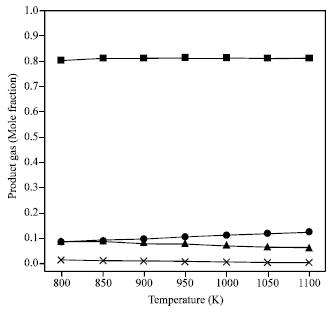 | |
| Fig. 2: | Effect of temperature on product gas composition. Steam/biomass ratio: 3.0; Sorbent/biomass ratio: 1.0. H2 ( ), CO ( ), CO ( ), CO2 ( ), CO2 ( ). CH4 ( ). CH4 ( ) ) |
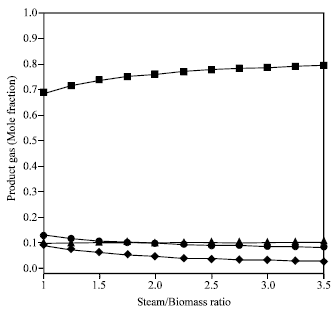 | |
| Fig. 3: | Effect of Steam/Biomass ratio on product gas composition. Biomass feed rate: 0.072 kg h-1; Temperature: 800 K; Sorbent/biomass ratio:1.0. H2 (), CO (), CO2 (). CH4 ( ) ) |
The model predicts that the system produces more than 0.8 mole fraction of hydrogen in the product gas. This is due to usage of pure steam and CO2 adsorption step in the system. The CO amount also increases with the increase in temperature. This observation originates from the exothermic and reversible behavior of the water gas shift reaction and due to the endothermic behavior of the Boudouard, char gasification and methane reforming reactions. On the other hand, CH4 and CO2 amounts are decreasing with the increasing temperature. The decreasing amount of CO2 may be due to the slower rate of the water gas shift reaction at high temperature and the carbonation reaction.
Another important variable in steam gasification process is the steam/biomass ratio. It is observed that with increasing steam/biomass ratio, H2 amount increases, CO and CH4 amount decrease. Figure 3 shows the profile for product gas composition when increasing steam/biomass ratio. Steam is the only gasification agent being used, so the reactions involving steam, i.e., methane reforming and water gas shift, are highly dependent on steam feed rate. Therefore, at higher steam/biomass ratio, H2 yield is increased while the amount of the reactants, i.e., CH4 and CO, is decreased.
Figure 4 shows the three-dimensional surface plot to capture the effect of both temperature and steam/biomass ratio on the hydrogen mole fraction in the product gas. The figure shows that hydrogen concentration increases by increasing both temperature and steam/biomass ratio. These results can be explained by the Le Chatelier’s principle: the endothermic reforming reactions of char and CH4 are promoted by the increasing temperature.
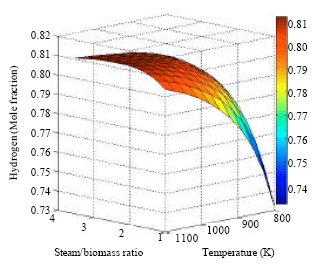 | |
| Fig. 4: | Surface plot of hydrogen mole fraction at different temperatures and steam/biomass ratios. Sorbent/biomass ratio: 1.0 |
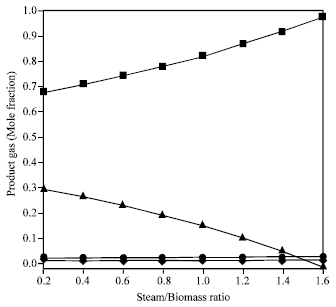 | |
| Fig. 5: | Effect of sorbent/biomass ratio on product gas mole fraction. Biomass feed rate: 0.072 kg h-1; Temperature: 1000 K; Steam/biomass ratio: 3.0. H2 (), CO (), CO2 (). CH4 () |
At 800 K with lower steam/biomass ratio of 1.0, the hydrogen amount is 0.73 mole fraction and at 1150 K with high steam/biomass ratio, the hydrogen amount is almost 0.80 mole fraction. Furthermore, the surface plot shows that the highest hydrogen mole fraction achieved is 0.81 mole fraction that occurs at 950 K and at steam/biomass ratio of 3.0.
The presence of CaO as sorbent in the system increases the hydrogen mole fraction in the product gas by absorbing the CO2 present in the system.
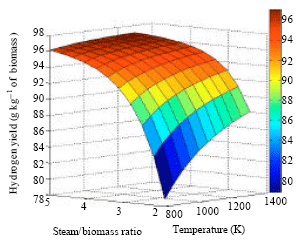 | |
| Fig. 6: | Surface plot of hydrogen yield at different temperatures and steam/biomass ratios. Sorbent/biomass ratio: 1.0 |
Figure 5 shows the effect of sorbent/biomass ratio on the product gas composition in the integrated gasification process. It shows clearly that by increasing sorbent/biomass ratio, the H2 amount increases and CO2 amount decreases. At sorbent/biomass ratio of 1.56, it is predicted that all CO2 is absorbed by the sorbent and no CO2 exists in the product gas. The maximum hydrogen observed is 0.99 mole fractions.
Effect of parameters on hydrogen yield: Temperature and steam/biomass ratio are both in favor for higher hydrogen yield. Figure 6 shows the surface plot of hydrogen yield with respect to temperature and steam/biomass ratio. Hydrogen yield is predicted to increase with the increase in both temperature and steam/biomass ratio. Figure 6 shows that in case of 800 K and lower steam/biomass ratio of 2.0, hydrogen yield is 78.5 g kg-1 of biomass. At the same temperature but with higher steam/biomass ratio of 5.0, hydrogen yield is 96 g kg-1 of biomass. The difference due to the increase of steam/biomass ratio at same temperature is 17.5. On the other hand, at a high temperature of 1300 K and low value of steam/biomass ratio of 2.0, hydrogen yield is 88.5 g kg-1 of biomass. At the same temperature of 1300 K with high steam/biomass ratio of 5.0, hydrogen yield is increased to 97 g kg-1 of biomass. In this case, the difference in hydrogen yield at high temperature is 8.5. By a crude comparison between the yield differences in both cases, it seems that the influence of steam feed rate at lower temperature is more significant than at high temperature for the steam gasification process. This is because the endothermic forward water gas shift reaction is favored at low temperature. Furthermore, water gas shift reaction is highly dependent on steam feed rate.
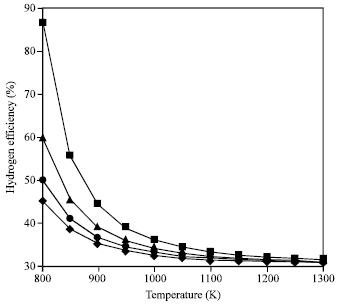 | |
| Fig. 7: | Effect of temperature on hydrogen efficiency. Sorbent/biomass ratio: 1.0, Steam/biomass = 2.0 (), Steam-/biomass = 3.0 (), Steam/biomass = 4.0 (), Steam-/biomass = 5.0 () |
Previously it has been observed that there was insignificant change in the hydrogen yield and efficiency when varying the sorbent/biomass ratio.
Moreover, Fig. 6 shows that the hydrogen yield is significantly more affected by steam/biomass ratio compared to by temperature. This might be due to the usage of pure steam as the gasifying agent.
Effect of parameters on hydrogen efficiency: As discussed in the previous section, it is concluded that more hydrogen can be produced by increasing the steam feed rate to the gasifier. However, this means more energy is required to generate more steam and more energy is lost via the steam loss in the product gas. Figure 7 shows the thermodynamic efficiency of hydrogen at different steam/biomass ratios and temperature. The maximum efficiency of hydrogen, i.e., 87% is predicted at steam/biomass ratio of 2.0 and at 800 K. At 800 K, hydrogen efficiency at steam/biomass ratios of 3.0, 4.0 and 5.0 are 60, 50 and 46%, respectively. This shows that by increasing steam/biomass ratio, the efficiency of hydrogen decreases as more energy is required to produce more steam. On the other hand, by increasing steam/biomass ratio, hydrogen yield and concentration increase, as reported in the previous sections. The figure also shows that at lower temperature, hydrogen efficiency is higher and with the increase in temperature, the efficiency decreases due to the increased external heat requirement to maintain the temperature inside the gasifier.
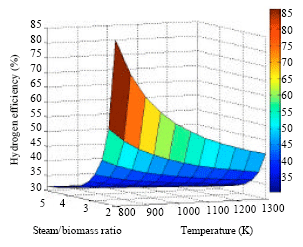 | |
| Fig. 8: | Surface plot of hydrogen efficiency at different temperatures and steam/biomass ratios. Sorbent/Biomass ratio: 1.0 |
In Fig. 7, it also observed that all trends for different steam/biomass ratio ends at the same point, i.e., 30% at 1300 K. This is due to fact that the same amount of biomass used for all profiles hence the LHV of biomass is limited to the same value.
A three-dimensional surface plot for hydrogen efficiency with respect to temperature and steam/biomass ratio is shown in Fig. 8.
The surface plot shows that the hydrogen efficiency decreases with the increase in temperature and steam/biomass ratio. The curves show that the steam/biomass ratio has higher impact than temperature to decrease the efficiency of hydrogen. Hence, steam/biomass ratio has more significant impact on the hydrogen yield and the hydrogen efficiency, compared to temperature.
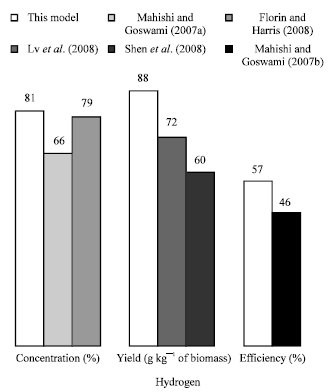
Comparison with experimental and modelling data: A comparison of results from the current study for hydrogen concentration, yield and efficiency has been done with published data on modeling and experimental work and is shown in Fig. 9.
The comparison has been done on the respective results at 900 K. The results on hydrogen concentration are compared with that of experimental results by Mahishi and Goswami (2007a) and simulation results by Florin and Harris (2008) on biomass steam gasification with CO2 adsorption. The comparison shows good agreement between the three.
For the hydrogen yield, the comparison has been done with that of Lv et al. (2007) on experimental work carried out with catalyst in the presence of air and steam and with that of Shen et al. (2008) on modeling results for air steam gasification.
 | |
| Fig. 9: | Comparison with literature |
The results show that this model predicts higher hydrogen production. The comparison also indicates that the hydrogen yield is higher in steam gasification system with CO2 capture step than in other conventional gasification and even with catalyst. This is also due to the presence of CaO that acts as sorbent and catalyst.
Due to limited data available in literature on hydrogen efficiency, our results are compared with the modeling results by Mahishi and Goswami (2007b) that is based on air-steam gasification system. The result shows that the hydrogen efficiency is higher in pure steam gasification system than air-steam gasification system. The steam gasification system is an endothermic reaction and more energy is required for steam generation, but in air-steam gasification system, there is some energy available from air-gasification which is an exothermic reaction. Nevertheless, the efficiency of hydrogen in steam gasification system is still high than that in conventional gasification process, due to the higher hydrogen yield in steam gasification process.
CONCLUSION
The effect of temperature, steam/biomass ratio and sorbent/biomass ratio is studied for a biomass steam gasification process with CO2 adsorption using a modeling approach. The effect is captured in terms of hydrogen concentration, yield and thermodynamic efficiency. Initially, temperature is the important variable, as the hydrogen yield increases and efficiency decreases by increasing temperature. Meanwhile, CO amount increases due to the net effect from the exothermic and reversible behavior of the water gas shift reaction and the endothermic behavior of Boudouard, char gasification and methane reforming reactions. On the other hand, CH4 and CO2 amounts decrease due to the slower rate of the water gas shift reaction at high temperature and the carbonation reaction.
In addition, steam/biomass ratio is a very important variable in steam gasification process because hydrogen concentration and yield increase when increasing steam/biomass ratio. Meanwhile, CO and CH4 amounts decrease in the product gas. These observations are based on the reason that both methane reforming reaction and water gas shift reaction are highly dependent on the steam feed. It is predicted that the maximum hydrogen mole fraction in the product gas of 0.81 is achieved at 950 K and the steam/biomass of 3.0. However, by increasing the steam/biomass ratio, the hydrogen efficiency decreases. Maximum hydrogen efficiency of 87% occurs at low temperature and low steam/biomass ratio, i.e., at 800 K and steam/biomass ratio of 2.0, due to the minimum consumption of energy.
Furthermore, the sorbent presence in the gasification process also affects the process performance. At sorbent/biomass of 1.52, it is predicted that all CO2 present in system is absorbed. By capturing CO2, the hydrogen yield increases as the water gas shift reaction is shifted forward when CO2 is removed from the system. In conclusion, it was observed that steam/biomass ratio has more significant impact on hydrogen yield and efficiency among the process parameters.
ACKNOWLEDGMENTS
The authors gratefully acknowledge the financial support from Universiti Teknologi PETRONAS and Petroleum Research Fund of PETRONAS to carry out this research.
REFERENCES
- Corella, J., J.M. Toledo and G. Molina, 2008. Biomass gasification with pure steam in fluidised bed: 12 variables that affect the effectiveness of the biomass gasifier. Int. J. Oil Gas Coal Technol., 1: 194-207.
Direct Link - Florin, N.H. and A.T. Harris, 2007. Hydrogen production from biomass coupled with carbon dioxide capture: The implications of thermodynamic equilibrium. Int. J. Hydrogen Energy, 32: 4119-4134.
CrossRef - Florin, N.H. and A.T. Harris, 2008. Enhanced hydrogen production from biomass with in situ carbon dioxide capture using calcium oxide sorbent. Chem. Eng. Sci., 63: 287-316.
CrossRefDirect Link - Franco, C., F. Pinto, I. Gulyurtlu and I. Cabrita, 2003. The study of reactions influencing the biomass steam gasification process. Fuel, 82: 835-842.
CrossRef - Guoxin, H. and H. Hao, 2009. Hydrogen rich fuel gas production by gasification of wet biomass using a CO2 sorbent. Biomass Bioenergy, 33: 899-906.
CrossRef - Holladay, J.D., J. Hu, D.L. King and Y. Wang, 2009. An overview of hydrogen production technologies. Catal. Today, 139: 244-260.
CrossRefDirect Link - Kamarudin, S.K., W.R.W. Daud, Z. Yaakubb, Z. Misrona, W. Anuara and N.N.A.N. Yusuf, 2009. Synthesis and optimization of future hydrogen energy infrastructure planning in Peninsular Malaysia. Int. J. Hydrogen Energy, 34: 2077-2088.
CrossRef - Kelly-Young, T.L., K.T. Lee, A.R. Mohamed and S. Bhatia, 2007. Potential of hydrogen from oil palm biomass as a source of renewable energy worldwide. Energy Policy, 35: 5692-5701.
CrossRef - Khan, Z., S. Yusup, M.M. Ahmad, V.S. Chok, Y. Uemura and K.M. Sabil, 2010. Review on hydrogen production technologies in Malaysia. Int. J. Eng. Technol., 10: 111-118.
Direct Link - Kumar, A., D.D. Jones and M.A. Hanna, 2009. Thermochemical biomass gasification: A review of the current status of the technology. Energies, 2: 556-581.
CrossRefDirect Link - Levin, D.B. and R. Chahine, 2010. Challenges for renewable hydrogen production from biomass. Int. J. Hydrogen Energy, 35: 4962-4969.
CrossRef - Lv, P., Z. Yuan, C. Wua, L. Maa, Y. Chena and N. Tsubakib, 2007. Bio-syngas production from biomass catalytic gasification. Energy Convers. Manage., 48: 1132-1139.
CrossRef - Mahishi, M.R. and D.Y. Goswami, 2007. An experimental study of hydrogen production by gasification of biomass in the presence of a CO2 sorbent. Int. J. Hydrogen Energy, 32: 2803-2808.
CrossRef - Mahishi, M.R. and D.Y. Goswami, 2007. Thermodynamic optimization of biomass gasifier for hydrogen production. Int. J. Hydrogen Energy, 32: 3831-3840.
CrossRef - Mahishi, M.R., M.S. Sadrameli, S. Vijayaraghavan and D.Y. Goswami, 2008. A novel approach to enhance the hydrogen yield of biomass gasification using CO2 sorbent. J. Eng. Gas Turbines Power, 130: 0115011-0115018.
CrossRefDirect Link - Momirlan, M. and T.N. Veziroglu, 2005. The properties of hydrogen as fuel tomorrow in sustainable energy system for a cleaner planet. Int. J. Hydrogen Energy, 30: 795-802.
CrossRef - Proll, T. and H. Hofbauer, 2008. H2 rich syngas by selective CO2 removal from biomass gasification in a dual fluidized bed system- Process modelling approach. Fuel Process.Technol., 89: 1207-1217.
CrossRef - Raveendran, K. and A. Ganesh, 1996. Heating value of biomass and biomass pyrolysis products. Fuel, 75: 1715-1720.
CrossRef - Shen, L., Y. Gao and J. Xiao, 2008. Simulation of hydrogen production from biomass gasification in interconnected fluidized beds. Biomass Bioenergy, 32: 120-127.
CrossRef - Sumathi, S., S.P. Chai and A.R. Mohamed, 2008. Utilization of oil palm as a source of renewable energy in Malaysia. Renewable Sustainable Energy Rev., 9: 2404-2421.
CrossRefDirect Link - Zhang, Y., J. Xiao and L. Shen, 2009. Simulation of methanol production from biomass gasification in interconnected fluidized beds. Ind. Eng. Chem. Res., 48: 5351-5359.
CrossRef