

M.A. Wazed
Department of Engineering Design and Manufacture, Faculty of Engineering, University of Malaya, 50603 Kuala Lumpur, Malaysia
Shamsuddin Ahmed
Department of Engineering Design and Manufacture, Faculty of Engineering, University of Malaya, 50603 Kuala Lumpur, Malaysia
Journal of Applied Sciences
Year: 2009 | Volume: 9 | Issue: 2 | Page No.: 372-376







ABSTRACT
The main objective of this research is to study the Sapchari waterfall in the Khagrachari district of Bangladesh as an initiative for harnessing power from micro-hydro. It is found that with the head and flow rate available encircling the year, Sapchari waterfall should be sustainable for micro hydro power plant. The effect on the ecosystem of the area is very less, the ecotourism will increases hopefully and both the way of living and the living standard of this vicinity will be ameliorated after such installation.
PDF Abstract XML References Citation
How to cite this article
M.A. Wazed and Shamsuddin Ahmed, 2009. A Feasibility Study of Micor-Hydroelectric Power Generation at Sapchari
Waterfall, Khagrachari, Bangladesh. Journal of Applied Sciences, 9: 372-376.
DOI: 10.3923/jas.2009.372.376
URL: https://scialert.net/abstract/?doi=jas.2009.372.376
DOI: 10.3923/jas.2009.372.376
URL: https://scialert.net/abstract/?doi=jas.2009.372.376
INTRODUCTION
Energy is one of the most fundamental elements of our universe. Human being use energy to do work, lights our cities, powers our vehicles, trains, planes and rockets, warms our homes, cooks our food, plays our music and gives us pictures on television. Energy is the basic inevitability for survival. It is indispensable for development activities, to promote education, health care, transportation and infrastructure for attaining a reasonable standard of living and is also a critical factor for economic development and employment. Bangladesh has very limited nonrenewable energy resources of its own. She is facing energy predicament and serious desertification problem in rural areas including suburban and coastal region, especially in the hilly areas. These issues could be enhanced if renewable energy is used as a primary source of energy in those areas. Micro-hydroelectric power generation may be a potential energy source for hilly areas in Bangladesh. In hills, there are springs and streams that are running throughout the year.
Now a days, energy crisis especially electricity in the form of electrical energy has been raised to a higher degree throughout the country. Lack of proper maintenance of the machines and equipments, many years old setup in production of electricity have made the situation even more badly. The demand for electricity is increasing day by day for burgeoning population as well as industries.
Energy crisis has been emerging out since a few years. Due to lack of far extending plan to cope the demand of energy, the government has failed to solve the problem and the situation is getting worse day by day. In recent days, the electrical energy crisis become in such extent that even four to five hours we are under load-shedding. The people of town and villages are suffering from scorching heat and they are blaming the government and the local electrical power authority. Under such a crucial energy situation, we should look for alternative sources for generating powers.
Khagrachari Hill District is full of hills and waterfalls. The people of hilly areas usually live on the top of the hills. The major problem for them is the crisis of drinking water on such height. A small scale hydroelectric power station can be set up across these springs and streams. The hydroelectric energy thus obtained can be used to drive pumps for lifting water on the top of the hills, thus solving water problem for highlanders. The people in the hill areas are still deprived and don`t have the civil facilities such as sanitation, proper education and economy.
The main objectives of this research are to study and locate proper location for micro-hydroelectric power generator, to measure the available height and flow rate and finally to estimate the plausible power generation. The effects on the environment have also been addressed to a limited extent.
MICRO-HYDROELECTRIC POWER GENERATION
Micro-hydroelectric plants are the smallest type of hydroelectric energy systems. They generate between one kilowatt and one megawatt of power. The amount of electricity that can be generated at a hydro plant is determined by two factors: head and flow. Head is how far the water drops. It is the distance from the highest level of the dammed water to the point where it goes through the power-producing turbine. Flow is how much water moves through the system. Generally, a high-head plant needs less water flow than a low-head plant to produce the same amount of electricity.
A dam serves two purposes at a hydro plant. First, a dam increases the head or height of a waterfall. Second, it controls the flow of water. Dams release water when it is needed for electricity production (Special gates called spillway gates release excess water from the reservoir during heavy rainfalls).
HYDRO ENERGY SCENARIO IN BANGLADESH
Renewable energy exploitation in Bangladesh is not new. People are using renewable energy sources like solar, wind, hydro power for different purposes from primordial time. The scope of hydropower generation is very limited in Bangladesh as the country consists of low and flat lands except some hilly regions in the north and northeastern part. The only hydro power station of the country, the Karnafuly Hydro Power Station with a generating capacity of 230 MW by 7 units, is located in Kaptai, across the river Karnafuly (Sadrul Islam et al., 2006). This plant is generating 3.28% of total 3651.2 MW demand of the country (Islam et al., 2008). The first micro hydropower unit of 10kW has been installed in a village of Bandarban through private initiatives. The project is providing electricity to 140 families in the village and to a Buddhist Temple (Islam et al., 2008).
Sangu project would be a new project with estimated annual energy of about 300 GW h year-1. For an installed capacity of 140 MW, the annual plant factor is 23% and it is assumed that the plant would operate in a peaking mode. Matamuhari hydroelectric project would be a potential project of capacity 75 MW and approximate average annual energy 200 GW h year-1. It would operate in a peaking mode similar to the Sangu project.
Barkal is one of the remote and unelectrified Upazila (sub-district) in the Chittagong Hill Tracts region (ranging 300-500 m in height). Engineers of Bangladesh Power Development Board (BPDB) have conducted reconnaissance survey in the Upazila and identified availability of water sources for Micro-Hydro Power Plant. Based on the electrical load demand of the adjacent area, they proposed and designed a 20 kW Micro-Hydro Power Plant with the help of RETScreen, developed by CANMET Energy Diversification Research Laboratory of Canada (CEDRL) (Sadrul Islam et al., 2006).
In 1981 the Water Development Board and Power Development Board carried out a study on the assessment of Small/Mini Hydropower Potential in the country. It identified 12 potential rivers/charas with an estimated annual production of 1.1 GW h in Chittagong-Bandarban area, 6.3 GW h in Sylhet and Moulovi Bazar area, 8.6 MW h in Mymensingh-Sherpur area and 1.8 GW h in the Dinajpur-Rangpur area. However, only inadequate study has been made for the micro-hydro potential. Recently, LGED (Reba, 1999) has taken up a project at Bamer chara in Bashkhali of Chittagong District and BCSIR (Hasanuzzaman et al., 2002) in Sailpropat, Bandarban and in Madhobkundu, Moulovibazar. The BCSIR has estimated that these two sites have the potential for annual energy production of 43.8 MW h and 1.3 GW h, respectively.
In 1984, six Chinese experts visited Bangladesh and identified some potential sites for development of mini hydro power plant. Out of these sites, only Mahamaya Chara has been taken up for development of an integrated project for flood control, irrigation and power generation. A working group has been formed by the engineers of Bangladesh Power Development Board (BPDB) and Bangladesh Water Development Board (BWDB) to carry out groundwork of the project. A dam is proposed to be constructed on the Mahamaya Chara for the retention of monsoon run-off from a drainage area of about 10.5 km2 and to provide irrigation facilities from the reservoir behind the dam. It is also planned to utilize the reservoir water for the generation of hydroelectricity. A mini hydro power plant will be installed at the foot of the dam.
Some researchers have studied a channel in Halda River near Madhunaghat Bridge on the Chittagong-Kaptai road in the Chittagong district as prospective site for micro-hydro (Wazed et al., 2004). The average flow velocity is 0.75 m sec-1, average flow rate is 7.87 cu-m sec-1 and average available water head is 3.28 m. The monthly average flow rate and available head in Mohamaya Chara Bamerchara and flow rate in Sailopropat, Bandarban (Reba, 1999) has been reported.
SAPCHARI WATERFALL IN KHAGRACHRI DISTRICT
Khagrachari is a hilly district situated east-southern region of Bangladesh. There are a few waterfalls, springs and streams throughout this hilly area. But not all of them are suitable to set up a micro-hydro power station. Considering water flow, locality oriented, approachability and security we have chosen the Sapcharai waterfall for study. The abridged portrayal of the site is shown in Table 1.
Sapchari waterfall is situated in Khagrachari Hill District and about 115 km north from Chittagong town. The waterfall is near to the Sapchari village and is emerged out from Alutila Hill Range situated by the Chengi River. One may go Khagrachari by bus from Chittagong city. From Khagrachari bus terminal using rickshaw or some other means s/he may reach at Khabangpujjya. Then across the Chengi river the Sapchari Village is situated.
| Table 1: | Summery description of Sapchari waterfall site |
 | |
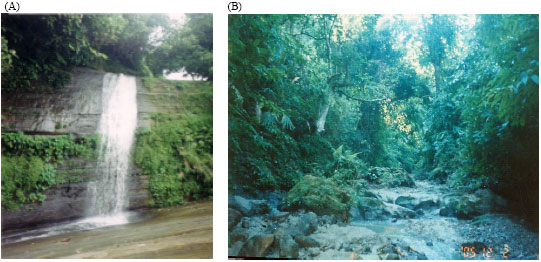 | |
| Fig. 1: | Photograph of the Sapchari waterfall (A) and the Sapchari stream originated from the waterfall (B) |
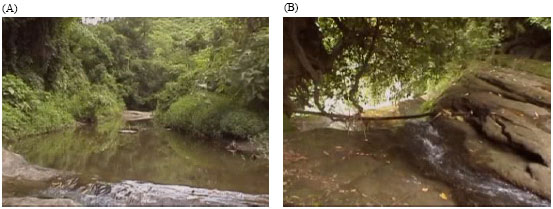 | |
| Fig. 2: | Photograph of the top reservoir of the waterfall (A) and water flows from reservoir to the waterfall (B) |
In the south of the Sapchari village the Sapchari waterfall is located. The landscape is very charismatic and the whole view of Khagrachari town can be observed from the top of the waterfall. However care should be taken for snakes that might be poisonous. While going up on the hills it will be very wise to take a first aid box for any incident. Figure 1 and 2 show the photographs of the Sapchari water fall, its stream, reservoir and flow from the reservoir.
DATA COLLECTION AND ANALYSIS
Data collection is a major task in this study. The data was collected throughout the year 2007 and during January-August, 2008 which covers the extreme dry season to full monsoon of Bangladesh. The place is located at the Hill tracks in Khagrachari district of Bangladesh. The Sapchari waterfall has a primary reservoir and a secondary reservoir from which the main waterfall is getting down to the third reservoir. The head from the primary to secondary reservoir is 3.6 m (11.81 ft) and from the secondary (Main Waterfall) to tertiary reservoir is 10 m (32.81 ft). The flow rate is measured simply with a bucket and a stopwatch. We have measured flow rate in the year 2007 and during January-August, 2008 that cover the shoddier dry Summer to precarious rainy season of Bangladesh.
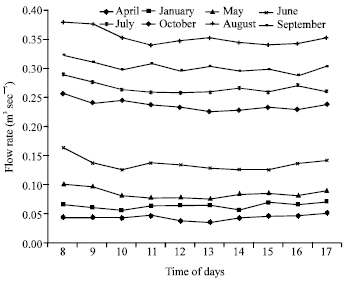 | |
| Fig. 3: | Time of day vs flow rate of water in cu-m sec-1 |
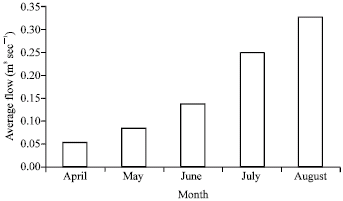 | |
| Fig. 4: | Average flow rate of water in cu-m sec-1 in the months |
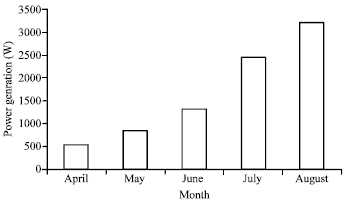 | |
| Fig. 5: | Average power generation in watt (W) in the months |
Figure 3 and 4 show, respectively the flow rate and average flow rate of the water in the waterfall in the observed period. The water flow in a day is nearly steady. The variation in the value may be of error in measuring the flow rate. It is pellucid that the flow rate is as low as 0.0035 cu m sec-1 in Summer and is as high as 0.038 cu m sec-1 in the rainy season. The water flow is increases from summer and reaches the pick in the rainy season. Then it starts to decline again.
The power generation capability with respect to the flow of the water is exposed in Fig. 5. It is nearly proportional to the flow rate. It is shown that the maximal rated power generation is about 3.5 kW.
RESULTS AND DISCUSSION
An extensive study has been carried out on the feasibility of hydroelectric power generation in Sapchari Waterfall. A number of data has been gathered, analyzed and sorted for decisions. There may remain some data fissure, but enough data have been collected and analyzed to reach the final results.
Summary results
| • | Head of the waterfall: 32.81 feet or 10 m |
| • | Minimum flow rate in dry season: 0.0035 cu m sec-1 |
| • | Maximum flow rate in rainy season: 0.038 cu m sec-1 |
| • | Minimum power rating: 525 W |
| • | Maximum power rating: 3458.11 W |
| • | Transportation facility to the site: Medium |
| • | Population in the vicinity: low, about 300 within 1 km2 |
Effects on ecosystem: There is a natural ecosystem in the surroundings of the waterfall. Usually the water world in the waterfall consists of small fishes, prawns and other microorganisms. Their natural surroundings may be hampered by the oil and grease leakage from the mechanical moving parts of the plant. Also, the people in the vicinity are used to live on the water of the stream originated from this waterfall. The water pollution by the oil and other lubricant leakage might be a great threat for population health in the vicinity. If proper measure can be assured then these negative effects will be very less.
Effects on local people`s life: The people in the area near the waterfall are very underprivileged and live on cultivating the hilly areas (Locally called Jum). With minimum electricity they can manage their daily life more effectively and comfortably. They can enjoy all the facilities of a city life. Also the maintenance of the plant needs a few people where they might get employed. Using pumps they can manage their water easily. If a micro hydro power plant is setup there, it will change their way of living.
Effects on ecotourism: Tourism is not yet established in the area. But it has an intense possibility to burgeon as a beloved tourist spot. Though the spot of the waterfall has become an attraction for the adventurers, it can be an additional feature for tourist attraction if a micro hydro electric power plant is installed. The living standard of the local people can be improved if the tourism is blossomed in this area.
CONCLUSION
Based upon the results and discussion, we could conclude that:
| • | The Sapchari waterfall is a prospective site for micro hydro power generation. With the available head and flow rate a Kaplan Turbine or a waterwheel will be the best for the electricity production and the generator should be flexible enough to cover the range 500-3500 W |
| • | Effect on the ecosystem of the area is very less and the ecotourism will increases hopefully. Both the way of living and the living standard of this vicinity will be ameliorated after such installation |
REFERENCES
- Sadrul Islam, A.K.M., M. Islam and T. Rahman, 2006. Effective renewable energy activities in Bangladesh. Renewable Energy, 31: 677-688.
CrossRefDirect Link - Islam, M.R., M.R. Islam and M.R.A. Beg, 2008. Renewable energy resources and technologies practice in Bangladesh. Renewable Sustainable Energy Rev., 12: 299-343.
CrossRefDirect Link