

N. Sameii
Department of Textile Engineering, Faculty of Technical and Engineering, Islamic Azad University, Science and Research Branch, Tehran, Iran
S.M. Mortazavi
Department of Textile, Isfahan University of Technology, Isfahan, Iran
A.S. Rashidi
Department of Textile Engineering, Faculty of Technical and Engineering, Islamic Azad University, Science and Research Branch, Tehran, Iran
S. Sheikhzadah-Najar
Department of Textile Engineering, Faculty of Technical and Engineering, Islamic Azad University, Science and Research Branch, Tehran, Iran
Journal of Applied Sciences
Year: 2008 | Volume: 8 | Issue: 22 | Page No.: 4204-4209







ABSTRACT
In this research, the desizing and scouring stages were eliminated by mercerizing greige cotton fabrics for 5 min at different temperatures ranging from 15 to 90 °C in both slack and under tension states. Mercerization is one of the most common wet processing of cotton materials to improve their dyeing and physical properties following changes in fine structure, morphology and conformation of the cellulose chains occur during mercerization. The barium activity number was used to express the degree of mercerization of the mercerized fabrics. The ratio of IR peak heights (α1372cm-1/α2900cm-1) obtained from treated fabrics was used to measure crystallinity index of mercerized cotton fabrics at various temperatures. It was observed that mercerization treatments decrease the cellulose crystallinity index where decrement in crystallinity index was varied in different mercerization conditions. Mercerization at low temperatures could increase dye uptake. Maximum dye uptake increase was observed at 35 °C for slack mercerized fabrics and at 65 °C for tension mercerized fabrics which were about 34 and 28.2% compared to un-mercerized fabric respectively. Also, these findings evidenced that tensile strength could be improved in mercerization process, whereas the increase of the tensile strength of tension mercerized fabric was small as compared to that of the slack mercerized fabric.
PDF Abstract XML References Citation
How to cite this article
N. Sameii, S.M. Mortazavi, A.S. Rashidi and S. Sheikhzadah-Najar, 2008. An Investigation on the Effect of Hot Mercerization on Cotton Fabrics Made up of Open-End Yarns. Journal of Applied Sciences, 8: 4204-4209.
DOI: 10.3923/jas.2008.4204.4209
URL: https://scialert.net/abstract/?doi=jas.2008.4204.4209
DOI: 10.3923/jas.2008.4204.4209
URL: https://scialert.net/abstract/?doi=jas.2008.4204.4209
INTRODUCTION
The swelling of cotton with an aqueous solution of sodium hydroxide is an important commercial treatment. Mercerization is utilized to improve properties as dye affinity, chemical reactivity, dimensional stability, tensile strength, luster and smoothness of the cotton fabrics (Wakida et al., 2000, 2002a; Kim et al., 2006; Haga et al., 2001). The treatment is normally applied either to yarn or to the fabric itself either in the slack state to obtain stretch products, or under tension to improve such properties as strength and luster (Bisanda, 2000; Wakida et al., 2002b). One of the changes that occur to the treated cotton is that its crystal structure can be converted from cellulose I to II. In addition to change in crystallinity, accessibility and unit cell structure, the orientation of cellulosic fibers, i.e., the fibrils along the fiber axis, increases with swelling in alkali due to the restraining influences of the primary fiber wall. The extent of changes that occurs depends on the processing time, caustic concentration, temperature, degree of polymerization and source of the cellulose, the physical state of the cellulose, slack or tension treatment and the degree of tension (Wakida et al., 2002b).
Different alkali systems have been used for efficient mercerization where caustic soda solution is still one of the bests (Tóth et al., 2003; Yuichi et al., 2006). There are two methods for mercerizing cotton yarns and fabrics; normal mercerization and hot mercerization. In normal mercerization, the goods are treated in caustic soda solution at temperature 15-20 °C following by a washing and neutralization stages.
There are difficulties in carrying out normal mercerization. Cotton exhibits hydrophobic behavior in the loom state because of its greasy impurities hardly allowing high viscosity caustic soda solution at low temperature to penetrate into the fibers internal structure (Haga et al., 2000; Vincent et al., 2006).
Increasing the mercerization temperature can decrease the viscosity of caustic solution and improve its diffusion by swelling the fiber and decreasing the hydrophobic effect of oily impurities. In concentrated caustic soda solution at elevated temperature, the fabric becomes highly plastic with every low elasticity capable of being readily stretched, leading to higher degree of improvement in fabric properties. The other advantage of hot mercerizing process is that no wetting agent is needed even for mercerization of grey fabrics.
The increasing public awareness and sense of social responsibility related to environmental issues have led the textile industry to manufacture products with improved environmental profiles. In hot mercerization, the desizing stage can be eliminated whether the sizing material is starch-based, a modified starch, carboxy methyl cellulose or a synthetic size such as polyvinyl alcohol to comply more with environmental efficiency regulations (Qin et al., 2008; Metaxiotis, 2004). With rapid recent increase in energy costs it can be considered useful to study the possibility of eliminating the desizing and scouring stages of the cotton finishing process using hot mercerizing process. In this research, the desizing and scouring stages were eliminated as the greige cotton fabrics made up of open-end yarns were mercerized. We have determined the effect of the temperature of the caustic soda solution on the degree of mercerization. We measured the degree of mercerization with barium activity number, infrared crystallinity index and dye sorption techniques. Infrared ratio, α1372cm-1/α2900cm-1, is proposed for measuring crystallinity index in mercerized cellulosic materials (Chen et al., 2002).
MATERIALS AND METHODS
Grade-one type (Gorgan, Iran) cotton fiber with average length of 28 mm was used in an open-end spinning line to produce 100% cotton yarns. Cotton yarns (20 Ne) were weaved on a weaving machine after sizing the warps using a starch rich sizing formulation. The woven greige fabric (120 g m-2) was then used in mercerization experiments. Analytical grade caustic soda (99.5% purity) was purchased locally. Remazol Red RB (C.I. Reactive Red 198) a vinyl sulphone reactive dye was used in dye uptake measuring experiments.
Methods
Mercerization: Fabric samples in greige form were immersed in a caustic solution (300 g L-1) in slack and stretched conditions kept at temperatures between 15-90 °C for 5 min. A square shaped frame with pins on its perimeter was used for applying tension on fabrics. The greige cotton fabric was slightly stretched before being fixed on the pins in order to eliminate the fabric slippage during alkali treatment. The fabric was then stretched to a certain amount using a screw type stretching device before immersing the framed fabric into the alkali solution. After finishing the mercerization time, the immersed fabric was washed with hot and cold water consequently to remove excess caustic soda. Any remaining alkali was finally neutralized with dilute acetic acid solution followed by cold rinsing.
Bleaching and dyeing: Mercerized fabrics were bleached in alkali Hydrogen Peroxide solution in an exhaustion procedure and dyed in a laboratory jigger dyeing machine at a liquor ratio of 40:1. Dyeing solution containing 3% (o.w.f) Remazol Red RB (Reactive dye), 10 g L-1 Na2CO3 and 20 g L-1 NaCl was adjusted at 25 °C and then raised to 60 °C at a rate of 2 °C min and maintained at this temperature for 90 min. Dyed samples were washed in a soap solution for removal of hydrolyzed dyes and were dried at 50 °C in an oven.
Measurements: The adsorptivity ratio of α1372cm-1/α2900cm-1 was obtained as the crystallinity index using an infrared (IR) spectrophotometer (IR-470, Shimadzu Co.). Measurement was performed by means of a diffuse reflection method using a compacted pill form mixture of cut fiber segments and potassium bromide. The infrared ratio was estimated according to the literature (Chen et al., 2002; Esfandiari, 2008). The methods of drawing the baselines are indicated in Fig. 1. For the bond at 2900 cm-1 the intensity at the adjacent shoulder near 3000 cm-1 was chosen as the base. For the bond at 1372 cm-1 a line was drawn between the maxima at approximately 1290 and 1410 cm-1 giving a common baseline for the group of three bands which occur close together in this region and which are changing simultaneously.
Barium activity number was measured according to AATCC 89-1998 test method. The mercerized and un-mercerized cotton fabrics were cut into small lengths, weighing 1 g were treated with 30 mL of 0.25 N barium hydroxide solutions in 100 mL flasks. After 2 h, 10 mL of the solution was titrated with 0.1 N hydrochloric acid.
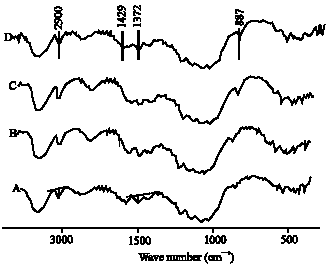 | |
| Fig. 1: | IR spectrum of fabrics with different treatment temperature: (A) untreated fabric, (B) slack mercerized (15 °C), (C) slack mercerized (25 °C), (D) tension mercerized (15 °C) |
A blank was also run in without any fabric sample. If A, B and C are the titration reading for the blank, mercerized sample and unmercerized sample respectively, then the barium activity number is given by Eq. 1.
 | (1) |
Dye uptake was measured using K/S values of dyed samples which were originally determined from Kubelka-Munk equation (Eq. 2) where K and S are the absorption and scattering coefficients respectively and R is the reflectance. A Tex-flash reflectance spectrophotometer set for illuminant D65 and CIE 1964 standard observer was used in colour measurements.
 | (2) |
The tensile strength and elongation were measured on a Tensolab tester in an environment set at 65% relative humidity and 21 °C. The gauge length in tensile tests was 150 mm and fabric samples were tested at a rate of extension of 125 mm min-1 (breakage time 20 ± 2 sec). For strength and elongation at break, 10 specimens were tested for each sample.
The efficiency of mercerization process in removal of sizing materials was calculated using Eq. 3 where D0 and D are the weight percentage of starch on greige and mercerized fabric respectively. To calculate these individual values, greige un-mercerized fabric was desized in an enzymatic process and its weight loss was considered as D0. A piece of mercerized sample was also desized in the same desizing procedure which gives the percentage of remaining sizing materials after mercerization process (D).
 | (3) |
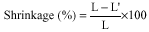
To measure the shrinkage happened in slack mercerization process, four lines, each 10 cm long, were marked on each sample in warp and weft directions and the changes in their length were subsequently used for calculating the shrinkage percentage according to Eq. 4:
 | (4) |
where, L and L` are the average markers` length on the samples, before and after the slack mercerization.
RESULTS AND DISCUSSION
Change in crystallinity index: These infrared curves reflect differences in the OH group content in regions at 700 and 3300 cm-1.
| Table 1: | The effect of mercerizing temperature on crystallinity index of infrared ratio |
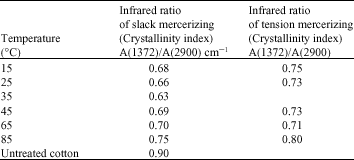 | |
Differences were also noted at 2900, 1372, 1429 and 893 cm-1. The strong band at 1590 cm-1 appeared to be related to the formation of hydrogen bonding in amorphous cellulose. Chen et al. (2002) and Esfandiari (2007) developed an empirical infrared crystallinity index for the native cellulose from the ratio of the absorptivities at 1429 and 893 cm-1. They proposed a new infrared ratio α1372 cm-1/α2900 cm-1 for estimating crystallinity of cellulose samples with mixed lattices. The infrared curves suggested that cellulose II is formed after sodium hydroxide treatments. A comparison of the effect of temperature treatment on crystallinity index as identified by infrared crystallinity ratio is shown in Table 1. Generally, all caustic mercerization treatments caused a decrease in the crystallinity index of cellulose. The decrease of crystallinity index varied with mercerization conditions. Infrared ratio of the fabrics tension mercerized is higher than that of the fabrics slack mercerized that this may related to the greater degree of orientation in tension mercerization. Table 1 showed that the crystallinity index of the sodium hydroxide treated fabrics first decreased, reached a minimum and then increased with an increasing treatment temperature. The initial decrease of the crystallinity index can be related to formation cellulose II and again increase of the crystallinity index may be attributed to the fact that increasing treatment temperature leads to the formation a product similar to cellulose I. The initial decrease in crystallinity index and its further increase usually happened faster in slack mercerized fabrics compared to tension mercerized ones which can be related to the easier diffusion of caustic solution in former fabrics.
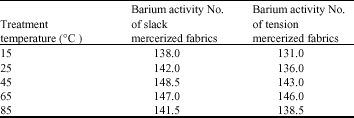
Barium activity number: The barium activity number is widely used to express the degree of mercerization. Table 2 shows the barium activity number according to the various temperature treatments. Increasing the mercerizing temperature could cause the barium activity number of the sodium hydroxide treated fabrics to first increased, reached a maximum and then decreased. There is an inverse correlation between crystallinity index and barium activity number of mercerized fabrics.
| Table 2: | The effect of mercerizing temperature on barium activity number |
 | |
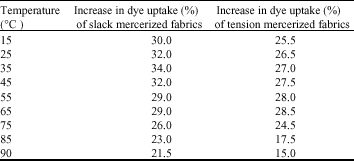
| Table 3: | The effect of mercerizing temperature on dye uptake |
 | |
The barium activity number of the slack mercerized fabric was higher than that of the mercerized fabric under tension. This may be due to the easier diffusion of chemicals following the reduction in crystallinity level which is in agreement with the crystallinity index data.
Dye uptake: The mercerized fabrics were bleached in hydrogen peroxide and caustic soda and then dyed by a reactive dye. Increase in dye uptake of mercerized samples in comparison with un-mercerized fabrics at the various mercerizing temperatures is shown in Table 3. The results clearly show that the dye uptakes of mercerized samples are higher than that of the un-mercerized fabric. This related to the destruction of crystalline regions during the swelling and structure change in mercerized cotton. The maximum dye uptake was observed in the tension mercerized fabrics at 65 °C whilst in slack state at 35 °C the highest amount of dye could be exhausted by the fabric. The penetration of sodium hydroxide into fabrics is easier in the slack mercerized than that of the tension mercerized that this caused maximum dye uptake of slack mercerized fabric happened at lower temperature. Saapan, Kandidand Habib reported (Saapan, 1984) that cellulose II is formed after sodium hydroxide treatment and the extent of conversion depended on the experimental conditions, i.e., caustic mercerization at 20 °C caused more conversion from cellulose I to cellulose II than is obtained by swelling in NaOH at 90 °C. In other words, cellulose II formation diminishes by increasing treatment temperature while cellulose I formation could be increased.
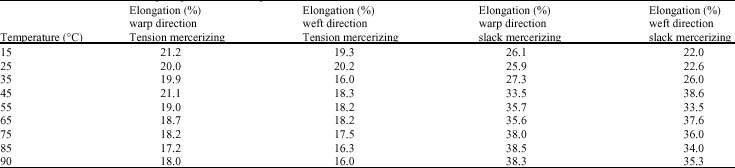
Tensile strength and elongation: Tensile strength and elongation of un-mercerized fabric were 31.9 kgf and 18.1%, respectively in warp direction (Table 4).
| Table 4: | The effect of mercerizing temperature on tensile strength in warp direction |
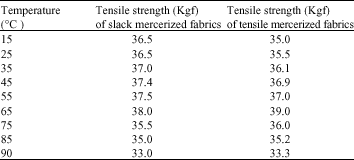 | |
The tensile strength of the slack and under tension mercerized fabric was showed a clear increase in all conditions. The major reason for the increased tensile strength can be an alleviation of internal stresses and the deconvoluting of the fibres in the fabric during swelling process. The tensile strength of mercerized samples in slack state is higher than that of the mercerized samples under tension. This may be related to the easier penetration of caustic soda into fiber structure in slack mercerized samples and thus increase in the degree of mercerizing and swelling in fibers. Since the slack mercerized fabrics showed higher barium activity number compared to those which were mercerized under tension, it is also expected that the tensile strength can be higher in the slack mercerized fabrics. Based on observations, increasing the mercerization temperature could increase the tensile strength where maximum strength was observed by mercerization at 65 °C that related to maximum degree of mercerizing and swelling at this point. At temperatures higher than 65 °C, the tensile strength of under tension mercerized fabrics is higher than that of the slack mercerized fabrics that this may be related to the greater degree of orientation in the fabrics caused by mercerization under tension. Increasing temperature could not linearly raise the strength which is in agreement with the results of the barium activity number. Elongation in warp and weft directions of the mercerized fabrics is shown in Table 5.
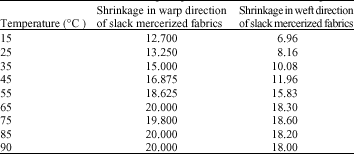
Shrinkage: Results is showing that for a fabric made up of open-end spun yarns, increasing the mercerization temperature can raise the shrinkage in warp and weft directions. Maximum shrinkage was observed at 65 °C. Shrinkage in the warp direction was usually higher than that of in the weft direction mainly because of the higher weave density in the warp direction (Table 6).
Size removal: The greige cotton fabrics were mercerized in slack state and under tension within temperature range of 15-90 °C.
| Table 5: | The effect of mercerizing temperature on Elongation |
 | |
| Table 6: | The effect of mercerizing temperature on the fabric shrinkage |
 | |
| Table 7: | The effect of mercerizing temperature on the fabric size removal (%) |
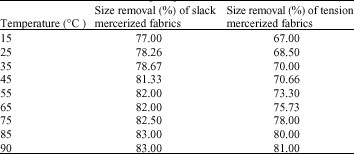 | |
Table 7 shows the removal size percent of the mercerized greige cotton fabric at various temperatures where increasing the mercerization temperature have had a significant effect on size removal percentage especially above 65 °C.
There is a correlation between treatment temperature and size removal percentage, as well as with degree of stretching and size removal percentage. Raising the mercerization temperature could lower the viscosity of caustic soda solution which facilitates penetration of alkali into the fabric. As it is also appear, the size removal percent of the mercerized samples in slack condition was higher than that of the mercerized samples under tension. The greater removal size percent in the slack mercerized fabrics may be related to the easier penetration of caustic soda into the relaxed fabric whilst in stretched fabric the porosity of the fabric was decrease because of the level of the applied tension which increases the compactness of yarn and fabric structure.
CONCLUSION
The greige cotton fabrics made up of open-end spun yarns was treated with caustic soda solutions at different temperatures, under tension and also in relaxed conditions. With increasing in treatment temperature the dye uptake, barium activity number and tensile strength of the mercerized fabrics first increased and then decreased. The maximum dye uptake of the slack mercerized fabric was observed at 35 °C, while for tension mercerized fabric was observed at 65 °C. The maximum barium activity number and tensile strength and minimum crystallinity index of the tension mercerized fabrics was observed at 65 °C, while for slack mercerized fabric was observed at 35 °C. On the other hand, results showed that all caustic mercerization treatments caused a decrease in the crystallinity index of cellulose. The crystallinity index of the sodium hydroxide treated fabrics first decreased, reached a minimum and then increased with an increasing treatment temperature.
REFERENCES
- Bisanda, E.T.N., 2000. The effect of alkali treatment on the adhesion characteristics of sisal fibres. Chem. Mater. Sci., 7: 331-339.
Direct Link - Chen, R., Jakes and A. Kathryn, 2002. Effect of pressing on the infrared spectra of single cotton fibers. Soc. Applied Spectroscopy, 56: 646-650.
CrossRef - Esfandiari, A., 2007. Mechanical properties of PP/jute and glass fibers composites: The statistical investigation. J. Applied Sci., 7: 3943-3950.
CrossRefDirect Link - Haga, T. and T. Takagishi, 2001. Structural change in mercerized cotton fibers on cellulase treatment. J. Applied Polym. Sci., 80: 1675-1680.
CrossRefDirect Link - Haga, T., R. Mori, T. Wakida and T. Takagishi, 2000. Hydrolysis of mercerized cotton fibers due to cellulase treatment. J. Applied Polym. Sci., 78: 364-370.
CrossRef - Metaxiotis, K., 2004. An expert system for the reduction of environmental cost in the textile industry. Inform. Manage. Comput. Security, 12: 218-227.
CrossRef - Qin, C., C.N. Soykeabkaew, N. Xiuyuan and T. Peijs, 2008. The effect of fibre volume fraction and mercerization on the properties of all cellulose composites. Carbohydrate Polymers, 71: 458-467.
CrossRef - Saapan, A.A., S.H. Kandil and A.M. Habib, 1984. Liquid ammonia and caustic mercerization of cotton fibers using X-Ray, infrared and sorption measurements. Textile Res. J., 54: 863-867.
CrossRef - Toth, T., J. Borsa, J. Reicher, P. Sallay, I. Sajo and I. Tanczos, 2003. Mercerization of cotton with tetramethylammonium hydroxide. Textile Res. J., 73: 273-278.
CrossRef - Wakida, T., Y. Kitamura, M. Lee. S. Bae, M. Chen, H. Yoshioka and Y. Yanai, 2000. Effect of hot water processing on dyeing and mechanical properties of cottons treated with liquid ammonia and sodium hydroxide. Textile Res. J., 70: 769-774.
CrossRef