

R. Abbasnia
Department of Civil Engineering, IUST, Iran
A. Afshar
Department of Civil Engineering, IUST, Iran
E. Eshtehardian
Department of Civil Engineering, IUST, Iran
Journal of Applied Sciences
Year: 2008 | Volume: 8 | Issue: 22 | Page No.: 4159-4165







ABSTRACT
In this study, a new approach has been investigated in solving time-cost trade off problem, because of uncertainties which affect on activity cost. Fuzzy logic theory is employed to consider affecting uncertainties in total direct and indirect cost of a construction project. Non-dominated Sorting Genetic Algorithm (NSGA), a multi objective optimization algorithm, is applied to provide a trade-off between time and total cost. Project manager can also have different non-dominated solutions or pareto solutions which are dependent on his measure of accepted risk through applying α cuts methods in fuzzy logic theory. The proposed model leads the decision maker to select the desirable pareto front solution through acceptable value of α cut.
PDF Abstract XML References Citation
How to cite this article
R. Abbasnia, A. Afshar and E. Eshtehardian, 2008. Time-Cost Trade-off Problem in Construction Project Management,
Based on Fuzzy Logic. Journal of Applied Sciences, 8: 4159-4165.
DOI: 10.3923/jas.2008.4159.4165
URL: https://scialert.net/abstract/?doi=jas.2008.4159.4165
DOI: 10.3923/jas.2008.4159.4165
URL: https://scialert.net/abstract/?doi=jas.2008.4159.4165
INTRODUCTION
Time cost trade off problem is one of the highly important issues in project accomplishment and has been ever taken into consideration by project managers. Time and cost as two critical objectives of construction project management, are not independent but intricately related. Trade-off between project duration and total cost are extensively discussed in the project scheduling literature because of its practical relevance. It is generally realized that when project duration is compressed, the project will call for an increase in labor and more productive equipment and require more demanding procurement and construction management and then the cost will increase. Time-cost optimization may be defined as a process to identify suitable construction activities for speeding up and for deciding by how much so as to attain the best possible savings in both time and cost. Since there is a hidden tradeoff relationship between project time and cost, it might be difficult to predict whether the total cost (i.e., the direct and indirect costs) would increase or decrease as a result of the schedule compression. Since different combinations of possible durations and costs for the activities can be associated with a project, the problem is which of these combinations are the best. Determining the best sets is the goal of time-cost optimization.
EXITING TECHNIQUE
Various methods such as heuristic methods and mathematical programming models have been proposed in recent decades to be applied to construction time cost optimization. Heuristic methods are based on rules of thumb, which generally lack mathematical rigor (Siemens, 1971; Moselhi, 1993). Mathematical programming methods convert the time cost trade off to mathematical models and utilize linear programming (Pagnoni, 1990; Liu et al., 1995), integer programming or dynamic programming (De et al., 1995). Less attention of recent researchers to these methods, insufficiency of them in discontinuous decision space and successful development and application of meta heuristic optimization algorithms for solving single objective optimization problems in recent years, has attracted the attention of researchers to investigate the possibility of their application to solve multi objective optimization problems.
There exist numerous difficulties and complexities in applying meta heuristic algorithms to solve multi objective problems and Feng et al. (1997), Li and Love (1997, 1999), Hegazy (1999) and Zheng et al. (2005) have engaged in appropriate use of these methods during past 2 decades. In this regards, different versions of GAs have successfully been applied to optimize time cost problem.
Uncertainties in the problem have received less attention due its complexity. Therefore, most of the studies have been focused on deterministic problems. In real construction projects however, cost of activities may face significant changes due to existing uncertainties such as inflation, economical and social stresses, execution errors of contractor, design errors, natural events such as climate changes, etc. Therefore, total cost of project may differ significantly because of these uncertainties.
In this study, a new approach has been investigated in solving time-cost trade off problem. Fuzzy logic theory is employed to consider affecting uncertainties in total direct and indirect cost of a construction project. To obtain appropriate solutions, genetic algorithm has been employed as an optimizer where uncertainties are considered through fuzzy logic representation. Project manager can also have different non-dominated solutions or pareto solutions which are dependent on his measure of accepted risk through applying α cuts methods in fuzzy logic theory. A case study through which considerable conclusions is drawn is finally investigated.
THEORETICAL BASIS
Non-dominated Sorting Genetic Algorithm (NSGA): A Genetic Algorithm (GA) is a search technique used to find true or approximate solutions to optimization and search problems (Deb, 1999). Genetic algorithms are categorized as global search heuristics approach. GAs are implemented as a computer simulation in which a population of abstract representations (called chromosomes) of candidate solutions (called individuals) to an optimization problem evolves toward better solutions. The evolution usually starts from a population of randomly generated individuals and forming a generation. In each generation, the fitness of every individual in the population is evaluated, multiple individuals are stochastically selected from the current population (based on their fitness) and modified (crossover and possibly mutation) to form a new population. The new population is then used in the next iteration of the algorithm. Commonly, the algorithm terminates when either a maximum number of generations has been produced, or a satisfactory fitness level has been reached for the population.
Non-dominated Sorting Genetic Algorithm (NSGA) is a multi objective optimization algorithm and provides a trade-off between the various objectives considered (Deb, 1999). NSGA basically differs from simple genetic algorithm in the way the selection operator works. Crossover and mutation operators may be used without any modification. Before the selection is performed, the population is ranked on the basis of an individual`s non-domination. The non-dominated individuals present in the population are first identified from the current population. Then, all these individuals are assumed to constitute the first non-dominated front in the population and assigned a large dummy fitness value. The same fitness value is assigned to give an equal reproductive potential to all these non-dominated individuals.
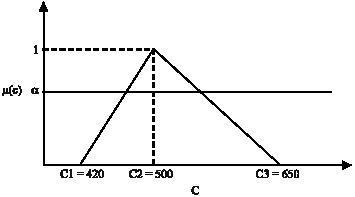 | |
| Fig. 1: | Fuzzy presentation of indirect cost |
These non-dominated individuals are ignored temporarily to process the rest of population in the same way to identify individuals for the second non-dominated front. These new set of points are then assigned a new dummy fitness value which is kept smaller than the minimum dummy fitness of the previous front. This process is continued until the entire population is classified into several fronts.
Fuzzy logic: A fuzzy set can be defined mathematically by assigning to each possible individual in the universe of discourse a value representing its grade of membership in the fuzzy set. This grade represents the degree to which that individual is similar or compatible with the concept represented by the fuzzy set. Thus, an individual may belong in the fuzzy set to a greater or lesser degree as indicated by a larger or smaller membership grade. These membership grades are very often represented by real-number values ranging in the closed interval between 0 and 1.
A fuzzy number is a fuzzy membership function that is both convex and normal. Fuzzy numbers are written in the form of a domain value and its corresponding confidence level. Figure 1 shows an example of a triangle and a normal fuzzy number. A fuzzy number can be considered a generalization of the concept of interval of confidence. Therefore, the mathematical operations of fuzzy numbers (i.e., addition, subtraction, multiplication and division) can be processed using the concepts of the interval of confidence.
For instance, the set of linguistic variable (A) around 500 as shown in Fig. 1 can be normalized as:
 | (1) |
where, X is the range of possible values and μA(x) is the membership function taking values from [0,1], specifying to what degree x belongs to the fuzzy set A.
The α cut is a commonly used method to connect the principles of fuzzy sets with a collection of crisp sets, which can in turn be fed into most of the existing systems. The α-cut level set or α-level cut of A is the set:
 | (2) |
The α represents the degree of risk that the managers is prepared to take. Since the value of α could severely influence the non dominated solutions, its choice should be carefully considered by decision makers. As a result, a general survey which aims at identifying the relationship between the value of α (i.e., 0 to 1) and the corresponding risk level (i.e., no risk to full risk) by collecting the risk attitudes of managers would be indispensable.
PROPOSED MODEL STRUCTURE
In solving Time cost trade off problem, for each activity, different options are considered with different times and costs. In reality due to different uncertainties involved cost of each option is not a crisp value. In another words, the actual cost of each option is not certainly known for the manager in advance. However, after project execution, they will be known. Lund calls them single value unknown parameter. It means that even though these parameters are subject to some uncertainties at the early stages of the project developments yet, they will receive a known crisp value after project completion and remains unchanged. To apply cost of each option may be well considered employing fuzzy set theory. So, the number presented for each activity cost is a fuzzy one.
A triangular fuzzy number ( = (c1, c2, c3)) may be assigned for the cost of that activity. Defining c1, c2 and c3 as optimistic, pessimistic and the most probable cost for an activity, respectively. To solve time-cost trade off problem, some options can be chosen for cost of each activity. For example, if there exist 7 activities and 5 options for each activity, then 57 sets of solutions will exist. Therefore, genetic algorithm is applied to obtain optimal solutions of the problem. Length of chromosome or number of genes equals to the number of activities and value of each gene is the option considered for fulfillment of the corresponding activity.
In this model, employing critical path concept and considering predecessor activities in network, project termination time for each trial solution was also determined. For each randomly generated trial solution, the total cost as a fuzzy number was determined by fuzzy summation of costs of the options in the alternative. Assume that  are two fuzzy costs and their α cuts are presented as C1α and C2α. The sum of these two numbers would be as follows:
 | (3) |
 | (4) |
 | (5) |
Model has the ability to easily calculate the total project cost. Total project cost will be obtained by multiplying daily cost (indirect cost) by project execution time and adding this product to the relevant direct cost. Daily cost of project could be in the form of a crisp value or a fuzzy number. Model is capable of accounting for both crisp and/or fuzzy indirect costs. If the indirect cost is fuzzy numbers, fuzzy mathematical equations will be employed to multiply these numbers because cost is fuzzy number and time is crisp number. Assume that  is fuzzy number and T is crisp number, the multiplication of these two numbers would be as follows:
 | (6) |
After multiplying indirect cost to time in a fuzzy manner using above mentioned equations and adding the indirect cost to direct cost in a fuzzy manner (Eq. 5), total cost which is a triangular fuzzy number will be obtained.
Therefore, there is a crisp value for total project time and a fuzzy one for total cost of project. In order to find dominated and non-dominated solutions, it is necessary to make a comparison between the times and the costs of chromosomes. In this situation, fuzzy numbers comparison and ranking methods are applied because costs are fuzzy numbers. Considering uncertainty essence of the costs and the fact that costs are triangular fuzzy numbers, a method base on Hamming distance (dH) between two fuzzy numbers  is defined as follows:
 | (7) |
The major idea is to find a fuzzy number as  which is greater than
  deterministically. It is obvious that
  can not be closed uniquely.
  can be selected as MAX(
 ), a fuzzy number which defined as follows:
 | (8) |
So, if hamming distance between  is greater than corresponding distance between
  , it can be concluded that
  is greater than
  .
.
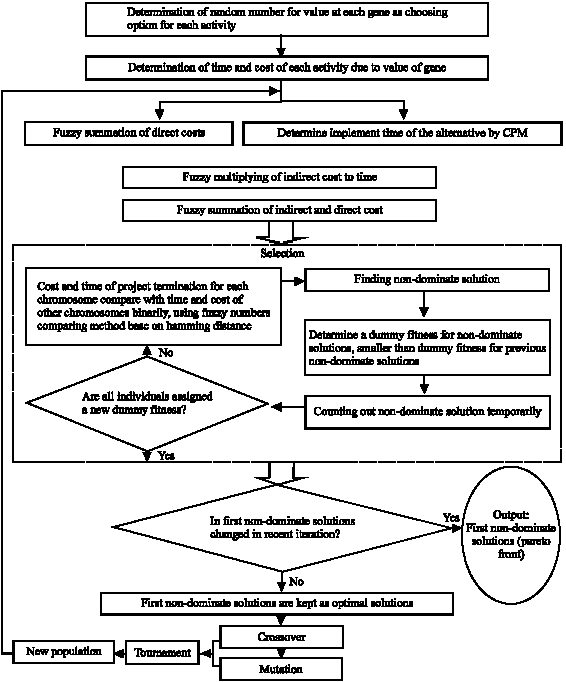 | |
| Fig. 2: | The schematic diagram of the proposed model |
The cost and time of project termination for each alternative solution (chromosome) can be compared with other (chromosomes) binarily using fuzzy numbers comparison method based on hamming distance.
Concepts addressed in NSGA were used to define selection operator. In the first generation, each solution is assigned fitness equal to its non-domination level (i.e., 1: corresponds to the best non-domination level, 2: to the next best level and so on).
To produce population of the next generation, non-dominated solutions from the previous generation are directly transferred to form part of the population for the new generation. Tournament selection is used to select parent chromosomes for crossover and mutation to complete the population size with reproduced offsprings. The process will continue until a desirable a set of non-dominated solutions (i.e., pareto front) is achieved. The schematic diagram of the suggested model is shown in Fig. 2.
Advantage of this model in comparison with similar ones lies on the method that, uncertainties in project cost are demonstrated aggregated and interpreted. Triangular fuzzy values are assumed for any individual option with total cost being presented as a fuzzy number. So, when project manager chooses his optimum solution, he would face a total cost and corresponding membership function ahead that considerably help him to make appropriate decisions based on his own level of risk acceptance.
The project manager may apply his own risk acceptance level to obtain a new pareto front with new non-dominated solutions using α cuts property. When he dose not want to risk, he would assign zero for α and therefore, costs of project activities, direct cost and total cost obtained for the project may be subject to high range of changes. When project manager wants to fully risk (i.e., 100%), he sets α equal to 1 and so, costs of project activities, direct cost and total cost would be transformed from a fuzzy value to a crisp one and problem would enter into a crisp space from a fuzzy one. In this situation, uncertainties in cost estimation would be practically ignored. Determination of α (i.e., accepting different risk percentage), would lead to different pareto solutions.
CASE STUDY
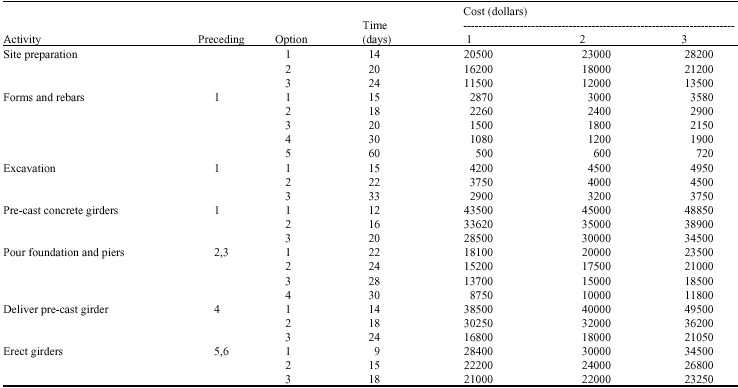
To demonstrate the concept and test the performance of the proposed model, a simple case example was adopted from Zheng et al. (2004). It consists of 7 activities with different possible options. The cost data reported by Mr. Dasiy X.M. Zheng et al. (2004) were assumed associate with the most probable condition with membership of 1; while for the minimum and maximum cost for any option cost values were assumed to form the triangular membership functions. Adopted and assumed values for cost of options along with other required data for 7 activity project are shown in Table 1. Assumed value for indirect cost is shown in Fig. 1.
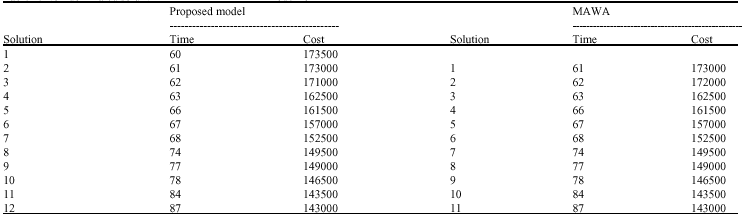
The example has been solved for different values of α cuts. Assuming α = 1, disregards uncertainties and solve the model in an absolutely crisp space. In this case, it is expected to obtain the same solution reported by previous researcher for a fully crisp problem. The same problem was approached by Zheng et al. (2004, 2005) in a fully deterministic environment (i.e., α = 1), employing Modified Adaptive Weighted Approach (MAWA). Their results are shown in Table 2. As is clear, the proposed approach has dominated the solution for duration of 62 days, as well as providing one more non-dominated solutions for 60 days of project execution.
To demonstrate the pareto front in a time-cost coordinate system, fuzzy cost will be transformed to a crisp value through application of center of gravity defuzzifier. Therefore, if total fuzzy cost ( ) is covered by membership function A, the center of gravity defuzzifier defines point C* as the center of region which is covered by A. For α = 1, value of C* will represent the total cost of the project in fully crisp environment.
 | (9) |
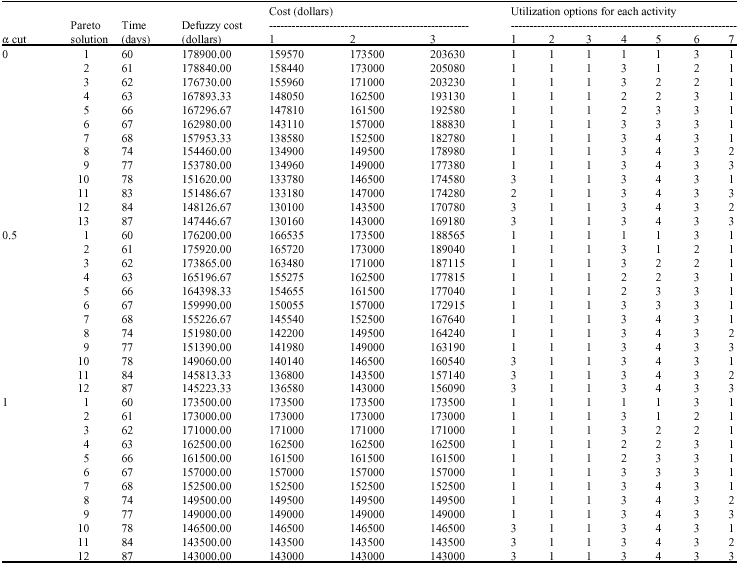
Fuzzy costs related to α = 0, α = 0.5 and α = 1 have been transformed to crisp values by center of gravity defuzzifier and pareto fronts in a time-cost coordinate system are shown in Fig. 3 and Table 3.
| Table 1: | Time and cost data for case example |
 | |
| Table 2: | Non-dominated solution; MAWA vs. proposed model for α = 1 |
 | |
| Table 3: | Non-dominated set of different α cuts |
 | |
The lower the α, the higher the total cost for any given time has been resulted. In another words, pareto front moves upward as it value of α approaches to zero. This issues means that for the lower risk, the higher cost would be accrued for project execution. In this case total cost will have smaller range of changes. However, assuming bigger values for α associates with the higher risk acceptance, which results in the lower cost with quite the larger range of changes. This is the major benefit of this model application.
The example can be solved for different values of α cuts for direct and indirect cost. It means that, project manager may apply different risk acceptance level for direct cost and indirect cost separately.
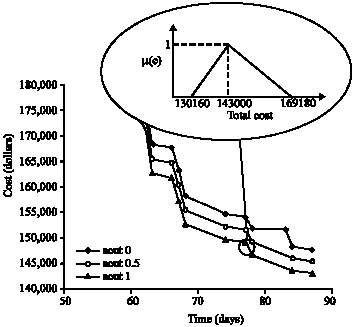 | |
| Fig. 3: | Pareto fronts for different α cuts |
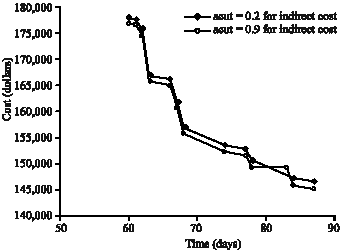 | |
| Fig. 4: | Pareto fronts (α = 0.2 for direct costs, α = 0.2 and α = 0.9 for indirect cost) |
As shown in Fig. 4, the project manager may apply his own risk acceptance level for direct cost to obtain the relevant pareto fronts.
CONCLUSION
Trade-offs between project duration and total cost are extensively discussed in the project scheduling literature because of its practical relevance. In a real construction project, cost of each activity and daily cost change as a result of many uncertainties such as inflation, economical and social stresses, execution errors of contractor, design errors, natural events. The model adopts fuzzy sets to simulate the degree of uncertainty of the input data. The incorporation of fuzzy sets theory in TCO problems is therefore a sensible step to emulate the decision-making process of human experts based on a set of uncertain or incomplete data. To find dominated and non-dominated solutions, fuzzy numbers comparison is applied because costs are fuzzy numbers. Non-dominated Sorting Genetic Algorithm (NSGA) is used for extraction the pareto front. Unlike the traditional models which focus primarily on the deterministic TCO problem, this model has the ability to adapt to deterministic and uncertain environment by changing the value of α. The project manager can apply his own risk acceptance level to obtain a new pareto front with new non-dominated solutions using α cuts property. For any given time, the lower the α, the higher the total cost has been resulted. Project manager can apply different risk acceptance level for direct cost and indirect cost separately.
REFERENCES
- De, P., E.J. Dunne and C.E. Wells, 1995. The discrete time-cost trade-off problem revisited. Eur. J. Operat. Res., 81: 225-238.
Direct Link - Deb, K., 1999. Multi-objective genetic algorithms: Problem difficulties and construction of test problems. Evol. Comput., 7: 205-230.
CrossRefDirect Link - Feng, C.W., L. Liu and S.A. Burns, 1997. Using genetic algorithms to solve construction time-cost trade-off problems. J. Comput. Civil Eng., 11: 184-189.
CrossRefDirect Link - Hegazy, T., 1999. Optimization of construction time-cost trade-off analysis: Using genetic algorithms. Can. J. Civil Eng., 26: 685-697.
CrossRefDirect Link - Li, H., J.N. Cao and P.E. Love, 1999. Using machine learning and GA to solve time-cost trade-off problems. J. Consult. Eng. Manage., 125: 347-353.
CrossRefDirect Link - Li, H. and P. Love, 1997. Using improved genetic algorithms to facilitate time-cost optimization. J. Const. Eng. Manage., 123: 233-237.
CrossRefDirect Link - Liu, L., S. Burns and C. Feng, 1995. Construction time�`cost trade-off analysis using LP/IP hybrid method. J. Construct. Eng. Manage., 121: 446-454.
CrossRefDirect Link - Moselhi, O., 1993. Schedule compression using the direct stiffness method. Can. J. Civil Eng., 20: 65-72.
CrossRefDirect Link - Zheng, D.X.M., S.T. Ng and M.M. Kumaraswamy, 2004. Applying a genetic algorithm-based multi-objective approach for time�`cost optimization. J. Construct. Eng. Manage., 130: 168-176.
CrossRefDirect Link - Zheng, D.X.M. and S.T. Ng, 2005. Stochastic time-cost optimization model incorporating fuzzy sets theory and non replaceable front. J. Construct. Eng. Manage., 131: 176-186.
CrossRefDirect Link