

A. Ebid
University Farm, Faculty of Agriculture, Ehime University, Ko 498, Hattanji, Matsuyama, Ehime 799-2424, Japan
H. Ueno
University Farm, Faculty of Agriculture, Ehime University, Ko 498, Hattanji, Matsuyama, Ehime 799-2424, Japan
A. Ghoneim
Rice Research and Training Center, Field Crops Research Institute, ARC, Egypt
N. Asagi
University Farm, Faculty of Agriculture, Ehime University, Ko 498, Hattanji, Matsuyama, Ehime 799-2424, Japan
Journal of Applied Sciences
Year: 2008 | Volume: 8 | Issue: 18 | Page No.: 3261-3266







ABSTRACT
The effect of a combination of inorganic fertilizer and organic inputs on nitrogen uptake and utilization efficiency was compared with that of only inorganic fertilizer. The treatments involved the addition of equivalent amounts of N (80 kg N ha-1) through inorganic fertilizer or three organic inputs (rice straw, rice root, or rice hull), in addition to a control treatment for rice (Oryza sativa L.) cultivars Koshihikari and Sakha 102. Rice straw was applied at two rates that corresponded to 5 and 10 Mg ha-1, the application rate of rice hull was 5 Mg ha-1 and rice root was 2.5 Mg ha-1. The rates of N utilization efficiency after 100th days after transplanting with 5 Mg ha-1 rice straw were relatively higher and ranged from 18.5 to 20.5%, while that with 10 Mg ha-1 ranged from 14.6 to 15.6%. The results show that a combination of inorganic fertilizers and rice straw enhanced N utilization efficiency. It is suggested that rice straw integrated with 40 kg N ha-1 of inorganic fertilizers and applied at a suitable time had a positive effect on N uptake derived from rice straw, whereas higher rates of rice straw application had an adverse affect on N uptake by the rice crop.
PDF Abstract XML References Citation
How to cite this article
A. Ebid, H. Ueno, A. Ghoneim and N. Asagi, 2008. Recovery of 15N Derived from Rice Residues and Inorganic Fertilizers Incorporated in Soil Cultivated with Japanese and Egyptian Rice Cultivars. Journal of Applied Sciences, 8: 3261-3266.
DOI: 10.3923/jas.2008.3261.3266
URL: https://scialert.net/abstract/?doi=jas.2008.3261.3266
DOI: 10.3923/jas.2008.3261.3266
URL: https://scialert.net/abstract/?doi=jas.2008.3261.3266
INTRODUCTION
The utilization of large amounts of inorganic nitrogen fertilizers in paddy fields has become a common agricultural practice in modern rice cultivation. However, such a practice decreases soil fertility and raises several environmental concerns (Hansen et al., 2001). It is well documented that the direct incorporation of organic materials such as plant residues can ameliorate physical properties of the soil, such as aggregate formation, bulk density, soil porosity, hydraulic conductivity and enhancing soil nutrient availability and productivity (Hansen et al., 2001). Thus, the application of these residues plays a prominent role in the accumulation of organic matter and in increasing the N-supplying capacity of wetland rice soils. Moreover, it also improves soil fertility, enhances soil moisture content, increases crop yield and soil microbial biomass (Bird et al., 2001; Kimura et al., 2004) and affects the utilization of N fertilizers by rice crop (Huang and Broadbent, 1989; Bird et al., 2001).
Rice straw is a commonly used organic material whose usage amounts to 420-1,600 kg ha-1 of field area in Japan (Kimura et al., 2004). Studies have indicated that the application of rice residues serves as an important source of N for rice plants. In a previous study (Ebid et al., 2007, 2008), we assessed the integrated use of organic amendments and low amounts of inorganic fertilizer in order to evaluate N dynamics in soil by using the stable 15N isotope. We concluded that a combination of low amendment rates of organic materials and sufficient fertilizers is an appealing alternative to inorganic fertilizer only in order to meet crop requirements and achieve higher productivity of rice and vegetables.
In this study, we evaluated the integrated use of a inorganic fertilizer with each of the three organic inputs (rice straw, hull and root) for its effect on yield, N uptake and N utilization efficiency by using two rice cultivars Koshihikari and Sakha 102. The former is grown in Japan and the latter is a high-yielding rice variety in Egypt. The objectives of this study were to ascertain the fate of N derived from 15N-labelled rice residues (straw, root and hull) in short-term experiments with paddy soil, to assess and compare the effects of treatment with rice residues on crop N availability between two rice varieties and to evaluate the effect of incorporating rice residues with N residues in the soil.
MATERIALS AND METHODS
Study site and soil properties: The experiment was carried out under greenhouse conditions in 2006 at the Ehime University Experimental Farm, Matsuyama, Ehime, Southwest Japan (lat. 33 °57`N and long. 132 °47`E). Gray lowland paddy soil which is classified as a Typic Udorthents (FAO/UNESCO 1987), was collected from the upper 0-20 cm layer and sieved in order to obtain soil with <2 mm particles. The composition of the soil on the basis of dry matter is as follows: sand, 58.46%; silt, 28.04%; clay, 13.49%; pH (H2O), 6.8; Electrical Conductivity (EC), 0.37 dS m-1; total C, 1.46%; total N, 0.15%; C/N ratio, 9.7; exchangeable K, 624 mg kg-1; Ca, 1449 mg kg-1; Mg, 341 mg kg-1; NH4– N, 0.435 mg g-1; NO3– N, 0.108 mg g-1 and Cation Exchange Capacity (CEC), 9.23 cmol (+) kg-1.
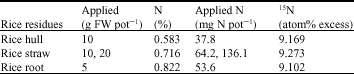
Preparations of 15N-labelled rice residues: Rice (Oryza sativa L. cv. Hinohikari) was grown in Wagner pots (0.02 m2) containing 2.5 kg of paddy soil under flooded conditions. A nutrient solution containing 15N-labelled fertilizer (15NH4Cl) with 15N atom% of 10.0 was applied as N fertilizer periodically during cultivation; was applied in the form of NH4Cl at a rate of 100 kg N ha-1, other essential nutrients were also supplied as basal dressing during sowing. At maturity, the plant parts above the ground were harvested; rice grains were removed; and finally, the hull was separated from the grain. The herbage residues of rice plants were cut into 3 cm long pieces. The application rates and some properties of the rice residues are shown in Table 1.
Experiment design: A green house experiment was conducted using 0.02 m2 Wagner pots, each of which contained 2.5 kg fine-textured soil (air-dried). Two rice cultivars-Koshihikari (Japanese variety) and Sakha 102 (Egyptian variety) were used; the herbage residues of rice plants which were cut into 3 cm long pieces were used for the following experiments. The treatments included (1) the use of control pots (containing neither organic amendments nor inorganic N fertilizers), (2) the use of inorganic fertilizer pots in which labelled N fertilizer with 99.7 atom% was applied in the form of NH4Cl at a rate of 80 kg N ha-1, which is the typical field application rate of N fertilizers in Japan, (3) the use of 10 g (9.2 g dry matter) of 15N-labelled rice hull (9.169 atom%; equivalent to 5 Mg ha-1) per pot, (4) the use of 5 g (4.6 g dry matter) of 15N-labelled rice root (9.102 atom%; equivalent to 2.5 Mg ha-1) per pot, (5) the use of 10 g (9.2 g dry matter) of 15N-labelled rice straw (9.273 atom%; equivalent to 5 Mg ha-1 which is further equivalent to the basal application 20 kg N ha-1) per pot and (6) the use of 20 g (18.5 g dry matter) of 15N-labelled rice straw (equivalent to 10 Mg ha-1 which is equivalent to the basal application of 40 kg N ha-1) per pot.
| Table 1: | Application rates and some properties of 15N-labelled rice residues |
 | |
Moreover, nonlabelled N fertilizer was added to the rice residue treatments for a total of three times throughout the cultivation period; the quantity applied was half that of the inorganic fertilizers. The nonlabelled N fertilizers were applied to improve the shot-term effectiveness of rice residues. Further, for all treatments, P and K fertilizers (phosphorus oxide [P2O5] and potassium chloride [KCl]) were supplied at a rate of 1.0 and 0.3813 g/pot, respectively. Three 17 day old rice seedlings (Koshihikari or Sakha 102) were transplanted at the centre of each pot on 12 June 2006. The rice plants were harvested from the pots by cutting the parts above the soil surface when they achieved physiological maturity revealed by full heading on the 100th Day after Transplanting (DAT).
Soil and plant analysis: At physiological maturity, the rice plants were harvested and the plant and soil samples were analysed in order to measure the total N and 15N concentrations. The soil samples were homogenized with an electric mixer and passed through a 2 mm sieve. The plant samples were separated into grain, straw and roots and dried at 70 °C to obtain a constant weight. The dried samples were weighed and ground into a fine powder with an electric mill for chemical analysis. The ground plant and soil samples were subjected to automatic combustion in Sn capsules and the N contents and 15N abundance were analysed by a stable isotope mass spectrometer (ANCA-SL, Europa Scientific Co. Ltd.). The following plant parameters were employed for comparison purposes: dry matter, total N, N derived from soil (Ndfs), N derived from amendments (Ndfa) and percentage of 15N recovery from the crop (%NRc).
Calculations: The N parameters were calculated as follows:
| • | The atom% of 15N excess was calculated based on the difference between the 15N atom% in the plants and natural abundance in the atmosphere (0.366%) |
| • | The atom% of 15N was recalculated by subtracting the mean value in nonlabelled samples from that in labelled samples |
| • | Derived N (Ndfa) (%) = (15N atom% excess of plant N)/(15N atom% excess of N applied)x100 |
| • | Derived N (Ndfa) (mg) = (15N atom% excess of plant N)/ (15N atom% excess of N applied)xtotal plant N |
| • | The recovery of 15N from soil and plant pools (%NRc) analysed by mass spectrometry was calculated using the following Equation |
Recovery percentage of N = 15N plant (kg ha-1)/N rate (kg ha-1)x100 | |
| • | dfs (mg) = Total plant N (mg) - Ndfa (mg) |
| where, Ndfa denotes N derived from rice residues applied as basal dressing, Ndfs denotes N derived from both the soil and the top-dressing inorganic N applied to residue-treated pots and %NRc denotes the recovery of the applied N. | |
| • | The N loss rates from the residues applied are calculated using the following equation |
L = 1-(P + I) | |
where, L denotes loss, P denotes N uptake by plants and I is the amount of N retained in the soil (= residual N, immobilization and assimilation).
Statistical analysis: All data were primarily subjected to Analysis of Variance (ANOVA). Next, the significance of differences between the treatments was determined by a multiple comparison test with the Tukey-Kramer method at p<0.05 by using the KyPlot software package (Kyenslab Inc., Tokyo, Japan).
RESULTS
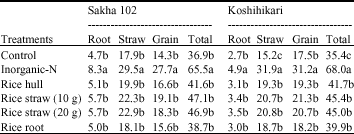
Dry matter and grain yield of rice crop: The growth rate of rice cultivars (revealed in dry matter yield and root biomass) varied significantly among the different treatments despite the uniform application rate of N. Table 2 presents the average dry matter yield of rice grain, straw and roots from both the rice cultivars i.e., Sakha 102 and Koshihikari. The inorganic fertilizer treatment was significantly more efficient than the rice residue treatment for both the cultivars. Treatment with rice residues yielded higher amount of dry matter than that with the control. It was observed that the weight of dry matter was higher with rice straw treatment than with rice root and hull treatments. For both the cultivars, treatment with inorganic fertilizers yielded a high amount of total dry matter which was not very different from the yield with rice residue treatments. The root dry matter yield of Sakha 102 was 1-2 times higher than that of Koshihikari, irrespective of the fertilizer type. The application of inorganic fertilizers and rice residues yielded equivalent straw and grain dry matter for both the cultivars.
| Table 2: | Dry matter yield (g/pot) of Sakha 102 and Koshihikari when amended with inorganic fertilizers and rice residues |
 | |
| The mean values within a column followed by the same letter(s) are not significantly different (Tukey-Kramer test; p<0.05), n = 5 | |
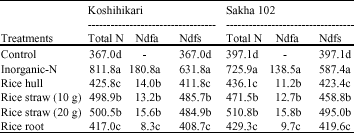
| Table 3: | Total N uptake (mg/pot), N uptake derived from amendments (Ndfa) (mg/pot) and N uptake derived from the soil (Ndfs) (mg/pot) for Koshihikari and Sakha 102 |
 | |
| The mean within a column followed by the same letter(s) are not significantly different (Tukey-Kramer test; p<0.05), n = 5 | |
However, the root biomass yield was significantly higher with inorganic fertilizers than with rice residues (Table 2).
Total N uptake, Ndfa, Ndfs and NRc: Total N uptake by rice crop showed a similar trend as dry matter yield and a significantly higher N uptake was observed with inorganic fertilizer treatment than with rice residue treatments. Relatively higher total N uptake rates were also observed with rice straw than with rice root and rice hull treatments (Table 3).
Because we applied inorganic fertilizers in addition to rice residue treatments, the amount of N derived from the soil was a combination of N derived from applied inorganic fertilizers and Ndfs. For both the cultivars, N uptake due to treatment with inorganic fertilizer was significantly higher than that due to treatment with rice residues, whereas there was no significant difference in the amount of Ndfs between the rice root and rice hull.
There was no difference in the N uptake between treatment with 5 and 10 Mg ha-1 rice straw, but the N uptake with rice straw treatment was higher than that with rice hull and root treatments. Ndfs was higher with inorganic fertilizer treatment than with rice residue treatments. Interestingly, there are significant differences in the Ndfs values among soils treated with rice residue amendments. For the two rice cultivars, the amount of Ndfs with rice straw treatment was significantly higher than that with rice hull and root treatments. The amount of Ndfs was the lowest with the control treatment.
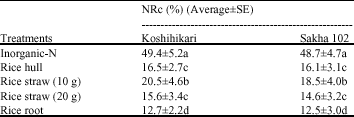
| Table 4: | N recovered (%NRc) (utilization efficiency) |
 | |
| The mean values within a column followed by the same letter(s) are not significantly different (Tukey-Kramer test; p<0.05), n = 5 | |
 | |
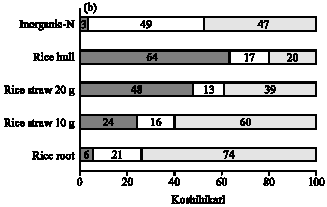 | |
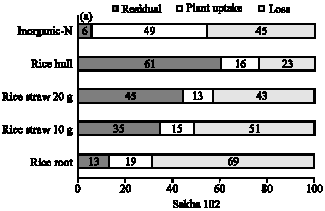
| Fig. 1: | Distribution rates of N derived from the applied rice residues (%) at the end of the cultivation period. Each value shows an average of 5 replicate data |
The highest NRc was obtained with inorganic fertilizer treatment (48.7-49.4%). NRc with 5 Mg ha-1 rice straw treatment was 18.5-20.5%, that with 10 Mg ha-1 rice straw treatment per pot was 14.6-15.6%, that with rice hull treatment was 16.5% and that with rice root treatment was 12.5-12.7%, which was the lowest (Table 4).
Distribution rates of Ndfa at the end of the cultivation: Figure 1a and b illustrates the N losses, presumably, via ammonia volatilization, denitrification and leaching of rice straw during the cultivation of Koshihikari and Sakha 102 was 39-60 and 43-51%, respectively, for 10 and 5 Mg ha-1 treatments. However, N losses increased by treatment with rice roots (69-74%) and decreased significantly by treatment with rice hull (20-23%). The percentage of N losses by inorganic fertilizer treatment was similar in both the cultivars and it ranged from 45 to 47%. On the other hand, the percentage of N retained in soil due to rice straw treatment was 28-46 and it increased to 61-64% with rice hull treatment and decreased to 6-13% with rice root treatment. In addition, the amount of N retained due to inorganic fertilizer treatment was very low (3-6%). For both the cultivars, N retained due to rice straw treatment at the rate of 10 Mg ha-1 was higher than that due to rice straw treatment at the rate of 5 Mg ha-1. The proportion of N uptake by rice plant from rice residues was in the range of 13-20% with an average of 17%. N losses showed a wide range of distribution from 20 to 74%.
DISCUSSION
Effect of rice residues on N uptake by rice: Numerous studies have shown that the incorporation of rice straw resulted in significantly greater recovery of applied N and increased the rice yield; this indicated that continuous application of rice straw affects soil supply of N by increasing the N and C inputs, which in turn is due to increased microbial biomass and N mineralization (Ueno and Yamamuro, 2001; Takahashi et al., 2003). However, a few studies have also demonstrated contradictory results, e.g., that the incorporation of rice straw negatively affects rice yield and N availability (Rao and Mikkelsen, 1976). It has been reported that the major disadvantage of incorporating cereal straw is the immobilization of inorganic N and its adverse effects due to the consequent N deficiency. Hence, rice straw and inorganic fertilizer is a recommended combination for increasing the yield of rice plants. In addition, Powlson et al. (1987) reported that the microbial biomass responds more rapidly than the soil organic matter to changes in the management that alter the annual organic input to soil.
The present application rate of 5-10 Mg ha-1 which corresponds to 4-8 g kg-1 soil is among the standard application rates in Japan; this data indicated that N uptake by rice plants was in the range of 18.5-20.5 and 14.6-15.6% when the application rates of rice straw were equivalent to 5 Mg ha-1 (10 g/pot) and 10 Mg ha-1, respectively. This study showed that the NRc (utilization efficiency) with 5 Mg ha-1 rice straw treatment was higher than that with 10 Mg ha-1 rice straw treatment; this is probably due to the limited availability of N from rice straw applied at the rate of 10 Mg ha-1 due to N immobilization. Consequently, this rate of N utilization from rice straw was higher than the 13-14% utilization efficiency reported by Takahashi et al. (2003), but it was in agreement with the results obtained by Ueno and Yamamuro (2001).
The results obtained through this experiment indicated that the N utilization efficiency increased when rice straw was applied at a rate of 4-8 g kg-1 soil along with low amounts of N fertilizer and when the residue was incorporated early; this enhanced the congruence between soil N supply and N uptake by plants, which has been reported by Witt et al. (2000). The apparent NRc with the application of the inorganic fertilizer was higher when applied at a rate of 80 kg N ha-1; this may be attributed to the high initial soil N level. The rice plants absorbed approximately 48-49% of the N from the applied inorganic fertilizer when the fertilizer was used alone. However, the plants absorbed 14-20% of the applied N from rice straw blended with the inorganic fertilizer. The main factor that limited NRc is the slow rate of net N mineralization, which is a characteristic of rice straw. Nevertheless, more than 30-60% of the applied N was retained in the residue-amended soil. If we continue the measurements, we would probably observe that the retained N is used by rice plants, while N losses are resisted because the residue is an organic fertilizer that is slowly released and one provides N for a longer duration and more consistently than inorganic fertilizers.
The results indicated that in both the cultivars, the rice plants derived most of their N from the soil (in this study N derived from the soil contained inorganic-N to residues treatments), which is in agreement with the result reported by Eagle et al. (2001). The Ndfs levels were significantly higher with inorganic fertilizer treatment than with rice residue treatments; this is probably because inorganic fertilizers and the rice residues yield different root biomasses (Table 2). The results thus obtained indicated that the inorganic fertilizer provided greater amounts of N which stimulated rapid rice growth.
The utilization efficiency in this case of the rice hull was 16.5% (Table 4), a finding in agreement with that of Ueno and Yamamuro (2001), although the C/N ratio was higher and decomposability was lower in rice hull than in rice straw treatments. The high N content in rice roots (Table 1) indicated that the mineralization of rice roots was comparable with that of rice hull; however, rice roots are characterized by their slow decomposability and may be associated with polyphenol contents or lignin/N ratios. The chemical properties such as C/N ratio and N, lignin and polyphenol concentrations can affect the decomposition rate of plant residues (Wang et al., 2004). However, previous studies have shown that lignin and cellulose may be more important for the decomposition rate than the C/N ratio. In contrast, Tian et al. (1992) have reported that plant lignin concentrations are negatively correlated with the decomposition rate. In our present study, the interaction between cultivars and rice residue application was not significant with respect to N utilization efficiency (Table 4), but it was considerably higher in Koshihikari than Sakha 102, probably due to the unsuitable cultivation conditions for Sakha 102.
N distribution: The relative N losses from inorganic fertilizers were high (45-47% of the applied N); N is usually lost in the form of NO3– -N because NO3– -N is a water-soluble and highly mobile form of N that is susceptible to leaching. However, the leaching loss of NO3--N in this experiment was negligible due to the nature of the pot experiment. The high N loss from the inorganic fertilizer may be due to the denitrification process. Low partial pressure of oxygen is a perquisite for denitrification; in addition, the hot weather in the green house during the experiment might have accelerated the denitrification process.
At the end of the experiment, rice roots exhibited higher N loss (denitrification rate) (69-74%) than rice hull (20-23%); this result was in agreement with that reported by Ueno and Yamamuro (2001). This loss can be attributed to the application of inorganic fertilizer along with the residues which might enhance the mineralization of rice hull and root. The N loss from rice residues was 20-74% of the total N input throughout the growing season; this result may be attributed to the enhancement of denitrification due to the top-dressed N in the rice residue treatments.
The utilization of N was higher with inorganic fertilizer treatment than with the rice residue treatments. These results are consistent with those reported by Tester (1989) and might be attributable to the slow nutrient release from rice residues and active N uptake by the plants. In general, inorganic fertilizers release nutrients rapidly; however, plants need a constant supply of nutrients. This gap between the supply and demand of N by plants can lead to excessive N losses from the soil following fertilization. By clarifying the relationships between the application amounts, rice growth responses and nutrient loss in fields, rice straw may emerge as a useful organic amendment.
ACKNOWLEDGMENTS
This study was financed by a Grant-in-Aid for Science Research from the Ministry of Education, Culture, Sports, Science and Technology, Japan (No. 14360041).
REFERENCES
- Bird, J.A., W.R. Horwath, A.J. Eagle and C. Van Kessel, 2001. Immobilization of fertilizer N in rice: Effects of straw management practices. Soil Sci. Soc. Am. J., 65: 1143-1152.
Direct Link - Eagle, A.J., J.A. Bird, J.E. Hill, W.R. Horwarth and C. van Kessel, 2001. Nitrogen dynamics and fertilizer N use efficiency in rice following straw incorporation and winter flooding. Agron. J., 93: 1346-1354.
Direct Link - Ebid, A., H. Ueno, A. Ghoneim and N. Asagi, 2007. Uptake of carbon and nitrogen through rice root from 13C and 15N dual-labeled maize residues compost. Int. J. Biol. Chem., 1: 75-83.
CrossRefDirect Link - Ebid, A., H. Ueno, A. Ghoneim and N. Asagi, 2008. Uptake of Carbon and nitrogen derived from carbon-13 and nitrogen-15 dual-labeled maize residue compost applied to radish, komatsuna and chingensai for three consecutive croppings. Plant Soil, 304: 241-248.
CrossRefDirect Link - Hansen, S., H.F. Alrøe and E.S. Kristensen, 2001. Approaches to assess the environmental impact of organic farming with particular regard to Denmark. Agric. Ecosys. Environ., 83: 11-26.
Direct Link - Kimura, M., J. Murase and Y. Lu, 2004. Carbon cycling in rice field ecosystems in the context of input, decomposition and translocation of organic materials and the fates of their end products (CO2 and CH4). Soil Biol. Biochem., 36: 1399-1416.
Direct Link - Powlson, D.S., P.C. Brooks and B.T. Christensen, 1987. Measurement of soil microbial biomass provides an early indication of changes in total soil organic matter due to straw incorporation. Soil Biol. Biochem., 19: 159-164.
CrossRefDirect Link - Takahashi, S., S. Uenosono and S. Ono, 2003. Short and long-term effects of rice straw application on nitrogen uptake by crops and nitrogen mineralization under flooded and upland conditions. Plant Soil, 251: 291-301.
Direct Link - Ueno, H. and S. Yamamuro, 2001. Fate of nitrogen derived from 15N-labeled plant residues and composts in rice-planted paddy soil. Soil Sci. Plant Nutr., 47: 747-754.
Direct Link - Wang, W.J., J.A. Baldock, R.C. Dalal and P.W. Moody, 2004. Decomposition of plant materials in relation to nitrogen availability and biochemistry determined by NMR and wet-chemical analysis. Soil Biol. Biochem., 36: 2045-2058.
Direct Link - Witt, C., K.G. Cassman, D.C. Olk, U. Biker and S.P. Liboon et al., 2000. Crop rotation and residue management effects on carbon sequestration, nitrogen cycling and productivity of irrigated rice systems. Plant Soil, 225: 263-278.
Direct Link