

M.M. Rahman
Automotive Excellence Center, Faculty of Mechanical Engineering, Universiti Malaysia Pahang, Locked Bag 12, 25000 Kuantan, Pahang, Malaysia
A.K. Ariffin
Department of Mechanical and Materials Engineering, Faculty of Engineering, Universiti Kebangsaan Malaysia, 43600 UKM, Bangi, Selangor, Malaysia
N. Jamaludin
Department of Mechanical and Materials Engineering, Faculty of Engineering, Universiti Kebangsaan Malaysia, 43600 UKM, Bangi, Selangor, Malaysia
S. Abdullah
Department of Mechanical and Materials Engineering, Faculty of Engineering, Universiti Kebangsaan Malaysia, 43600 UKM, Bangi, Selangor, Malaysia
M.M. Noor
Department of Mechanical and Materials Engineering, Faculty of Engineering, Universiti Kebangsaan Malaysia, 43600 UKM, Bangi, Selangor, Malaysia
Journal of Applied Sciences
Year: 2008 | Volume: 8 | Issue: 9 | Page No.: 1612-1621







ABSTRACT
This study presents the finite element based fatigue life prediction of a new free piston linear generator engine mounting. The objective of this research is to assess the critical fatigue locations on the component due to loading conditions. The effects of mean stress and probabilistic nature on the fatigue life are also investigated. Materials SAE 1045-450-QT and SAE 1045-595-QT are considered in this study. The finite element modeling and analysis was performed using computer-aided design and finite element analysis codes. In addition, the fatigue life prediction was carried out utilizing the finite element based fatigue code. Total-life approach and crack initiation approach were applied to predict the fatigue life of the free piston linear engine mounting. The results show the contour plots of fatigue life and damage histogram at the most damaging case. The comparison between the total-life approach and crack initiation approach were investigated. From the results, it can be concluded that Morrow mean stress correction method gives the most conservative (less life) results for crack initiation method. It can be seen that SAE 1045-595-QT material gives consistently higher life than SAE 1045-450-QT material for all loading conditions for both methods.
PDF Abstract XML References Citation
How to cite this article
M.M. Rahman, A.K. Ariffin, N. Jamaludin, S. Abdullah and M.M. Noor, 2008. Finite Element Based Fatigue Life Prediction of a New Free Piston Engine Mounting. Journal of Applied Sciences, 8: 1612-1621.
DOI: 10.3923/jas.2008.1612.1621
URL: https://scialert.net/abstract/?doi=jas.2008.1612.1621
DOI: 10.3923/jas.2008.1612.1621
URL: https://scialert.net/abstract/?doi=jas.2008.1612.1621
INTRODUCTION
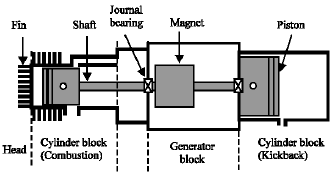
A free piston linear generator integrates a combustion engine and a linear electrical machine into a single unit without a crankshaft. This provides an unconventional solution for series hybrid vehicles and distributes/emergency power units (Blarigan, 2000; Goertz and Peng, 2000; Arshad et al., 2003; Cosic et al., 2003). Blarigan (2000) developed the free piston alternator in the 30 kW range. The author implemented a non-conventional combustion technique known as homogeneous charge compression ignition (HCCI). The schematic diagram of free piston linear engine is shown in Fig. 1. The absence of the crankshaft has benefits in the reliability, efficiency, fuel consumption and environmental emissions (Arshad et al., 2004). The used of free piston generators to produce electricity with the Stirling engines has been around for quite some times. However, applications with the internal combustion engines are relatively new. Although many patents have been reported by Gray (2003), Berlinger et al. (2004), Schaeffer (2005) and Wood (2005) and the reported research works were rather sparse (Blarigan, 2000; Goertz and Peng, 2000).
 | |
| Fig. 1: | Free piston linear engine |
Arshad et al. (2004) investigated the use of transverse flux machines in a free piston generator. The authors concentrated only on the electric generator. The past research at West Virginia University of United States of America demonstrated the stable operation of a free piston engine generator by Famouri et al. (1999). Spark-ignited linear engine and an air-core linear alternator system manage to produce 500 W of output power. The engine system was based on a pair of opposed cylinders, operating under a two-stroke cycle. For the linear alternator, moving permanent magnets are located within a series of stationary coils for voltage induction.
In the two-stroke free piston engine two horizontally opposed pistons are mounted on a connecting rod, which is allowed to oscillate between two end-mounted cylinders. Most of the previous studies (Aichlmayr, 2002; Arshad et al., 2003, 2004), which are related to the engine, combustion occurred in both cylinders, in order to get the linear movement of the piston. For this linear engine, crank and camshaft are eliminated and there is no rotary movement involved. Additionally, the linear system of the engine should prove to be more efficient as the frictional losses associated with the crack and rod bearings are eliminated. However, in previous study by Aichlmayr (2002) determined that a single piston engine with rebound device and the unbalanced situation. These need to be encounter for this new free piston generator engine.
Mounting of the two-stroke free piston engine structures is commonly fatigue loading. Fatigue durability has important issues in the design of free piston linear generator engine structures. In engineering applications, the purpose of fatigue research consists of predicting the fatigue life of structures, increasing fatigue life and simplifying fatigue tests especially fatigue tests of full-scale structures under a random load spectrum. The fatigue life of an engineering structure principally depends upon that of its critical structure members and also depends on the nature of loading, type of the materials, vibration effects and invariants i.e., in automotive the road profiles etc. There is an increasing interest within the internal combustion engine industry in the ability to produce designs that are strong, reliable and safe, whilst also light in weight, economic and easy to produce. These opposing requirements can be satisfied by analytically optimizing components of linear generator engine. In the engine system design, the mounting structure is among the most critical parts. Numerical techniques are necessary to simulate the physical behavior and to evaluate the structural integrity of the different designs. The objectives of the current study are to calculate the fatigue life for a mounting of linear engine using total life and crack initiation methods, to investigate the effect of mean stress on fatigue life and the probabilistic nature of fatigue on the S-N curve via the design criteria.
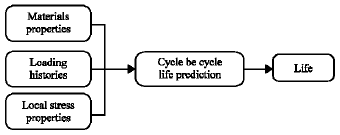
Finite element based fatigue analysis: The fatigue analysis is used to compute the fatigue life at one location in a structure. For multiple locations the process is repeated using geometry information applicable for each location. Necessary inputs for the fatigue analysis are shown in Fig. 2. The three input information boxes are descriptions of the material properties, loading history and local geometry. All of these inputs are discussed following sections.
 | |
| Fig. 2: | Fatigue analysis prediction strategy |
| • | Material information-cyclic or repeated material data based on constant amplitude testing. |
| • | Load histories information-measured or simulated load histories applied to a component. The term loads is used to represent forces, displacements, accelerations, etc. |
| • | Geometry information-relates the applied load histories to the local stresses and strains at the location of interest. The geometry information is usually derived from finite element (FE) results. |
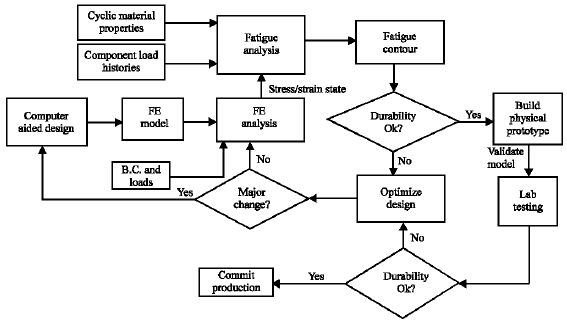
An integrated FE based durability analysis is considered a complete analysis of an entire component. Fatigue life can be estimated for every element in the finite element model and contour plots of life. Geometry information is provided by FE results for each load case applied independently, i.e., the FE results define how an applied load is transformed into a stress or strain at a particular location in the component. Appropriate material data are also provided for the desired fatigue analysis method. The schematic diagram of the integrated finite element based fatigue life prediction analysis is shown in Fig. 3.
Fatigue analysis methods: Fatigue analyses can be carrying out one of three basic methodologies, i.e., the total-life approach, the crack initiation approach and crack propagation approach. The total-life (stress-life) approach was first applied over a hundred years ago (Wöhler, 1867) and considers nominal elastic stresses and how they are related to life. The crack initiation (strain-life approach) considers elastic-plastic local stresses and strains. It represents more fundamental approach and is used to determine the number of cycles required to initiate a small engineering cracks. Crack propagation or linear elastic fracture mechanics (LEFM) approach is used to predict how quickly pre-existing cracks grow and to estimate how many loading cycles are required to grow these to a critical size when catastrophic failure would occur. First two methods are used in this study and briefly discussed these two methods in the following sections.
The fatigue total-life (S-N) approach is usually used for the life prediction of components subjected to high cycle fatigue, where stresses are mainly elastic.
 | |
| Fig. 3: | Integrated finite element based fatigue life prediction analysis |
This approach emphasizes nominal stresses rather than local stresses. It uses the material stress-life curve and employs fatigue notch factors to account for stress concentrations, empirical modification factors for surface finish effects and analytical equations such as modified Goodman and Gerber equation to account for mean stress effects. The modified Goodman and Gerber equations are given by Eq. 1 and 2, respectively.
 | (1) |
 | (2) |
where, σa, Se, σm and Su are the alternating stress in the presence of mean stress, alternating stress for equivalent completely reversed loading, the mean stress and the ultimate tensile strength, respectively. The typical representation of these mean stress correction methods is shown in Fig. 4.
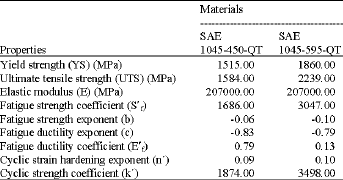
The Basquin (1910) showed that alternating stress versus number of cycles to failure (S-N) in the finite life region could be represented as a log-log linear relationship. Basquin equation was then used to obtain the fatigue life using the material properties listed in Table 1. S-N approach uses to estimate the fatigue life for combined loading by determining an equivalent axial stress (Zoroufi and Fatemi, 2004) using one of the common failure criteria such as Tresca, von Mises, or maximum principal stress. The S-N equation is mathematically given by:
| Table 1: | Mechanical and cyclic properties of the materials (Boardman, 1982) |
 | |
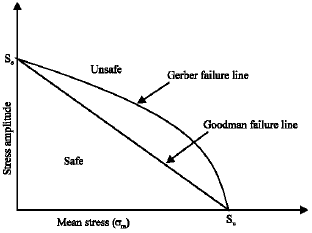 | |
| Fig. 4: | Comparison of the mean stress correction method |
 | (3) |
where, Se, σ΄f, 2Nf and b are the stress amplitude, the fatigue strength coefficient, the reversals to failure and the fatigue strength exponent, respectively.
An important aspect of the fatigue process is plastic deformation. Fatigue cracks initiate from the plastic straining in localized regions. Therefore, cyclic strain-controlled fatigue method could better characterize the fatigue behaviour of the materials than cyclic stress-controlled fatigue. Particularly in notched members where the significant localized plastic deformation is often present. In the crack initiation approach the plastic strain is directly measured and quantified. The total-life approach does not account for plastic strain. One of the main advantages of this method is that it accounts for changes in local mean and residual stresses.
When the load history contains large overloads, significant plastic deformation can exist, particularly at stress concentrations and the load sequence effects can be significant. In these cases, the crack initiation approach is generally superior to the total-life approach for fatigue life prediction analysis. However, when the load levels are relatively low such that the resulting strains are mainly elastic, the crack initiation and total-life approaches usually result in similar predictions.
The crack initiation approach to fatigue problems is widely used at present especially when the linear generator engine are started or stopped then it is subjected to a very high stress range. The fatigue crack initiation approach involves the techniques for converting load history, geometry and material properties (monotonic and cyclic) input into the fatigue life prediction. The operations involved in the prediction must be performed sequentially. First, the stress and strain at the critical site are estimated and rainflow cycle counting method (Amzallang et al., 1994) is then used to reduce the load-time history based on the peak-valley sequential. The next step is to use the finite element method to convert a reduced load-time history into a strain-time history and calculate the stress and strain in the highly stressed area. Then the crack initiation methods are employed for predicting fatigue life. Following this, the simple linear damage hypothesis proposed by Palmgren (1924) and Miner (1945) is used to accumulate the fatigue damage. Finally, the damage values for all cycles are summed until a critical damage sum (failure criteria) is reached.
In order to perform the fatigue analysis and to implement the stress-strain approach in complex structures, Conle and Chu (1997) used strain-life results which is simulated using the three dimensional models to assess fatigue damage. After the complex load history was reduced to an elastic stress history for each critical element, a Neuber plasticity correction method was used to correct for plastic behaviour. Elastic unit load analysis, using strength of material and an elastic finite element analysis model combined with a superposition procedure of each load point’s service history was proposed. Savaidis (2001) verified the local strain approach for fatigue evaluation.
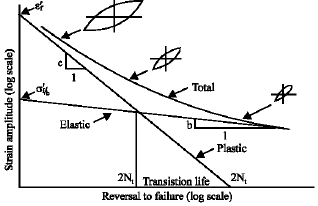 | |
| Fig. 5: | Typical total strain-life curve |
In this study, it was observed that the local strain approach using the Smith-Watson-Topper (SWT) strain-life model is able to represent and to estimate many factors explicitly. These include mean stress effects, load sequence effects above and below the endurance limit and manufacturing process effects such as surface roughness and residual stresses and also stated in the book by Juvinall and Marshek (1991).
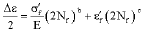
The fatigue resistance of metals can be characterized by a strain-life curve. These curves are derived from the polished laboratory specimens tested under completely reversed strain control. The relationship between the total strain amplitude (Δε/2) and reversals to failure (2Nf) can be expressed in the following form (Coffin, 1954; Manson, 1953). Figure 5 represents the typical total strain-life curves.
 | (4) |
where, Nf is the fatigue life; σ΄f is the fatigue strength coefficient; E is the modulus of elasticity; b is the fatigue strength exponent; ε΄f is the fatigue ductility coefficient and c is the fatigue ductility exponent.
Morrow (1968) suggested that mean stress effects are considered by modifying the elastic term in the strain-life equation by mean stress (σm).
 | (5) |
Smith et al. (1970) was introduced another mean stress model which is called SWT mean stress correction model. It is mathematically defined as:
 | (6) |
where, σmax is the maximum stress and εa is the strain amplitude.
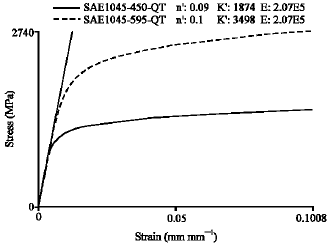
Material information: The material data is one of the major input, which is the definition of how a material behaves under the cyclic loading conditions it typically experiences during service operation. Cyclic material properties are used to calculate elastic-plastic stress strain response and the rate at which fatigue damage accumulates due to each fatigue cycle. The materials parameters required depend on the analysis methodology being used. Normally, these parameters are measured experimentally and available in various handbooks. Two different materials were used for this component, SAE 1045-QT and SAE 1045-595-QT. Figure 6 shows a comparison between the two materials with respect to S-N behaviour. It can be seen that these curves exhibit different life behaviour depending on the stress range experienced. From the figure, it is observed that in the long life area (high cycle fatigue), the difference is lower while in the short life area (low cycle fatigue), the difference is higher. Figure 7 shows the cyclic stress-strain curve of these two materials. It is seen than how these two materials behave under cyclic loading conditions. It can also be seen that how they behave relative to each other. It is also observed that SAE 1045-595-QT is much higher strength steel with its yield point well above that of SAE 1045-450-QT.
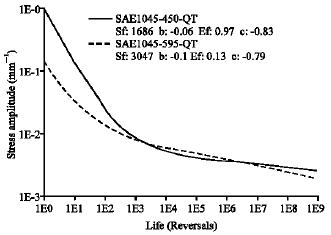
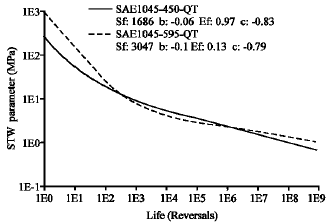
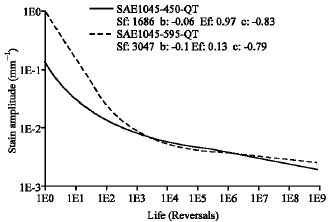
Figure 8 represents the strain-life curve indicating that different fatigue life behaviour for both materials. It is plotted based on the Coffin-Manson relationship. From the figure, it can be seen that in the long life area (high cycle fatigue) the difference is lower while in the short life area (low cycle fatigue) the difference is higher. Figure 9 and 10 also show that another strain-life curves those are based on SWT and Morrow models, respectively.
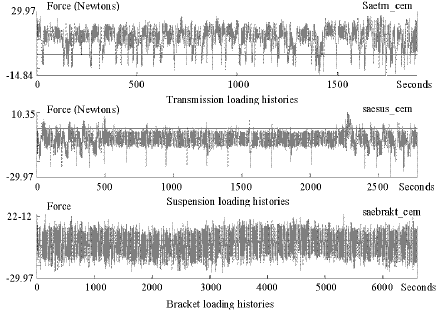
Loading information: Loading is another major input for the finite element based fatigue analysis. The component was loaded with three random time histories corresponding to typical histories for transmission, suspension and bracket components at different load levels. The detailed information about these loading histories was contained in the literature (Tucker and Bussa, 1977). These loading histories were scaled to two peak strain levels and used as full-length histories. Raw load-time histories of the component are shown in Fig. 11. The terms of SAETRN, SAESUS and SAEBRAKT represent the load-time history for the transmission, suspension and bracket, respectively. The considered load-time histories are based on the SAE’s profile. The abscissa uses the time in seconds.
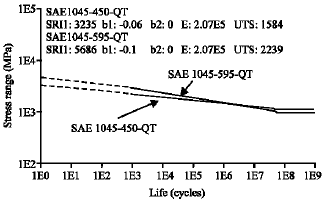 | |
| Fig. 6: | Stress-life (S-N) plot |
 | |
| Fig. 7: | Cyclic stress-strain plot |
 | |
| Fig. 8: | Strain-life plot |
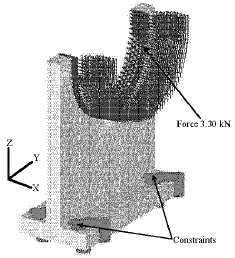
Finite element analysis: Three-dimensional model of linear generator engine mounting was developed using the CATIA® software. A parabolic tetrahedron element was used for the solid mesh. Sensitivity analysis was performed in order to obtain the optimum element size. These analyses were performed iteratively at different element lengths until the solution obtained appropriate accuracy Convergence of stresses was observed, as the mesh size was successively refined.
 | |
| Fig. 9: | SWT strain-life plot |
 | |
| Fig. 10: | Morrow’s strain-life plot |
 | |
| Fig. 11: | Load-time histories |
 | |
| Fig. 12: | Geometry, loading, constraints and finite element model |
A total of 35415 elements and 66209 nodes were generated at 0.20 mm element length. The constraints were applied on the bolt-hole for all six degree of freedom. The objective of the FE analysis was to investigate of the mounting. Figure 12 shows the geometry, loading and boundary conditions used for the FE analysis of mounting. From the resulting stress contours, the state of stress can be obtained and consequently used for uniaxial life predictions.
RESULTS AND DISCUSSION
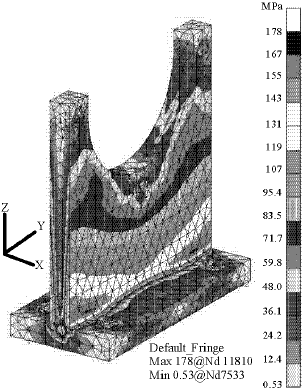
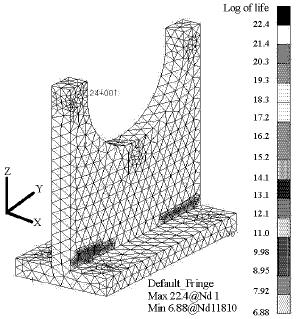
The linear static finite element analysis was performed using MSC.NASTRAN® finite element code. The equivalent von Mises stress contours and critical locations are shown in Fig. 13. The bolt holes and fillet areas were found to be areas of high stresses. The von Mises equivalent stresses are used for subsequent fatigue life analysis and comparisons. From the FE Analysis results, the maximum von Mises stresses of 178 MPa at node 11810 was obtained. The fatigue life of the free piston engine mounting is obtained using variable amplitude loading conditions by means of SAETRN, SAESUS and SAEBRAKT data set. The fatigue life prediction results of mounting corresponding to 99.5% reliability value are shown in Fig. 14. It can be seen that the predicted fatigue life at most critical location near the bolt hole edge (node 11810) is 106.88 seconds when using SAE 1045-450-QT material and Goodman mean stress correction method. The fatigue life is in terms of seconds using the variable amplitude SAESUS loading. The fatigue equivalent unit is 3000 cpm (cycle per min) of time history. The critical locations are also shown in Fig. 15 when using the SAESUS loading histories. It is found that bolt edge is the most critical positions among the mounting.
Most realistic service situations involve nonzero mean stresses. It is, therefore, very important to know the influence that mean stress has on the fatigue process so that the fully-reversed (zero mean stress) laboratory data are usefully employed in the assessment of real situations. Four types of mean stress correction method are considered in this study i.e., Goodman and Gerber correction methods for total-life approach and SWT and Morrow methods for crack initiation approach. The predicted fatigue life at most critical location (node 11810) using different loading histories are tabulated in Table 2 and 3, respectively, using different materials and approaches.
It is difficult to categorically select one procedure in the preference to the other. However, in Table 2, it can be seen that when using the loading sequences are predominantly tensile in nature, the Goodman approach is more conservative.
 | |
| Fig. 13: | Von mises stresses distribution contours |
 | |
| Fig. 14: | Life contour plotted in log of life |
In the case where the loading is predominantly compressive, particularly for wholly compressive cycles, the no correction can be used to provide more realistic life estimates and Gerber mean stress correction has been found to give conservative when the time histories predominantly zero mean.
| Table 2: | Predicted fatigue life using total-life approach |
 | |
| Table 3: | Predicted fatigue life using crack initiation approach |
 | |
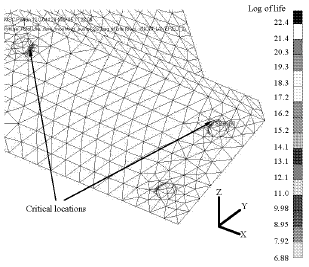 | |
| Fig. 15: | Critical locations of mounting |
From Table 3, it is also seen that the two mean stress methods, SWT and Morrow give lives less than that achieved using no mean stress correction with the SWT method being the most conservative for loading sequences which are predominantly tensile in nature. In the case where the loading is predominantly compressive (SAESUS), particularly for wholly compressive cycles SWT and Morrow’s methods have been found higher lives than no mean stress correction. When using the time history has a roughly zero mean (SAEBRAKT) then all three methods have been given approximately the same results. It can also be seen that SAE 1045-595-QT is consistently higher life than SAE 1045-450-QT for all loading conditions.
The three-dimensional cycle histogram and corresponding damage histogram for materials SAE 1045-450-QT using SAESUS loading histories is shown in Fig. 16 and 17, respectively. Figure 16 shows the results of the rainflow cycle count for the critical location on the component.
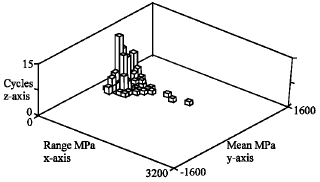 | |
| Fig. 16: | Rainflow cycle counting histogram at critical location (node 11810) using SAESUS data set |
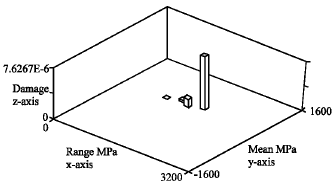 | |
| Fig. 17: | Damage histogram at the critical location (node 11810) using the SAESUS data set |
It can be seen that a lot of cycles with a low stress range and fewer with a high range. The height of each tower represents the number of cycles at that particular stress range and mean. Each tower is used to obtain damage on the S-N curve and damage is summed over all towers. Figure 17 shows the lower stress ranges produced zero damage. It is also showed that the high stress ranges were found to give the most of the damage and a fairly wide damage distribution at the higher ranges which mean that it cannot point to a single event causing damage.
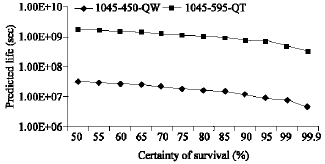 | |
| Fig. 18: | Effect of probabilistic nature of fatigue |
In this research investigate the effect of probabilistic nature on the fatigue life. It can be seen that 1045-595-QT is the higher strength steel, gives a much higher life prediction (Table 2, 3) for all mean stress corrections. This means 1045-595-QT is a better material to use. It is also observed at the S-N curve as shown in Fig. 6. Figure 18 shows the effect of probabilistic nature of fatigue using the SAESUS data set for total-life approach. From the Fig. 15, it can be seen that when increases the design criterion up to 99.9 (certainty of survival 99.9%) then the life decreases as compared to lower certainty of survival. This is due to the probabilistic nature of fatigue and the scatter associated with the S-N curves themselves. The material parameters associated with S-N curves take this into consideration with the standard error of Log(N) (SE) determined by the regression analysis of the raw data. It is recommended that 99.9 (99.9% certainty of survival) as the design criterion. The larger the scatter in the original S-N data that makes up the curve, the less certain will be of survival. For both cases, it can be seen that 99.9% certainty of survival is obtained more conservative results and also determined that SAE 1045-595-QT was a better material at all lives based on the S-N curves. This is due to the probabilistic nature of S-N curves where the scatter in the S-N data for SAE 1045-595-QT is much more variable than for SAE 1045-450-QT.
CONCLUSION
A computational numerical model for the fatigue life assessment for mounting of the linear generator engine is presented in this study. Through the study, several conclusions can be drawn with regard to the fatigue life of a component when subjected to complex variable amplitude loading conditions. The fatigue damage estimated based on the Palmgren-Miner rule is non-conservative and SWT correction and Morrow’s damage rule can be applied to improve the estimation. It can be concluded that the influence of mean stress correction is different for compressive and tensile mean stress. Failure appears to be more sensitive to tensile mean stress, than compressive mean stress for total life approach. It is also concluded for crack initiation approach that when the loading is predominantly tensile in nature, SWT approach is more sensitive and is therefore recommended. However, when the loading is compressive, the Morrow correction can be used more realistic life estimates. Therefore, it can be used an efficient and reliable means for the sign-off of durability of a prototype engine with actual service environments in the early-developing stage. It can be also seen that SAE 1045-595-QT is consistently higher life than SAE 1045-450-QT for all cases.
ACKNOWLEDGMENTS
The authors would like to thank the Department of Mechanical and Materials Engineering, Faculty of Engineering, Universiti Kebangsaan Malaysia to provide the laboratory facilities. The authors would like to express their especial thanks to Universiti Malaysia Pahang for providing financial support under the project (No. RDU070346).
REFERENCES
- Amzallag, C., J.P. Gerey, J.L. Robert and J. Bahuaud, 1994. Standardization of the rainflow counting method for fatigue analysis. Int. J. Fatigue, 16: 287-293.
CrossRefDirect Link - Arshad, W.M., P. Thelin, T. Bäckström and C. Sadarangani, 2004. Use of transverse flux machines in a free piston generator. IEEE Trans. Ind. Applied, 40: 1092-1100.
Direct Link - Coffin, L.F., 1954. A study of the effect of cyclic thermal stresses on a ductile metals. Trans. ASME., 76: 931-950.
Direct Link - Cosic, A., J. Lindbäck, W.M. Arshad, M. Leksell, P. Thelin and E. Nordlund, 2003. Application of a free piston generator in a series hybrid vehicles. Proceedings of the 4th International Symposoum on Linear Drives for Industrial Applied (LDIA 2003), September 8-10, 2003, Birmingham, England, pp: 541-544.
- Famouri, P., W.R. Cawthrne, N. Clark, S. Nandhumar and C. Atkinson et al., 1999. Design and testing of a novel linear alternator and engine system for remote electrical power generator. Proceedings of the Power Engineering Society Winter Meeting, January 13-February, 1999, New York, USA., pp: 108-112.
- Savaidis, G., 2001. Analysis of fatigue behaviour of a vehicle axle steering arm based on local stresses and strains. Materialwissenschaft und Werkstofftechnik, 32: 362-368.
Direct Link