

Abbas Ghasemizad
Department of Physics, University of Guilan, Rasht,P.O. Box 41335-1914, Guilan, Iran
Soheil Khoshbinfar
Department of Physics, University of Guilan, Rasht,P.O. Box 41335-1914, Guilan, Iran
Journal of Applied Sciences
Year: 2008 | Volume: 8 | Issue: 8 | Page No.: 1586-1589







ABSTRACT
Investigations imply that a proper ignition of target and subsequent burning wave propagation into the cold fuel is strongly affected by the hot spot dynamics. A series of approximation on the hot spot energy balance differential equation leads to an analytical expression for ignition criteria as function of its areal density Hs and temperature Ts which determines ignition boundaries. In these calculations the uniform work done by cold fuel against hot spot pressure is also added. Its tamping effect allows the ignition at new spark parameter sets than a bare DT micro-sphere. By tamping effect growth, from a prolonged to a short effective confinement time, a hole is boring inside the ignition boundary which is sensitive to implosion velocity and become broader at higher values.
PDF Abstract XML References Citation
How to cite this article
Abbas Ghasemizad and Soheil Khoshbinfar, 2008. Ignition Criteria of Spark Parameters in Direct Drive Inertial Confinement Fusion. Journal of Applied Sciences, 8: 1586-1589.
DOI: 10.3923/jas.2008.1586.1589
URL: https://scialert.net/abstract/?doi=jas.2008.1586.1589
DOI: 10.3923/jas.2008.1586.1589
URL: https://scialert.net/abstract/?doi=jas.2008.1586.1589
INTRODUCTION
In order to achieve acceptable high gains from economically aspects in ICF, the concept of Central Spark Ignition (CSI) has been proposed, where only the central part of the fuel is heated and its outer part is kept cool (Meyer-Ter-vehn, 1982). The main fuel region is heated by alpha particles generated in the innermost region called Hot Spot and then a nuclear detonation wave burns the rest of the target. In order to be success in this scenario, it is necessary to increase the hot spot temperature by self-heating mechanism. The condition of self-heating in central region is called ignition condition. The necessary conditions for self-heating are at least met by breakeven of gain and loss processes in the hot spot which together determine the fate of target (Nakai and Mima, 2004).
During last years, different approaches to show a picture of admissible parameters at ignition time were performed by many authors from a simple one to a more complicated (Nakai and Takabe, 1996; Fraley et al., 1974). For example, Lindl calculations carried out based on a model of an imploding-expanding dynamical core. Fraley have carried out many simulations including a fusion reaction in the situation where a compressed DT fuel with a radius R and density ρ is assumed for initial state. Their simulations have been carried out with a three-temperature (ion, electron and radiation) model.
IGNITION CRITERIA
In Inertial Confinement Fusion (ICF) research, the Central Spark Ignition (CSI) scheme with the isobaric condition is widely considered to be a promising approach for achieving high energy gain. In this scheme,however, an implosion with high uniformity is indispensable to successfully form a central hot spot through the stagnation phase; because the implosion is susceptible to the Rayleigh-Taylor (RT) instability. Uniformly compressed targets at rest were assumed as initial state, which correspond to maximum compression. In high gain target design, alpha particle heating plays an important role to bootstrap plasma temperature. In a bare DT microsphere, the conduction loss leads to energy leakage from hot spot and its cooling. While, the work rate done by cold mater surrounded hot spot insert an additional term to compensate the heat loss from hot spot and slow down the process of temperature gradient. We can study the gain and loss process in the central region by the energy balance equation:
 | (1) |
where, ε is the DT plasma internal energy per unit mass and is a function of ρ and T under the assumption of local thermal equilibrium:
 | (2) |
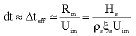
where, k is the Boltzmann constant, ADT is the fuel mass number and mp is the proton mass. If we restrict our discussion to the time interval at stagnation, i.e., maximum compression, we can express the effective time of inertial confinement by Δteff:
 | (3) |
where, Rm and Uim are fuel outer radius at stagnation and its implosion velocity, respectively. By definition of a dimensionless parameter ξi ≡ ri/Rm which enables us to study a class of fusion targets with the same radii ratio at ignition time regardless their values for specific experiments. We now put proper approximations for first two terms of RHS in Eq. 1 which show our gain processes in DT plasma in CSI. For alpha heating we have:
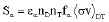 | (4) |
where, εα = 3.52 MeV is alpha particles birth energy, ni represent ions number density in the plasma and ⟨σv⟩DT is the Maxwellian average reactivity for DT mixture and we adopted an expression given by Piriz (1996). fα is reduction factor for alpha particles energy deposition within the hot spot. The plasma particles are mainly heated through direct collision by the alpha particles. It is noted that the alpha particles deposit their energy to the ions predominantly compared to the electrons when the temperature is higher than about 30 keV (Fraley et al., 1974). In Eq. 1, Sei is the ion-electron energy relaxation term proportional to (Te-Ti). In the dense region beyond the ablation front ion and electron temperatures are almost equal to each other due to relaxation process. In the following calculations, it is assumed we have equal ions-electrons temperature. The work rate done on hot spot is given by:
 | (5) |
where, ρs, Ts and Hs = ρsxrs are hot spot density, temperature and ICF parameter of hot spot, respectively. The remaining terms in Eq. 1 are responsible for hot spot cooling and its dissipation. The Bremsstrahlung emission SB is given by:
 | (6) |
By temperature rise of hot spot, the role of Bremsstrahlung radiation becomes crucial in cooling process. The radiation loss determines the minimum temperature of ignition. If, however, the plasma is optically thick, the emitted radiation is reabsorbed in the fuel and the radiation loss in the global energy balance is reduced. The term  is thermal conduction flux for energy escape form hot spot and is given by:
 | (7) |
where, κec ∝ Ts5/2 is thermal conductivity coefficient and has weakly dependence on coulomb logarithm ln Λ(ρs, Ts) which a value of 5 has been chosen.
 | (8) |
The last term  represent energy loss by plasma expansion which leads to plasma dissipation and cooling of hot spot which in turn like other loss processes reduce fusion rate:
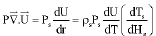 | (9) |
where, Ps = ρsε is equation of state for an idealized plasma. Here U is the flow velocity which is related to hot spot isothermal sound speed through Mach number:
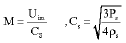 | (10) |
and 2≤M≤20 are adopted for dT/dH calculation in Eq. 9. If we work in subsonic regime of inertial fusion which sonic timescale is much shorter than the timescale of temperature gradient due to heat conduction into the cold surrounding medium, then we can assume the thermal decay of hot spot proceeds at a constant pressure P and governed by the equation of mass and energy conservation:
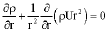 | (11) |
 | (12) |
We can integrate the energy equation Eq. 12 and reduce it to the zero net flux; it gives the following differential equation:
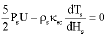 | (13) |
Substitution and doing simple analytical operation of the latter equation in Eq. 9 we have:
 | (14) |
To make our final expression for ignition condition we substitute Eq. 3-6, 8 and 14 in energy balance Eq. 1 and we will obtain our golden equation for ignition condition:
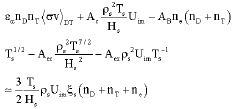 | (15) |
substitution of <σv>DT for DT reaction in Eq. 15, the ignition boundaries for a typical fixed values of ξs = 0.3 and Uim = 3×10⁵ m sec-1 is calculated. The result for (Hs, Ts) pairs of hot spot presented in Fig. 1. Hot spot parameters (Hs, Ts) which satisfy Eq. 15, separate it into three parts shown in Fig. 1 by labels A, B and C. Ignition criteria for a proper final fuel burn is only met by region B, i.e., white color area, which its inside net energy equation is positive. Some finite pairs lie on the ignition boundaries which counted theoretically as admissible values but not exactly in practical sense.
COLD FUEL TAMPING EFFECT
Experimentally, fuel implosion trajectory up to ignition time in HT parametric plane does not always lie inside the ignition boundaries (Gain region) in Fig. 1. It starts from an initial point in low Hs and Ts values and gradually with possible fluctuation attains itself to another point in admissible area at the beginning of ignition. At this point, self-ignition condition should be satisfied to observe subsequent ignition and burn of the whole target.
The result of ignition condition which obtained by applying some approximations on energy balance equation is in good agreement with direct-derive 1D simulation data for hot spot implosion trajectory in HT plane from initial implosion phase to stagnation time (Herrmann et al., 2001). This result for four capsules from a slow implosion to a very fast implosion added to the ignition boundaries calculated for a typical implosion velocity and plotted parametrically, as shown in Fig. 2. The consistency of Eq. 15 result is clearly demonstrated.
In a bare DT microsphere, conduction loss cause to injection of hot spot energy into the surrounding vacuum, leaving the medium and cooling. The presence of cold fuel tamping effect against hot spot allows it to access to new (Hs, Ts) pairs than to ignition boundaries for a bare DT microsphere (Ghasemizad and Khoshbinfar, 2005). The ignition condition presented by Ghasemizad and Khoshbinfar (2005) which obtained here is only equal for prolonged confinement intervals.
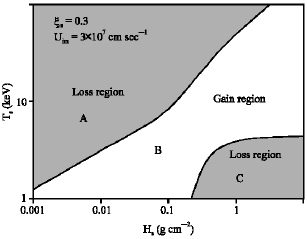 | |
| Fig. 1: | Ignition boundary for hot spot parameters in HT plane obtained from Eq. 15 |
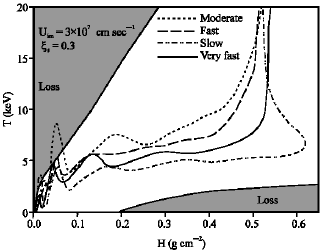 | |
| Fig. 2: | Hot spot implosion trajectory in HT parametric plane |
The energy leaving the hot spot in the form of heat conduction losses goes back into the hot spot in the form of internal energy and compression work of the ablated plasma.
On the other hand, leads to plasma expansion and hot spot thermal suppression which by cold fuel presence would play little effect on the ignition dynamics. So, the work done PdV on hot spot is increase by applying a stronger shock where cold fuel acts as piston. This corresponds to shorter confinement time. The overall consequence of the latter talk permission of direct-drive ignition in low temperature ignition condition which the hot spot central temperature is about 1-2 keV (Johzaki et al., 1998).
After launching a strong shock on the capsule, it produces a dense matter behind the return shock which act like a barrier for energy leakage from hot spot.
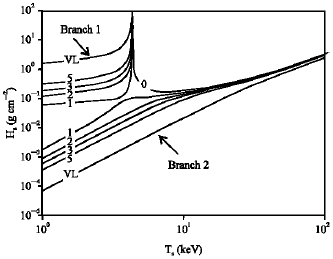 | |
| Fig. 3: | Ignition boundary for different Uim (x105 m sec-1) ranges from 0 to a very large (VL) values in Eq. 15 |
These provide better temperature stability than a bare DT. A fraction of conduction loss through hot spot surface transforms into its internal energy and the rest produce PdV work done by ablated plasma against the hot spot pressure. Its general effect is energy trap inside the hot spot and slowing down the loss process. Thick full line in Fig. 3 shows the ignition boundary for a prolonged confinement interval (Ghasemizad and Khoshbinfar, 2005). When the cold tamping effect raises in Eq. 15, it cause to bore a hole inside the ignition boundary and opens new accessible area in HT plane for hot spot. It is become wider by implosion velocity increase. The variations of Hs with respect to Uim obey a linear proportionality Hs∝UimTs-2 in branch 1, but it has Hs∝Uim-1Ts2.5 dependency on implosion velocity in branch 2. This case is clearly observable in Fig. 3.
On the other hand, in this Fig. 3, we see branch 1 asymptotically for all range of implosion velocity tends infinity at Ts = 4.36 keV which is called self-ignition temperature. On this curve, Bremsstrahlung emission is the most important term in Eq. 15 and is in balance with alpha particle heating. In high Ts values region of branch 2, ignition boundary tends to an asymptotic line Hs∝Ts0.6 form for all curves regardless their implosion velocities. On the branch 2, alpha particle heating is equal to heat conduction loss.
CONCLUSION
Applying some approximations in the direct-derive isobaric model for the hot spot energy balance differential equation, lead to an analytic expression for ignition criteria of DT targets. The solution of this equation, Eq. 15, reveal ignition boundaries which their inside the net positive energy condition is satisfied. In actual target implosion its whole trajectory in HT plane does not always lie inside ignition boundaries, but ignitable set of Hs and Ts is attained at the time ignition. This optimistic adventure provides a proper ignition of fuel and fusion energy release. The results of 1D simulation of hot spot parameters is in agreement with the recent analytical approximations. Then the strength of cold fuel tamping is studied from a prolonged to a very short confinement time by change of implosion velocity. The results show that the hole-boring of zero implosion ignition boundaries is very sensitive at lower implosion velocities. New accessible pairs of spark parameters become larger at higher implosion values and ignition boundaries broadening are less sensitive. Additionally, the solution of ignition condition reproduces self ignition temperature of about 4.36 keV.
REFERENCES
- Fraley, G.S., E.J. Linnebur, R.J. Mason and R.L. Morse, 1974. Thermonuclear burn characteristics of compressed deuterium‐tritium microspheres. Phys. Fluids, 17: 474-489.
CrossRefDirect Link - Ghasemizad, A. and S. Khoshbinfar, 2005. The method of self-similar solution for energy gain scaling in ICF targets. Proceedings of the International Conference Nuclear Energy for New Europe Bled, September 5-8, 2005, Slovenia, pp: 1-4.
Direct Link - Herrmann, M.C., M. Tabak and J.D. Lindl, 2001. Ignition scaling laws and their application to capsule design. Phys. Plasmas, 8: 2296-2304.
Direct Link - Johzaki, T., Y. Nakao, M. Murakami and K. Nishihara, 1998. Ignition condition and gain scaling of low temperature ignition targets. Nucl. Fusion, 38: 467-479.
Direct Link - Meyer-Ter-Vehn, J., 1982. On energy gain of fusion targets: The model of kidder and bodner improved. Nucl. Fusion, 22: 561-565.
Direct Link - Nakai, S. and H. Takabe, 1996. Principles of inertial confinement fusion-physics of implosion and the concept of inertial fusion energy. Rep. Progr. Phys., 59: 1071-1131.
Direct Link - Nakai, S. and K. Mima, 2004. Laser driven inertial fusion energy: Present and prospective. Rep. Prog. Phys., 67: 321-349.
Direct Link - Piriz, A.R., 1996. Conditions for the ignition of imploding spherical shell targets. Nucl. Fusion, 36: 1395-1403.
Direct Link