

Wen-Kuang Yang
Department of Marketing and Logistics Management,
Chaoyang University of Technology, Taichung, Taiwan, Republic of China
Hung-Fu Huang
Department of Digital Content Design, Kao Fong College, Pingtung, Taiwan, Republic of China
Yu-Cheng Tu
Department of Marketing and Logistics Management,
Chaoyang University of Technology, Taichung, Taiwan, Republic of China
Yung-Fu Huang
Department of Marketing and Logistics Management,
Chaoyang University of Technology, Taichung, Taiwan, Republic of China
Journal of Applied Sciences
Year: 2007 | Volume: 7 | Issue: 24 | Page No.: 4018-4022







ABSTRACT
The main purpose of this study is to investigate the retailer’s inventory policy under two-level delay permitted to reflect the supply chain management situation. In this study, we assume that the retailer maintains a powerful position. So, it is assumed that the retailer can obtain the full trade credit offered by the supplier yet the retailer just offers the partial trade credit to his customers. Under these conditions, the retailer can obtain the most benefits. Then, an algebraic approach is provided to investigate the retailer’s inventory system as a cost minimization problem to determine the retailer’s optimal inventory policy under the supply chain management. One ease-to-use theorem is developed to efficiently determine the optimal inventory policy for the retailer. Finally, numerical examples are given to illustrate the theorem.
PDF Abstract XML References Citation
How to cite this article
Wen-Kuang Yang, Hung-Fu Huang, Yu-Cheng Tu and Yung-Fu Huang, 2007. Powerful Retailer’s Ordering Policy Under Two-Level Delay Permitted in Supply Chain Derived Without Derivatives. Journal of Applied Sciences, 7: 4018-4022.
DOI: 10.3923/jas.2007.4018.4022
URL: https://scialert.net/abstract/?doi=jas.2007.4018.4022
DOI: 10.3923/jas.2007.4018.4022
URL: https://scialert.net/abstract/?doi=jas.2007.4018.4022
INTRODUCTION
The traditional Economic Order Quantity (EOQ) model assumes that retailer’s capitals are adequate and must pay for the items as soon as the items are received. However, this may not be true. In practice, the supplier will offer the retailer a delay period, that is the trade credit period, in paying for the amount of purchase. Before the end of the trade credit period, the retailer can sell the goods and accumulate revenue and earn interest. A higher interest is charged if the payment is not settled by the end of the trade credit period. All previously published models discussed delay permitted assumed that the supplier would offer the retailer a delay period but the retailer would not offer the delay period to his customer. That is one level of delay permitted. Huang (2003) modified this assumption to assume that the retailer will adopt the delay permitted policy to stimulate his customer demand to develop the retailer’s replenishment model. That is two levels of delay permitted. This new viewpoint is more matched real-life situations in the supply chain model. Many studies have appeared in the literature that treat inventory problems with varying conditions under one level of delay permitted. Some of the prominent studies are discussed here.
Goyal (1985) established a single-item inventory model under permissible delay in payments. Chung (1998) developed an efficient decision procedure to determine the economic order quantity under condition of permissible delay in payments. Teng (2002) assumed that the selling price was not equal to the purchasing price to modify Goyal’s model (1985). Chung and Huang (2003a) investigated this issue within EPQ (economic production quantity) framework and developed an efficient solving procedure to determine the optimal replenishment cycle for the retailer. Huang and Chung (2003) investigated the inventory policy under cash discount and trade credit. Chung and Huang (2003b) adopted alternative payment rules to develop the inventory model and obtain different results. Huang (2004) adopted the payment rule discussed in Chung and Huang (2003b) and assumed finite replenishment rate, to investigate the buyer’s inventory problem. Chung et al. (2005) investigated retailer’s lot-sizing policy under permissible delay in payments depending on the ordering quantity. Huang (2006) extended Huang (2003) to develop retailer’s inventory policy under retailer’s storage space limited. Recently, Huang (2007) incorporated Chung and Huang (2003a) and Huang (2003) to investigate retailer’s ordering policy.
Recently, Huang et al. (2007) extended Huang’s (2003) model to investigate the situation in which the retailer has a powerful position. That is, they assume that the retailer can obtain the full trade credit offered by the suppliers and the retailer just offers the partial trade credit to his customers. Under these conditions, the retailer can obtain the most benefits. In practice, this model setting is more realistic. In the present study, we try to use the more easily algebraic method to find the optimal solution in Huang et al. (2007) model. In previous all published studies which have been derived using differential calculus to find the optimal solution and the need to prove optimality condition with second-order derivatives. The mathematical methodology is difficult to many younger students who lack the knowledge of calculus. In recent studies, Cárdenas-Barrón (2001) and Grubbström and Erdem (1999) showed that the formulae for the EOQ and EPQ with backlogging derived without differential calculus. They mentioned that this approach must be considered as a pedagogical advantage for explaining the basic inventory concepts to students that lack knowledge of derivatives, simultaneous equations and the procedure to construct and examine the Hessian matrix. This algebraic approach could be used easily to introduce the basic inventory theories to younger students who lack the knowledge of calculus.
Under these conditions, we model the retailer’s inventory decision-making as a cost minimization problem to determine the retailer’s optimal ordering policies.
MODEL FORMULATION
The following notation and assumptions will be used throughout the study:
Notation:| D | = | Demand rate per year |
| A | = | Ordering cost per order |
| c | = | Unit purchasing price |
| h | = | Unit stock holding cost per year excluding interest charges |
| α | = | The customer’s fraction of the total amount payable at the time of placing an order within the delay period to the retailer, 0 ≥ α ≥ 1 |
| Ie | = | Interest earned per $ per year |
| Ik | = | Interest charged per $ in stocks per year by the supplier |
| M | = | The retailer’s trade credit period as measured by years offered by the supplier |
| N | = | The customer’s trade credit period as measured by years offered by the retailer |
| T | = | The cycle time in years |
| TRC(T) | = | The annual total relevant cost, which is a function of T |
| T* | = | The optimal cycle time of TRC(T) |
| Q* | = | The optimal order quantity, also defined by DT* |
Assumptions:
| • | Demand rate, D, is known and constant |
| • | Shortages are not allowed |
| • | Time horizon is infinite |
| • | Replenishments are instantaneous |
| • | Ik ≤ Ie, M ≤ N |
| • | Since the supplier offers the full trade credit to the retailer. When T ≤ M, the account is settled at T = M and the retailer starts paying for the interest charges on the items in stock with rate Ik. When T ≥ M, the account is settled at T = M and the retailer does not need to pay any interest charge |
| • | Since the retailer just offers the partial trade credit to his customers. Hence, his customers must make a partial payment to the retailer when the item is received. Then his customers must pay off the remaining balance at the end of the trade credit period offered by the retailer. That is, the retailer can accumulate interest from his customer partial payment on [0, N] and from the total amount of payment on [N, M] with rate Ie. |
The annual total relevant cost consists of the following elements.
| • | Annual ordering cost =  |
| • | Annual stock holding cost (excluding interest charges) =  |
| • | According to assumption (6), there are three cases to consider in costs of interest charges for the items kept in stock per year. |
Case 1: M ≥ T
Annual interest payable =cIk D(T-M)2/2T
Case 2: N ≥ T ≥ M
In this case, annual interest payable = 0
Case 3: T ≥ N
Similar to Case 2, annual interest payable = 0
According to assumption (7), there are three cases to consider in interest earned per year.
Case 1: M ≥ T, as shown in Fig. 1.
 |
Case 2: N ≥ T ≥ M, as shown in Fig. 2.
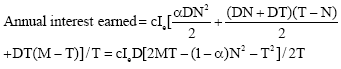 |
Case 3: T ≥ N, as shown in Fig. 3.
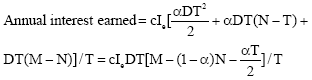 |
From the above arguments, the annual total relevant cost for the retailer can be expressed as:
TRC(T) = ordering cost + stock-holding cost + interest payable-interest earned.
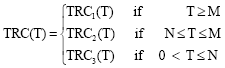 | (1a) |
| (1b) | |
| (1c) |
Where:
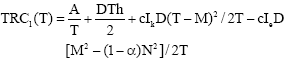 | (2) |
 | (3) |
and
 | (4) |
Since TRC1(M) = TRC2(M) and TRC2(N) = TRC3(N), TRC(T) is continuous and well-defined. All TRC1(T), TRC2(T), TRC3(T) and TRC(T) are defined on T > 0.
Then, we can rewrite
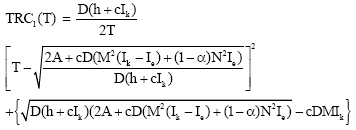 | (5) |
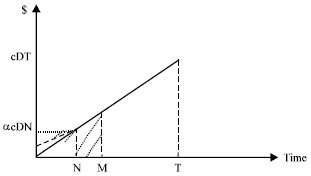 | |
| Fig. 1: | The total amount of interest earned when M ≥ T |
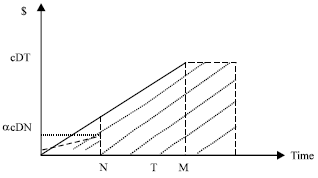 | |
| Fig. 2: | The total amount of interest earned when N ≥ T ≥ M |
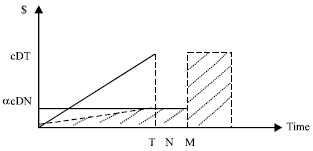 | |
| Fig. 3: | The total amount of interest earned when T ≥ N |
From Eq. 5 the minimum of TRC1(T) is obtained when the quadratic non-negative term, depending on T, is equal to zero. The optimum value T1* is
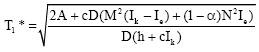 | (6) |
Therefore,
 | (7) |
Similarly, we can derive TRC2(T) without derivatives as follows.
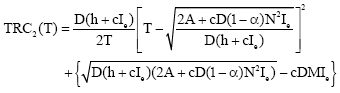 | (8) |
From Eq. 8 the minimum of TRC2(T) is obtained when the quadratic non-negative term, depending on T, is equal to zero. The optimum value T2* is
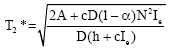 | (9) |
Therefore,
 | (10) |
Likewise, we can derive TRC3(T) algebraically as follows.
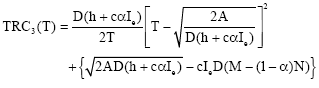 | (11) |
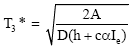
From Eq. 11 the minimum of TRC3(T) is obtained when the quadratic non-negative term, depending on T, is equal to zero. The optimum value T3* is
 | (12) |
Therefore,
 | (13) |
DECISION RULE OF THE OPTIMAL CYCLE TIME T*
From Eq. 6 the optimal value of T for the case of T ≤ M is T1* ≤ M. We can substitute Eq. 6 into T1* ≤ M to obtain the optimal value of T
 | (14) |
Similarly, from Eq. 9 the optimal value of T for the case of N ≥ T ≥ M is N ≥ T2* ≥ M. We can substitute Eq. 9 into N ≥ T2* ≥ M to obtain the optimal value of T:
if and only if Δ1= -2A+DM2(h+cIe)-cD(1-α)N2Ie ≤ 0 and
 | (15) |
Finally, from Eq. 12 the optimal value of T for the case of T ≥ N is T3* ≥ N. We can substitute Eq. 12 into T3* ≥ N to obtain the optimal value of T:
 | (16) |
From above arguments, we see Δ1 ≤ Δ2 and summarize following results.
Theorem 1:| (A) | If Δ2 ≤ 0, then TRC(T*) = TRC(T3*) and T* = T3*. |
| (B) | If Δ1 > 0 and Δ2 < 0, then TRC(T*) = TRC(T2*) and T* = T2*. |
| (C) | If Δ1 ≥ 0, then TRC(T*) = TRC(T1*) and T* = T1*. |
Theorem 1 immediately determines the optimal cycle time T* after computing for the numbers Δ1 and Δ2. Theorem 1 is an efficient solution procedure.
NUMERICAL EXAMPLES
To illustrate the result developed in this study, let us apply the proposed method to solve the following numerical examples. For convenience, the numerical values of the parameters are selected randomly. The optimal solutions for different parameters of α, N and c are shown in Table 1.
| Table 1: | Optimal solutions under various parametric values |
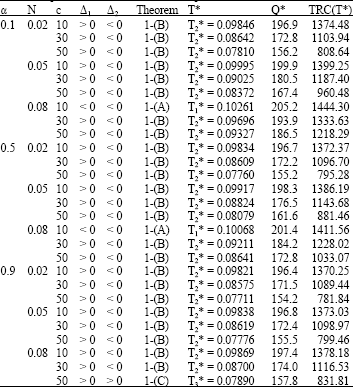 | |
| LetA = $80/order,D = 2000 units/year,h = $7/unit/year, Ik = $0.15/$/year,Ie = $0.13/$/year,M = 0.1 year | |
CONCLUSIONS
This study further relaxes the assumption of the two-level trade credit policy in the previously published works to investigate the inventory problem in which the retailer maintains a powerful position derived without derivatives. Theorem 1 helps the retailer accurately and speedily determining the optimal ordering policy after computing for the numbers Δ1 and Δ2. Finally, numerical examples are given to illustrate the result developed in this study.
ACKNOWLEDGMENTS
This study is supported by NSC Taiwan, No. NSC 96-2221-E-324-007-MY3 and CYUT.
REFERENCES
- Cardenas-Barron, L.E., 2001. The economic production quantity (EPQ) with shortage derived algebraically. Int. J. Prod. Econ., 70: 289-292.
CrossRef - Chung, K.J., 1998. A theorem on the determination of economic order quantity under conditions of permissible delay in payments. Comput. Operat. Res., 25: 49-52.
Direct Link - Chung, K.J. and Y.F. Huang, 2003. The optimal cycle time for EPQ inventory model under permissible delay in payments. Int. J. Prod. Econ., 84: 307-318.
CrossRefDirect Link - Chung, K.J., S.K. Goyal and Y.F. Huang, 2005. The optimal inventory policies under permissible delay in payments depending on the ordering quantity. Int. J. Prod. Econ., 95: 203-213.
Direct Link - Goyal, S.K., 1985. Economic order quantity under conditions of permissible delay in payments. J. Operat. Res. Soc., 36: 335-338.
Direct Link - Grubbstrom, R.W. and A. Erdem, 1999. The EOQ with backlogging derived without derivatives. Int. J. Prod. Econ., 59: 529-530.
CrossRef - Huang, Y.F., 2003. Optimal retailer's ordering policies in the EOQ model under trade credit financing. J. Operat. Res. Soc., 54: 1011-1015.
Direct Link - Huang, Y.F. and K.J. Chung, 2003. Optimal replenishment and payment policies in the EOQ model under cash discount and trade credit. Asia Pac. J. Operat. Res., 20: 177-190.
Direct Link - Huang, Y.F., 2004. Optimal retailer's replenishment policy for the EPQ model under supplier's trade credit policy. Prod. Plan. Control, 15: 27-33.
CrossRefDirect Link - Huang, Y.F., 2006. An inventory model under two levels of trade credit and limited storage space derived without derivatives. Applied Math. Model., 30: 418-436.
CrossRefDirect Link - Huang, Y.F., 2007. Optimal retailer's replenishment decisions in the EPQ model under two levels of trade credit policy. Eur. J. Operat. Res., 176: 1575-1589.
CrossRefDirect Link - Teng, J.T., 2002. On the economic order quantity under conditions of permissible delay in payments. J. Operat. Res. Soc., 53: 915-918.
CrossRefDirect Link