

Mehmet Akgul
Department of Forest Products Engineering, Faculty of Forestry, D�zce University, D�zce, Turkey
Yalcin Copur
Not Available
Cengiz Guler
Not Available
Ayhan Tozluoglu
Not Available
Umit Buyuksari
Not Available
Journal of Applied Sciences
Year: 2007 | Volume: 7 | Issue: 7 | Page No.: 1085-1087







ABSTRACT
The objective of this study was to investigate the suitability of oak (Ouercus robur L.) wood fibers from Turkey as a raw material for medium density fiberboard. In this study, some of the oak wood parts that are especially not suitable for other forest industries was utilized to produce fiberboards in laboratory environment. Test panels of varying densities (0.6, 0.7 and 0.8 g cm-3) were produced at 18 mm thickness using urea-formaldehyde adhesive. Mechanical, water resistance and dimensional stability properties of the test panels were determined according to Turkish standards. The results indicated that laboratory MDF panels produced using oak fibers resulted in mechanical properties that exceed (except panel type A) levels specified in the appropriate existing standards for the general propose fiberboards.
PDF Abstract XML References Citation
How to cite this article
Mehmet Akgul, Yalcin Copur, Cengiz Guler, Ayhan Tozluoglu and Umit Buyuksari, 2007. Medium Density Fiberboard from Quercus robur. Journal of Applied Sciences, 7: 1085-1087.
DOI: 10.3923/jas.2007.1085.1087
URL: https://scialert.net/abstract/?doi=jas.2007.1085.1087
DOI: 10.3923/jas.2007.1085.1087
URL: https://scialert.net/abstract/?doi=jas.2007.1085.1087
INTRODUCTION
Oak, a rare forest tree has survived for approximately 80-100 million years since its first appearance in geological ages to today. There are over 200 oak species, subspecies, varieties and natural hybrids in the mild zones of the northern hemisphere. Turkey consisting 18 native oak species, some subspecies and varieties, has a quite important oak stock in the world (Yaltirik, 1998). One or more oak taxons could be observed in all regions of Turkey including steppes. Compared to the past years, oak distributions are quite limited due to destructions. Now, the total distribution is of oak is 5.8 million hectares (http://www.ogm.gov.tr/agaclarimiz/agac12.htm 2006). Oak still is the most widespread leaved tree in Turkey. Therefore, oak wood is extensively utilized in timber, furniture and parquet industries.
There is a significant pressure on standing forest resources as a result of higher wood demand in forest industry due to increasing population and new application areas. On the other hand, collecting industrial wood from the natural forests continues to decline. The decline in forest resources is due to the depletion of the resources and the withdrawal of forest areas from industrial production for other uses like recreational area. The shortage of raw material in medium density fiberboard industry as well as other forest industries tends to utilize different forest resources as raw material.
Birch (Betula), ash (Fraxinus), lime (Tilia), douglas-fir (Pseudotsuga), spruce (Picea) and larch (Larix) fibers has been recognized as high quality raw material to produce MDF (Chow and Zhao, 1992). Fibers produced from low quality oak, beech and pine are used either lonely or in a mixture in MDF production in Turkey (Akbulut et al., 2000). In addition, the study (Akgül et al., 2007) with rhododendron (R. ponticum) biomass showed that the production of MDF from this biomass is technically feasible and it could be utilized in a mixture at varying ratios with pine and oak fibers.
MDF production in Turkey tends to increase and the demand shows that the increase will continue in coming years. The expected increase could be around 15% for 2007 (Çöpür et al., 2005). On the other hand, the shortage of the raw material for the forest industry is the main problem. To overcome the shortage of the raw material, this study aimed to examine the feasibility of using some of oak wood parts that are especially not suitable for other forest industries to produce medium density fiberboard.
MATERIALS AND METHODS
Oak wood except steam obtained from the Duzce region in 2006 was used as a raw material in this study. Fibers were generated with pressurized disc refiners at feed pressure of 10 and 40 psi in Divapan A.Ş., Duzce-Turkey. Before further processing, the fibers were dried at 100-110°C to reach the target moisture content (3-4%). Fibers were used to produce 18 mm thick MDF panels in three selected densities (A: 0.6 g cm–3, B: 0.7 g cm–3 and C: 0.8 g cm–3). The produced fiberboards had 8% resin and 1% wax content based on solid content and oven-dry fiber weight. Each panel density was considered a replicated set and 2 individual panels were produced for each density. Urea formaldehyde resin and hardener, 1% of ammonium chloride (solid content 33%) were mixed together using a high speed laboratory mixer.
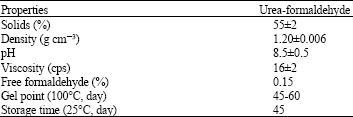
| Table 1: | The properties of urea-formaldehyde adhesive |
 | |
| Table 2: | Production parameters of fiberboards |
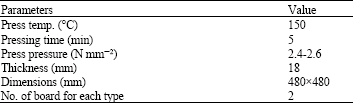 | |
The mixture was sprayed onto wood fibers in a drum type blender. The properties of the urea-formaldehyde used in this study are given in Table 1. All panels were consolidated using steam heated press in the laboratory of Duzce University. Panels were pressed to 25 kg cm–2 at 150°C for 6 min. Test panels having dimensions of 50x50x1.8 cm was conditioned at 20±2°C and 65±5% of relative humidity to reach the moisture content of 12%. Finally, edges of the boards were trimmed to the final dimension of 48x48x1.8 cm. Fiberboard production parameters were summarized in Table 2.
Mechanical and physical properties were tested according to TS-EN 326-1 (1999). Prior to mechanical testing all test specimens were conditioned at 65% relative humidity and 20°C in a conditioning room. The water absorption and thickness swelling of the specimens were measured according to TS-EN 317 (1999). The specimens were also tested for bending (TS-EN 310, 1999), internal bond strengths (TS-EN 319, 1999) and hardness (ASTM D 1037-78, 1994). The obtained data were statistically analyzed by using the analysis of variance (ANOVA) and Duncan mean separation tests.
RESULTS AND DISCUSSION
The results of ANOVA and Duncan’s mean separation tests for water absorption and thickness swelling of the fiberboards made from Oak wood fibers are shown in Table 3 for the produced fiberboards. Statistical analyses showed that water absorption and thickness swelling of fiberboards were significantly affected by panel density.
Higher thickness swelling was observed when the densities of the boards were increased from 0.6-0.8 g cm–3 for both 2 and 24 h soaking times. This result was expected because denser boards have more fibers holding higher moisture which results in more swelling.
| Table 3: | Thickness Swelling (TS) and Water Absorption (WA) test results of ANOVA and Duncan’s mean separation tests |
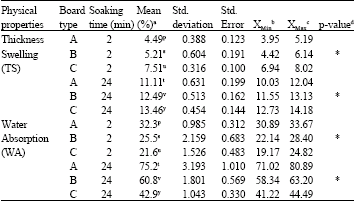 | |
| aMean values are the average of 20 specimens. bMinimum value; cMaximum value; dSignificance level of 0.001 (for ANOVA); p,s,u,t,v,yValues having the same letter are not significantly different (Duncan test) | |
| Table 4: | The mechanical properties of fiberboards and the test results of ANOVA and Duncans mean separation tests |
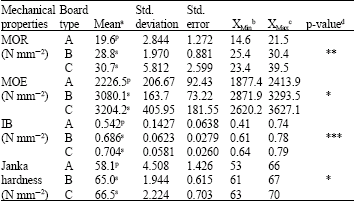 | |
| aMean values are the average of 10 specimens. bMinimum value; cMaximum value; dSignificance level; * Significant at 0.001, **Significant at 0.01, *** significant at 0.05 for ANOVA; p,sValues having the same letter are not significantly different (Duncan test) | |
The measured thickness swelling met the minimum required value according to TS 64-5 EN 622-5 (1999). Standard for the 24 h water immersion time. On the other hand, increase in panel density resulted in lower water absorption for the produced panels. This could be due to the intra- and intermolecular hydrogen bonds that may restrain water acceptability (Sjostrom, 1993) in denser panels. Thickness swelling and water absorption of fiberboards produced in this study was higher compared to the industrially produced fiberboards (Ayrilmis, 2003).
The mechanical properties of the produced fiberboards (modulus of rupture, modulus of elasticity, internal bond and janka hardness) were shown in Table 4. Results indicated that panel density significantly affected Modulus Of Rupture (MOR), Modulus Of Elasticity (MOE), Internal Bond (IB) and janka hardness. The measured mechanical properties increased as the panel density increased. This could be explained by the compression ratio, which affects both physical and mechanical properties of fiberboards. Panels with higher density gave higher compression ratios.
The standard method (TS64-5 EN622-5, 1999) recommends a minimum MOR (22 N mm–2), MOE (2500 N mm–2) and IB (0.50 N mm–2) values for the fiberboards manufactured for general propose use. The findings in this study indicated that all produced fiberboards met the minimum requirement except panel type A (density at 0.6 g cm–3) for MOR and MOE. The measured janka hardness values ranged from 58.1-66.5 N mm–2. Results indicated that increase in panel density resulted in harder panels. The mechanical properties measured in this study were almost similar to the properties measured for industrially manufactured fiberboards (Ayrilmis, 2002).
CONCLUSIONS
In this study, this study examined certain physical and mechanical properties of fiberboards produced using oak wood fibers for varying panel densities. Results indicated that panel density significantly has a significant effect on physical and mechanical properties of fiberboards. Panel density resulted in an increase in thickness swelling and a decrease in water absorption. Higher mechanical properties were obtained for denser panels. The results from this experiment indicated that laboratory MDF panels made from oak fibers could be manufactured with panel mechanical properties that exceed (except panel type A) levels specified in the appropriate existing standards for general purpose fiberboards.
REFERENCES
- Chow, P. and L. Zhao, 1992. Medium density fiberboard made from phenolic resin and wood residues of mixed species. For. Prod. J., 42: 65-67.
Direct Link