

R.M. Jayabalakrishnan
Department of Environmental Sciences, Tamil Nadu Agricultural University, Coimbatore-641 003, India
D. Augustine Selvaseelan
Not Available
Journal of Applied Sciences
Year: 2007 | Volume: 7 | Issue: 7 | Page No.: 1048-1052







ABSTRACT
Raw tannery effluent was leached through mono and mixed columns (different grades) of vermiculite to evaluate their removal efficiency for chromium and other pollutant. It was found that among mono-columns, the chromium removal was the highest in RVG2 (T1) where it was 63.6% at the first pore volume but incase of mixed columns of RVG2 + RVG3 still a higher quantum of chromium removal (74.6%) in the first pore volume was evidenced. In case of removal of cations the vermiculite columns retained most of the cations viz., Ca, Mg, Na and K as evidenced by the substantial decrease in the concentration of these ions in the leachate of the first pore volume. The retention of total chromium, anions and cations by the mono and mixed columns of vermiculite followed a general trend of maximum adsorption during the first pore volume followed by a linear decreasing trend upto third pore volume and in the fourth pore volume the adsorption decreased drastically as a result, the leachate of fourth pore volume was almost equal to that of the original effluent with reference to the pollution load.
PDF Abstract XML References Citation
How to cite this article
R.M. Jayabalakrishnan and D. Augustine Selvaseelan, 2007. Efficiency of Mono and Mixed Columns of Vermiculite for Treating Raw
Tannery Effluent. Journal of Applied Sciences, 7: 1048-1052.
DOI: 10.3923/jas.2007.1048.1052
URL: https://scialert.net/abstract/?doi=jas.2007.1048.1052
DOI: 10.3923/jas.2007.1048.1052
URL: https://scialert.net/abstract/?doi=jas.2007.1048.1052
INTRODUCTION
The discharge of wastes, particularly the industrial wastes into the water bodies has been a matter of great concern in the industrialized countries of the world since long. With the rapid growth of industries in India, pollution has increased tremendously.
Tanning industry is one of the important industries in India, which earns considerable foreign exchange through the leather export. There are about 5000 tanneries in India. The quantity of effluent released from the tanneries is about 50 to 60 L kg–1 of leather tanned. The tannery wastes are ranked as high pollutants among the industrial wastes. Tannery effluent is rich in salt content especially the chromium. Chromium in its hexavalent form is one of the undesirable heavy metals because it affects human physiology, accumulates in the food chain and causes several ailments (Park and Jung, 2001).
The trivalent form is relatively innocuous, but hexavalent chromium is toxic, carcinogenic and mutagenic in nature, highly mobile in soil and aquatic system and also is a strong oxidant capable of being adsorbed by the skin (Singh and Singh, 2002). So the removal of Cr (VI) besides colour, sodium, calcium, magnesium salts from tannery effluents is important before discharging them into aquatic environments or on to land.
A wide range of physical and chemical processes are available for the removal of Cr (VI) and salts from tannery effluents include chemical precipitation, reverse osmosis, evaporation, ion exchange and adsorption. Adsorption on Activated Carbon (ARC) has been adopted as tertiary treatment in various types of industries because of its excellent adsorption capability (Bailey et al., 1999). However, it's use is limited by its high cost (El-Geundi, 1997). In this context, vermiculite mineral with its high cation exchange capacity and reactive surface area was scientifically evaluated for its potential to substitute the activated carbon which could be cost effective and economically feasible treatment method. Column studies were carried out to assess the suitability of raw and exfoliated vermiculite grades obtained from Tamil Nadu Minerals Ltd., Chennai for the removal of Cr (VI) and specific pollutants from tannery effluent.
MATERIALS AND METHODS
The untreated chrome tan liquor collected from a tannery at Erode, Tamil Nadu was analysed for its physical and chemical properties following the standard procedures.
Raw vermiculite comprising of aluminium, iron, magnesium, silicate mineral mixtures, which is excavated as a mineral comprising of thin layers was obtained from M/s. TAMIN, Chennai. Exfoliated vermiculite is obtained by heating the raw vermiculite to temperatures upto 1000°C. These vermiculite are graded accordingly to specific sizes.
Mono and mixed vermiculite columns: Mono and mixed column experiments using selected raw (RVG) and Exfoliated Vermiculite Grades (EVG) were carried out using PVC pipes of 5 cm diameter and 50 cm long (height). The bottom of the pipe was fitted with a filter paper (Whatman No. 1) and a wire mesh (0.1 mm), which were tightly wrapped to hold the weight of different grades of vermiculite. At the bottom, the treated effluent (leachate) was collected through a funnel.
Four selected grades of vermiculites (RVG 2, 3, 4 and EVG 5) were gently packed in the PVC pipes of required height in the column which exhibited varied bulk densities ranging from 0.95 to 1.48 g cc–1 with four replications. Four treatments with mixed grades of vermiculite (RVG2 mixed with equal quantities of RVG3 (T1). RVG4 (T2), EVG (T3) and RVG5 (T4)) were also gently packed to required column height which exhibited varied bulk densities ranging from 1.61 to 1.98 g cc–1.
Calculation of pore volume: To calculate one pore volume, the weight of the columns packed with mono and mixed grades of vermiculites saturated with tannery effluent was substracted from its original weight. The columns were leached based on pore volumes and leachates collected from four pore volumes were analyzed for pH, EC, TS, chromium (VI), sodium, sulphate, calcium and magnesium following standard methods.
RESULTS AND DISCUSSION
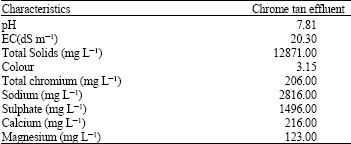
The analytical results of the chrome tan liquor are furnished in Table 1. The effluent was neutral in reactions with high EC (20.3 dS m–1), TS (12871 mg L–1), colour (3.15 OD unit), total chromium (206 mg L–1), sodium (2816 mg L–1), sulphate (1496 mg L–1), calcium (216 mg L–1) and magnesium (123 mg L–1).
| Table 1: | Physico-chemical characteristics of raw tannery effluent |
 | |
| Table 2: | Physical and chemical properties of different grades of raw and exfoliated vermiculites |
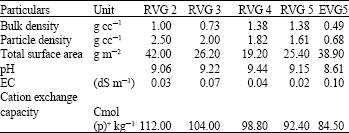 | |
| (Mean of three replications); RVG-Raw vermiculite grade; EVG-Exfoliated vermiculite grade | |
The composition of chrome tan liquor mainly depended on the chemicals present in hides, products formed during the decomposition and chemicals used in the tanning of the hides.
Table 2 records the analytical results of the both the raw and exfoliated vermiculite grades. These adsorbent materials were alkaline in nature which could be due to the presence of associated carbonate rock impurities, the reaction of which is normally alkaline. The bulk density, total surface area, particle density and CEC were the highest in RVG2.
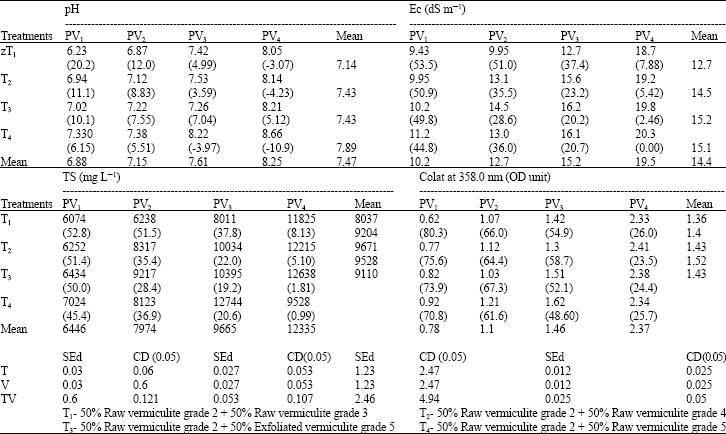
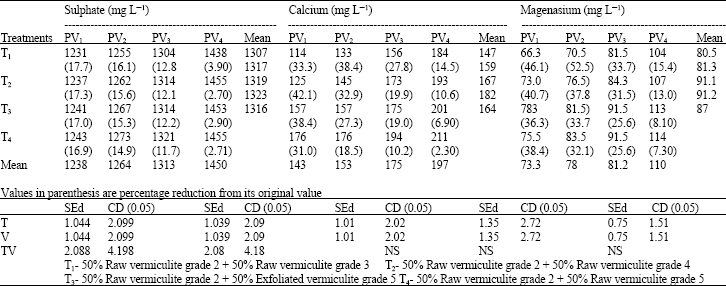
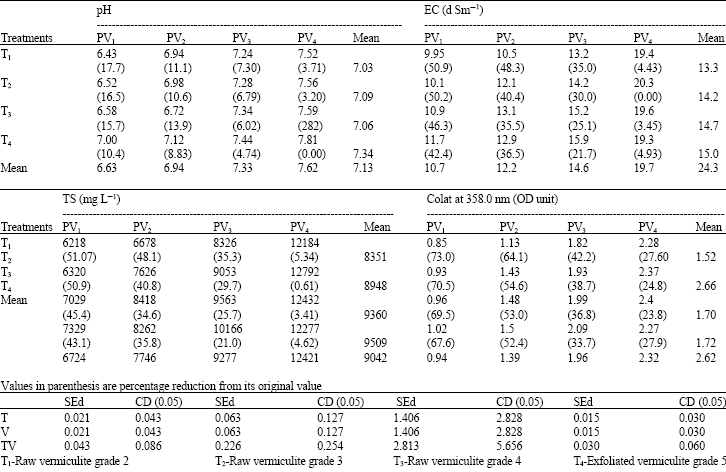
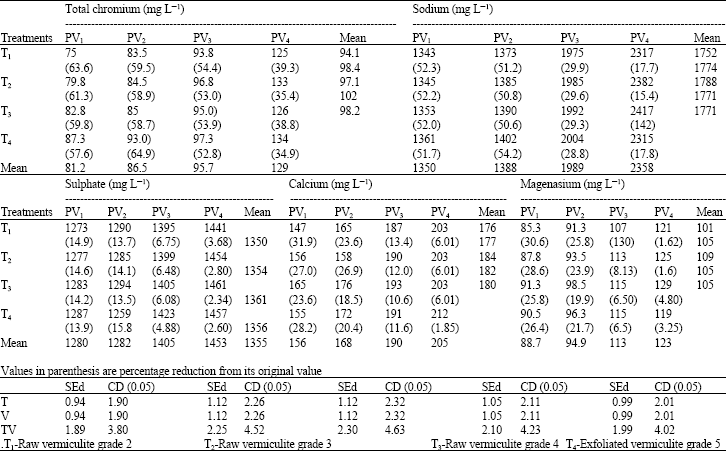
The trend of retention of soluble salts and removal of colour by mono (0.73 v/v) and mixed columns (1.52 v/v) (Table 3 and 4) was a maximum adsorption during the first pore volume, followed by a linear decreasing trend upto the third pore volumes. In the fourth pore volume, the adsorption was the least. There was only a meager difference with reference to pollutant load between the leachate of fourth pore volume compared to that of the original values, indicating that the vermiculite at this stage has attained the point of saturation of all its exchange sites.
Among mono columns, reduction of total solids was maximum in RVG2 (T1) which was found to be 51.1% in the first pore volume, 48.1, 35.3, 5.34% in the 2nd, 3rd and 4th pore volumes. But incase of mixed columns, 50% RVG2 + 50% RVG3 columns (T1) was found to reduce total solids by 52.8, 51.5, 37.8 and 8.13% in the 1st, 2nd, 3rd and 4th pore volumes. The differences in the per cent removal of total solids among mono and mixed column could be ascribed to the increased bulk density of the latter system than the former, besides the enhanced CEC.
The percentage reduction of total solids which decreased with the advancement of pore volumes indicated that the predominant sorption mechanism initially was probably physical sorption associated with the Van Der Waals force which consequently would have been reversed due to weak adsorption as the pore volume advanced.
| Table 3: | Characteristics of vermiculite mixed-columns leachates of raw tannery effluent |
 | |
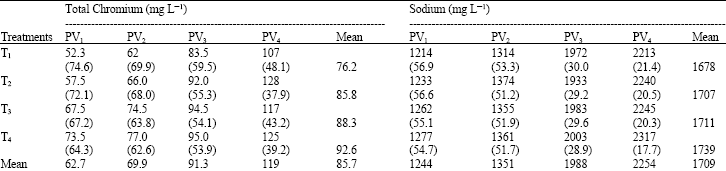
| Table 3: | Characteristics of vermiculite mixed-columns leachates of raw tannery effluent |
 | |
| Table 3: | Characteristics of vermiculite mixed-columns leachates of raw tannery effluent |
 | |
| Table 4: | Characteristics of vermiculite mono-columns leachates of raw tannery effluent |
 | |
| Table 4: | Characteristics of vermiculite mono-columns leachates of raw tannery effluent |
 | |
A similar result was observed by Sasi Kala Rani (2003) who reported that vermiculite layer showed greater percent of removal in the first three pore volumes and the adsorption decreased thereafter with reference to soluble barium and salts.
The same trend was also noticed in case of colour removal where RVG2 (T1) recorded 73% removal in the first pore volume in mono-column and in mixed column of 50% RVG2 + 50% RVG3 colour removal of as high as 80.3% was observed. This might be due to the retention of total solids on the inter-lattice surfaces of vermiculite which resulted in the colour reduction. Similar observation was also reported by Sumathi (1999 and 2003).
In mono-columns, the chromium removal was the highest in RVG2 (T1) where it was 63.6% in the first pore volume but incase of mixed-columns of 50% RVG2 + 50% RVG3, still a higher quantum removal of chromium 74.6% in the first pore volume was evident. Incase of removal of cations, the vermiculite mineral in the columns retained most of the cations viz., Ca, Mg, Na and K which was evident from the substantial decrease in the concentration of these ions in the leachate of the first pore volume. The increased adsorption of chromium and cations at varying pore volumes could be attributed to the high cation exchange capacity of RVG2 (112 Cmol (p)+ kg–1) and mixed column (RVG3-104 Cmol (p)+ kg–1). These adsorption sites could have adsorbed large amounts of Cr and strongly retained in the exchange sites. Similar observations have been reported by Sumathi (1999) and Sasi Kala Rani (2003).
CONCLUSIONS
The efficacy of chromium removal was maximum of 74.6% in the 1st pore volume of mixed vermiculite column (RVG2 + RVG3), whereas among the mono columns, it was the highest in RVG2, were it was 63.6% in the 1st pore volume. The general trend with reference to the retention and removal efficiency of various cations, anions and chromium by mono and mixed vermiculite columns was of maximum removal during the first pore volume followed by a linear decreasing trend upto third pore volumes and in the fourth pore volume the adsorption decreased drastically as a result, the leachate of fourth pore volume was all most equal to that of the original effluent with reference to the pollutant load. Hence it is inferred that RVG2 + RVG3 mixed vermiculite column could be utilized as a substitute for activated carbon in tertiary treatment of tannery effluent.
ACKNOWLEDGMENT
The authors are thankful to Managing Director, Tamil Nadu Minerals Limited, Chennai for rendering financial support for this research under TNAU-TAMIN Scheme project.
REFERENCES
- Bailey, S.E., T.J. Olin, R.M. Bricka and D.D. Adrian, 1999. A review of potentially low-cost sorbents for heavy metals. Water Res., 33: 2469-2479.
CrossRefDirect Link - Singh, I.B. and D.R. Singh, 2002. Cr(VI) removal in acidic aqueous solution using iron-bearing industrial solid wastes and their stabilisation with cement. Environ. Technol., 23: 85-95.
Direct Link