

Yalcin Copur
Department of Forest Industrial Engineering, Faculty of Forestry, Duzce University, 81620 Duzce, Turkey
Hannu Makkonen
Not Available
Journal of Applied Sciences
Year: 2007 | Volume: 7 | Issue: 7 | Page No.: 1043-1047







ABSTRACT
The aim of this study was to test the measurement precision and accuracy of the Kajaani FS-100 giving attention to possible machine error in the measurements. Fiber length of pine pulps produced using polysulfide, kraft, biokraft and soda methods were determined using both FS-100 and FiberLab automated fiber length analyzers. The measured length values were compared for both methods. The measurement precision and accuracy was tested by replicated measurements using rayon stable fibers. Measurements performed on pulp samples showed typical length distributions for both analyzers. Results obtained from Kajaani FS-100 and FiberLab showed a significant correlation. The shorter length measurement with FiberLab was found to be mainly due to the instrument calibration. The measurement repeatability tested for Kajaani FS-100 indicated that the measurements are precise.
PDF Abstract XML References Citation
How to cite this article
Yalcin Copur and Hannu Makkonen, 2007. Precision and Accuracy Studies with Kajaani Fiber Length Analyzers. Journal of Applied Sciences, 7: 1043-1047.
DOI: 10.3923/jas.2007.1043.1047
URL: https://scialert.net/abstract/?doi=jas.2007.1043.1047
DOI: 10.3923/jas.2007.1043.1047
URL: https://scialert.net/abstract/?doi=jas.2007.1043.1047
INTRODUCTION
Methods developed to determine fiber dimensions could be divided into manual and automated methods. Based on measurement methods, fiber dimensions can be determined either by direct measurements (e.g., microscopic counting, image analysis, measurement from slurry) or by an indirect fractionation method. Until recently, fiber length and coarseness were measured using the method explained in TAPPI Method T234, which is lengthy, but may be performed rapidly to determine fiber coarseness and length (Butler, 1948; Reed and Clark, 1950; Anderson, 1953). Today modern image analyzers make it easy to measure fiber length and to define fiber coarseness in a short time because optical analyzers are faster and less tedious. Moreover, recent improvements in computer-based image processing systems have led to the development of fiber analyzers that provide rapid and operator-independent measurements.
The earliest method to measure the fiber length, width and coarseness was the microscopic method (Wilson, 1954). This procedure suffered from defects (fractionation of flat or collapsed fibers) that occur during measurements on the fibers. In addition, every single fiber in the specimen had to be measured to the nearest 0.1 mm and experiments had to be performed meticulously, which took a very long time to complete (Clark, 1942). Instead of the microscopic method, the projection method makes fiber length measurements easier (Sugden, 1968). In this method, a fiber photo is projected on to a surface and dimensions are measured manually. In addition, it is possible to measure the fiber widths to the nearest micron with this technique, but of course measurements take time and require careful attention. When weight-weighed average fiber length is of interest, problems arise, since most fiber length measurement methods do not discriminate fibers according to their weight. The weight-weighed average fiber length of a pulp sample can be determined with conventional methods using screen classification of a sample onto different length fractions using the Bauer McNett fiber classifier. This separates the fibers into length classes by using a relatively dilute fiber suspension. Four or more wire-mesh screens in compartments, each screen having successively smaller openings separates fiber based mainly on length characteristics (Nadelman et al., 1955; Edgerton, 1956; Vecchi, 1969; Tasman, 1972). On the other hand, studies revealed that several factors influence the results of Bauer McNett fractionation such as the amount of water used in classification, screen size, sequence of screens and etc. In addition, Bauer McNett classifies fibers not only on the length base, but fiber coarseness and flexibility are also parameters playing a role in classification. Conclusively, inferior reproducibility, especially for chemical pulps, is the major problem for this measurement method (Levlin, 1982).
Today, there are several automated optical fiber length analyzers on the market. Kajaani introduced three types of laboratory fiber analyzers: The Kajaani FS-100 and FS-200 (Young, 1993) and FiberLab and an online analyzer (FSA) (Tiikkija, 1994). The first automated fiber analyzer, the Kajaani FS-100 (Bichard and Scudamore, 1988) was introduced to the pulp and paper industry in the 1980 and is an optical device accepted as method for laboratory fiber length measurements (Tappi T271) to measure fiber length and coarseness. This instrument is designed to make measurements within minutes with one simple measurement procedure (Piirainen, 1985). It consists of a capillary tube (0.2 mm) through which an aqueous suspension of the fibers is passed. A light source is located on one side of the capillary and a detector is on the opposite side. As a fiber passes through the capillary tube, its polarized image is projected onto the detector, which provides lengthwise dimension of the fiber, which can be calculated. A low-pressure vacuum pump and chamber collect the analyzed fibers. The measurement range is between 0-6.79 mm, divided into 24 classes, of which the first 12 classes are resolved to 0.2 mm lengths and the last 12 have a resolution of 0.4 mm (for the 0-0.7 mm range) (Jackson, 1988).
One of 3 measuring ranges is chosen previous to the sample is introduced. As the diluted fiber suspension (0.0004% consistency) is introduced by pouring it into the capillary funnel, fiber counting is initiated manually on the keyboard. After all the fibers have passed through the capillary, the counting is stopped manually at the keyboard and the results of the fiber length measurement are printed out. The essential number of fibers is counted and fiber length characteristics are presented, including the cumulative fiber length distribution, arithmetic and length-weighed average fiber length. In addition, the graphical presentation of results is obtained directly from the FS-100 output to show fiber length distribution, both in population terms and weight by results. As the Kajaani apparatus is based on the measurement of the total projected length of a known amount of pulp fibers with an optical image analyzer, coarseness is calculated simply by dividing the pulp mass by the total measured length of the fibers. The Kajaani FS-200 is designed to be a process control instrument and is wholly automated; therefore, the capillary tube diameter changes from 0.2 -0.4 mm in FS-200 automatically. Providing enough vacuums ensures the fibers in the capillary tube to be straight. A laser light source is used and on the opposite side, a highly sensitive detector is set up (Luukkonen et al., 1990).
Kajaani introduced the new laboratory fiber analyzer, the Kajaani FiberLab, in 1997 (Tiikkaja, 1997). This new device measures fiber length by the same method as used in the FS-100 and FS-200, but in addition it measures fiber width and cell wall thickness. This new device is easy to use, fully automated and modular. FiberLab uses both conventional optical measurements and 2D-image analysis techniques developed especially for this device. Measurements take place in a capillary tube, one fiber at a time, where fiber length is measured according to TAPPI method T-271 with 50 μm resolution and thus, fiber width and cell wall thickness is measured from the same fiber (Tiikkaja, 1997). FiberLab measures thousands of fibers in only 8 min and determines fiber width and cell wall thickness with 1 μm resolution. It is able to determine the ratio of three different wood species in a blend from the fiber length, width and cell wall thickness measurements.
Several other optical fiber length analyzers are on the market today, such as the Galai CIS-100 and SilviScan-2, the Imaging Fiber Analyzer (Olson et al., 1995) and the Confocal Laser Scanning Microscopy (Jang et al., 1992). Although the CIS-100 system is a particle analyzer based on the direct visualization of the fiber and it also measures fiber coarseness. In contrast to the FS-200, the CIS-100 is not restricted just to the cellulosic fibers and thus is more generally applicable. The SilviScan-2 is an instrument that is combined with a scanning x-ray micro-densitometry, x-ray diffractometry and image analysis to measure wood fiber properties, which in addition controls the fiber quality. Fiber diameter, wall thickness, coarseness and wall perimeter, specific surface, wood density and microfibril angle can all be easily measured with this system. The Imaging Fiber Analyzer determines the distribution of fiber shape and length in samples of papermaking fibers using a CCD camera. Confocal laser microscopy in combination with image analysis allows determining the collapse and coarseness of fibers in paper sheets from cross-sectional dimensions (Sundin et al., 1996).
Kajaani FS-100 is in operation measuring the length of fibers. One measurement error, a machine error for Kajaani FS-100 has not drawn much attention. Therefore, the objective of this study is to evaluate Kajaani FS-100 for measurement precision and accuracy and compare the measured values with Kajaani FiberLab.
MATERIALS AND METHODS
Unbleached pulp samples from Scots pine (Çöpür, 2003), which was produced using different alkaline pulping methods, polysulfide, kraft, biokraft and soda, were used for fiber length and coarseness analysis. Kajaani FS-100 fiber length analyzer was used to measure the numerical average fiber length and the fiber coarseness values from the never-dried screened pulps. Coarseness was determined by dividing the pulp mass (oven dry) by the total measured length of the fibers. All measurements were performed in five replication and the instrument was calibrated prior to use by running a sample of synthetic (rayon) calibration fibers. Fiber length determinations were achieved with the system optics adjusted to the 0-7.0 mm measuring range. Metso Automation at Kajaani measured never-dried pine samples by using the Kajaani FiberLab from screened pulps. Twenty replicate measurements with rayon stable fibers were made to determine the Kajaani FS-100 precision. The repeatability of the Kajaani FS-100 was also tested with kraft fibers collected from the compartment of Bauer McNett classifier screen 14.
RESULTS AND DISCUSSION
In general, the Kajaani FS-100 instrument is considered to generate repeatable results, as indicated by small variations observed between replicate measurements. However, for the present study verifying the precision, accuracy and repeatability of the FS-100 measurements was appropriate. A rayon staple fiber, provided by the equipment manufacturer, was used for these experiments. Runs were made using new aliquots from a single preparation to provide 20 replicate measurements to test the precisians. The average length determined was 0.8836 mm with standard error of 0.0016 at a 95% confidence level. This indicated that measurements with Kajaani FS-100 are precise (Fig. 1).
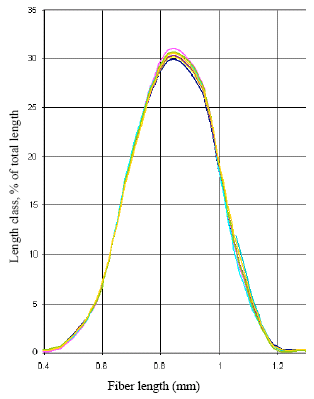 | |
| Fig. 1: | Repeatability control for Kajaani FS-100 with staple rayon fibers |
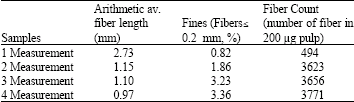
Repeatability in an instrument can be measured if the same sample is measured several times in a recycling manner. In this study the sample was collected after the first run and rerun for 4 additional times. Table 1 shows the results obtained after each measurement and results indicated that after first run, fibers were broken into parts. This is most likely a result of the sudden pressure drop at the exit from the measurement tube. This effect continued throughout the additional cycles. The arithmetic average fiber length became smaller with an increasing amount of fines and fiber counts as the fibers were reanalyzed. Therefore, this procedure did not allow us to determine the repeatability on Kajaani FS-100 to determine the machine error. The results from the precision study, which include an aliquot sampling error, do set an upper limit for the repeatability standard error of 0.0016 at 95% confidence interval. This overestimate of the repeatability error would indicate a high enough repeatability to have confidence in the instruments results, even though it could not be directly measured.
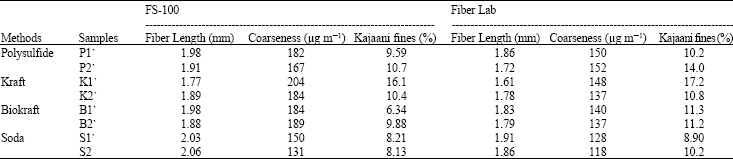
Table 2 gives the fiber length averages, arithmetic, L(n) length-weighed, L(l) and weight-weighed, L(w) for the five replicate determinations for pine pulps. In general, each instrument was found to generate repeatable results as indicated in small variations observed between replicate measurements.
Fiber tests that give numerical values should be relatively independent of the method or instrument used. It may not be possible to get a similar value in one test using a different instrument, but the values should still correlate. Automated optical fiber analyzers make it possible to get reliable fiber length data in a relatively short period of time. However, the differences between instruments have an important effect on the results for average fiber length.
Basically, the differences between the Kajaani FS-100 and FiberLab fiber length analyzers are the method and accuracy of measurement. A brochure from Metso Automation Kajaani Ltd (2000) reveals that FiberLab measures fiber cell wall thickness and fiber width with 1 μm and length with 50 μm resolutions. The resolution with the Kajaani FS-100 is lower because the Kajaani FS-100 is able to measure at 24 classes, 12 of which have resolution at 0.2 mm and the remaining 12 have a resolution of 0.4 mm.
| Table 1: | Repeatability control for Kajaani FS-100 with the same pulp fibers in a recycling manner |
 | |
| Table 2: | Fiber length analysis of pine fibers measured with FS-100 and FiberLab |
 | |
In addition, the Kajaani FS-100 does not include the first and last fiber length classes in the calculation, which means that a significant number of fines in the first class will not be included in the average calculation. In addition, it is possible to measure around 20,000 fibers with FiberLab, which should yield statistically more accurate fiber length data.
A comparison with Kajaani FS-100 revealed that the FiberLab measured the same fibers on average 0.142 mm shorter (range 0.09-0.19). Finer sensitivity and better resolution of FiberLab detected more short fibers and fines and revealed 1.8% more fine contents. Therefore the regression results showed that arithmetic average fiber lengths (R,% = 91.7-L(n)), fines content (R, % = 72.8) and coarseness (R, % = 83.8) measured with Kajaani FS-100 and Fiberlab methods were well correlated.
CONCLUSIONS
The results indicated that the measurements using Kajaani FS-100 and FiberLab were well correlated. FiberLab, the new technology, has the advantage of measuring thousands of fibers in a short time without plugging. In general Kajaani generated repeatable results. Replicate measurements showed small variations. The standard error observed was 0.0016 at a 95% confidence level. This indicated that measurements with Kajaani FS-100 are precise.
REFERENCES
- Copur, Y., D. Kiemle, A. Stipanovic, J. Koskinen and H. Makkonen, 2003. HNMR spectroscopic determination of carbohydrates and yield in pine and maple pulps. Paperi Puu, 85: 158-162.
Direct Link