

A. Kaewrawang
Not Available
S. Swatdiponphallop
Not Available
A. Siritaratiwat
Department of Electrical Engineering, Faculty of Engineering, Khon Kaen University, Khon Kaen, 40002, Thailand
Journal of Applied Sciences
Year: 2007 | Volume: 7 | Issue: 7 | Page No.: 1009-1012







ABSTRACT
In this study, the complex permittivities including dielectric constants, dielectric loss factors and loss tangents of fruits - apple, orange, lemon and pineapple were studied. From the tests, we have found that the complex permittivities depend upon the operating frequency of electromagnetic wave and the date.
PDF Abstract XML References Citation
How to cite this article
A. Kaewrawang, S. Swatdiponphallop and A. Siritaratiwat, 2007. Study on Complex Permittivity of Tropical Thai Fruits. Journal of Applied Sciences, 7: 1009-1012.
DOI: 10.3923/jas.2007.1009.1012
URL: https://scialert.net/abstract/?doi=jas.2007.1009.1012
DOI: 10.3923/jas.2007.1009.1012
URL: https://scialert.net/abstract/?doi=jas.2007.1009.1012
INTRODUCTION
Thailand is one of the agricultural exporter countries, for example; fruits, vegetables, fish, rubber etc. Fruits such as orange, pineapple etc are the important exported fruits of Thailand. A number of the nondestructive and destructive methods was been used to inspection. For instance, mango and durian inspection was studied by Krairiksh et al. (2004) using inverse scattering technique and Kongrattanapraset et al. (2001) using force vibration and ultrasonic, respectively. In addition, Nelson and Bartaly (2002) measured the permittivity of a homogenized macaroni, cheese, wheat apple juice.
In this research, we study the behavior of dielectric constant, dielectric loss factor and loss tangent of four juices - apple, orange, lemon and pineapple which depend upon frequency and age. Firstly, the parameters of material are reviewed and followed by measurement. Results are shown in topic 3 and finally concluded.
DIELECTRIC PARAMETERS
In this topic, we briefly review the permittivity of materials. This parameter indicates the electromagnetic energy stored in a material.
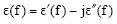
Generally, the permittivity is a complex number whose real and imaginary parts depend upon frequency as equation Balanis (1989):
 | (1) |
where  and
and  are the real and imaginary parts of complex permittivity, respectively.
Divided Eq. 1 by permittivity of free space  , it sis known as the relative complex permittivity,
 ,:
,:
 | (2) |
where the real part, έr (f), is the dielectric constant and the imaginary part, εr″(f), is the dielectric loss factor.
The εr″(f) indicates the loss and conductivity of material as below equation:
 | (3) |
where σ is the conductivity and f is the operating frequency of electromagnetic wave.
The definition of loss tangent, which is another important parameter of dielectric, is the ratio of imaginary part to real part of complex permittivity given by;
 | (4) |
where δ is the loss tangent of material.
MEASUREMENT
The electrical equipments to measure the complex permittivities of fruits are Network Analyzer E5061A, coaxial cable RG-58A/U and dielectric probe. The regular calibration procedure is performed under open-circuit, short-circuit and distilled water at temperature of 25°C references. Dielectric constants and dielectric loss factors are calculated by Agilent Technologies 85070 Dielectric Probe Kit Software version E1.00. In this paper, four samples of fruits; apple, orange, lemon and pineapple, are studied on a frequency range from 20 kHz to 1.5 GHz.
RESULTS
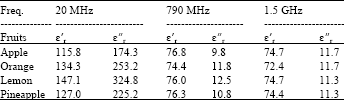
The variation of permittivity properties of four fruits on the first day was performed at 20 MHz, 790 MHz and 1.5 GHz as shown in Table 1 and Fig. 1.
The trend of loss tangent is likewise and the loss tangent on date 2 is the lowest. At the low frequency, the loss tangents are high and then drastically decrease on high frequency range. The dielectric constant and dielectric loss factor parameters on the first date are shown in Fig. 2.
From Fig. 2, At the low frequency, the dielectric constant, dielectric loss factor and loss tangent of lemon and apple are the highest and lowest, respectively. After that all of parameters decrease as the frequency increases.
Loss tangent of apple and orange at 20 MHz, 286, 790 and 1.5 GHz, shown in Fig. 3, is the same pattern. The oscillation of loss tangent occurs at 20 MHz and then it is stable at 286, 790 MHz and 1.5 GHz.
| Table 1: | Permittivities of four juices at various frequency |
 | |
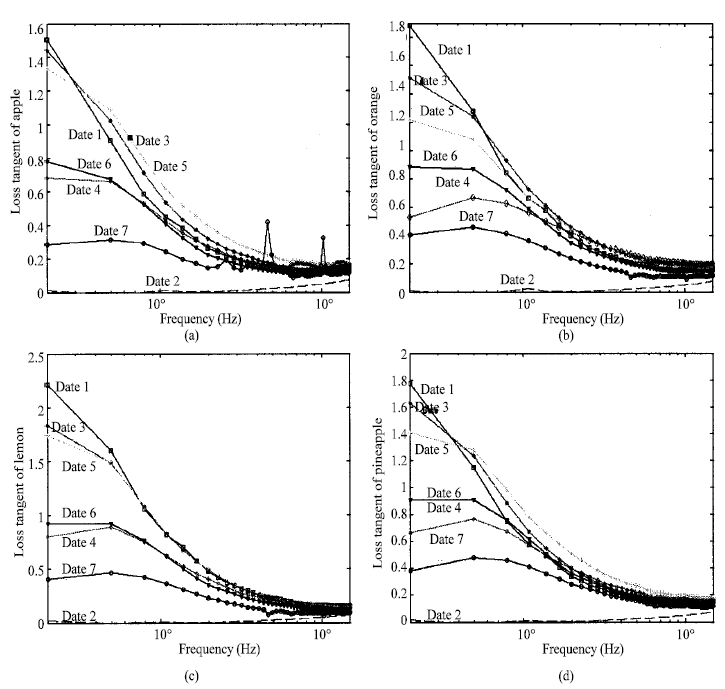 | |
| Fig. 1: | Loss tangent of fruits vs frequency for (a) apple (b) orange (c) lemon and (d) pineapple |
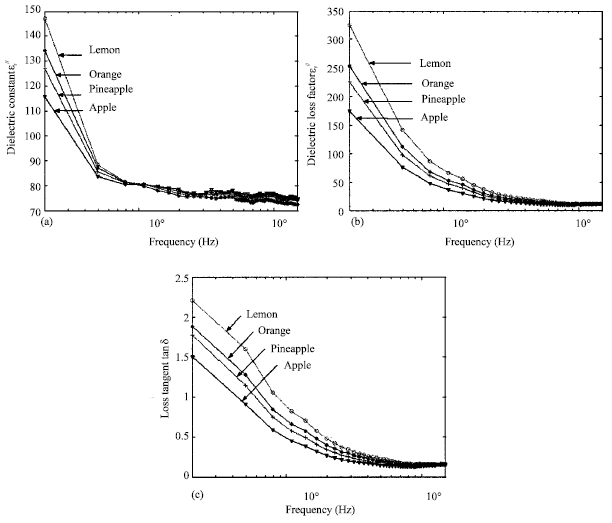 | |
| Fig. 2: | Dielectric parameters of sample fruits vs frequency on the first date in terms of (a) dielectric constant (b) dielectric loss factor and (c) loss tangent |
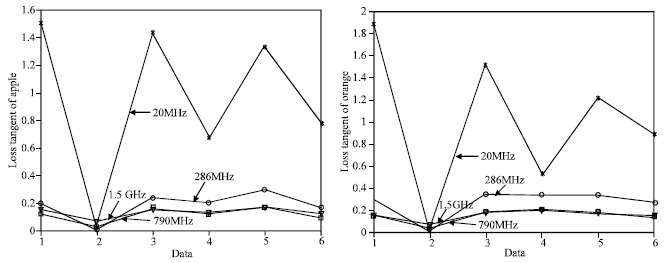 | |
| Fig. 3: | Loss tangent of sample fruits vs date for (a) apple and (b) orange |
CONCLUSIONS
It is seen from this study that loss tangent, dielectric constant and dielectric loss factor are obviously shown at low frequency. The oscillation of these parameters on each date is thought to be due to the uncompleted fermentation. However, these parameters tend to decrease as the age increases.
ACKNOWLEDGMENTS
The authors wish to thanks the EMC laboratory at the department of Electrical Engineering, Khon Kaen University, Khon Kaen, Thailand who has supported all the test equipments.
REFERENCES
- Krairiksh, M., A. Mearnchu and C. Phongcharoenpanich, 2004. Nondestructive measurement for mango inspection. Proceedings of the International Symposium on Communications and Information Technology, October 26-29, 2004, IEEE Computer Society, USA., pp: 646-649.
CrossRefDirect Link - Nelson, S.O. and P.G. Bartley, Jr., 2002. Measuring frequency and temperature-dependent permitti-vities of Food Materials. IEEE Trans. Instrum. Measur., 51: 589-592.
CrossRefDirect Link