

B.H. Kabura
Department of Crop Production, Faculty of Agriculture, University of Maiduguri, Nigeria
B. Musa
Department of Crop Production, Faculty of Agriculture, University of Maiduguri, Nigeria
P.E. Odo
Department of Crop Production, Faculty of Agriculture, University of Maiduguri, Nigeria







ABSTRACT
Field studies were conducted during the 2002/2003 and 2004/2005 cool dry seasons to assess the effect of different onion/pepper intercrop spacings (additive effect) on yield and yield components of onion (Allium cepa L.) and pepper (Capsicum annuum L.) in the Sudan Savanna, Nigeria. Eight different onion/pepper intercrop spacings and a sole each for the two crops were assigned to plots in a randomized complete block design with three replications. The results obtained for the two years were similar. The sole for both crops produced significantly (p≤0.05) higher marketable bulbs and bulb yield ha-1 for onion and greater number of fruits plant-1 and fresh fruit yield ha-1 for pepper than the intercrops. For the onion based intercrops (onion/pepper), the spacings at 15x20/60x45 cm and 15x20/60x75 cm produced significantly (p<0.05) higher bulb yield ha-1 for both years. Whereas, for the pepper based intercrops (pepper/onion) the yield at 60x30/15x40 cm superceded the yield ha-1 of the other intercrops. The Land Equivalent Ratio (LER) values greater than one were obtained from the onion/pepper intercrops of 15x20/60x45 cm and 15x20/60x75 cm as well as from the pepper/onion combinations of 60x30/15x30 cm and 60x30/15x40 cm. The pepper/onion intercrop of 60x30/15x40 cm appeared as the best, with an average LER value of 1.19 for the two years; and therefore a practice to be considered most suitable when adding onion to pepper field. But when adding pepper to onion field, the onion/pepper intercrop of 15x20/60x45 cm which had a mean LER of 1.17 should be considered.
PDF Abstract XML References Citation
How to cite this article
B.H. Kabura, B. Musa and P.E. Odo, 2008. Evaluation of the Yield Components and Yield of Onion (Allium cepa L.)-Pepper (Capsicum annuum L.) Intercrop in the Sudan Savanna
. Journal of Agronomy, 7: 88-92.
DOI: 10.3923/ja.2008.88.92
URL: https://scialert.net/abstract/?doi=ja.2008.88.92
DOI: 10.3923/ja.2008.88.92
URL: https://scialert.net/abstract/?doi=ja.2008.88.92
INTRODUCTION
Onion (Allium cepa L.) belongs to the family Lilliaceae and is believed to have originated in Asia (Anonymous, 1999). It is the most important of the bulb crops as it is grown for consumption worldwide. Leading producers in the world include the United States of America, China and India (Burden, 2007). In Nigeria, onion is grown extensively as a dry season vegetable under irrigation. It can be eaten raw in salads, fried, boiled or roasted as well as for flavouring soups and stews. It is of high nutritional composition (Narasinga Rao et al., 1993).
Pepper (Capsicum annuum L.) belongs to the genus Capsicum and the family Solanaceae. It is believed to have originated in America and is now widely cultivated in most tropical and sub-tropical areas of the world (Tindall, 1992). Sweet pepper is used in soups and stews as well as in salad and are of high nutritional composition (Narasinga Rao et al., 1993).
Intercropping is a crop management system involving two or more economic species grown together for at least a portion of their respective productive cycle and planted sufficiently close to each other so that inter-specific competition occurs (Sulliva, 2003; Dugje, 2004). The advantages of intercropping system include better use of available land resources, yield stability, reduced crop loses due to weeds, pests or diseases. Others include erosion control, reduced leaching of nutrients, soil fertility maintenance, balanced distribution of labour and higher economic returns than sole cropping (Odo and Futuless, 2002; Alamu et al., 2002; Blaser et al., 2007).
Although the onion-pepper intercropping system is popular among resource poor farmers in the Sudan savanna, not much research work has been carried out for improving the productivity of this binary mixture, especially in relation to the spatial arrangements and the relative plant population densities per hectare of the components in the mixture. The determination of the appropriate productive onion/pepper population mixture is therefore imperative.
This study is an investigation of the optimum spacing of pepper that can be intercropped with a fixed standard onion spacing of 15x20 cm without agronomically depressing onion yield as well as to determine the optimum spacing of onion that can be intercropped with a fixed standard pepper spacing of 60x30 cm without agronomically depressing pepper yield.
MATERIALS AND METHODS
Field experiments were conducted during the 2002/2003 and 2004/2005 cool dry season of October to March of each year in the Sudan Savanna ecological zone of Nigeria. The soil of the site was sandy loam, low in nitrogen (0.13%), P (5.6 mg kg-1) and K (0.26 meq/100 g soil). The organic carbon content was 1.36% (Zephaniah, 2001).
The experiment was a two factor experiment i.e., two crops combined under different intercropping spacings, laid out in a Randomized Complete Block Design (RCBD), replicated three times. There were ten treatments as follows:
| T1 | = | 15x20 cm sole onion |
| T2 | = | 60x30 cm sole pepper |
| T3 | = | 15x20 cm onion/60x30 cm pepper |
| T4 | = | 15x20 cm onion/60x45 cm pepper |
| T5 | = | 15x20 cm onion/60x60 cm pepper |
| T6 | = | 15x20 cm onion/60x75 cm pepper |
| T7 | = | 60x30 cm pepper/15x20 cm onion |
| T8 | = | 60x30 cm pepper/15x30 cm onion |
| T9 | = | 60x30 cm pepper/15x40 cm onion |
| T10 | = | 60x30 cm pepper/15x50 cm onion |
Bama Red variety of onion and Damasak variety of pepper, which are the high yielding and most popular varieties in the area, were used. For both the onion and pepper, seeds were used to raise seedlings for the experiments.
Uniform standard agronomic and management practices were kept at equal levels for both the intercrop and each of its reference monocultures. Phosphorus and nitrogen were applied at 45 kg P2O 5 ha-1 and 65 kg N ha-1, at once during transplanting and in two half split doses at two and six weeks after transplanting, respectively (BOSADP, 1993). Some yield parameters (bulbs diameter, bulb weight/plant, percentage marketable [bulbs with diameter >3 cm] and non-marketable bulb [bulbs with diameter ≤3 cm], total bulb yield ha-1 and percentage missing stands at harvest) of onion and (number of fruits/plant, fruit length, fresh weight of fruits/plant and total fresh fruit yield ha-1) of pepper were determined for the two years and subjected to analysis of variance. Difference among treatment means were identified using Duncan`s Multiple Range Test (DMRT). Other intercropping analytical model used for productivity measure was:
Land equivalent ratio (LER) determination: Land Equivalent Ratio (LER) is interpreted as relative land requirements for intercrops versus monocultures (Odo and Futuless, 2002) expressed as:

Where:
| Ryonion | = | Partial LER of onion |
| Rypepper | = | Partial LER of pepper |
| Ponion | = | Onion yield in intercrop |
| Ppepper | = | Pepper yield in intercrop |
| Monion | = | Onion yield in monocrop |
| Mpepper | = | Pepper yield in monocrop |
RESULTS
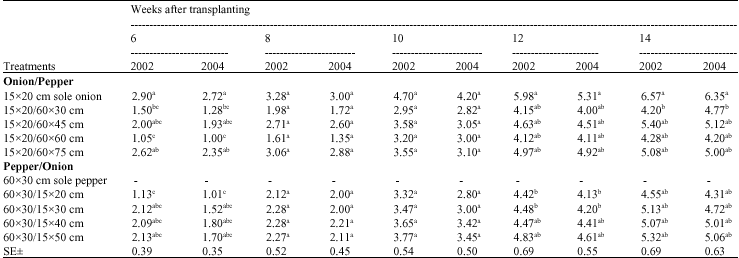
Yield parameters of onion: Similar results were obtained in both years. Bulb initiation began at about 6 weeks after transplanting for all the intercrops and the bulb diameter (of the initiated bulb) maintained an increasing trend up to harvest period for all the treatments. Sole onion (15x20 cm) produced significantly (p≤0.05) large bulb diameter which was comparable to the rest of the treatments except onions grown at 15x20/60x30 cm onion/pepper intercrop spacing (Table 1).
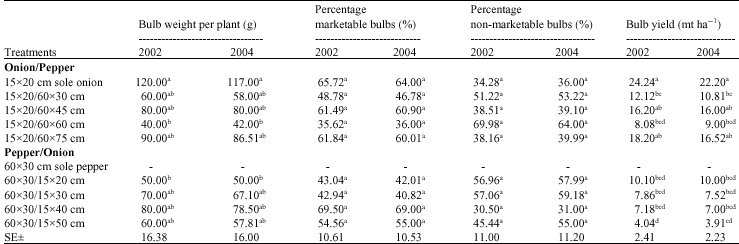
Table 2 shows the effect of the various onion/pepper intercrop spacings on bulb weight/plant, percentage marketable bulbs, percentage non-marketable bulbs and total bulb yield (mt ha-1).
Bulb weight/plant varied significantly (p≤0.05) with the intercrop spacing treatments. Sole onion produced significantly higher bulb weight/plant than onions grown at 15x20/60x30 cm and 15x20/60x60 cm onion/pepper and 60x30/15x20 cm pepper/onion intercrop spacings in both years (Table 2).
Percentage marketable bulbs showed no significant difference (p≤0.05) in response to the intercrop spacing treatments (Table 2). However, pepper/onion spacings of 60x30/15x40 cm gave the highest percentage marketable bulbs than all the other treatments used. Similarly, the percentage non-marketable bulbs did not differ significantly between the treatments. Bulb yield (mt ha-1) varied significantly (p≤0.05) among the various intercrop spacings. Sole onion gave higher bulb yield ha-1 and the lowest value was obtained under the pepper/onion intercrop of 60x30/15x50 cm (Table 2).
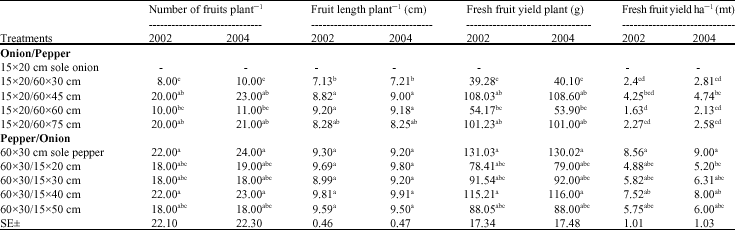
Yield parameters of pepper: The results obtained were similar for both the two years of the trial. Generally, mixtures with lower plant densities produced higher number of fruits/plant as well as longer fruits than those with higher plant densities.
| Table 1: | Effect of onion/pepper intercrop spacings on onion bulb diameter (cm) at the specified weeks after transplanting |
 | |
| Means within the same column followed by the same letter(s) are not significantly different (p≤0.05) from each other, according to Duncan`s Multiple Range Test (DRMT) | |
| Table 2: | Effect of onion/pepper intercrop spacings on yield components and yield of onion |
 | |
Means within the same column followed by the same letter(s) are not significantly different (p≤0.05) from each other, according to Duncan`s Multiple Range Test (DRMT) | |
| Table 3: | Effect of onion/pepper intercrop spacings on yield components and yield of pepper |
 | |
Means within the same column followed by the same letter(s) are not significantly different (p≤0.05) from each other, according to Duncan`s Multiple Range Test (DRMT) | |
Fresh fruit yield plant-1 as well as per hectare differed significantly (p≤0.05) among the various intercrop spacings. Sole pepper (60x30 cm) gave higher fresh fruit yield plant-1 as well as per hectare than the intercrop treatments. However, among the intercrops, the pepper/onion intercrop spacing of 60x30/15x40 cm gave the highest fresh fruit yield ha-1 (Table 3).
| Table 4: | Effect of onion/pepper intercrop spacings on land equivalent ratio |
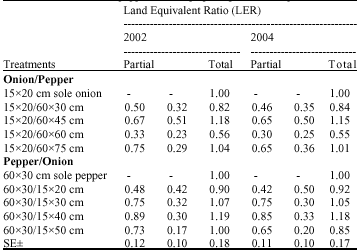 | |
Intercrop efficiency: The measures of intercrop efficiency determined in the study also follow similar trend for both the two years of the experiment (Table 4). For onion the highest partial LER value was obtained at the onion/pepper condition of 15x20/60x75 cm and the lowest value was at the treatment where onion was added at the spacing of 15x50 cm to pepper grown at the fixed standard spacing of 60x30 cm. For pepper the highest partial LER value was obtained at the pepper/onion combination of 60x30/15x40 cm while the least value was obtained at the onion/pepper combination of 15x20/60x60 cm.
Total Land Equivalent Ratio (LER) values were generally higher for 15x20/60x45 cm onion/pepper and 60x30/15x40 cm pepper/onion and lowest for 15x20/60x60 cm onion/pepper (Table 4).
DISCUSSION
Effect on yield components and yield of onion: The additive effect of pepper to onion/pepper intercrop achieved the highest onion bulb yield at 15x20/60x45 cm and 15x20/60x75 cm spacings, which had lower populations of pepper. Whereas, the additive effect of onion to pepper/onion intercrop produced the highest bulb yield of onion at the highest population of onion (Table 2). This was due to the shading effect of the pepper which had greater spatial aerial competition than the onion (Odo, 1991).
Intercropping did not affect bulb size in this study, as values obtained did not show any significant difference from the sole. However, the pepper/onion intercrop of 60x30/15x40 cm produced the highest marketable bulb which subsequently produced similar comparative bulb yield ha-1 as the sole onion in both years.
Sole onion (15x20 cm) produced the highest bulb yield per hectare. This was not unexpected as the sole onion is not subjected to any intercrop competition. Among the intercrops used, the 15x20/60x75 cm onion/pepper combination produced the highest bulb yield per hectare, because the least density of pepper subjected the mixture to less competition for the growth resources. This agrees with the study of Dugje and Odo (2006) on pearl millet intercropped with groundnut, as well as that of Ghosh et al. (2006) on soyabean/sorghum intercropping system.
Effect on yield components and yield of pepper: Yield components of Capsicum annuum L. such as number of fruits plant-1, fruit length and fresh fruit weight plant-1 were affected by intercropping. The higher values obtained for the yield components and yield with sole pepper, might be due to limited resources in the intercrops.
The pepper/onion combination of 60x30/15x40 cm appeared to have encouraged higher productivity among the intercrops. The reason for this could be attributed to good and better growth of pepper and onion at this combination. This agrees with Sulliva (2003) who reported that the optimum plant density of individual crops in a mixture should not be exceeded beyond certain limits to avoid interplant competition between the intercrops.
Intercrop efficiency (land equivalent ratio): In this study, LER values were greater than one for 15x20/60x45 cm; 15x20/60x75 cm onion/pepper intercrops as well as for pepper/onion combinations of 60x30/15x30 cm and 60x30/15x40 cm, which suggests that these combinations were highly efficient and therefore exhibiting higher degree of mutual compensation (Odo, 1991). Higher tendency of mutual inhibition were exhibited by the onion/pepper intercrop of 15x20/60x30 cm producing the least LER values.
Land Equivalent Ratio (LER) values greater than one implies that, although yield of component crops in an intercropping combination is reduced, total yield of the intercrop is significantly greater than that of each crop grown in sole (Pal et al., 1993).
CONCLUSION
In conclusion, the present study has shown that the possibility of achieving a productive onion/pepper combination in the Sudan Savanna for a farmer whose primary interest is in onion is imposing pepper on onion at 15x20/60x45 cm and for a pepper based farmer is imposing onion at 60x30/15x40 cm.
REFERENCES
- Alamu, J.F., J.D. Olarewaju and A.A. Coker, 2002. Profitability assessment of tomato and pepper produced under Fadama Development Programme in Kaduna State. Nig. J. Hortic. Sci., 6: 44-48.
Direct Link - Blaser, B.C., J.W. Singer and L.R. Gibson, 2007. Winter cereal, seeding rate and intercrop seeding rate effect on red clover yield and quality. Agron. J., 99: 723-729.
CrossRefDirect Link - Ghosh, P.K., M.C. Manna, K.K. Bandyopadhyay, Ajay and A.K. Tripathi et al., 2006. Interspecific interaction and nutrient use in soybean/sorghum intercropping system. Agron. J., 98: 1097-1108.
CrossRefDirect Link - Odo, P.E. and K.N. Futuless, 2000. Millet-soyabean intercropping as affected by different sowing dates of soyabean in a semi-arid environment. Cereal Res. Commun., 28: 153-160.
Direct Link - Pal, U.R., T.O. Oseni and J.C. Norman, 1992. Effect of component densities on the productivity of soybean/maize and soybean/sorghum intercrops. J. Agron. Crop Sci., 170: 66-70.
CrossRef