

Adamu Kabir Mohammed
Department of Zoology, Delta State University, P.M.B. 1, Abraka, Delta State, Nigeria
Audu Bala Sambo
Department of Zoology, University of Jos, Nigeria
International Journal of Zoological Research
Year: 2008 | Volume: 4 | Issue: 1 | Page No.: 48-52







ABSTRACT
The effects of sub lethal concentrations of Portland cement powder in solution on some haematological parameters of the Nile tilapia (Oreochromis niloticus (L.)) mean weight 8.20 ± 0.25 g was investigated using static bioassay system for 70 days. The sub lethal concentrations used were 19.60, 9.80, 4.90, 2.45, 1.23 and 0.00 (control) mg L-1. There were significant differences (p<0.05) in the water quality parameters monitored. However, temperature did not show any significant variation (p>0.05) in both test tanks and the control. Haematological parameters examined include: Pack Cell Volume (PCV), Haemoglobin (Hgb), Total Erythrocytes Count (TEC), Total Leucocytes Count (TLC) and Erythrocyte Sedimentation Rate (ESR) which all decreased significantly (p<0.05), the decrease being proportional to the increase in the Portland cement powder in solution.
PDF Abstract XML References Citation
How to cite this article
Adamu Kabir Mohammed and Audu Bala Sambo, 2008. Haematological Assessment of the Nile Tilapia Oreochromis niloticus Exposed to Sublethal Concentrations of Portland Cement Powder in Solution. International Journal of Zoological Research, 4: 48-52.
DOI: 10.3923/ijzr.2008.48.52
URL: https://scialert.net/abstract/?doi=ijzr.2008.48.52
DOI: 10.3923/ijzr.2008.48.52
URL: https://scialert.net/abstract/?doi=ijzr.2008.48.52
INTRODUCTION
Tilapia exhibits high tolerance to adverse environmental condition; it possesses some degree of resistance to disease and parasitic infections (Chervinski, 1982; Randell and Brauner, 1991). Portland cement is composed of tricalcium aluminate (Ca3Al2O6), tricalcium aluminoferrite (Ca4Al2Fe2O10), Belite/dicalcium silicate (Ca2SiO5), Alite/tricalciumsilicate (Ca3Al2O4), sodium oxide (Na2O), potassium oxide (K2O) and gypsum (CaSO4.2H2O) (Mindess and Young, 1981). The dry powder is obtained by grinding the clinker to which gypsum is added to control the settling processes (Steve and Panarese, 1988). Studies on the impact of cement dust on surrounding vegetation showed continuous decrease in the growth rate, diversity and productivity of the flora and fauna (Farmer, 1993; Misra et al., 1993; Hegazy, 1996; Sharifi et al., 1997; Iqbal and Shafiq, 1998). According to Hansen (1998) cement dust is largely made up of Cement Kiln Dust (CKD), a by-product of the final product and is usually stored as waste in open pit unlined landfill, which has a pH of 13.
Blood physiology is currently considered as an essential index to the general health status in a number of fish species. Haematological analysis provides a quick screening method for the assessment of the health status of the fish thus its variables are now in use when clinical diagnosis of fish physiology is applied to determine the effects of external stressors. Several authors have reported works on the haematological parameters of fish exposed to various toxicants (Omoregie et al., 1998; Omoregie et al., 2002; Das et al., 2004; Adeyemo, 2005; Kori-Siakpere et al., 2005; Lipika and Patra, 2006).
Despite, the fact that cement production results to the formation of aerosols that invariably reach aquatic systems, no detailed study has been reported on its effects on fish particularly the Nile Tilapia which is a freshwater candidate found in most lenthic and or lotic aquatic systems. The present study, determined the sub lethal effects of Portland cement powder in solution on haematological parameters of the Nile Tilapia (Oreochromis niloticus (L.)) under static bioassay laboratory conditions.
MATERIALS AND METHODS
Fingerlings of the Nile Tilapia (O. niloticus) mean weight (8.20 ± 0.25 g) were obtained from rock water fish farms, Jos, Plateau State, Nigeria. The fish were held in the undergraduate Research Laboratory Department of Zoology, University of Jos in large plastic aquaria (30 L capacity) and supplied with well-aerated dechlorinated municipal water and acclimatized for ten (10) days. During the acclimatization period the fish were fed with pelleted reference diet (NRC, 1983) at 08:00 and 16:00 h and the fish were sorted out in to ten (10) fish/tank/15/aquaria with replicate. A preliminary toxicant concentration was investigated, supported by the results of the acute concentration of Portland cement powder solution on Oreochromis niloticus in static bioassay under laboratory conditions (Audu, 2004). The following toxicant concentrations were obtained by dissolving the equivalent dry weights in 1 L of unionized water: 19.60, 9.80, 4.90, 2.45 and 1.23 mg L-1. the entire cement toxicant in each test tank was renewed fortnightly.
Water quality parameters such as Dissolved Oxygen (DO), total alkalinity, free carbon (iv) oxides and pH were monitored 48 h interval while Temperature was monitored every 24 h using the methods described by APHA (1985).
Blood samples were taken from the control and experimental fish at the end of the 70 days exposure period. The blood was collected by caudal artery puncture at the caudal peduncle and introduced into heparinized micro-capillary and EDTA (anti-coagulant) tubes. The blood samples were then used for the determination of the haematological parameters PCV, Hgb, TEC, TLC and ESR in accordance to the method described by Blaxhall and Daisley (1973).
Results obtained were subjected to statistical analysis using Analysis of Variance (single classification), at probability level of 0.05. to determine significant differences between treatment means which were aided using SPSS 13.0 and Microsoft Excel 2003.
RESULTS AND DISCUSSION
The results of the water quality parameter (Table 1) revealed that temperature showed no variation in all tanks recording 21.26 °C including control tank. However, slight variations were recorded in the other water quality parameters investigated. pH was in the range of 7.42-7.90; the highest pH value recorded in test tank having the highest toxicant concentration (19.60 mg L-1) while the least pH value was recorded in the control tank (0.00 mg L-1). Dissolved Oxygen (DO) content decreases as the Portland cement toxicant concentration increases in the range of 5.42 to 3.16 mg L-1 while the control tank recorded DO value of 6.10 mg L-1. Free carbon iv oxide and total alkalinity values varied significantly (p<0.05) with increase in toxicant concentration, such that the highest toxicant concentration (19.60 mg L-1) had the highest carbon (iv) oxide and total alkalinity values of 2.40 and 30.20 mg L-1, respectively, while the least free carbon (iv) oxide and total alkalinity values (1.67 and 7.67 mg L-1) were recorded in the control tank (0.00 mg L-1).
The summary of the mean values of haematological parameters is as represented in Table 2. Changes in haematological values occur in relation to the physiological stress, disease and toxic environmental conditions (Blaxhall and Daisley, 1973).
The mean PCV decreased significantly (p<0.05) with the increase in Portland cement powder in solution concentration. PCV is used to determine the ratio of plasma to corpuscles in the blood as well as the oxygen-carrying of the blood (Larsson et al., 1985). The significant decrease in the PCV in this study could be attributed to gill damage and/or impaired osmoregulation causing anaemia and haemodilution. Tort and Torres (1988) and Omoregie et al. (2002) reported similar decrease in PCV following exposure of dogfish Scyliorhinus canicula and Tilapia zilli to cadmium and lubricating oil contaminations.
| Table 1: | Water quality parameters for sub lethal bioassay of Portland cement on fingerlings of the Oreochromis niloticus during the 70 days exposure period |
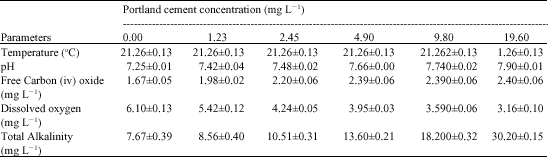 | |
| Values are shown in mean ± SE | |
| Table 2: | Mean ± SE# of Haematological parameters of Oreochromis niloticus exposed to sub lethal concentrations of Portland cement powder in solution during the 70 days of exposure period |
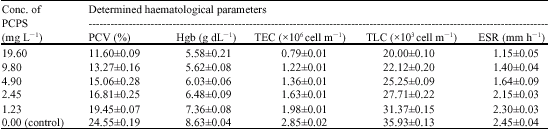 | |
| #: Mean values calculated from 6 fishes each from exposure and control; each result was duplicated so that the mean ± SE given were calculated from 12 observations; PCPS: Portland Cement Powder in Solution | |
Hgb is the oxygen-carrying component in the blood of fish and its concentration can be used as good indicator of anaemia (Blaxhall and Daisley, 1973). The significant decrease (p<0.05) of Hgb in the experimental fish exposed to Portland cement powder in solution could thus be an indication that anaemic condition occurred in fish during exposure. Decreased haemoglobin following metal exposure usually result in haemodilution, which has been regarded as a mechanism that reduce the concentration of the toxicant/pollutant in the circulatory system (Smith et al., 1979). Kori-Siakpere et al. (2005) and Adeyemo (2005) have reported decrease in the Hgb of Heteroclarias and Clarias gariepinus exposed to sub lethal concentrations of cadmium and cassava mill effluent, respectively.
TEC of the fish exposed to Portland cement powder in solution showed significant decrease (p<0.05) which is directly proportional to the concentration of the toxicant in solution. The Red blood cells have the important function of haemoglobin transport which carries oxygen to all tissues in the body (Hibiya, 1982). The decrease level of TEC observed following the exposure of Oreochromis niloticus to sub lethal concentrations of Portland cement powder in solution could be as a result of haemolysis or destruction of the Red Blood Cells (RBC). The cause of the reduction of circulating erythrocytes of stressed fish has been attributed to aggregation of Red Blood Cells in damaged gills (Singh and Singh, 1982). The significant decrease in the TEC observed in the test fish may also be ascribed to the swelling of the erythrocytes, which may also be attributed to the decrease in the erythropoitic activity of the kidney (Santhakumar et al., 1999). Adeyemo (2005) and Lipika and Patra (2006) have reported significant decrease in TEC level in Clarias gariepinus and Clarias batrachus exposed to sub lethal concentrations of cassava mill effluent and carbarylin, respectively.
Similarly, TLC also showed significant difference (p<0.05) with corresponding increase in Portland cement powder solution. The White Blood Cells (WBC) of the blood respond to various stressors including infections and chemical irritants. The decreasing number of TLC in this study is a normal reaction to a chemical such as Portland cement powder in solution. However, the decrease of TLC may also be as the result of bio-concentration of the test toxicant in the kidney and liver (Agrawal and Srivastava, 1980). Ipso-Facto, Das (1998) related the decrease of TLC to protective response of fish to stress. Leucocytes are known to be involved in the regulation of immunological functions of the body (Santhakumar et al., 1999) implying that decrease in TLC exposes fish to opportunistic infections invariably supporting earlier assertions that low productivity was associated with aquatic systems and vegetations of neighbouring cement plants (Farmer, 1993; Misra et al., 1993; Hegazy, 1996; Sharifi et al., 1997; Iqbal and Shafiq, 1998). Svobodova et al. (1994) concluded that prolonged exposure of toxicant causes failure of TLC production leading to a decrease in the non-specific immunity of fish, which translate to low productivity, as fish exposed to such toxicants cannot withstand environmental stress.
ESR also decreased significantly (p<0.05) with increase in toxicant concentration. The decrease in ESR could be as a damaged gills and impaired osmoregulation during the sub lethal exposure of the fish to Portland cement powder in solution which caused haemodilution that led to decrease in the number of RBC through haemolysis (Gardner and Yevich, 1970). Kori-Siakpere et al. (2005) reported decrease in ESR in Heteroclarias exposed to sub lethal concentrations of cadmium.
The introduction of cement directly or indirectly (in the form of aerosols) into the aquatic systems could cause deleterious and debilitating effects on the haematology of the Nile Tilapia Oreochromis niloticus as revealed in this study.
REFERENCES
- Adeyemo, O.K., 2005. Haematological and histopathological effects of cassava mill effluent in Clarias gariepinus. Afr. J. Biomed. Res., 8: 179-183.
CrossRefDirect Link - Agrawal, S.J. and A.K. Srivastava, 1980. Haematological responses in a fresh water fish to experimental manganese poisoning. Toxicology, 17: 97-100.
CrossRefDirect Link - Blaxhall, P.C. and K.W. Daisley, 1973. Routine haematological methods for use with fish blood. J. Fish Biol., 5: 771-781.
CrossRefDirect Link - Das, P.C., S. Ayyapan, J.K. Jena and B.K. Das, 2004. Acute toxicity of ammonia and its sublethal effects on selected haematological and enzymatic parameters of Mrigal (Cirrhinus mrigal) (Hamilton). Aquacult. Res., 35: 134-143.
CrossRefDirect Link - Farmer, A.M., 1993. The effects of dust on vegetation-a review. Environ. Pollut., 79: 63-75.
CrossRefDirect Link - Gardner, G.R. and P.P. Yevich, 1970. Histological and hematological responses of an estuarine teleost to cadmium. J. Fish Res. Board, Canada, 27: 2185-2196.
CrossRefDirect Link - Hegazy, A.K., 1996. Effects of cement-kiln dust pollution on the vegetation and seed-bank species diversity in the eastern desert of Egypt. Environ. Conserv., 23: 249-258.
CrossRefDirect Link - Larsson, A., C. Haux and M.L. Sjobeck, 1985. Fish physiology and metal pollution: Results and experiences from laboratory and field studies. Ecotoxicol. Environ. Saf., 9: 250-281.
CrossRefPubMedDirect Link - Patnaik, L. and A.K. Patra, 2006. Haemoatopoietic alterations induced by carbaryl in Clarias batrachus (LINN). J. Applied Sci. Environ. Manage., 10: 5-7.
Direct Link - Omoregie, E., S.A. Okunsebor and B.S. Audu, 2002. Haematological assessment of the effects of lubricating oil in the cichlid, Tilapia zilli (L.) under Laboratory conditions. Afr. J. Environ. Pollut. Health, 1: 28-36.
Direct Link - Randall, D. and C. Brauner, 1991. Effects of environmental factors on exercise in fish. J. Environ. Biol., 160: 113-126.
Direct Link - Santhakumar, M., M. Balaji and K. Ramudu, 1999. Effect of sublethal concentrations of monocrotophos on erythropoietic activity and certain hematological parameters of fish anabas testudineus (Bloch). Bull. Environ. Contam. Toxicol., 63: 379-384.
CrossRefDirect Link - Sharifi, M.R., A.C. Gibson and P.W. Rundel, 1997. Surface dust impacts on gas exchange in mojave desert shrubs. J. Applied Ecol., 34: 837-846.
Direct Link - Smit, G.L., J. Hattingh and A.P. Burger, 1979. Haematological assessment of the effects of the anaesthetic MS 222 in natural and neutralized form in three freshwater fish species: Interspecies differences. J. Fish Biol., 15: 633-643.
CrossRefDirect Link - Tort, L. and P. Torres, 1988. The effects of sublethal concentrations of cadmium on haematological parameters in the dogfish, Scyliorhinus canicula. J. Fish Biol., 32: 277-282.
CrossRefDirect Link