

Ouni Mabrouk
Laboratoire d`Elevage et de la Faune Sauvage des Regions Arides et Desertiques, Institut des Regions Arides, Medenine, Tunisie
Najari Sghaier
Laboratoire d`Elevage et de la Faune Sauvage des Regions Arides et Desertiques, Institut des Regions Arides, Medenine, Tunisie
Gaddour Amor
Laboratoire d`Elevage et de la Faune Sauvage des Regions Arides et Desertiques, Institut des Regions Arides, Medenine, Tunisie
Ben Amor Mohamed
Laboratoire d`Elevage et de la Faune Sauvage des Regions Arides et Desertiques, Institut des Regions Arides, Medenine, Tunisie
Khorchani Touhami
Laboratoire d`Elevage et de la Faune Sauvage des Regions Arides et Desertiques, Institut des Regions Arides, Medenine, Tunisie
Ben Ammar Elgaaied Amel
Laboratoire de Genetique, Immunologie et Pathologies Humaines, Faculte des Sciences de Tunis
International Journal of Zoological Research
Year: 2008 | Volume: 4 | Issue: 1 | Page No.: 12-20







ABSTRACT
Data corresponding of 276 local kids` periodic control, harvested during 4 years (2001-2005) under pastoral mode in Tunisian arid region, was used to study some factors effects upon body parts evolution after birth. Morphostructural variables were; body length, height-at-withers and heart girth. The linear measurement periodically registered at every control day from birth and till 5 months age. For each kid, performances were standardized at typical ages; birth, 30, 60, 90, 120 and 150 days. Statistical analysis were achieved by GLM procedure and SNK (α = 5%) means comparison test to identify factors effects upon studied variables and the homogeneous classes. The kid`s body parts seem affected (p<0.05) by several environmental factors, sex, type of birth and age of dam. The type of birth and the age of dam exerts a high effect (p<0.01) on all characters after the birth. However, the factors statistical effects depend to the kid`s age. The sex acts differently on the morphometric characters before and afterwards of two month age. Thus, phenotypic individual differences can be elapsed by environmental factors of arid harsh conditions. Such conclusion underlines the necessity to study the particularities of the genetic expression of adapted populations towards restrictive resources.
PDF Abstract XML References Citation
How to cite this article
Ouni Mabrouk, Najari Sghaier, Gaddour Amor, Ben Amor Mohamed, Khorchani Touhami and Ben Ammar Elgaaied Amel, 2008. Some Non Genetic Factors Effects on Morphostructural Growth of Local
Kids in Tunisian Arid Area. International Journal of Zoological Research, 4: 12-20.
DOI: 10.3923/ijzr.2008.12.20
URL: https://scialert.net/abstract/?doi=ijzr.2008.12.20
DOI: 10.3923/ijzr.2008.12.20
URL: https://scialert.net/abstract/?doi=ijzr.2008.12.20
INTRODUCTION
In Tunisian arid zone livestock plays a significant role in the livelihood of rural populations and the agricultural development (Najari et al., 2006, 2007a). Thanks to its physiological and anatomical characteristics, goat is selected in the valorisation of these zones. This animal is well adapted to the harsh environment and limited feed and utilizes marginal land to produce high protein products. There is also a worldwide tendency for rapid increase in demand for goat meat (Kadim et al., 2003).
Indeed, more than 60% of caprine national herd was raised in the arid areas of our country (Ouni et al., 2006b). Animal production modes were radically changed and diversified in this region with disappearance of nomadism. However, traditional pastoral breeding remains the principal local goat production mode and the kid`s meat still the main product of the goat production. Our local goat is well-adapted to a wide range of farming environments and the meat is preferred by the local population. Najari (2005) estimated that goat`s herds contributed with about 75% in the arid area meat consumption.
Even though under harsh conditions, local goat potentialities improvement remains possible and contributes to indigenous genetic resources conservation (Moruppa and Ngere, 1986; Ibiwoye and Oyatogun, 1987). Also, better animal incomes promote local goat production interest. Thus, the study of the young kid`s growth, during early age, is necessary to apprehend improvement plan by monitoring variation factors effects. The growth determines the meat producing ability of kids up to marketable age. Rapid growth during the pre-weaning period minimizes the cost of rearing and thus provides more profit to the farmer (Al-Shorepy et al., 2002).
Actually, there are insufficient parameters regarding phenotypic and genetic performance for local kid`s traits under low input production circumstances for indigenous population (Zaitoun et al., 2005). Such is known for animal quantitative traits, variation in body size is one of the criteria largely used for classifying and characterizing caprine breeds (Mohammed and Amin, 1996).
Very few studies have been carried out on the linear body measurements of Tunisian local goat and their possible use for estimating the animals` live weights (Ouni, 2006). So, understanding body parts kinetic evolution after birth and the effects of some factors upon individual performance is of essential importance to handle and to improve final goat herd output.
This study was carried out to establish some non genetic factors influences on kid`s body size under prevailing natural condition in Tunisian arid area to characterize local goat population and then, to adjust morphostructural variables numerical relations as a part of improvement scheme.
MATERIALS AND METHODS
Study Zone
This study was carried out in the experimental station of Arid Land Institute (IRA), located in the south-east of Tunisia (North Africa) under arid Mediterranean climate (Gaddour et al., 2007a). Natural environment is characterized by its hardness and irregularity (Ouled, 2006). With an annual average of 140 mm, precipitation presents a large spatial and seasonal variation. The arid zone is actually the most important rangelands of the country and is mainly valorized by extensive and transhumant camel and small ruminants herds (Nasr et al., 2000).
Animal Materials
The indigenous goats` population shows a large variability both in morphology and performances (Ouni et al., 2007a; Gaddour et al., 2007c). Local goats` populations vary in color, body weight, size, morphostructural characteristics, shape of horns and wattles. Also, differences can be observed among goats of different geographical parts in Tunisian arid area Najari (2005). Kidding begins in October and continues till February with a concentration in November and December when 69.2% of kids are born.
Data Collection
The data used for this study were collected during 4 years, from 2001 and till 2005 on 149 male and 127 female indigenous kids born single or twins. The experimental herd raised in an extensive pastoral mode, Kid`s periodic control starts since the birth and continue till five month of age.
For each kid, data regroups the measurements of body parts, as follows:
| • | Body length was measured as the distance from the external occipital protuberance to the base of the tail. |
| • | Height-at-withers was measured as the distance from the surface of a platform to the withers and |
| • | Heart girth represented the circumference of the chest. |
Statistical Analyses
The PROC GLM procedure (SAS, 1999) was applied to diagnose the statistical effects of the kid`s sex, birth mode and age of mother upon body parts evolution after birth. For each quantitative variable, the linear model was as follow:
Yijkl = Si +mnj +agemk + eijk |
| Y | = | The individual performance: measurements of heart girth, height at withers and body length, estimated at 1, 30, 60, 90, 120 and 150 days. |
| Si | = | The fixed effect of sex (male or female); mnj is the fixed effect of the kidding mode (single, twin); |
| agemk | = | The fixed effect of the age of dam; and eijk is the random residual error. |
After variance analysis, a means comparison test (SNK, α = 0.05) was applied to identify homogenous class of studied factors for each variable and each age.
RESULTS AND DISCUSSION
Analysis of variance (GLM) results of body size variables shown in Table 1. Statistical test of significance shows that all studied linear body measurements (body length, height-at-withers and heart girth) were not significantly (p<0.05) affected by sex, especially during the tow first month of age, but the sex effect become significant on performances registered after this age.
Type of birth presents a highly significant (p<0.01) effect on body measurements at birth, 60, 90 and 150 days but only significant effect (p>0.05) at 30 on height at withers and body length. Also, similar effect is registered at 120 days for height at withers. This variable seems to be affected by all factors after tow month of age.
There was a significant effect of birth mode and rearing on heart girth and cannon circumference while sex and age of dam were not important (p>0.05).
Table 1 shows that at three months age, all studied factors had a high significant effect on all variables. It seems that at this age, kids express their real potentialities, which allows registering clear differences between categories performances (Najari, 2007a; Ouni et al., 2007a).
As well for other animal quantitative traits, the action of sex, birth mode and age of dam can be considered as classic in animal quantitative genetic. In fact, such effect was largely signalled for small ruminants (Janssens and Vandepitte, 2004).
| Table 1: | Analysis of variance results of the statistical effects of kid`s sex, birth mode and age of dam upon kid`s Heart girth, height-at-withers and body length (cm) and at different standard ages |
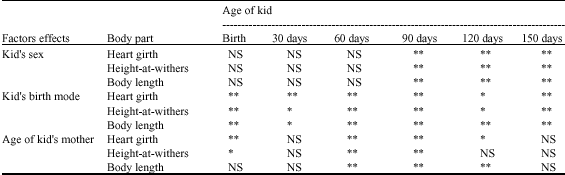 | |
| **: Highly significant effect (p<0.01); *: Significant effect (p<0.05); NS: Non Significant effect (p>0.05) | |
Therefore, age of dam was non significant (p>0.05) on linear body measurements at 60 days of age, the same factor had a highly significant (p<0.01) effect at 60 and 90 days. It`s non significant (p>0.05) effect for Height-at-withers at 120 days. Also age of dam had a highly significant (p<0.01) effect for all parameters at 90 and 120 age of animal. After this age the factor had now effect. Such results confirm those presented by Najari (2005) regarding kid`s growth under pastoral conditions.
Kid`s Sex Effects upon Body Parts Evolution
For almost mammalian livestock species is well known that, since the birth, sex presents a clear effect upon animal growth and body shape (Gerstmayr and Horst, 1995; Bhoite et al., 1996); males have morphostructural traits superior to females. However, in our case, the kid`s sex does not have an effect on the body characters except after tow month`s age (Fig. 1-3). Such conclusion was verified for other goat character upon arid conditions (Ouin, 2006; Ouni et al., 2006a). So, this aspect can be considered as a result of a specific genetic behaviour towards harsh breeding conditions (Najari et al., 2002, 2007a). Male and female kids register similar traits during this early age, essentially due to reduced goat mother dairy production, signalled for local goat population (Gaddour et al., 2007b). A limited milk production does not allow exteriorising the differences between the male and the female. Consequently, the action aridity can occult the effect of some classic factors such the sex.
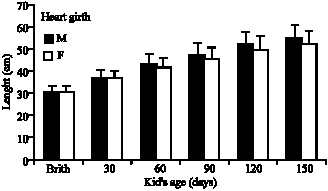 | |
| Fig. 1: | Sex effects on the evolution of local kid`s Hearth girth at the standard ages |
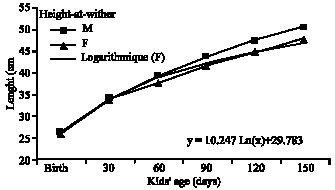 | |
| Fig. 2: | Sex effects on the evolution of local kid`s Height-at-wither at the standard ages |
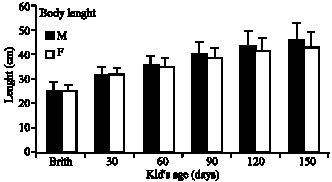 | |
| Fig. 3: | Sex effects on the evolution of local kid`s body length at the standard ages |
After two months age, difference of kids` body size becomes remarkable among the two sexes. This male superiority continues during the growing period (Fig. 1-3). Consistent superiority of male kids has been widely reported (Inyangala et al., 1992). This difference has been attributed to hormonal differences between sexes and their resultant effects on growth. In favourable years, it is common that indigenous female kids can be covered during summer without particular problem. The often local breeds small body size allows local goats populations to success the reproduction process and by which, to guarantee the survival and the genetic continuity of the population even under arid conditions (Najari, 2005). Female kids can reach the maturity state rapidly and its can began reproductive process since the first year of age. This can be considered as an adaptation criteria of the indigenous population; the priority to guaranty the genetic continuity of the animal group under harsh condition by a rapid reproductive rhythm of young females (Najari et al., 2007b).
Kid`s Kidding Mode Effects upon Body Parts Evolution
The effect of this factor is considered classic for almost livestock species (Demiroren et al., 1995; Gaddour et al., 2007a; Ouni et al., 2007b). Since foetal life, single kids have normally better conditions to realize heaviest weights and larger body than twins, this continues during all animal life (Bandages et al., 1993). Alexandre et al. (1997) indicate that the difference between simple and double kids could reaches till 15% of weight at birth. In our case (Fig. 4- 6) the single and twins difference isn`t clearly before 3 months age; after this age body sizes differ clearly with birth mode. Note that this age concords, in pastoral breeding mode, with the favourable spring season (Ouled, 2006).
Type of birth and rearing influenced body growth rates significantly in agreement with Nicoll (1985) and Gifford et al. (1990). Besides, all body traits except body length were also affected by type of birth and rearing (Wenzhong et al., 2005).
Age of Mother upon Body Parts Evolution
Age of dam varies the kid`s early growth rate especially after 30 days of age and till 120 days of age. Kids issued from the goat females aged between 2 and 3 years had larger body size than those corresponding to other factor categories (Table 2-4). The unfavourable effect of young dams on their kids suggests the importance of feeding and management during mating and pregnancy. The harsh feeding condition of dams was responsible for reduced birth body shape and early growth rates of kids.
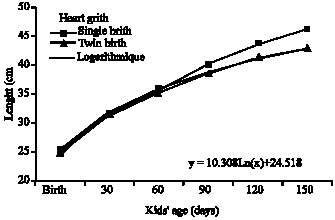 | |
| Fig. 4: | Type of birth effects on the Hearth girth of the local kid`s at the standard ages |
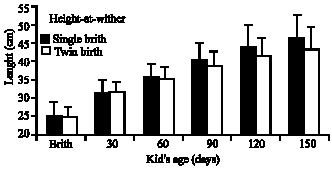 | |
| Fig. 5: | Type of birth effects on the Height-at-wither of the local kid`s at the standard ages |
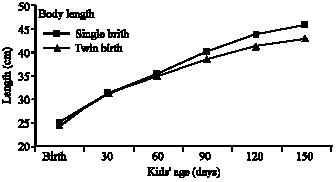 | |
| Fig. 6: | Type of birth effects on the body length of the local kid`s at the standard ages |
| Table 2: | Results of means comparison test (SNK) of the kid`s mother age effects on Heart girth (cm) at kid`s standard ages |
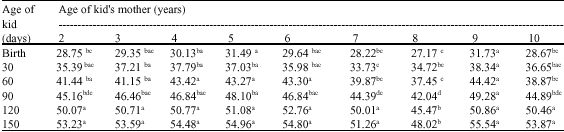 | |
| a, b and c: Homogeneous groups; Birth, 30, 60, 90, 120 and 150 days: Heart girth of kids` age at, birth, 30, 60, 90, 120 and 150 days | |
| Table 3: | Results of means comparison test (SNK) of the kid`s mother age effects on Height-at-withers (cm) at kid`s standard ages |
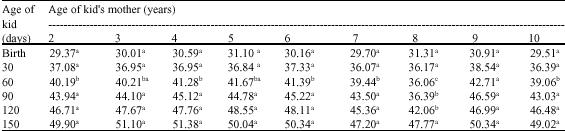 | |
| a, b and c: Homogeneous groups; Birth, 30, 60, 90, 120 and 150 days: Height-at-withers of kids` age at, birth, 30, 60, 90, 120 and 150 days | |
At 60, 90 and 120 days the age of the mother have a highly significant influence on the all studied measurements. Wenzhong et al. (2005), announced similar results as well as for Khombe (1985) regarding goats breeds in Zimbabwé.
| Table 4: | Results of means comparison test (SNK) of the kid`s mother age effects on Body length (cm) at kid`s standard ages |
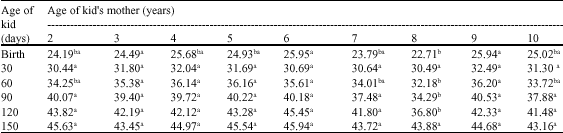 | |
| a. b and c: Homogeneous groups; Birth, 30, 60, 90, 120 and 150 days: Body length of kids` age at, birth, 30, 60, 90, 120 and 150 days | |
The age of mother represents essentially the lactation range with which varies the milk potentialities. In fact, goat lactation evolves to a maximum reached at the 3rd or 4th lactation (Ba Diao et al., 1994). The relation between kids` growth and the mother age was demonstrated in several studies (Nadarajah et al., 1995; Pinkerton et al., 1994; Gromela et al., 1998).
In this study, the lowest kids` performances were registered for the kids of first lactating goats, followed by the category of the goat two years aged and the oldest goats. Goats aged between 3 and 7 years seem to allow the better kids growth; it seems that the forage scarcity avoid to distinguish differences into this group (Table 2-4).
CONCLUSION
Results explain the major impact of kid sex, birth mode and mother age upon body stature since the birth and till 5 months age under harsh Tunisian arid environment. However, it is necessary to underline the specific effect of the sex on the linear body measurement especially during the first two month age. Moreover, age of dam was the major factors affecting growth of local kid`s body. Such effect drives us to suggest planning the kidding season to improve production efficiency in spite of the pastoral breeding hardness. Therefore, it recommended studying deeply the non genetic factors effects upon this production mode market class, especially environmental factors and their interaction, to optimize the pastoral herd management. In fact, a complete scientific knowledge in this level allows to improve production and to reduce desertification risks.
REFERENCES
- Al-Shorepy, S.A., G.A. Alhadrami and K. Abdulwahab, 2002. Genetic and phenotypic parameters for early growth traits in Emirati goat. Small Rumin. Res., 45: 217-223.
Direct Link - Alexandre, G., G. Aumont, J.C. Mainaud, J. Fleury and M. Naves, 1999. Productive performances of Guadeloupean Creole goats during the suckling period. Small Rumin. Res., 34: 155-160.
CrossRefDirect Link - Bhoite, U.Y., S.U. Bhoite, D.P. Koratkar and S.G. Patil, 1996. First clip performance of Angora and graded Angora goats. Indian Vet. J., 73: 422-425.
Direct Link - Demiroren, E., J.N.B. Shrestha and W.J. Boylan, 1995. Breed and environmental effects on components of ewe productivity in terms of multiple births, artificial rearing and 8-month breeding cycles. Small Rumin. Res., 16: 239-249.
CrossRefDirect Link - Gaddour, A., S. Najari and M. Ouni, 2007. Dairy performances of the goat genetic groups in the Southern Tunisian. Agric. J., 2: 248-253.
CrossRefDirect Link - Gaddour, A., S. Najari and M. Ouni, 2007. Kid's growth and dairy performances of pure breeds and crossed caprine genotypes in the coastal oases of Southern Tunisia. Pak. J. Biol. Sci., 1: 51-58.
Direct Link - Gerstmayr, S. and P. Horst, 1995. Estimates of performance traits in Turkish Angora goats. Small Rumin. Res., 16: 141-157.
CrossRefDirect Link - Gifford, D.R., R.W. Ponzoni, J. Burr and R.J. Lampe, 1990. Environmental effects on fleece and body traits of South Australian Angora goats. Small Rumin. Res., 3: 249-256.
CrossRefDirect Link - Goromela, E.H., I. Ledin and P. Uden, 1996. On-Farm Performance of Dual Purpose Goats and Farmers Attitudes Towards Introduction of Goats in HADO Areas of Kondoa. In: Integrated Farming in Human Development, Dolberg, F. and P.H. Petersen (Eds.). DSR-Forlag, Denmark.
Direct Link - Ibiwoye, T.I.I. and M.O.O. Oyatogun, 1987. Body weight estimation from measured parameters in sheep and goats in the Kainji Lake Basin, Nigeria. Proceedings of the 12th Annual Conference, Nigerian Society for Animal Production, March 22-26, 1987, Ahmadu Bello University, Shika-Zaria, Nigeria, pp: 1-1.
Direct Link - Janssens, S. and W. Vandepitte, 2004. Genetic parameters for body measurements and linear type trait in Belgian Bleu du Maine, Suffolk and texel sheep. Small Ruminant Res., 54: 13-24.
CrossRef - Mohammed, I.D. and J.D. Amin, 1997. Estimating body weight from morphometric measurements of Sahel (Borno White) goats. Small Rumin. Res., 24: 1-5.
CrossRef - Najari, S., A. Gaddour, M.B. Hamouda, M. Djemali and G. Khaldi, 2007. Growth model adjustment of local goat population under pastoral conditions in Tunisian arid zone. J. Agron., 6: 61-67.
CrossRefDirect Link - Sghaier, N., G. Amor, O. Mabrouk, A. Mouldi and B.H. Mohamed, 2007. Indigenous kids` weight variation with respect to non genetic factors under pastoral mode in Tunisian Arid Region. J. Anim. Vet. Adv., 6: 441-450.
CrossRefDirect Link - Ouni, M., A. Gaddour, S. Najari and M. Abdennabi, 2006. Factors influencing the characters morphometric with the age-types of the local caprine population of the Tunisian arid areas. Meeting internatinal Stock management biotechnologiques and application in aridocultures and cultures oasiennes: Perspectives for the valorization of the potentialities of the Sahara (December 25-28, 2006).
- Ouni, M., A. Gaddour, S. Najari, M. Abdennabi and T. Khorchani, 2007. Influences of the non genetic factors on the Ponderal growth of the kids of the local caprine population in the Tunisian arid areas. 18 emes Biological Days; 2nd Day of Biotechnology Tunisian Association of Biological Sciences Association Maghrebine de Biotechnologie.
- Scott, A. and I.C. Gardner, 1973. Papillar from in the forestomach of the sheep. J. Anatomy, 116: 255-267.
Direct Link - Wenzhong, L., Y. Zhang and Z. Zhou, 2005. Adjustement for non-genetic effects on body weight and size in Angora goats. Small Rumin. Res., 59: 25-31.
Direct Link - Zaitoun, I.S., M.J. Tabbaa and S. Bdour, 2005. Differentiation of native goat breeds of Jordan on the basis of morphostructural characteristics. Small Rumin. Res., 56: 173-182.
CrossRefDirect Link - Kadim, I.T., O. Mahgoub, D.S. Al-Ajmi, R.S. Al-Maqbaly, N.M. Al-Saqri and A. Ritchie, 2004. An evaluation of the growth, carcass and meat quality characteristics of Omani goat breeds. Meat Sci., 66: 203-210.
CrossRefDirect Link