

D.I. Martinez Herrera
Facultad de Medicina Veterinaria y Zootecnia, Universidad Veracruzana, Circunvalacion s/n esquina Yanez, Col. Unidad Veracruzana, C.P. 91710, Veracruz, Veracruz, Mexico
J.A. Morales Morales
Facultad de Medicina Veterinaria y Zootecnia, Universidad Veracruzana, Circunvalacion s/n esquina Yanez, Col. Unidad Veracruzana, C.P. 91710, Veracruz, Veracruz, Mexico
A.E. Peniche Cardena
Facultad de Medicina Veterinaria y Zootecnia, Universidad Veracruzana, Circunvalacion s/n esquina Yanez, Col. Unidad Veracruzana, C.P. 91710, Veracruz, Veracruz, Mexico
B. Molina Sanchez
Facultad de Medicina Veterinaria y Zootecnia, Universidad Veracruzana, Circunvalacion s/n esquina Yanez, Col. Unidad Veracruzana, C.P. 91710, Veracruz, Veracruz, Mexico
M.A. Rodriguez Chessani
Facultad de Medicina Veterinaria y Zootecnia, Universidad Veracruzana, Circunvalacion s/n esquina Yanez, Col. Unidad Veracruzana, C.P. 91710, Veracruz, Veracruz, Mexico
R. Loeza Limon
Facultad de Medicina Veterinaria y Zootecnia, Universidad Veracruzana, Circunvalacion s/n esquina Yanez, Col. Unidad Veracruzana, C.P. 91710, Veracruz, Veracruz, Mexico
M.L. Robledo Salinas
Facultad de Medicina Veterinaria y Zootecnia, Universidad Veracruzana, Circunvalacion s/n esquina Yanez, Col. Unidad Veracruzana, C.P. 91710, Veracruz, Veracruz, Mexico
J.F. Morales Alvarez
CENID-Microbiolog�a Animal-INIFAP, Km 15.5 Carretera Mexico-Toluca, Col. Palo Alto, D.F. C.P. 05110, Mexico
R. Flores-Castro
Facultad de Medicina Veterinaria y Zootecnia, Universidad Veracruzana, Circunvalacion s/n esquina Yanez, Col. Unidad Veracruzana, C.P. 91710, Veracruz, Veracruz, Mexico
International Journal of Dairy Science
Year: 2010 | Volume: 5 | Issue: 1 | Page No.: 10-17







ABSTRACT
With the aim to evaluate strain RB51 Brucella abortus vaccine under field conditions in goats and ovine communities, located at Perote and Coffer Region in Veracruz, Mexico, where, prevalence rates varies, several vaccination operatives were done between 12 to 15 months, using 3x10⁸ to 3x10⁹ Colony Forming Units (CFU) of such vaccine for each animal. A total of 5,168 goats or ovine females 3 months old and older, were vaccinated. Those animals belonged to 322 herds in different communities. Vaccination was done despite their reproductive condition. Twenty animals were randomly selected in each herd and blood samples collected, before and after 12 to 15 months of vaccination, in order to determine brucellosis seroprevalence. Sample size for each community was estimated by a probabilistic model, with unknown population and 50% known prevalence rate (n = 1-p/pv); where, n corresponds to sample size, p for prevalence rate and v variation coefficient (0.05), blood samples were taken by jugular vein punction using vacuum tubes system. The sera collected were tested by using 3% antigen concentration card test as screening and complement fixation as confirmation test, according with Mexican regulations. During the first sampling tests it was found that seroprevalence rates in the communities were: 0, 0.5, 4.5, 5, 38 and 1.4%. The rates of seroprevalence in the second sampling were: 0, 0, 5.5, 0 and 0%. The rates of serum reactors were reduced 80% from different rates to 0.0%. According with these results, RB51 Brucella abortus strain vaccination provided a successful response at the indicated dosage. It is conclusive that RB51 Brucella abortus strain goat and ovine vaccination at communities from Perote and Coffer Region is useful for brucellosis control.
PDF Abstract XML References Citation
How to cite this article
D.I. Martinez Herrera, J.A. Morales Morales, A.E. Peniche Cardena, B. Molina Sanchez, M.A. Rodriguez Chessani, R. Loeza Limon, M.L. Robledo Salinas, J.F. Morales Alvarez and R. Flores-Castro, 2010. Use of RB51 Vaccine for Small Ruminants Brucellosis Prevention, in Veracruz, Mexico. International Journal of Dairy Science, 5: 10-17.
DOI: 10.3923/ijds.2010.10.17
URL: https://scialert.net/abstract/?doi=ijds.2010.10.17
DOI: 10.3923/ijds.2010.10.17
URL: https://scialert.net/abstract/?doi=ijds.2010.10.17
INTRODUCTION
Brucellosis is an infectious disease, very difficult to eradicate and widely distributed around the world. Brucella abortus is the first agent for bovine brucellosis with a high economic impact for dairy and cattle production, while 90% of Malta Fever or Human Mediterranean Fever cases is due by Brucella melitensis with higher impact for public health (Luna and Suárez, 1998); in Mexico 90% of human brucellosis cases are due to Brucella melitensis (Bautista et al., 2003a), but natural hosts are small ruminants such as goats and sheep. The main agent responsible of caprine and ovine brucellosis is Brucella melitensis. A possibility for infection with this microorganism in other domestic and wild mammals is not excluded.
Although, Brucella melitensis is a very infectious bacilli it is easily attenuated by heat at 65°C or if it is exposed to 5.0 or less pH environment (Alton et al., 1988). Transmission could be direct or indirect by dairy products like fresh chesses which are the most important infection resource, because when they are manufactured, bacteria are trapped into fat milk and plays a role as the major vehicle for B. melitensis in human transmission (Gurria, 1998; Lopez, 1998; Meljem and Flores, 1998). Brucellosis is not transmitted among people, thus, human brucellosis is the first signal that B. melitensis could be infecting goats and sheep in animal populations (Alton, 1990; Hernández, 1998).
In 1994, Mexican Agriculture Ministry (SAGARPA) improved a national vaccination program. This was to avoid human and animal brucellosis, using Brucella melitensis Rev1 vaccine (Castell-Blanch, 1998; Luna and Suárez, 1998; Martinez et al., 2001b), during 1994, as a part of the same national vaccination program, the Veracruz State Government coordinated with SAGARPA to promote intensive actions against small ruminants brucellosis, particularly at Perote Coffer and Valley Region, using vaccination as a response to higher human brucellosis cases (Luna and Suárez, 1998; Martinez et al., 2000, 2001a).
The evaluation of this program indicated that more than 60% of the Rev1 vaccinated goats were positive to official serological tests after vaccination. It was also demonstrated that some of those vaccinated animal were shedding Brucella melitensis biovar 1 through their milk (Martinez et al., 2000). For this reason, it was considered that Brucella melitensis Rev1 vaccine did not provide to be, under the circumstances studied in Veracruz, a significant tool for reduction of the number of human brucellosis cases (Martinez et al., 2001b, 2002).
In view of the results of low protection conferred by Rev1 goat vaccination, another study was carried out to evaluate protection obtained using another kind of vaccines like Brucella abortus strain RB51 (Martinez et al., 2003a). The RB51 Brucella abortus strain was evaluated for efficacy, safety, innocuously, efficiency, protection conferred duration and possibility to revaccinate small ruminants, previously vaccinated with Rev1 vaccine (Martinez et al., 2003a, b, 2004a, b).
After an evaluation (Martinez et al., 2003a), it was demonstrated the efficiency of RB51 Brucella abortus strain to protect 87% of vaccinated animals using a dosage of 3x10⁸ to 3x10⁹ Colony Forming Units (CFU). This was measured by official serologic tests and 83% for milk shedding and vaginal discharges. The RB51 vaccine demonstrated to be safe and innocuous when applied in pregnant small ruminant females; not abortion induction, milk shedding and vaginal discharges were observed (Martinez et al., 2003b). On the other hand, a unique specified dosage conferred protection at least for 36 months and immune response for more than 60 months (Bautista et al., 2003b; Molina et al., 2003), it was efficient because its use did a 3.4 : 1 benefit-cost relationship (Martinez et al., 2004b).
As a consequence of all the above mentioned, between December 2006 and October 2007, 4 vaccination operatives were conducted against caprine and ovine brucellosis using RB51 Brucella abortus vaccine. This procedure included 322 farmer that concentrated a mixed group of 5,168 animals (goats and sheep). The coverage of vaccination for the area was higher than 90% of the small ruminant herds located at Perote and Coffer Region, where, brucellosis is an endemic disease. The studio considered the need to determine prevalence rate reduction impact at the communities above mentioned one year after of initiated the vaccination operatives.
MATERIALS AND METHODS
Study Area
This study took place at Frijol Colorado, La Gloria, Orilla del Monte, Tenextepec, Tlalconteno and Totalco communities, at Perote and Jalacingo Municipalities, in Veracruz State of Mexico. They were selected in order to had the higher goats and sheep inventory. Between, December 2006 and October 2007 more than 5,000 small ruminant females were vaccinated in four vaccination operatives.
Inclusion Criteria
In order to measure the impact provided by the vaccination operatives, a trial was conducted amongst animals of the above mentioned communities. Because, difficulties and expensiveness for sampling the total number of animals, a sample size was estimated in order to guarantee reliable results. Given the fact that it was not easy to determine if the females were vaccinated at the beginning of the operative, sample size was estimated considering unknown population and estimated prevalence with formula:
 |
where, n is sample size, p is prevalence and v is variation coefficient.
Assuming that prevalence is unknown too, a considerated rate was 50% for selected communities and variation coefficient was 5% (Dohoo et al., 2003; Navarro, 1988; Smith, 2006); on that way, sample size (n) was 20 females per community, because feeding was done at the same pasture ground and water source; in other words, herds are mixed into the same community although, their owners are different.
Serology Diagnosis
Samples were obtained by jugular punction with sterile vacuum tubes system and without anticoagulant. Once the samples were collected, they were transported under refrigeration conditions at 4°C to an official authorized laboratory by SAGARPA at Boca de Rio, Municipality in Veracruz, State of Mexico to be processed. All collected sera were tested by 3% antigen concentration card test and the positive ones were confirmed by complement fixation test according with Mexican regulations (NOM-041-ZOO-1995, 1997).
Vaccination Procedures
All small ruminants females were vaccinated following procedures established by Mexican regulations (NOM-041-ZOO-1995, 1997) in order of edge at vaccination, applied dosage, specific considerations for authorized vaccines and special permits to use RB51 vaccine from SAGARPA state delegation and Veracruz State Government on goats and sheep according with previous results obtained at the selected zone (Martinez, 2002; Martinez et al., 2003a, b, 2005; Molina et al., 2003).
RESULTS
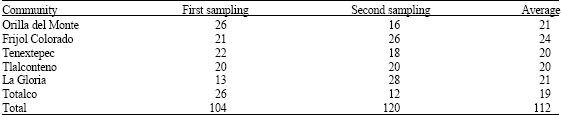
Samples were collected in two samplings in six different communities as it can be observed in Table 1. The number tested animals varied amongst the communities, as well as between the first and second sampling.
| Table 1: | Number of serum samples collected by each community |
 | |
| Table 2: | Brucellosis serum prevalence at selected communities obtained at the first sampling |
 | |
| Table 3: | Brucellosis serum prevalence obtained by community at second sampling |
 | |
The biggest number of samples collected during the first sampling period corresponded to Orilla del Monte and Totalco communities, while in the second sampling La Gloria and Frijol Colorado were the communities with the higher number of tested animals. The total numbers animals studied during the first and second sampling was 104 and 120, respectively, with an average of 112.
During the first sampling, the serological studies of the samples showed no infection evidence for brucellosis in Orilla del Monte. In contrast, infection was demonstrated by these serological studies in all the other communities, with different seroprevalence as shown in Table 2. La Gloria had the higher ratio of seroprevalence (38%), while in the other 3 communities these ratio fluctuated between 0.5 to 5.
For the second sampling period, serum samples were obtained approximately 12 months after last vaccination operative and data are summarized in Table 3. All communities but Tenextepec were negatives to the presence of seropositive animals. The samples collected from Tenextepec showed a 5.5% seroreactors ratio.
DISCUSSION
Amongst the first and second samplings all females from selected herds at different communities were vaccinated and therefore, animal sampling at both times was randomly done targeting 20 serum samples per community approximately (Dohoo et al., 2003) in order to obtain significant results.
As it is shown in Table 2 herd inventory, herd quantity and serum prevalence differ between communities because, main economic activity and pasture ground availability were different; as an example Tenextepec and Tlalconteno communities are adjacent and their main activity is caprine production, but they are located at the most deforested zone as it happens in La Gloria community at Perote Valley and Coffer Regions (INEGI, 1991). This condition represents a higher pressure directed to pasture grounds and according with different publications (Martinez et al., 2004a; Schurig, 1998; Stevens, 1997), brucellosis prevalence could be higher due to an inferior nutritional status. This is related with worse body condition and its influence for a higher risk to Brucella sp., infection.
Herd inventory, herd quantity and serum prevalence were different amongst communities during the second sampling procedure, as occurred during the first one (Table 3). This situation is related with the fact that vaccination operatives with RB51 vaccine must be done just once in the animals productive life, as it was demonstrated in previous studies (Franco, 2005; Molina et al., 2003) in which was established that just one vaccination could be enough to protect through all productive life in small ruminants populations. This fact also explains the decrease in vaccinated females, with the exception of Totalco community that could be vaccinated because they were young female replacements in order to be future breeders.
On the other hand, Table 2 and 3 showed how brucellosis serum prevalence was reduced in almost all the communities highlighting those at La Gloria where, serum prevalence rate went from 38% during the first sampling to 0% at the second one. These results are coincident with previous obtained (Martinez et al., 2003a, 2005; Suárez et al., 1998) in this sense that RB51 vaccine is very effective for Brucella sp., heterologous strains infection prevention.
Present study is very useful to support the fact that vaccination could be effective if a vaccination permanent program is established according with Mexican regulations (NOM-041-ZOO-1995, 1997), thus, in this way it is possible to avoid Brucella sp., field strains circulation, as it was proposed previously (Alton et al., 1988; Martinez et al., 2000, 2001b; Schurig, 1998; Stevens, 1997) resulting in an effective prevention of infection risk for another domestic and wild life mammals and of course for man that coexist with them or trough their products.
Respect to Tenextepec community a raise of 1% in prevalence rate was observed compared with the results obtained during the first sampling (Table 3); nevertheless, result could be explained in two ways; the first is that Brucella melitensis field strains remain at animal population as well as the infection possibility, although, previous studies conducted at the same community (Martinez et al., 2003a, 2004b) reported to obtain 87.5 and 90% efficacy rates, respectively. This means that observed serum prevalence was into the protection conferred rate. The second one is related with the nature of study, in which only one sample was obtained per each selected female, so the chosen animal was exposed to Brucella melitensis antigens and serumconverted; however, another studies (Cheville et al., 1993; Cheville et al., 1996; Molina et al., 2003), have demonstrated that animals protected by this vaccine, are exposed to Brucella sp. smooth strains as it occurs with Brucella melitensis field strains and develop serum conversion as a physiological response to challenge, but into 60 days period they could be desensitized and return as negative ones.
According with the amount of existing information related with RB51 vaccine obtained by several studies (Martinez et al., 2003b; Molina et al., 2003; Cheville et al., 1993; Schurig, 1998; Stevens, 1997), a common observation in all the studies is that postvaccinal effect is a clear evidence that conventional serologic test done by card and complement fixation tests employed in several countries as it happen in Mexico, does not represent any cross reaction difficulty as it occurs when animals have been vaccinated with traditional smooth strains Rev1 and S19 vaccines (Rodriguez, 1998) as it is shown in Table 2 and 3 for Orilla del Monte community, because at both samplings serum conversion was not observed. This observation means on one side that Brucella sp., field strains circulation could be very low and on the other, that small ruminants vaccinate with RB51 vaccine do not serum convert.
Finally and as a consequence of data shown in Table 3, an 80% serum prevalence rate reduction was observed at communities with any serum prevalence appreciated in Table 2 coinciding with previous observations (Martinez et al., 2003a, 2005) done at Tenextepec community and confirm that use of RB51 vaccine, in the dosage utilized for present study was effective to avoid serum conversion, safe and innocuous for vaccinated females.
CONCLUSIONS
Protective effect from RB51 Brucella abortus strain was demonstrated in five of six selected communities because reactors rate diminished with evident lower rate serum prevalence. On the other hand, 3x10⁸ to 3x10⁹ RB51 used dosage was very efficient to reduce 80% of brucellosis serum reactors in 12 months, did not induce serum conversion in sampled females as it could be clearly observed at Orilla del Monte community which confirms its safety and innocuousness.
ACKNOWLEDGMENTS
Present study received support and financing from grants of the project Use of Brucella abortus RB51 Strain for Prevention of Goat Brucellosis of the Program of Improvement of the Teaching Staff (PROMEP). Publication for present article received support from grants of Colegio Estatal de Medicos Veterinarios Zootecnistas de Veracruz, A.C.
REFERENCES
- Alton, G.G., L.M. Jones, R.D. Angus and J.M. Verger, 1988. Techniques for the Brucellosis Laboratory. 1st Edn., Institute Nationale de le Rech, France, Paris, Pages: 174.
Direct Link - Cheville, N.F., M.G. Stevens, A.E. Jensen, F.M. Tatum and S.M. Halling, 1993. Immune responses and protection against infection and abortion in cattle experimentally vaccinated with mutant strains of Brucella abortus. Am. J. Vet. Res., 54: 1591-1597.
PubMed - Cheville, N.F., S.C. Olsen, A.E. Jensen, M.G. Stevens and M.V. Palmer, 1996. Effects of age at vaccination on efficacy of Brucella abortus strain RB51 to protect cattle against Brucellosis. Am. J. Vet. Res., 57: 1153-1156.
PubMedDirect Link - Martinez, H.D.I., J.L. Barojas, S.B. Molina, C.M.A. Rodriguez, B.R. Bautista and M.M. Alpirez, 2005. Experiencias de campo con la vacuna RB51 de Brucella abortus en caprinos de Tenextepec, Ver. Avances en la Investigacion Agricola, Pecuaria, Forestal y Acuicola en el Tropico Mexicano, INIFAP, Mexico, pp: 285-290, (In Spanish).