

J. Anbu Jeba Sunilson
School of Pharmacy, Masterskill University College of Health Sciences, Taman Kemacahaya 11, Jalan Kemacahaya, Cheras, Selangor, Malaysia
R. Suraj
School of Pharmacy, Masterskill University College of Health Sciences, Taman Kemacahaya 11, Jalan Kemacahaya, Cheras, Selangor, Malaysia
K. Anandarajagopal
School of Pharmacy, Masterskill University College of Health Sciences, Taman Kemacahaya 11, Jalan Kemacahaya, Cheras, Selangor, Malaysia
G. Rejitha
School of Pharmacy, Masterskill University College of Health Sciences, Taman Kemacahaya 11, Jalan Kemacahaya, Cheras, Selangor, Malaysia
M. Vignesh
School of Pharmacy, Masterskill University College of Health Sciences, Taman Kemacahaya 11, Jalan Kemacahaya, Cheras, Selangor, Malaysia
P. Promwichit
School of Pharmacy, Masterskill University College of Health Sciences, Taman Kemacahaya 11, Jalan Kemacahaya, Cheras, Selangor, Malaysia
International Journal of Biological Chemistry
Year: 2009 | Volume: 3 | Issue: 2 | Page No.: 84-89







ABSTRACT
In this study, petroleum ether, chloroform and methanol extracts of Codium decorticatum showed the presence of amino acids, carbohydrates, saponins, phytosterols, alkaloids and glycosides. The antibacterial activity against Gram-positive bacteria, such as Streptococcus pneumoniae, Staphylococcus aureus and Gram-negative bacteria, Escherichia coli, Klebsiella pneumoniae, Salmonella typhi, Pseudomonas aeruginosa was carried out using cup-plate method. All the extracts showed good zone of inhibition against S. pneumoniae and K. pneumoniae at the concentrations of 25, 50 and 100 mg mL-1 compared with standard drugs, gentamicin and ampicillin (30 μg mL-1). To standardize the algae, elemental analysis was also carried out on C. decorticatum powder which revealed the presence of various elements. The present findings show the importance of C. decorticatum in producing new compounds having antibacterial activity.
PDF Abstract XML References Citation
How to cite this article
J. Anbu Jeba Sunilson, R. Suraj, K. Anandarajagopal, G. Rejitha, M. Vignesh and P. Promwichit, 2009. Preliminary Phytochemical Analysis, Elemental Determination and Antibacterial Screening of Codium decorticatum-A Marine Green Algae. International Journal of Biological Chemistry, 3: 84-89.
URL: https://scialert.net/abstract/?doi=ijbc.2009.84.89
URL: https://scialert.net/abstract/?doi=ijbc.2009.84.89
tum except anticoagulant activity (Rogers et al., 1990) and homeostasis effect (Marina et al., 2007). No extensive and individual scientific reports are available stating the potential antimicrobial property of these algae. On the light of the above information and since marine algae are rich in active constituents showing antimicrobial activity, C. decorticatum was selected for this study.
MATERIALS AND METHODS
Sample Collection and Extract Preparation
Codium decorticatum were collected by hand picking using snorkeling from Gulf of Mannar, Thoothukudi, Tamilnadu, India in February, 2005 and preserved in ice until further processing. It was authenticated by Dr. R. Santhanam at the Fisheries College and Research Institute in India. A specimen sample was preserved in the Herbarium, Fathima College of Pharmacy in Kadayanallur, Tamilnadu, India for future reference (FCP/MD/CD01/H-002). The algae were washed with tap water to remove epiphytes and salt, further washed with distilled water. Algae were dried under shade for 10 days and crushed in an electric mill until a coarse powder was obtained (Chiheb et al., 2009). The powder (500 g) was successively extracted with petroleum ether, chloroform and methanol by Soxhlet extraction (Bose et al., 2007). The extracts were concentrated using rotary vaccum evaporator and kept in dessicator until further investigation.
Preliminary Phytochemical Tests
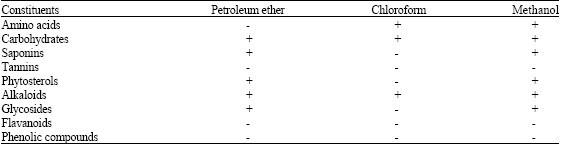
Preliminary phytochemical tests for the identification of amino acids, carbohydrates, saponins, tannins, phytosterols, alkaloids, proteins, glycosides, flavanoids and phenolic compounds were carried out for all the extracts by the methods described by Harborne (1998). The results were reported in Table 1.
Elemental Analysis
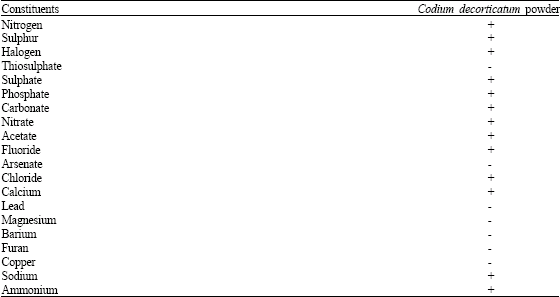
The dried powder of C. decorticatum was subjected to elemental analysis by applying standard procedures (Serfor et al., 1999) for the detection of Nitrogen, Sulphur, Halogen, Thiosulphate, Sulphate, Phosphate, Carbonate, Nitrate, Acetate, Fluoride, Arsenate, Chloride, Calcium, Lead, Magnesium, Barium, Furan, Copper, Sodium and Ammonium. The results were reported in Table 2.
Test Microorganisms
Gram-negative bacteria such as Escherichia coli, Klebsiella pneumoniae, Salmonella typhi, Pseudomonas aeruginosa and Gram-positive bacteria such as Streptococcus pneumoniae, Staphylococcus aureus were used for this study. All the bacterial cultures were procured from microbiology lab, Fathima College of Pharmacy, Kadayanallur, Tamilnadu, India.
Antibacterial Activity
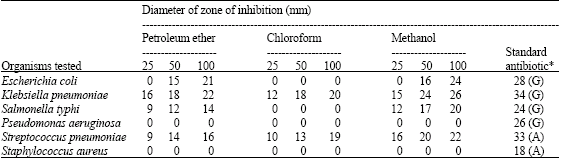
All the extracts were dissolved in Tween 80 at various concentrations of 25, 50 and 100 mg mL-1. The antibacterial activity was performed by cup-plate method (Onkar et al., 1995). The respective bacterial culture was poured into the nutrient agar plates for uniform distribution of microorganisms (Idu et al., 2007). Using a sterile cork borer, 8 mm wide well was made on each agar plates. Various concentrations of petroleum ether, chloroform and methanol extracts (25, 50 and 100 mg mL-1) were poured into each wells using a sterile micropipette (Srinivasan et al., 2007). Gentamicin and ampicillin (30 μg mL-1) were used as standards. The plates were incubated for 24 h at 37°C. After incubation, the zone of inhibition was measured and the values were shown in Table 3. All the experiments were done in triplicate.
RESULTS
The extracts of C. decorticatum varied in their colour and yield. Petroleum ether, chloroform and methanol extracts appeared to be brownish green, yellowish brown and deep brown colour in the day light with yield of 4.2, 9.6 and 15.4 %, respectively. The presence of amino acids, carbohydrates, saponins, phytosterols, alkaloids and glycosides were found in extracts which was shown in Table 1. The powder of C. decorticatum showed the presence of nitrogen, sulphur and halogens and revealed the presence of acid radicals such as sulphate, phosphate, carbonate, nitrate, acetate, fluoride, arsenate and chloride. The powder also showed the presence of basic radicals such as calcium, sodium and ammonium which was shown in Table 2.
The antibacterial activity of various extracts exhibited concentration dependant effect against S. pneumoniae, E. coli, K. pneumoniae, S. typhi and Ps. aeruginosa. All the extracts showed excellent concentration dependent inhibition (25, 50 and 100 mg mL-1) against K. pneumoniae and S. pneumonia which was well compared with standard drugs, gentamicin and ampicillin (30 μg mL-1).
| Table 1: | Preliminary phytochemical screening of various extracts of C. decorticatum |
 | |
| +: Present, -: Absent | |
| Table 2: | Analysis of elements and radicals in C. decorticatum powder |
 | |
| +: Present, -: Absent | |
| Table 3: | Antibacterial activity of various extracts (mg mL-1) of C. decorticatum |
 | |
| *G: Gentamicin (30 μg mL-1), A: Ampicillin (30 μg mL-1) | |
The petroleum ether and methanol extracts at higher concentrations showed remarkable antibacterial activity against E. coli, where as chloroform extract was devoid of activity even at higher concentrations. Petroleum ether and methanol extracts inhibited S. typhi on all the selected concentrations except chloroform extract which showed deficient inhibition. Ps. aeruginosa and S. aureus were not susceptible to the extracts and all the values were shown in Table 3.
DISCUSSION
Marine genus synthesizes active constituents which are used in traditional and complementary medicine. Different varieties of marine algae were reported to contain active ingredients that can cure diseases. Nowadays, higher percentage of population prefer to use remedies of natural origin for curing illness as these claimed to produce less side effects (Tyagi and Bohra et al., 2002). The present study was focused on C. decorticatum for the presence of phytochemical substances, powder elemental analysis and antibacterial activity against Gram-positive and Gram-negative bacteria.
Algae are eukaryotic organisms inhabited in salty sea water and is recognized to synthesize several bioactive (Micheal et al., 2002) compounds which show antimicrobial property. In addition, other substances identified as antimicrobial agents were chlorellin derivatives, acrylic microbial acid, halogenated aliphatic compounds, terpenes, sulphur containing heterocyclic compounds and phenolic inhibitors (Espeche et al., 1984).
The activity of the algae against both Gram-positive and Gram-negative bacteria may be indicative of the presence of broad spectrum antibiotic compounds or simply the content of pharmacological active constituents like alkaloids, saponins, glycosides, tannins etc. (Omulokoli et al., 1997; Phang et al., 1994; Milgate and Roberts, 1995). Phytochemical screening of C. decorticatum revealed the presence of carbohydrates and alkaloids in all the extracts where as saponins, phytosterols and glycosides were found only in petroleum ether and methanol extracts. In addition, chloroform and methanol extracts also showed the presence of amino acids. The antifungal, antiviral and antibacterial activities of saponins are well documented (Lacaille-Dubois and Wagner, 1996; Milgate and Roberts, 1995) which clearly explains the activity of petroleum ether and methanol extracts against E. coli (Cowan, 1999).
Alkaloids are commonly found to have antimicrobial properties (Omulokoli et al., 1997) against both Gram-positive and Gram-negative bacteria (Cowan, 1999). Presence of alkaloids in all the extracts and hence exerting a remarkable antibacterial activity against Gram-positive (S. pnemoniae) and Gram-negative (K. pneumoniae) bacteria fall in line with the above findings. An earlier study reported the antibacterial activity of methanol extract of six marine macroalgae including C. decorticatum which inhibited the growth of S. aureus and Bacillus subtilis (Juan et al., 2006). The present study differs from the previous study since the antibacterial activity was evaluated using petroleum ether, chloroform and methanol extracts of C. decorticatum. Apart from this, C. decorticatum being studied individually for the first time was comparatively a new concept. In conclusion, the preliminary phytochemical screening of C. decorticatum indicates the presence of chemical constituents playing an indispensable role in antibacterial activity. On evaluating the antibacterial property of C. decorticatum, the algae proved to be a potent antibacterial agent. The findings of this study also paves the way for further research to identify the specific active compounds that is responsible for its claimed antibacterial activity.
ACKNOWLEDGMENT
The authors are thankful to the management, Fathima College of Pharmacy, Kadayanallur, Tamilnadu, India and Dr. R. Santhanam, M.Sc., Ph.D., Dean, Fisheries College and Research Institute, Thoothukudi, Tamilnadu, India for providing facilities and technical assistance. Also the authors are grateful to Dato’ Prof. Dr. Ishak Bin Tambi Kechik, Vice-Chancellor and Dato’ Edmund Santhara, CEO, Masterskill University College of Health Sciences, Malaysia, for their funding, continuous encouragement and support.
REFERENCES
- Alejandro, M.S. and P. Betina, 1984. Antitumor evaluation of marine algae in Argentina. Hydrobiologia, 116-117: 529-533.
CrossRefDirect Link - Berland, B.R., D.J. Bonin, A.L. Cornu, S.Y. Maestrini and J.P. Marino, 1972. The antibacterial substances of the marine alga Stichochrysis immobilis (Chrysophyta). J. Phycol., 8: 383-392.
Direct Link - Biard, J.F., J.F. Verbist, J. Le Boterff, G. Ragas and M. Lecocq, 1980. Seaweeds of French Atlantic coast with antibacterial and antifungal compounds. Planta Med., 40: 136-151.
CrossRefDirect Link - Bonnie, L. and B. Cynthia, 1991. Antibiotic production by marine algae isolated from the New York/New Jersey coast. Bull. Environ. Contam. Toxicol., 46: 329-335.
CrossRefDirect Link - Bose, A., S. Mondal, J.K. Gupta, T. Ghosh, G.K. Dash and S. Si, 2007. Analgesic, anti-inflammatory and antipyretic activities of the ethanolic extract and its fractions of Cleome rutidosperma. Fitoterapia, 78: 515-520.
CrossRefPubMedDirect Link - Burkholder, P.R., L.M. Burkholder and L.R. Almodovar, 1960. Antibiotic activity of some marine algae of puerto Rico. Bot. Mar., 2: 149-156.
CrossRefDirect Link - Chenieux, J.C., J.F. Verbist, J.F. Biard and E. Clement, 1980. Seaweeds of French Atlantic coast with antimitotic compounds. Planta Med. Suppl., 40: 152-162.
Direct Link - Ibtissam, C., R. Hassane, M.J. Jose, D.S.J. Francisco, G.V.J. Antonio, B. Hassan and K. Mohamed, 2009. Screening of antibacterial activity in marine green and brown macroalgae from the coast of Morocco. Afr. J. Biotechnol., 8: 1258-1262.
Direct Link - Cowan, M.M., 1999. Plant products as antimicrobial agents. Clin. Microbiol. Rev., 12: 564-582.
CrossRefPubMedDirect Link - El-Gendy, M.M., U.W. Hawas and M. Jaspars, 2008. Novel bioactive metabolites from a marine derived bacterium Nocardia sp. ALAA 2000. J. Antibiot., 61: 379-786.
Direct Link - Espeche, M.E., E.R. Fraile and A.M.S. Mayer, 1984. Screening of Argentine marine algae for antimicrobial activity. Dev. Hydrobiol., 22: 525-528.
CrossRef - Howe, M.A., 1911. Phycological studies-V. Some marine algae of lower California, Mexico. Bull. Torrey Bot. Club, 38: 489-514.
CrossRefDirect Link - Idu, M., S.E. Omonigho and C.L. Igeleke, 2007. Preliminary investigation on phytochemistry and antimicrobial activity of Senna alata L. Flower. Pak. J. Biol. Sci., 10: 806-809.
Direct Link - Morales, J.L., Z.O. Cantillo-Ciau, I. Sanchez-Molina and G.J. Mena-Rejon, 2006. Screening of antibacterial and antifungal activities of six marine macroalgae from coasts of yucatan peninsula. Pharm. Biol., 44: 632-635.
CrossRefDirect Link - Karabay Yavasoglu, N.U., A. Sukatar, G. Ozdemir and Z. Horzum, 2007. Antimicrobial activity of volatile components and various extracts of red alga Jania rubens. Phytother. Res., 21: 153-156.
Direct Link - Lacaille-Dubois, M.A. and H. Wagner, 1996. A review of the biological and pharmacological activities of saponins. Phytomedicine, 2: 363-386.
CrossRef - Mahasneh, I., M. Jamal, M. Kashashneh and M. Zibdeh, 1995. Antibiotic activity of marine algae against multi-antibiotic resistant bacteria. Microbios, 83: 23-26.
Direct Link - Marina, C., Q. Irene, I.V. Maria, K. Luciana, D. Agustina de, M.E. Jose and S.C. Alberto, 2007. Polysaccharides from the green seaweeds Codium fragile and C. vermilara with controversial effects on hemostasis. Int. J. Biol. Macromol., 41: 641-649.
Direct Link - Milgate, J. and D.C.K. Roberts, 1995. The nutritional and biological significance of saponins. Nutr. Res., 15: 1223-1249.
CrossRefDirect Link - Al-Haj, N.A., N.I. Mashan, M.N. Shamsudin, H. Mohamad, C.S. Vairappan and Z. Sekawi, 2009. Antibacterial activity in marine algae Eucheuma denticulatum against Staphylococcus aureus and Streptococcus pyogenes. Res. J. Biol. Sci., 4: 519-524.
Direct Link - Omulokoli, E., B. Khan and S.C. Chhabra, 1997. Antiplasmodial activity of four Kenyan medicinal plants. J. Ethnopharmacol., 56: 133-137.
CrossRefPubMedDirect Link - Richards, J.T., E.R. Kern, L.A. Glasgow, J.C. Overall, E.F. Deign and M.T. Melvin, 1978. Antiviral activity of extracts from marine algae. Antimicrobial Agents Chemother., 14: 24-30.
Direct Link - Rogers, D.J., K.M. Jurd, G. Blunden, S. Paoletti and F. Zanetti, 1990. Anticoagulant activity of a proteoglycan in extracts of Codium fragile ssp.atlanticum. J. Appled Phycol., 2: 357-361.
CrossRefDirect Link - Sachithananthan, K. and A. Sivapalan, 1975. Antibacterial properties of some marine algae of Sri Lanka. Bull. Fish. Res. Station, 26: 5-9.
Direct Link - Serfor, A.Y., B.J.B. Nyarko, E.K. Osae, D. Carboo and F. Seku, 1999. Elemental analysis of some green and brown seaweeds from the coastal belt of Ghana. J. Radioanal. Nucl. Chem., 242: 193-197.
CrossRefDirect Link - Siddhanta, A.K., K.H. Mody, B.K. Ramavat, V.D. Chauhan and H.S. Garg et al., 1997. Bioactivity of marine organisms: Part VIII-Screening of some marine flora of Western coast of India. Indian J. Exp. Biol., 35: 638-643.
Direct Link - Srinivasan, K., N. Devarajan, C. Mohanasundari, V. Chinthambi and N. Nandakumar, 2007. Antibacterial, preliminary phytochemical and pharmacognostical screening on the leaves of Vicoa indica (L)DC. Iran. J. Pharmacol. Therapeutics, 6: 109-113.
Direct Link - Taskin, E., M. Ozturk, E. Taskin and O. Kurt, 2007. Antibacterial activities of some marine algae from the Aegean Sea (Turkey). Afr. J. Biotechnol., 6: 2746-2751.
Direct Link - Tuney, I., B.H. Cadirci, D. Unal and A. Sukatar, 2006. Antimicrobial activities of the extracts of marine algae from the coast of Urla (Izmir, Turkey). Turk. J. Biol., 30: 171-175.
Direct Link - Athukorala, Y., K.W. Lee, S.K. Kim and Y.J. Jeon, 2007. Anticoagulant activity of marine green and brown algae collected from Jeju Island in Korea. Bioresour. Technol., 98: 1711-1716.
CrossRefPubMedDirect Link
g subramanian Reply
Sir
This is very good publication for futher rference