

Majid Lotfalian
Faculty of Natural Resources, University of Mazandaran, P.O. Box 737, Badeleh, Sari, Iran
Yahya Kooch
Faculty of Natural Resources, University of Mazandaran, P.O. Box 737, Badeleh, Sari, Iran
Nosratollah Sarikhani
Faculty of Natural Resources, University of Tehran, Iran
Asian Journal of Scientific Research
Year: 2008 | Volume: 1 | Issue: 4 | Page No.: 470-475







ABSTRACT
The aim of this research is to consider roads network quantity by reviewing the effective factors and finally determining the optimal road density. Sangdeh forests of Farim Wood Company were selected for this research that located at Savadkouh region of Mazandaran province (in Iran). In this research it is assumed that the effective factors in costs can be determined by using the mathematical model, as well as by the help of graphical model, less costs of skidding and road construction can be obtained; therefore, optimal road density can be evaluated. Harvesting methods, different types of roads, the ratio of each road to the whole network, stand per hectare, slope, geological conditions, presence of sand mine for constructing surface of roads, capital interest rate, wood exit costs, type of skidding or yarding machinery, slope and length correction coefficient, routes, type and number of load, allowable winching distance, brush and underbrush, condition of the roots, silvicultural methods (cutting form), regional soil, regional height, direction of the slope and morphology of the forest are factors which have been mentioned in this research as affecting determination of roads network density. For this, the model of evaluation and calculation of the time of skidder movement, which determines the skidding costs under the existing conditions in Sangdeh Forest, is as follows: Y = -25.05 + 1.20 X. For the forest region of Sangdeh with 353 cubic meters stand per hectare and skidding in contract method, the roads network density is 23 m in hectare and for skidding by the company, the roads network density is 19 meters in hectare; these numbers are the optimal ones.
PDF Abstract XML References Citation
How to cite this article
Majid Lotfalian, Yahya Kooch and Nosratollah Sarikhani, 2008. Effective Factors in Determination Optimal Density of Forest Road Network. Asian Journal of Scientific Research, 1: 470-475.
DOI: 10.3923/ajsr.2008.470.475
URL: https://scialert.net/abstract/?doi=ajsr.2008.470.475
DOI: 10.3923/ajsr.2008.470.475
URL: https://scialert.net/abstract/?doi=ajsr.2008.470.475
INTRODUCTION
Forestry plans are provided to assist the forest protection and its life regeneration by forest management and essential marking of the removable trees. In this direction, forest roads network as forest divisions to the programming units (parcel) providing forestry plans, management, logging and wood extraction, as well as forest protection play important roles (Sarikhani and Majnounian, 1994; Mostafanejad, 1995, 2001; Sarikhani, 2001).
Quality and quantity of the forest roads network are important subjects because if there is an error in this case, not only inflicts a lot of losses to the production establishment but also causes some other damages such as, soil erosion, ground sliding, unavailability to the forest and etc. (Bazargan, 1998; Ejtehadi, 2000; Jourgholami, 2005). The goal of this research is to consider roads network quantity by reviewing the effective factors and finally determining the optimal road density for a sample region. This subject is very important because of the todays need to the forest management in country; more over since there no sufficient research in this field, there is any identical operation (Lotfalian, 2000).
For this purpose, the research is assumed that the effective factors in costs and can be determined by using the mathematical model, as well as by the help of graphical model, less costs of skidding and road construction can be obtained; therefore, optimal road density can be evaluated. In Iran, there has been no related researches have been done; as follows: Pilehvar (1994), Naghdi (1996), Ejtehadi (2000) and Lotfalian (2000) have examined skidding time studies and evaluated related cost and mathematical model.
Some studies have been done out of Iran. Some of them include: In Korea, Kim (1996) have examined economic issues of the forest road according to the forest growing and forest road density. In the research, the effects of 54 forest roads network which were planned based on the forest stocking conditions (such as the percent of planted forests, volume of removable tree) skidding costs and road construction costs have been examined. Research results show that, for 46, 60, 100, 150 and 200 m3 stands ha-1, 7.7, 10, 16, 23 and 29 road densities ha-1 are suitable, respectively. Acar (1997) has done ground classification and planning the optimal forest roads network and have discussed about production and costs in Kumbet in Turkey. Also, network design models are well studied and results for models have been reported by Arvidsson et al. (2002), Karlsson et al. (2002), Karlsson (2002), Olsson and Lohmander (2005) and Olsson (2005).
MATERIALS AND METHODS
Study Area
In 1968, development plan of the Caspian Sea forests at 27 km of East Polsefid (Mazandaran province) in Sangdeh was provided by the cooperation of FAO experts in five forest districts with 27000 hectare in area. The region is located on north direction (side) of Alborz mountain chain (North Iran) in 36° North latitude and 52° East longitudes. The maximum and minimum height of this forest is 3100 and 750 m, respectively. Sangdeh forestry plan is the second of these five forest district that has a humid climate and cold winters. The annual average rainfall is 1200 mm, average forest standing is 353 m3 ha-1 and yearly growing of this region is 6 m3 ha-1. Regional soil is podzolic soil. This research was performed in the summer of 2005.
Data Collection
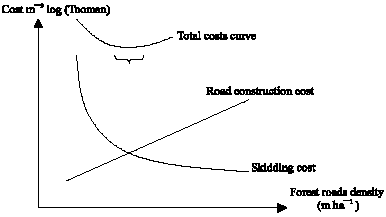
Pay attention to, the best rate of roads network density for each forest is a condition which includes the least total costs of road construction and skidding also other factors are constant in this region, for this purpose, model to minimize total costs of the road construction and skidding (Fig. 1) was used in this study.
 | |
| Fig. 1: | The minimize total costs model |
Total curve minimum shows a limitation of the roads network density which has the least total costs of road construction and skidding as well as shows the optimal road density (Fig. 1). Since winching and unloading time are variables which are independent of roads network density and their changes reduce the correlation between skidding route length and skidding time, while calculating the skidding costs, these variables to 151 samples are averaged and it is assumed that in each point of the skidding route, this time will be averagely spent on winching and unloading. In order to calculate the skidding costs, two methods, contract and accounting, are used. In contract method, the costs inquiry as commission and in accounting method, the time study of the connected times and calculating of the machinery costs with the method offered by FAO have been used. To obtain road construction costs, by referring to the company previous years costs the region and adjusting them in order to be fitted to the roads with standards included in 131 publication guide line of plan and budget organization and updating them to the current year, some measurements have been done.
RESULTS
Mathematical Model of Predicting the Time of Skidder Movement
After evaluating the number of the needed samples (51 samples were needed in surface 5% and considering the selection of at least 3 samples, 54 samples were needed to obtain credit, by doing time studies, for 67 samples and 151 samples were measured for winching and unloading) evaluating coefficients in math. Model of predicting time of skidder movement, Minitab statistical software was used, for this purpose with using the multiple regressions, the best model for predicting the time of skidder movement was distinguished as follows, in addition to the effective factors in skidding time which included, distance, volume and etc. (Pilehvar, 1994), interactions of these factors were also examined. For this, the product of both factors as a new specification in regression equation had been reviewed and related model, variance analysis results and its table were also determined as follows:
Y = -121 + 1.19x1 - 1.06x2 + 15.0x3 + 25.7x4 + 0.38x5 - 9.08x6 - 1.15x7 | (1) |
Where:
| Y | = | Time of skidder movement per case (sec) |
| X1 | = | Skidding distance (m) |
| X2 | = | Slope of skidding route (%) |
| X3 | = | No. of logs per case |
| X4 | = | Volume of logs per case (m3) |
| X5 | = | Slope and volume interaction |
| X6 | = | Volume and number of logs interaction |
| X7 | = | No. of logs and slope of skidding route interaction |
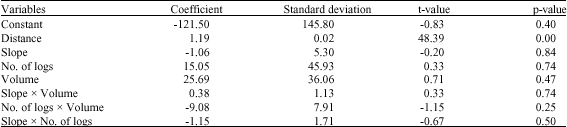
In Table 1, considering p-value, only the distance variable is in the significant level. Table 2 shows the model variance analysis, also.
| Table 1: | p-value for model variables |
 | |
| Table 2: | Model analysis variance |
 | |
| S = 100.4, R-2 = 96.1%, R-2 (adj.) = 96.1% | |
Calculated F shows that it is significance in the level a = 1%. It also shows the significance of the selected regression and significant difference of the regression variable coefficient from zero, as well as represents the regression to 96.1% changes. Now, for determining the best model with the Back Ward Stepwise Method, effective specifications have been determined in the model. Here, it is distinguished that p-value is significant just for distance variable in 5% level, that is, time of skidder movement in each case is only depended on distance. And form there, below model is provided:
Y = -25.05 + 1.20 X | (2) |
Where:
| Y | = | Time of skidder movement in each case (sec) |
| X | = | Skidding route length (m) |
To evaluate model credit, prediction of the time of skidder movement calculated by recognized model was compared to the three samples of the real time of skidder movement obtained from ground measurement (selected randomly) and it was recognized that this model enjoys statistical credit with the probability of 5%.
Final Calculation and Determination of the Optimal Road Network Density
To draw the diagram of the road construction cost of any cubic meter of wood under operation, at first, roads construction and preservation in each kilometer had been calculated, then, road construction cost in any hectare for different roads network densities had been obtained. Considering growing of 6 m3 in a hectare, it is assumed that averagely, the same rate of the wood in surface unit can be remove in a year and by dividing it to the road construction cost in any hectare, the related diagram can be drawn.
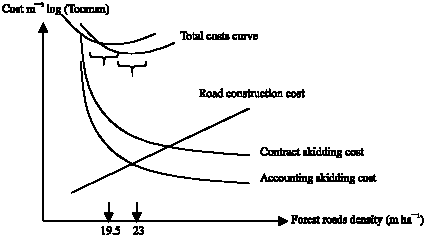
To consider that different roads network densities are followed by various lengths of the skidding routes, by doing the time study, regression between different skidding routes lengths and time of skidding movement was obtained. From there, the relation between network different densities and time of skidder movement was obtained. Having the spent average time for winching and unloading, as well as calculating of the skidding time cost, the relation between network various densities and skidding time cost had been recognized. Obtaining production rate in skidding hour in the time study, the relation of the network different densities and skidding cost of any cubic meter of wood had been gained, then skidding cost diagram had been drawn. Moreover, skidding costs had been evaluated by two different methods, contract and accounting and by calculating the total costs curve Fig. 2 was obtained.
Here, it would be seen that for different managements and selection of the skidding kind, densities of 19.5 and 23 m ha-1 have been determined that total of these numbers shows a suitable and logic limitation of the forest roads network density which guides the researcher to gain the least cost for this study.
 | |
| Fig. 2: | The model to minimize total costs |
DISCUSSION
Among the effective factors in skidding, just distance factor, is important in time of skidder movement factors such as load volume, number of log, route slope and their interactions are not important in time of skidder movement (with or without load). Pilehvar (1994), in his study about the function of the timber jack skidder 450 c, found that the skidding time was depend on variables such as, skidding distance, log volume in each skidding and skidding rout slope. Naghdi (1996), during his study about the timber jack skidder 450 c in downward slopes, concluded that the skidding time was depended on variables such as skidding distance, log volume in each time of skidding, skidding rout slope and the number of logs per case. As seen, in mentioned studies, more variables had been effective in the skidding time, while in the present research; only the distance factor has taken into account.
Firstly, it must be mentioned that in above studies, the whole of the skidding time have been examined; however, in the present research just the time of skidder movement is considered. Therefore, we can conclude that the elimination of winching and unloading stages can lead to the elimination of some variables and this shows the accurate selection of the research in elimination of these stages, because the purpose of this research is the examination of the effective factors in determination of the roads network density, while it was previously pointed out that the spent time in winching and unloading stages was not depended on the roads network density. As had been predicted in the hypothesis, the effective factors in costs and their relation with costs can be determined by the mathematical model. For this, the model of evaluation and calculation of the time of skidder movement, which determines the skidding costs under the existing conditions in Sangdeh Forest, is as follows:
Y= -25.05 + 1.20 X | (3) |
Where:
| Y | = | Time of skidder movement (sec) |
| X | = | Skidding route length (m) |
Mostafanejad (1995, 2001) has stated that in Neka forest region, the best distance of skidding route is 250 m and forest roads density (main and secondary) is 25 m ha-1 Ejtehadi (2000) has declared that, in Vaz forest region (in North of Iran) the best length density of the roads network is about 19.0 m ha-1. Kim (1996) in Korea shows that for stands of 46, 60, 100, 150 and 200 m3 in hectare, roads densities of 7.7, 10, 16, 23 and 29 m in hectare are suitable, respectively. It is evident that, considering various and regional affects of the pointed factors in this research, different results had been gained so it is suitable for the same region. Therefore, the results of the present research like predicted hypothesis can be evaluated by the graphical model (Fig. 2). For the forest region of Sangdeh with 353 m3 stand per hectare and skidding in contract method, the roads network density is 23 m ha-1 and for skidding by the company, the roads network density is 19 m ha-1; these numbers are the optimal ones.
REFERENCES
- Mostafanejad, S.R., 2001. Investigation influence of skidding distance on density of forest roads in forest management plan for Neka-Zalemrod, Articles collection in national congress of management of North forests in Iran and sustainable development. Forest and Rangeland Organization, pp: 461-469, (In Persian).
- Olsson, l. and P. Lohmander, 2005. Optimal forest transportation with respect to road investments. For. Policy Econ., 7: 369-379.
CrossRef - Olsson, L., 2005. Road investment scenarios in Northern Sweden. For. Policy Econ., 7: 615-623.
CrossRef