

Nivedita Jaiswal
Department of Biochemistry, Institute of Technology, Banaras Hindu University, Varanasi-221005, U.P., India
Om Prakash
Department of Biochemistry, Institute of Technology, Banaras Hindu University, Varanasi-221005, U.P., India
Mahe Talat
Department of Physics, Nano-Sciences and Technology Unit, Faculty of Sciences, Institute of Technology, Banaras Hindu University, Varanasi-221005, U.P., India
S.H. Hasan
Department of Applied Chemistry, Institute of Technology, Banaras Hindu University, Varanasi-221005, U.P., India
Rajesh Kumar Pandey
Department of Biochemistry, Institute of Technology, Banaras Hindu University, Varanasi-221005, U.P., India
Asian Journal of Biochemistry
Year: 2011 | Volume: 6 | Issue: 4 | Page No.: 357-365







ABSTRACT
α-amylase from soybean seeds was purified to apparent homogeneity by affinity precipitation via entrapment in alginate with 84% recovery and about 20-fold purification. The α-amylase activity and stability was characterized at various pH and temperature. Response Surface Methodology (RSM) using two-level-two-factor full factorial Central Composite Design (CCD) model was employed to optimize process parameters like pH and temperature which affects the kinetics of α-amylase catalyzed hydrolysis of starch. The results predicted by the design were found in good agreement (R2 = 97.85%) with the experimental results indicating the applicability of proposed model. The multiple regression Analysis and ANOVA showed the individual and cumulative effect of pH and temperature on enzyme activity indicating that the activity increased with the increase of pH unto 5.5 and temperature 75°C. Thus, the RSM was successful in determining the optimum reaction conditions for starch hydrolysis by α-amylase.
PDF Abstract XML References Citation
Received: February 19, 2011;
Accepted: May 18, 2011;
Published: June 18, 2011
How to cite this article
Nivedita Jaiswal, Om Prakash, Mahe Talat, S.H. Hasan and Rajesh Kumar Pandey, 2011. Application of Response Surface Methodology for the Determination of Optimum Reaction Conditions (Temperature and pH) for Starch Hydrolysis by α-Amylase. Asian Journal of Biochemistry, 6: 357-365.
DOI: 10.3923/ajb.2011.357.365
URL: https://scialert.net/abstract/?doi=ajb.2011.357.365
DOI: 10.3923/ajb.2011.357.365
URL: https://scialert.net/abstract/?doi=ajb.2011.357.365
INTRODUCTION
α-amylase (α-1, 4-D-glucan glucanohydrolase EC 3.2.1.1) is a key enzyme catalyzing the hydrolysis of α-D- (1, 4) glycosidic linkages in starch components and other related carbohydrates. It is widely used in the production of starch derivatives, in desizing fabrics, in baking industry, pharmaceutical and detergents industries, etc (Van der Maarel et al., 2002). In order to meet the growing demands of this enzyme in the industry, it is necessary to improve the performance of the system and thereby increase the yield without increasing the cost of production.
The importance of α-amylase in specific industrial processes depends critically on their pH and temperature. There is a very huge demand to improve the stability of the enzymes to meet the requirements set by specific applications, especially with respect to temperature and pH. α-amylases are generally stable over a wide range of pH from 4 to 11 (Hamilton et al., 1999; Khoo et al., 1994) however, α-amylases with stability in a narrow range have also been reported (Coronado et al., 2000). Generally, α-amylases are found to be more thermostable compared to β-amylases. Thermostability of α-amylases finds potential for use in the starch liquefaction as it is generally carried out at high temperatures between 70 and 90°C.
Thus, the optimization of such parameters and the knowledge of the interactions between these variables are important for the successful economical production of the enzyme and determination of its industrial applicability. Several papers regarding the statistical methods for the optimization of α-amylase (Dey et al., 2001; Francis et al., 2002; Ahuja et al., 2004; Kunamneni et al., 2005; Rao and Satyanarayana, 2007) have been published. Using Response Surface Methodology (RSM) for conventional method is advantageous because there is variation of only one parameter at a time, keeping the other parameters constant and thus, the cumulative effect of all the affecting parameters at a time cannot be studied (Ranjan et al., 2009). However, in RSM, the interactions of two or more variables can be studied simultaneously. Ibrahim and Elkhidir (2011) has discussed in detail the efficiency of RSM over other statistical optimization techniques. RSM approach has been used by many researchers to optimize the effects of process parameters for enhanced production and yields of many target products used for commercial and industrial application (Ai-Noi et al., 2008; Ahmad et al., 2009; Omar et al., 2009; Claver et al., 2010).
In this study, the two important process parameters, temperature and pH affecting the performance of the enzyme were subjected to optimization using Response Surface Methodology (RSM) using two-level-two-factor full factorial Central Composite Design (CCD) model thereby comparing the predicted results with the experimental results.
MATERIALS AND METHODS
Soybean seeds were procured from the local market. Sodium alginate and 3, 5-Dinitrosalicylic Acid (DNS) was purchased from Sigma Chemicals Co. (St. Louis, MO, USA). Soluble starch was from Qualigens Fine Chemicals, Mumbai. All other reagents were analytical grade chemicals either from BDH or E. Merck, India. The study was conducted during January 2009 to December 2009.
Isolation of α-amylase: α-amylase was isolated and purified in 25 mM sodium acetate buffer (pH 5.5) from soybean seeds to electrophoretic homogeneity as described earlier (Prakash and Jaiswal, 2010).
Purification of α-amylase by affinity precipitation
Calcium alginate beads preparation: A 2% (w/v) of alginate was prepared in 25 mM sodium acetate buffer (pH 5.5) and stored at 4°C. The crude soybean extract (1.0 mL containing 803.64 U) was mixed with 2 mL of chilled sodium alginate solution. The bound enzyme was precipitated by dropping the mixture with the help of micropipette in 1.0 M CaCl2 solution under constant stirring. The beads were allowed to harden in the CaCl2 solution for 2 h. The beads were thoroughly washed with buffer and stored at 4°C.
Elution of alginate bound α-amylase: The bound enzyme activity was eluted by adding 2.0 mL of 1.0 M maltose followed by centrifugation at 10,000 g for 10 min at 27°C. The supernatant obtained was collected and the process was repeated until no activity was recovered from the supernatant. The supernatant collected was subjected to dialysis for overnight against extraction buffer followed by concentration against solid sucrose. The concentration and purified enzyme was stored at -20°C for further use.
α-amylase assay: α-amylase activity was estimated following the method as described previously (Bernfeld, 1955). One unit of α-amylase activity was defined as the amount of enzyme required to produce 1 μmol of maltose per min from soluble starch under specified conditions.
Protein was estimated by the method of Lowry et al. (1951) with Folin-ciocalteau reagent calibrated with crystalline bovine serum albumin.
Effect of pH and temperature: The effect of pH on soluble starch hydrolytic activity were examined using Tris-acetate buffer at pH values from 4.0-9.0. Similarly, the effect of temperature was also examined by changing the incubation during 3 min in sodium acetate buffer of optimum pH from 5-100°C. The relative activity at different pH and temperature was calculated keeping the enzyme activity at the optimum pH and temperature as 100°C.
Statistical analysis: A two-level-two-factor (22) full factorial central composite design with 4 axial (α = 1.414) points, 4 cube points and six central points resulting in a total 13 or 14 experimental points will be used in a single block to observe the effect of the parameters influencing the activity of enzyme. As a result the two variables viz, pH (low 5.5 mM and high 9.0) temperatures (10-80°C) have been considered. The analysis of results was performed with statistical and graphical analysis software MINITAB® Release 15 developed by Minitab Inc. USA.
RESULTS AND DISCUSSION
Even though enzymatic reactions are emerging as an alternative processes over inorganic catalytic reactions, the main drawbacks such as high cost associated with the production and the purification of enzymes and their inactivation during the reactions limit the applications of these catalysts at large. Therefore, the main strategy used in enzymatic industrial processes is experimental design and optimization of such enzymatic process for the most economical use. Response Surface Methodology (RSM) has been widely engaged for the optimization of enzymatic processes as well as in other catalytic studies (Lee et al., 2003; Schepers et al., 2003). It is an efficient statistical technique for optimization of multiple variables in order to predict the best performance conditions with a minimum number of experiments. These designs are used to find improved or optimal process settings, troubleshoot process problems and weak points and make a product or process more robust against external and non-controllable influences (Silva et al., 2006; Kunamneni and Singh, 2005). Recently, Baskar et al. (2008) optimized enzymatic hydrolysis of Manihot esculenta root starch by immobilized α-amylase using response surface methodology. Gangadharan et al. (2008) have also used RSM for the optimization of α-amylase production by Bacillus amyloliquefaciens.
pH and temperature optima for α-amylase activity: The enzyme showed complete inactivation at pH 4.0 indicating its acid labile nature which is a feature observed in cereal α-amylases (Thoma et al., 1971). The optimum pH for α-amylase activity was found to be 5.5. The optimum temperature for soybean α-amylase activity was 75°C beyond which a gradual decline in enzyme activity was observed. This low pH and high thermostability is the major requirement for initial starch liquefaction as the process is generally carried out at high temperatures of between 70-90°C and low pH liquefaction results in cost savings and less complex operations for a starch processor (Fig. 1a, b).
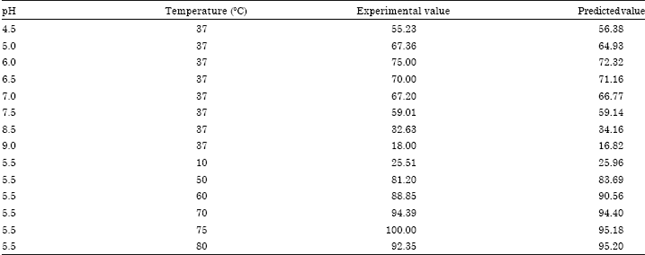
Response surface factorial design for the optimization of the process: Experiments were performed in the pH ranging from 4.0 to 9.0 and temperature from 10 to 80°C (Table 1). Significant changes in enzyme activity were observed for all the combinations, showing that these variables were significantly affecting the enzyme activity.
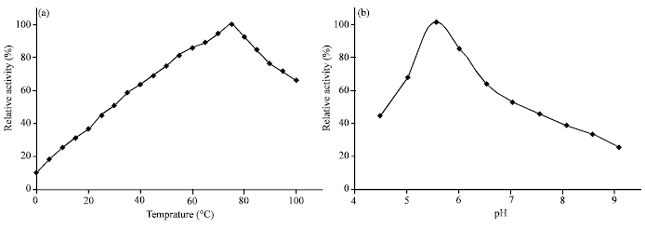 | |
| Fig. 1(a-b): | (a) Temperature-activity profile of soybean α-amylase and (b) pH-activity profile of soybean α-amylase |
| Table 1: | Predicted and experimental data showing the enzyme activity of α-amylase at different pH and temperature |
 | |
| Table 2: | Estimated regression coefficients of enzyme activity of amylase Vs pH and temperature in coded units |
 | |
| R2 = 99.31%, R2 (pred) = 97.85%, R2 (adj) = 99.00% | |
It can be observed from the results given in Table 2 that the value of constant was 78.26 with the t-value of 60.060 and p<value of 0.000. Thus, the value of constant is significant because of high T-value and low p = value. It also represented that the value of constant does not depend on linear term, square term as well as interaction term of the variables. It can also be observed from the Table 2 that linear term pH was significant because of the low (p<0.005) and high value i.e., T = 14.964. However, the quadratic term of pH was also found significant (p = 0.000) with T = 14.313 because T value in case of quadratic term was higher than the linear term of pH. This indicated that there was a curve relationship between pH and relative activity.
| Table 3: | Analysis of variance of enzyme activity of amylase Vs pH and temperature in coded units |
 | |
indicated that there was a curve relationship between pH and relative activity. Thus initially, the enzyme activity will increase with the increase in pH and after attaining the maximum the enzyme activity decreases with the further increase of pH. Similarly the linear term temperature was also found significant because low p<value of 0.000 with a very high t-value of 22.294 where as quadratic term of temperature is also significant as p-value is 0.000 but T-value is only 8.582 and less is than the linear term where t-value is 22.294. Thus, there is a linear relationship between temperature and relative activity that means there will be an increase in the activity with an increase in the temperature. It was also observed that both the linear term temperature and pH were having the positive value of regression coefficient. Thus because of the synergistic effect of pH and temperature, enzyme activity increases initially with the increase of temperature and pH where as quadratic term of pH and temperature are having the negative value of regression coefficient, this indicate antagonistic effect of square of pH and temperature on activity which means at higher pH and temperature i.e., with the further increase of pH and temperature, enzyme activity will decrease.
Analysis of Variance (ANOVA) was utilized for statistical testing of the model in the form of linear terms, squared terms and the interaction (Table 3). The p<value (0.000) both for linear and square terms confirms the applicability of the model. It was found from the results that the p-value for all the variables were lower than 0.05 which shows the significant correlation of the regression equation with the response variable in the interpretation of regression analysis. Significant high value of F i.e., 322.83 indicated that the second order polynomial model response ratio and was sufficient to show the actual relationship between the response i.e., relative activity and model process variables namely pH and temperature.
The analysis of the residuals was done with the help of residual plots in order to determine whether the model meets the assumption of the analysis. It was observed that the residual points on the plot fall fairly close to the straight line which represented a normal distribution of the residual (Zulkali et al., 2006).
The main effect plot was drawn to visualize the main effects of each variable and is shown in Fig. 1a and b for pH and temperature, respectively. Figure 1a shows that the response was greater at pH 5.5 while it was less than average for rest of the pH i.e., 4.5, 5.0, 6.0, 6.5, 7.0, 8.0, 8.5 and 9.0. Figure 1b shows that the enzyme activity increases with the increase in temperature. At the initial temperature such as 10 and 37°C the response were below mean value where as for the rest of the temperature 50 to 80°C response was above the mean value. The mean response was found to be maximum affected by higher temperature 60, 70 and 80°C and the maximum was achieved at 75°C. This type of main effect plot using statistical design has been shown for the effect of two parameters i.e., force and speed in the output voltage of nanogenerators (Song et al., 2010).
The three dimensional response surface plot is a 3D graphic representation of the regression equation showing the individual and cumulative affect of the variable and the mutual interaction between the variable (Fig. 2).
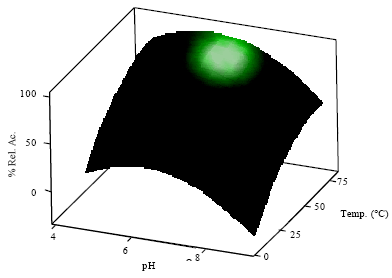 | |
| Fig. 2: | 3D plot of the cumulative effect of pH and temperature on the α-amylase activity |
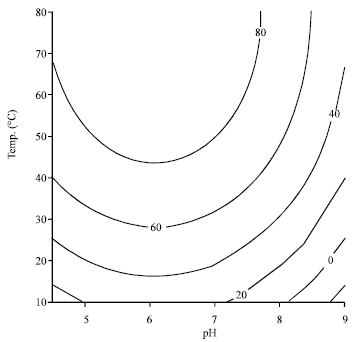 | |
| Fig. 3: | Contour plot of the cumulative effect of pH and temperature on α-amylase activity |
Figure 2 indicates the quadratic nature of the surface with the maxima and the minima of the response and the significance of the coefficient of the canonical equation. However, contour plot gives better understanding about the influence of variable and their interaction on the response as compared to the 3D surface plot (Ravikumar et al., 2007). Contour plot representing the combined effect of pH and temperature on the enzyme activity represented in Fig. 3 which explains that the activity increases with the increase in temperature whereas in case of pH with the increase in pH, the enzyme activity was found to first increase from 4.5 to 5.5 and thereafter decreased with further increase of pH from 5.5 to 9.0 .The maximum enzyme activity was found to be at 5.5 pH and 75°C temperature.
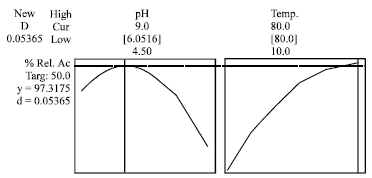 | |
| Fig. 4: | Optimization plot to determine the optimum reaction conditions |
A response optimization plot is useful in determining the operating conditions that will result in a desirable response. In the present study, the goal for the enzyme activity was to obtain a value at or near the target value of 50. The optimum condition which is defined as the best combination of factor settings for achieving the optimum response, was found to be pH 6.0516 and temperature 80.00 for a predicted response of 97.31 (y) with a desirability score of 0.05365 (Fig. 4). The other advantages of optimization plot is to achieve predicted response with higher desirability score along with the lower cost factor settings with near optimal properties.
CONCLUSION
A model was predicted by Statistical and Graphical Technique Response Surface Methodology (RSM) where two-level-two factor (22) was used for the experimental results. This method was successfully applied to determine the optimum reaction conditions (Temperature i.e., 75°C and pH i.e., 5.5) for starch hydrolysis by a-amylase. It was found that the predicted results were close to the experimental value indicating the suitability of the model.
REFERENCES
- Hamilton, L.M., C.T. Kelly and W.M. Fogarty, 1999. Purification and properties of the raw starch degrading α-amylase of Bacillus sp. IMD 434. Biotechol. Lett., 21: 111-115.
CrossRefDirect Link - Khoo, S.L., A.A. Amirul, M. Kamaruzaman, N. Nazalan and M.N. Azizan, 1994. Purification and characterization of α-amylase from Aspergillus flavus. Folia Microbiol., 39: 392-398.
CrossRefDirect Link - Coronado, M., C. Vargas, J. Hofemeister, A. Ventosa and J.J. Nieto, 2000. Production and biochemical characterization of an α-amylase from the moderate halophile Halomonas meridiana. FEMS Microbiol. Lett., 183: 67-71.
PubMed - Dey, G., A. Mitra, R. Banerjee and B.R. Maiti, 2001. Enhanced production of amylase by optimization of nutritional constituents using response surface methodology. Biochem. Eng. J., 7: 227-231.
CrossRef - Ahuja, S.K., G.M. Ferreira and A.R. Moreira, 2004. Application of Plackett-Burman design and response surface methodology to achieve exponential growth for aggregated shipworm bacterium. Biotechnol. Bioeng., 85: 666-675.
CrossRefDirect Link - Kunamneni, A., K.S. Kumar and S. Singh, 2005. Response surface methodological approach to optimize the nutritional parameters for enhanced production of α-amylase in solid state fermentation by Thermomyces lanuginosus. Afr. J. Biotechnol., 4: 708-716.
Direct Link - Rao, J.L.U.M. and T. Satyanarayana, 2007. Improving production of hyperthermostable and high maltose-forming &alpha,-amylase by an extreme thermophile Geobacillus thermoleovorans using response surface methodology and its applications. Bioresour. Technol., 98: 345-352.
CrossRef - Ranjan, D., M. Talat and S.H. Hasan, 2009. Biosorption of arsenic from aqueous solution using agricultural residue rice polish. J. Hazard. Mat., 166: 1050-1059.
CrossRef - Ibrahim, H.M. and E.E. Elkhidir, 2011. Response surface method as an efficient tool for medium optimisation. Trends Applied Sci. Res., 6: 121-129.
CrossRefDirect Link - Ai-Noi, S., S. Abd-Aziz, N. Alitheen, O. Hassan and M.I. Abdul Karim, 2008. Optimization of cyclodextrin glycosyltransferase production by response surface methodology approach. Biotechnology, 7: 10-18.
CrossRefDirect Link - Ahmad, A., F.M. Anjum, T. Zahoor and H. Nawaz, 2009. Extraction of β-glucan from oat and its interaction with glucose and lipoprotein profile. Pak. J. Nutr., 8: 1486-1492.
CrossRefDirect Link - Omar, K.A., L. Shan, X. Zou, Z. Song and X. Wang, 2009. Effects of two emulsifiers on yield and storage of flaxseed oil powder by response surface methodology. Pak. J. Nutr., 8: 1316-1324.
CrossRefDirect Link - Claver, I.P., H. Zhang, Q. Li, Z. Kexue and H. Zhou, 2010. Optimization of ultrasonic extraction of polysaccharides from Chinese malted sorghum using response surface methodology. Pak. J. Nutr., 9: 336-342.
CrossRefDirect Link - Prakash, O. and N. Jaiswal, 2010. A highly efficient and thermostable α-amylase from soybean seeds. Biotechnol. Applied Biochem., 57: 105-110.
PubMed - Lowry, O.H., N.J. Rosebrough, A.L. Farr and R.J. Randall, 1951. Protein measurement with the folin phenol reagent. J. Biol. Chem., 193: 265-275.
CrossRefPubMedDirect Link - Lee, H., M. Song and S. Hwang, 2003. Optimizing bioconversion of deproteinated cheese whey to mycelia of Ganoderma lucidum. Process Biochem., 38: 1685-1693.
CrossRef - Schepers, A.W., J. Thibault and C. Lacroix, 2003. Lactobacillus helveticus growth and lactic acid production during pH-controlled batch cultures in whey permeate/yeast extract medium. Part I. Multiple factor kinetic analysis. Enzyme Microbial Technol., 30: 176-186.
CrossRef - Silva, C.J.S.M., G. Gubitz and A. Cavaco-Paulo, 2006. Optimisation of a serine protease coupling to Eudragit S-100 by experimental design techniques. J. Chem. Technol. Biotech., 81: 8-16.
CrossRefDirect Link - Kunamneni, A. and S. Singh, 2005. Response surface optimization of enzymatic hydrolysis of maize starch for higher glucose production. Biochem. Eng. J., 27: 179-190.
CrossRefDirect Link - Baskar, G., C. Muthukumaran and S. Renganathan, 2008. Optimization of enzymatic hydrolysis of Manihot esculenta root starch by immobilized &alpha,-amylase using response surface methodology. Int. J. Chem. Biol. Eng., 1: 155-159.
Direct Link - Gangadharan, D., S. Sivaramakrishnan, K.M. Nampoothiri, R.K. Sukumaran and A. Pandey, 2008. Response surface methodology for the optimization of α amylase production by Bacillus amyloliquefaciens. Bioresour. Technol., 99: 4597-4602.
CrossRefPubMedDirect Link - Zulkali, M.M.D., A.L. Ahmad and N.H. Norulakmal, 2006. Oryza sativa L. husk as heavy metal adsorbent: Optimization with lead as model solution. Bioresour. Technol., 97: 21-25.
CrossRefDirect Link - Song, J., H. Xie, W. Wu, V.R. Joseph, C.F.J. Wu and Z.L. Wang, 2010. Robust optimization of the output voltage of nanogenerators by statistical design of experiments. Nano Res., 3: 613-619.
CrossRefDirect Link - Ravikumar, K., S. Krishnan, S. Ramalingam and K. Balu, 2007. Optimization of process variables by the application of response surface methodology for dye removal using novel adsorbent. Dyes Pigments, 72: 66-74.
CrossRef - Van der Maarel, M.J.E.C., B. van der Veen, J.C.M. Uitdehaag, H. Leemhuis and L. Dijkhuizen, 2002. Properties and applications of starch-converting enzymes of the α-amylase family. J. Biotechnol., 94: 137-155.
CrossRefPubMedDirect Link