

K.J.P. Narayana
Department of Microbiology, Acharya Nagarjuna University, Guntur- 522 510, A.P., India
M. Vijayalakshmi
Department of Microbiology, Acharya Nagarjuna University, Guntur- 522 510, A.P., India
Asian Journal of Biochemistry
Year: 2008 | Volume: 3 | Issue: 3 | Page No.: 194-197







ABSTRACT
A streptomycete strain, Streptomyces albidoflavus was isolated from soil and culture conditions were optimized for maximum production of α-amylase under submerged fermentation. The optimum period for maximum amylase production was found to be 84 h. The suitable pH and temperature for amylase activity were 6.5 at 30°C. The levels of α-amylase activity detected in culture filtrate varied greatly with type of carbon source used. Soluble starch stimulated α-amylase yield followed by trehalose and maltose. Nitrogen sources like yeast extract, tryptone, NaNO3, peptone and soybean meal were found to support the amylase production by the strain. The strain produced maximum amylase when medium contained starch and yeast extract at concentration of 1.5% (wt./vol.) and 0.2% (wt./vol.) respectively.
PDF Abstract XML References Citation
How to cite this article
K.J.P. Narayana and M. Vijayalakshmi, 2008. Production of Extracellular α-amylase by Streptomyces albidoflavus. Asian Journal of Biochemistry, 3: 194-197.
DOI: 10.3923/ajb.2008.194.197
URL: https://scialert.net/abstract/?doi=ajb.2008.194.197
DOI: 10.3923/ajb.2008.194.197
URL: https://scialert.net/abstract/?doi=ajb.2008.194.197
INTRODUCTION
Amylases belong to hydrolase category of enzymes, which catalyze the hydrolysis of starch to produce glucose (Teresita et al., 1996). α-amylases have numerous biotechnological applications in the production of syrups containing oligosaccharides, maltose and glucose. α-amylases are distributed widely in microorganisms. Industrial α-amylases are produced by bacteria and fungi, e.g., Bacillus licheniformis, B. subtilis, Aspergillus oryzae, A. niger, Micrococcus halobius etc. (Aditi et al., 2004). Streptomyces species are mostly chemoorganotrophs and widely distributed in soil and water.
A few Streptomyces strains have been reported to have amylolytic activity such as α-amylases, pullalanase and glucosyltransferase activities (Hoque et al., 2006). The production of amylases by Streptomyces is affected to a great extent by the carbon and nitrogen sources, incubation period, temperature and pH values (Shatta et al., 1990). Hence an attempt was made to optimize the production of α-amylase by Streptomyces albidoflavus.
MATERIALS AND METHODS
An actinomycete strain was isolated from the soils of Acharya Nagarjuna University campus and the culture was identified as Streptomyces albidoflavus by 16S r RNA analysis and gene sequences was submitted to NCBI genbank with accession number EF 142856. The total experiment was conducted in the Department of Microbiology, Acharya Nagarjuna University. The strain was cultivated on yeast extract-malt extract-dextrose (YMD) agar medium at 30°C for 7 days. Culture suspensions prepared from YMD slants were inoculated to 100 mL of inorganic salts-starch liquid broth (International Streptomyces Project medium, ISP-4) contains % of wt./vol.: soluble starch, 1; (NH4)2 SO4, 0.2; K2HPO4, 0.1; MgSO4.7H2O, 0.1; NaCl, 0.1 and CaCO3, 0.2. The medium was incubated at 30°C for five days. Production of biomass and α-amylase were studied at 12 h interval. The culture filtrate obtained by filtering the culture broth was used for amylase assay (Fisher and Stein, 1960). The collected biomass in filtration was dried in hot air oven at 90°C. After 24 h, the cell dry weight was determined. The amylase activity was expressed in terms of mg of maltose liberated in 10 min at 30°C by 1 mL of culture filtrate. The effect of pH and temperature on α-amylase production by the strain was also studied.
Impact of various carbon and nitrogen sources on amylase production was investigated by cultivating the strain in basal medium (K2HPO4, 0.1; MgSO4.7H2O, 0.1; NaCl, 0.1 and CaCO3, 0.2). The effect of carbon sources (1%, wt. /vol.) such as dextrose, lactose, maltose, mannitol, sucrose and trehalose were examined by amending in the basal medium as sole carbon supply on cell growth and α-amylase production with Na NO3 as nitrogen source. Different nitrogen sources (0.2%, wt. /vol.) like NaNO3, KNO3, NH4Cl, (NH) 2 SO4, peptone, soybean meal, tryptone and yeast extract were tested by adding to the basal medium as sole nitrogen supply and starch as carbon source on biomass and α-amylase production by the strain. The suitable concentration of best carbon and nitrogen sources was also investigated.
RESULTS AND DISCUSSION
The influence of incubation period was studied on α-amylase production by S. albidoflavus (Fig. 1). The production of α-amylase began after 24 h of cultivation and reached to peak levels after 84 h and declined there after. Maximum biomass was found with 96 h old culture. The highest yield of amylase from Streptomyces diastaticus has been found after 52 to 56 h (Simpson and McCoy, 1953).
The impact of pH and temperature on α-amylase production was presented in Fig. 2. The enzyme production was found to be maximum at pH value of 6.5 and a decline on either side was observed. The optimum temperature for maximum enzyme activity was found to be at 30°C and enzyme was stable upto 35°C. At higher temperature, the enzyme activity decreased sharply. Kuo and Hartman (1966) showed that Thermoactinomyces vulgaris produces best yields of α-amylase when starch or maltose is used as a carbon source. They also found that T. vulgaris synthesized amylase most rapidly at pH values ranging from 6.5 and 7.5 and that amylase inactivation occurred rapidly if pH rose above 7.5. Amylase production by Streptomyces aureofaciens 77 has been increased gradually as the initial pH values ascended from 5 to 7 (Shatta et al., 1990).
Among the various carbon sources used for amylase production, starch was found to be the best substrate, showing maximum enzyme activity of 2.04 IU mL-1. Cell growth was found to be better in medium contained maltose as carbon source but poor α-amylase production was observed (Table 1). Amylase production by the strain was totally absent in the medium contained sucrose and lactose as carbon sources. Effect of different nitrogen sources on amylase production by the strain was given in Table 2. The medium amended with yeast extract produced maximum biomass as well as amylase activity. This was fallowed by tryptone, NaNO3, peptone and soybean meal. Vidal et al. (1995) reported that trypticase, peptone, casitone are good nitrogen sources for amylase production.
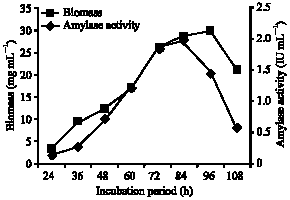 | |
| Fig. 1: | Effect of incubation period on biomass and α-amylase production by Streptomyces albidoflavus |
| Table 1: | Effect of carbon sources on cell growth and α-amylase production by Streptomyces albidoflavus |
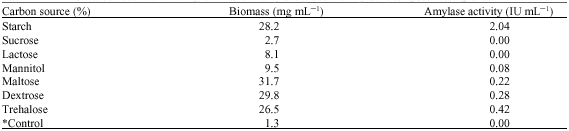 | |
| *Control - medium without carbon source | |
| Table 2: | Effect of nitrogen sources on cell growth and α-amylase production by Streptomyces albidoflavus |
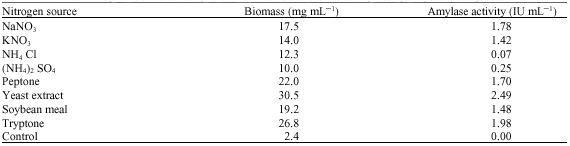 | |
| *Control - medium without nitrogen source | |
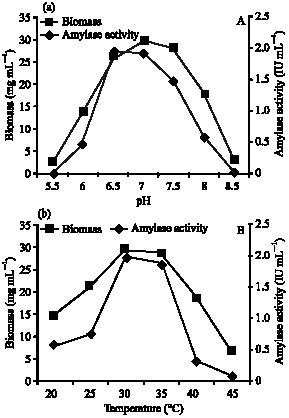 | |
| Fig. 2: | Impact of (a) pH and (b) temperature on biomass and α-amylase production by Streptomyces albidoflavus |
The highest yield of amylase production was obtained by increasing the concentration of soluble starch from 1% as sole carbon source upto 1.5%. The concentration of yeast extract of 0.5% was found to be suitable for maximum production of amylase (Fig.3). Upton and Fogarty (1977) found that soluble starch (1.5%) gave higher yield of α-amylase than any other carbon sources studied. The concentration of yeast extract has been reported to improve the synthesis α-amylase in several organisms (Alam et al., 1989). The present study revealed that the medium contained soluble starch (1.5%) and yeast extract (0.5%) gave maximum yield of α-amylase (3.08 IU mL-1) by S. albidoflavus.
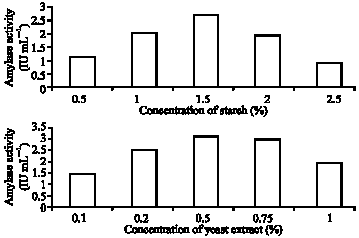 | |
| Fig. 3: | Impact of different concentrations of starch and yeast extract on amylase activity |
ACKNOWLEDGMENT
The author KJPN is thankful to Andhra Pradesh - Netherlands Biotechnology Programme (A.P.N.L.B.P.), Hyderabad, India for the financial assistance.
REFERENCES
- Alam, S.J., J. Hong and W.A. Weigand, 1989. Effect of yeast extract on α-amylase synthesis by Bacillus amyloliquifaciens. Biotechnol. Bioeng., 33: 780-785.
Direct Link - Hoque, M.M., M. Khanam, M.A. Shiekh, N. Nahar, M.R. Khan and Z.U.M. Khan, 2006. Characterization and optimization of α-amylase activity of Streptomyces clavifer. Pak. J. Biol. Sci., 9: 1328-1332.
CrossRefDirect Link - Kuo, M.J. and P.A. Hartman, 1966. Isolation of amylolytic strains of Thermoactinomyces vulgaris and production of thermophilic actinomycete amylases. J. Bacteriol., 92: 723-726.
Direct Link - Simpson, F.S. and E. McCoy, 1953. The amylases of five streptomycetes. Applied Microbiol., 1: 228-236.
Direct Link - Upton, M.E. and W.M. Fogarty, 1977. Production and purification of thermostable amylase and protease of Thermomonospora viridis. Applied Microbiol., 33: 59-64.
Direct Link - Vidal, M.E.F., A.F. Vivas, F. Gonzalez and J.M. Arias, 1995. Properties and significance of an α-amylase produced Myxococcus coralloides. J. Applied Bacteriol., 78: 14-19.
Direct Link
neelima.daka Reply
hello madam,
my name is neelima.iam doing ph.d in gitam.my topic is amylase in bacteria.can u send me this fulltext PDF file to my mail.please