

M. Ullah
Department of Biochemistry and Biotechnology, University of Science and Technology Chittagong (USTC), Foy�s Lake, Chittagong-4202, Bangladesh
Fazlul Karim Chy
Department of Biochemistry and Biotechnology, University of Science and Technology Chittagong (USTC), Foy�s Lake, Bangladesh
Subodh Kumar Sarkar
Department of Biochemistry and Biotechnology, University of Science and Technology Chittagong (USTC), Foy�s Lake, Chittagong-4202, Bangladesh
M. Khairul Islam
Department of Crop Science and Technology, University of Rajshahi, Rajshahi-6205, Bangladesh
Nurul Absar
Department of Biochemistry and Biotechnology, University of Science and Technology Chittagong (USTC), Foy�s Lake, Chittagong-4202, Bangladesh
LiveDNA: 880.8190
ORCID: 0000-0001-9284-366X
Asian Journal of Agricultural Research
Year: 2011 | Volume: 5 | Issue: 3 | Page No.: 186-193







ABSTRACT
Bitter gourd (Momordica charantia) were analyzed for their major nutrient contents as well as Vitamin C, minerals and phytochemical constituents. The selected varieties were Charantia C.B. Clarke, Muricata (Willd.), Hybrid green and Hybrid white karala. The result revealed the presence of nutrient constituent among the varieties comprising Total sugar (0.114±0.01% to 0.22±0.02%), Starch (0.74±0.01% to 5.3±0.04%), Total protein (1.17±0.01% to 2.4±0.02%), Fat (0.3±0.02 to 0.8±0.02%) and Vitamin C (9.41±0.26 to 13±0.57mg%). This vegetable is good source of minerals such as Mg, Ca, S and Cu. The fruits contained calcium (0.55±0.30 to 7.0±0.25 mg%) and sulpher (44.9±0.38 to 72.4±0.51 ppm). All the varieties were found to contain tannin, flavonoids, terpenoids, cardiac glycosides, triterpin and sterol, resin, amino acid and phenolic compounds except coumarin and free anthraquinone. Based on the findings from this study, bitter gourd (Momordica charantia), although a bitter known vegetables but has enormous nutritional potentials.
PDF Abstract XML References Citation
Received: March 01, 2011;
Accepted: May 10, 2011;
Published: July 30, 2011
How to cite this article
M. Ullah, Fazlul Karim Chy, Subodh Kumar Sarkar, M. Khairul Islam and Nurul Absar, 2011. Nutrient and Phytochemical Analysis of Four Varieties of Bitter Gourd (Momordica charantia) Grown in Chittagong Hill Tracts, Bangladesh. Asian Journal of Agricultural Research, 5: 186-193.
DOI: 10.3923/ajar.2011.186.193
URL: https://scialert.net/abstract/?doi=ajar.2011.186.193
DOI: 10.3923/ajar.2011.186.193
URL: https://scialert.net/abstract/?doi=ajar.2011.186.193
INTRODUCTION
Nutrition is the science of food, the nutrients and other substances there in and their action, interaction and balance are related to health and diseases (Clamp, 2007). Now a days malnutrition is one of the common word in today’s world.
A large number of populations in Bangladesh have been suffering from malnutrition. There are many kinds of plants available in Bangladesh which are rich in nutrients. For the ignorance and proper knowledge of the people, they do not know the nutritive value of most of vegetables and fruits. Green vegetables occupy an important place among the food crops as they provide adequate amounts of many vitamins and mineral for humans. In particular, the consumption of whole-plant foods slows digestion and allows better absorption. A more favorable balance of essential nutrients per calorie, results in better management of cell growth, maintenance and mitosis, as well as better regulation of appetite and blood sugar (Fuhman and Oz, 2003). They are rich sources of carotene, ascorbic acid, folic acid and minerals like calcium, iron and phosphorus (Fasuyi, 2006). In addition they contain anti nutrients which reduce their bioavailability (Akindahunsi and Salawu, 2005). Momordica charantia, or bitter melon, is a common food in Indian cusine and is also used as a medicine to treat a wide array of conditions in the tropical regions in which it grows. The leaves and fruit of bitter gourd have been used in folk medicine traditions of China, India, Africa and the West Indies since ancient times. Bitter gourd has important role as a source of carbohydrate, proteins, vitamins, minerals and other nutrients in human diet (Ali et al., 2008) which are necessary for maintaining proper health. The presence of secondary metabolites such as alkaloids, saponins, tannins, glycosides and cardiac glycosides in the M. charantia may contribute to its medicinal value. Some of these compounds are well documented to exhibit hypoglyceamic activity in animals. Saponins inhibit Na+ efflux leading to higher Na+ concentration in cells, thereby activating a Na+- Ca2+ antiport. This effect produces elevated cytosolic Ca2+ which strengthens the contraction of the heart muscle and thereby reducing congestive heart failure (Schneider and Wolfling, 2004). Bitter melon has been implicated experimentally to achieve a positive sugar regulatory effect by suppressing the neural response to sweet taste stimuli and also keep the body functions operating normally. Other use of the plant include to expel intestinal gas, for tumors wound treatment, rheumatism, malaria, vaginal discharge and the seeds are used to induce abortion (Taylor, 2005). M. charantia leaves has been used extensively in traditional medicine as a remedy for diabetes (Cefalu et al., 2008; Nahas and Moher, 2009). Rahman et al. (2005) reported that blood glucose level of experimental rat was decreased significantly (8.96 to 4.82 mol L-1) when karala was administered orally 200 mg kg-1 body weight and they suggested that the active constituents of Momordica charantia might be responsible for anti-hypoglycemic activity.
Bitter gourd has also been used as a traditional medicine for several other ailments, including dysentery, colic, fevers, burns, painful menstruation, scabies and other skin problems. (Beloin et al., 2005). Further, the different plant foliar extracts including bitter gourd (Momordica charantia) was found to be effective against infestation of maize and rice by two major pests (Rani and Devanand, 2011).
This is the main reason why this vegetable is used in a number of native medicines of Asia and Africa. Till now there is no such data available about the nutrient contents of karala produced in Bangladesh. This study has been under taken to obtain information regarding major and minor nutrient contents as well biologically important phytochemicals in Bitter gourd.
MATERIALS AND METHODS
Collection and identification of plant materials: Momordica charantia is commonly known as “karala” and “Uchchhey” in Bangladesh. Four varieties of Momordica charantia, charantia C.B. Clarke, muricata (Willd.), Hybrid green and Hybrid white were collected from Chittagong hill tracts, Chittagong, Bangladesh. The study was carried out in 2009 in the Department of Biochemistry and Biotechnology, University of Science and Technology, Chittagong, Bangladesh Fig. 1. The varieties were identified in the Department of Botany; University of Chittagong. The seeds were dissected from the vegetables and removed the foreign materials. After then, the fruits (pericerp) were used for experimental analysis. The fruit (pericarp) were air-dried for 5 days and milled into powder with the aid of an electrical grinder. The ethanol extract of each sample was prepared by soaking 300 g of dried powdered samples in 2 L pure ethanol for 24 h. The extracts were filtered using Whatman filter paper No 42 (125 mm).
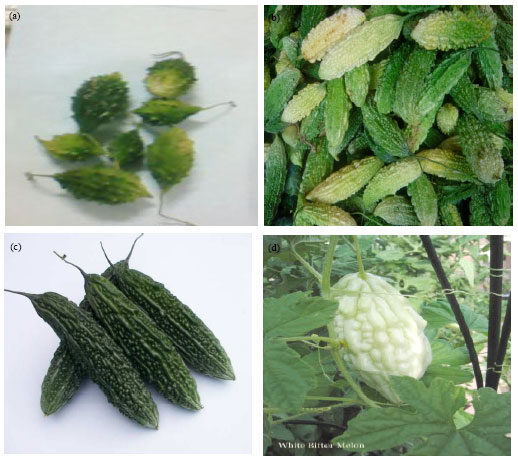 | |
| Fig. 1: | Photographic representation of four varieties of bitter gourd; (a) Charantia C.B. Clarke (karala), (b) Muricata (Willd) [Uchchhe], (c) Hybrid green and (d) Hybrid white |
Procedure of nutrient analysis: The analysis of bitter gourd moisture were carried out by the standard IUPAC (1979) and Ash were determined by the standard method of AOAC (1995). The other nutrients were determined using the established reported methods as reported: total sugar and starch content by the anthrone method of Jayaraman (1981), reducing sugar by dinitrosalicylic acid method of Miller (1972). The water soluble protein by the method of Folin-Lowry of Lowry et al. (1951) and Total protein by Micro-Kjeldahl method of AOAC (1960) using 6.25 factor to calculate protein content from nitrogen content. Vitamin C by the standard method of AOAC (1995) while Lipid content by the method of Bligh and Dyer (1959).
Estimation of mineral content: The minerals present in fruits were analyzed by the procedure as described in Analytical methods (Petersen, 2002).
Phytochemical screening: Chemical tests were carried out on the ethanolic extract and on the powdered specimens using standard procedures to identify the constituents as described by the Sofowora (1982), Trease and Evans (1989) and Harborne (1973).
Statistical analysis: The results generated from the analysis were subjected to statistical analysis using the Statistical Package for Social Sciences (SPSS) Version 15. Means were used for the analysis of the result.
RESULTS AND DISCUSSION
The amount of moisture, ash, total sugar, reducing sugar and starch content present in four varieties of bitter gourd fruits are shown in Table 1. It appears from the table that the moisture content varies from 91.6 to 92.92% and the ash content ranges from 0.75-1.2%. The moisture content of karala was reported to be 91.2% (Soomro and Ansari, 2005). Varieties muricata contained higher amount of ash (1.2±0.02%) (Table 1).
Among the varieties examined the highest amount of total sugar was recorded from varieties muricata (0.216±0.02%) followed by varieties hybrid green karala (0.170±0.01%). All the four varieties contained negligible amount of reducing sugar. while the starch content ranges from (0.74-5.3%). Further, the varieties muricata contained significantly higher amount of starch contents (5.3±0.04) than all the other varieties. This study might be suggested that muricata (willd.) is also used as a good source of carbohydrate. It is not clear at this moment that why muricata variety contained more than double amount of carbohydrate as compared to that of the other varieties.
Table 2 represents the protein, fat and Vitamin-C contents of four varieties bitter gourds. It appears from the table that total protein content varies from 1.17 to 2.4%. Among the varieties examined the highest amount of protein was recorded in Muricata (2.4±0.02%) followed by varieties charantia (1.58±0.02%).
The protein content of karala was reported to 1.9% by Soomro and Ansari (2005) which is very similar to our result but much higher than that of unpeeled bitter gourd as reported (0.7 gm%) by Alvi et al. (2003). No significant differences in water soluble protein contents extracted from the four varieties bitter gourd samples was observed in (Table 2). From this study it may suggest that both uchchhey and karala are moderate sources of protein. The fat content of bitter gourds ranges from 0.3 to 0.8%. Among them varieties, Muricata contained higher amount (0.8±0.02%) than others. The least amount was recorded from hybrid white karala (0.3±0.02%). Hybrid green karala contained 0.4% fat that is similar to the result found by Soomro and Ansari (2005). This finding indicates that bitter gourd is not good source of lipid.
Vitamin C content (16.2 mg/100 g) of varieties hybrid green karala recorded in this study was found to be lower than that (33 mg/100 g) reported by USDA Nutrient database. The Vitamin C content of four varieties ranges from 9.41 to 16 mg%. Among the varieties the highest amount of vitamin C was recorded from varieties hybrid green karala followed by varieties muricata (13.0±0.57 mg%).
| Table 1: | Comparative contents of moisture, ash, total sugar, reducing sugar, starch content in the four varieties bitter gourd fruits |
 | |
| All values were the average of three determinations | |
| Table 2: | Comparative contents of water soluble protein, total protein, fat and vitamin C content in the four varieties bitter gourd fruits |
 | |
| All values were the average of three determinations | |
Emebu and Anyika (2011) recorded vitamin C values of Brassica oleracea (Borecole) 23.43 mg/100 gm Free radicals change to cellular structures and other molecules can result in painful information, as the body tries to clear out the damaged part. Vitamin C which prevents the free radical damage that triggers the inflammatory cascade, is this also associated with reduced severity of inflammatory conditions, such as asthma, osteoarthritis and rheumatoid arthritis (Cohen et al., 2000).
The minerals contents of four varieties of bitter gourds are represented in Table 3. Magnesium content of hybrid white karala is slightly higher. The magnesium content ranges from 0.99 to 1.1 mg%. Of the minerals examined calcium was found to be present (0.54-7.0 mg%). Variety charantia contained higher amount of calcium (7.0±0.25 mg%) followed by muricata (4.3±0.18 mg%). On the other hand high amount of calcium was recorded in bitter gourd 137.69 mg/100 gm by Soomro and Ansari (2005). The actual reason is unknown may be the environmental and soil factors are responsible for this difference. Sulphar is an important nutrient element for human body.
Sulpher content of bitter gourd is 72.4±0.51 ppm, 60.05±0.45 ppm and 70.35±0.53 ppm in charantia and muricata, hybrid green karala respectively. The least amount of sulpher was recorded from hybrid white karala, 44.95±0.38 ppm. Copper content of uchchhey is higher than karala and its content in bitter gourds varied from 0.51 to 2.53 ppm. Among the varieties the highest amount of copper was recorded from varieties muricata 2.53±0.01 ppm followed by varieties hybrid white karala so on. Soomro and Ansari (2005) recorded copper values of Momordica charantia (3.54 mg/100 g (3.54404 ppm).That is slightly higher than the varieties muricata.
The present data in Table 4 clearly indicated that the different types of bitter gourd contained almost the similar types of phytochemicals constituents i.e., functional groups which might be helpful for comparison and determination of the structure of active principles present in them.
| Table 3: | Comparative contents of minerals in the four varieties bitter gourd fruits |
 | |
| All values were the average of three determinations. | |
| Table 4: | Phytochemical screening of ethanol extract of four varieties of bitter gourd (edible part) |
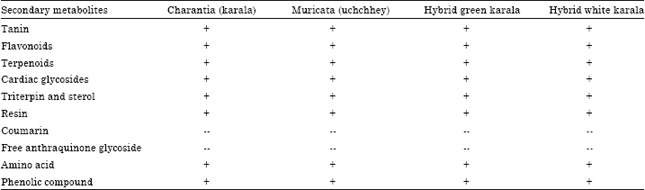 | |
| +: Presence of constituent, --: Absence of constituent | |
M. charantia fruits showed the presence of Tanin, Flavonoids, Terpenoids, Cardiac glycosides, Triterpin and sterol, Resin, Amino acid, Phenolic compound which are of much biological importance. Fruit extracts of some cucurbit; Lagenaria siceraria (Bottel gourd), Luffa cylindrica(Sponge gourd) and Cucurbita maxima (Pumpkin) also revealed the presence of alkaloids, flavonoids, saponins and steroids in moderate concentration (Irshad et al., 2010).
The presence of phenolic compounds in the plants indicates that these plants might have anti-microbial agent. This ptoperties agreed with the findings of Ofokansi et al. (2005) who reported that B. pinnatum is effective in the treatment of typhoid fever and other bacterial infections, particularly those caused by Staphylococcus aureus, Esterichia coli, Bacillus subtilis, Pseudomonas aeruginosa, klebsiella aerogenes, klebsiella pneunoniae and Salmonella typhi. From this data, it can be suggested that both the karala and Uchchhey might be used in the treatment of the placenta and navel of newborn baby which not only heals fast but also prevent the formation of infections (Okwu, 2001, 2003). The presence of an unidentified alkaloid with Rf.0.098 and 5-hydroxytryotamine is also reported by Dhalla et al. (1961). It may be noted that all the varieties of bitter gourd did not contain Coumarin and Free anthraquinone glycoside. It was already reported that the extract of crude bitter gourd is used for different disease such as disease of liver and pancreas, anti-inflammatory, analgesic, reduces cholesterol level, promotes appetite and supports blood sugar management for diabetes or people with high risk of developing diabetes (Verma and Aggarwal, 1956). Our present data clearly indicate that bitter gourd contain many types of phytochemicals. Among them flavonoid is present in significant amount as well as also contain substantial amount of resin and phenolic constituents. Further biological study is needed to confirm the result more precisely.
CONCLUSION
In conclusion, the nutritional study suggests that Momordica charantia L. (Variety muricata) contains a good amount of nutritional components, though somebody dislike it due to bitter taste. All the varieties contained similar types secondary metabolite such as Tanin, Flavonoids, Terpenoids, Cardiac glycosides, Triterpin etc. It also reveals significant effects like antimicrobial activity as well as anti-inflammatory activities. Further study is necessary to elucidate the mechanisms behind the traditional effects.
REFERENCES
- Akindahunsi, A.A. and S.O. Salawu, 2005. Phytochemical screening and nutrient-antinutrient composition of selected tropical green leafy vegetables. Afr. J. Biotechnol., 4: 497-501.
Direct Link - Bligh, E.G. and W.J. Dyer, 1959. A rapid method of total lipid extraction and purification. Can. J. Biochem. Physiol., 37: 911-917.
CrossRefPubMedDirect Link - Cefalu, W.T., J. Ye and Z.Q. Wang, 2008. Efficacy of dietary supplementation with botanicals on carbohydrate metabolism in humans. Endocr. Metab. Immune. Disord. Drug Targets, 8: 78-81.
PubMed - Cohen, J.H., A.R. Kristal and J.L. Stanford, 2000. Fruit and vegetable intakes and prostate cancer risk. J. Natl. Cancer Inst., 92: 61-68.
CrossRefPubMedDirect Link - Emebu, P.K. and J.U. Anyika, 2011. Vitamin and antinutrient composition of kale (Brassica oleracea) grown in Della State, Nigeria. Pak. J. Nutr., 10: 76-79.
CrossRefDirect Link - Fasuyi, A.O., 2006. Nutritional potentials of some tropical vegetable leaf meals: Chemical characterization and functional properties. Afr. J. Biotechnol., 5: 49-53.
Direct Link - Irshad, M., I. Ahmad, H.C. Goel and M.M.A. Rizvi, 2010. Phytochemical screening and high performance TLC analysis of some cucurbits. Res. J. Phytochem., 4: 242-247.
CrossRefDirect Link - Lowry, O.H., N.J. Rosebrough, A.L. Farr and R.J. Randall, 1951. Protein measurement with the folin phenol reagent. J. Biol. Chem., 193: 265-275.
CrossRefPubMedDirect Link - Miller, G.L., 1959. Use of dinitrosalicylic acid reagent for determination of reducing sugar. Anal. Chem., 31: 426-428.
CrossRefDirect Link - Beloin, N., M. Gbeassor, K. Akpagana, J. Hudson, K. de Soussa, K. Koumaglo and J.T. Arnason, 2005. Ethnomedicinal uses of Momordica charantia (Cucurbitaceae) in Togo and relation to its phytochemistry and biological activity. J. Ethnopharmacol., 96: 49-55.
CrossRefDirect Link - Nahas, R. and M. Moher, 2009. Complementary and alternative medicine for the treatment of type 2 diabetes. Can. Fam. Physician, 55: 591-596.
Direct Link - Ofokansi, K.C., C.O. Esimone and C.K. Anele, 2005. Evaluation of the in vitro combined antibacterial effect of the leaf extracts of Bryophyllum pinnatum (Fam: Crassulaceae) and Ocimum gratissimum (Fam: Labiatae). Plant Prod. Res. J., 9: 23-27.
CrossRefDirect Link - Okwu, D.E., 2001. Evaluation of the chemical composition of indigenous spices and flavouring agents. Global J. Pure Applied Sci., 7: 455-459.
Direct Link - Rahman, M.W., M. Mostofa, S.A. Sardar, M.R. Sultana, M.M. Haque and M.E. Choudhury, 2005. Investigation of comparative hypoglycemic effect of neem (Azadirachta indica), karala (Momordica charantea) and nayantara (Cathranthus roseus) with glibenclamide on rat. Int. J. Pharmacol., 1: 257-260.
CrossRefDirect Link - Alvi, S., K.M. Khan, M.A. Sheikh and M. Shahid, 2003. Effect of peeling and cooking on nutrients in vegetables. Pak. J. Nutr., 2: 189-191.
CrossRefDirect Link - Rani, P.U. and P. Devanand, 2011. Efficiency of different plant foliar extracts on grain protection and seed germination in maize. Res. J. Seed Sci., 4: 1-14.
CrossRefDirect Link - Schneider, G. and J. Wolfling, 2004. Synthetic cardenolides and related compounds. Curr. Org. Chem., 8: 1381-1403.
CrossRefDirect Link