

M. Jayarajan
Environmental Nanotechnology Division, Sri Paramakalyani Centre for Environmental Sciences, Manonmaniam Sundaranar University, Alwarkurichi-627 412, Tamil Nadu, India
R. Arunachalam
Environmental Nanotechnology Division, Sri Paramakalyani Centre for Environmental Sciences, Manonmaniam Sundaranar University, Alwarkurichi-627 412, Tamil Nadu, India
G. Annadurai
Environmental Nanotechnology Division, Sri Paramakalyani Centre for Environmental Sciences, Manonmaniam Sundaranar University, Alwarkurichi-627 412, Tamil Nadu, India
Asian Journal of Applied Sciences
Year: 2011 | Volume: 4 | Issue: 3 | Page No.: 263-270







ABSTRACT
The plan of the present study was to discover the effect of agricultural waste product nano-porous adsorbent of Jack fruit peel waste for removing dye Rhodamine dye (Rd) from aqueous solution. The effect of adsorption isotherm were studied by carrying out a series of isotherm at different adsorbent dosages (1.0, 2.0, 3.0 g L-1), temperatures (30, 40 and 60°C) and pH (4.95, 8.14, 9.74), respectively. The adsorption equilibrium data were analyzed by using various adsorption isotherm models and the results have shown that adsorption behavior of the dye could be described reasonably well by langmuir and freundlich models. The characteristic parameters for each isotherm have been determined. The monolayer adsorption capacity determined was reasonably high (g L-1) at adsorbent dosage 4.361 (g L-1), temperature 2.8496 (g L-1) and pH 4.3614 (g L-1) for adsorption of Rd dye, respectively. The monolayer adsorption capacity was determined to be 4.361 to 1.98 mg g-1. We concluded based on these results that Jackfruit peel nano-porous adsorbent was an attractive candidate for removing Rd dye from the wastewater.
PDF Abstract XML References Citation
How to cite this article
M. Jayarajan, R. Arunachalam and G. Annadurai, 2011. Agricultural Wastes of Jackfruit Peel Nano-Porous Adsorbent for Removal of Rhodamine Dye. Asian Journal of Applied Sciences, 4: 263-270.
DOI: 10.3923/ajaps.2011.263.270
URL: https://scialert.net/abstract/?doi=ajaps.2011.263.270
DOI: 10.3923/ajaps.2011.263.270
URL: https://scialert.net/abstract/?doi=ajaps.2011.263.270
INTRODUCTION
Among the different pollutants of an aquatic ecosystem, dyes are a large and important group of industrial chemicals with over 700,000 tons of waste produced annually (Jumasiah et al., 2005). Dyes are widely used in industries such as textile, rubber, paper, plastic, cosmetic etc. Among these various industries, textile ranks first in usage of dyes for coloration of fiber (Arunachalam and Annadurai, 2011; Azhar et al., 2005; Grag et al., 2004). Many techniques have been found for removal of dye-containing wastewater such as chemical oxidation, membrane filtration, biodegradability, separation and adsorption techniques (Koyuncu, 2009; Choy et al., 1999). Among these, the adsorption process is one of the effective methods for removal dyes from the waste effluent. Liquid phase adsorption using activated carbon is one of the most effective treatment methods for removing a wide variety of dyes present in the wastewater. Although activated carbon is highly effective, its running costs are also high (Jumasiah et al., 2005). Therefore, locally available and abundant material should be found as a source for cost-effective activated carbon.
Nowadays, there is numerous numbers of low cost, commercially available adsorbents coal, fly ash, wood, silica gel, clay materials (bentonite, montmorillonite, etc.), agricultural wastes (bagasse pith, maize cob, coconut shell, rice husk, etc.), cotton wastes and cellulose based wastes such as orange, lemon, banana and lychee (Arunachalam and Annadurai, 2011; Bhatnagar and Minocha, 2010; Thirumavalavan et al., 2010; Bhatnagar et al., 2010; Memon et al., 2009; Achak et al., 2009) which had been used for the dye removal (Azhar et al., 2005; Annadurai et al., 2002; Juang et al., 1997; Theng and Wells, 1995; Singh and Rawat, 1994). Thereby, the present investigation was made on cellulose-based wastes of Jackfruit peel for adsorption of rhodamine dye from aqueous solution. The amounts of equilibrium adsorption were also investigated.
MATERIALS AND METHODS
Materials: Jackfruit peels were obtained from a local fruit market at Nagercoil, India on January, 2010. The peels were cut into small pieces, crushed and washed thoroughly with deionized water to remove the adhering dirt. They were air dried in an oven at 40°C for 48 h, before being ball-milled to form particles approximately 0.840 mm-1 in size. Rhodamine dye was purchased from Merck Co. The concentrations of dyes were measured with an UV/visible spectrophotometer (Hitachi Model U-2000). The solution pH was adjusted by adding a small amount of 0.1 M HCl or NaOH.
Adsorption studies: In batch equilibrium experiments, the Rd dye solutions were prepared by dissolving dye in deionzied water to the required concentrations. A portion of adsorbent material Jackfruit sorbent of known (1 g) and varied concentration of initial dye concentration 20-120 mg L-1 was poured into the reaction conical flask. The time required to reach equilibrium as determined in equilibrium studies was 24 h. The effect of adsorption isotherm was studied by carrying out a series of isotherm at different temperatures (30, 40 and 60°C) and adsorbent dosages (1.0, 2.0 and 3.0 g L-1) and pH (4.95, 8.14 and 9.74), respectively. The concentrations of dyes were measured with an UV/visible spectrophotometer (Hitachi Model U-2000). The amount of dye absorbed onto the peels, qe (mg g-1), was calculated by a mass balance relationship (Eq. 1). The aqueous samples were taken at preset time intervals and the concentrations of dyes were similarly measured.
The amount of adsorption at time t, qt (mg g-1), was obtained as follows:
 | (1) |
where, C0 (mg L-1) and Ct (mg g-1) are the liquid-phase concentrations of solutes at initial and any time t, respectively, V is the volume of the solution, M is the dosage of adsorbent in the solution (g L-1).
To find the relation between the mass of dye adsorbed at a particular dosage, temperature and pH and liquid phase of dye concentration, the Langmuir (1918) and Freundlich (1906) isotherm model have been used.
RESULTS AND DISCUSSION
Effect of dosage, temperature and pH: Figure 1a-c had shown the adsorption of dye at different adsorbent dosage, temperature and pH by using environmental nano-porous material of Jackfruit peel. The adsorbent rate variation may be due to the number of positive charges on the sorbent surface which leads to the no rejection of the negatively charged dye molecule and thereby increasing the adsorption. The adsorption of dye increased with the increases of adsorbent dosage (Fig. 1a).
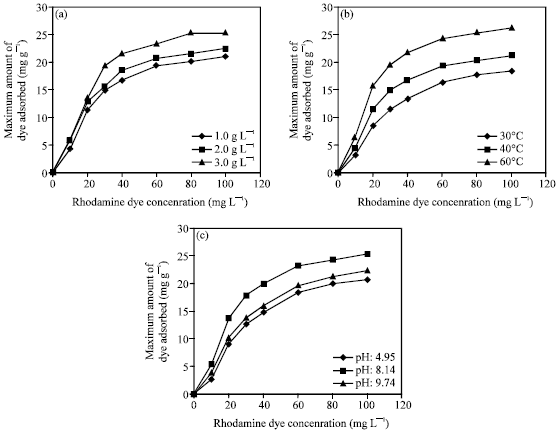 | |
| Fig. 1: | Effect of specific dye uptakes (a) at different dosages with dye concentration, (b) at different temperatures dye concentration and (c) at different pH with dye concentration |
The maximum percentage removal of 25.3 g L-1 was obtained for adsorbent dosage of 3.0 g L-1 for Rd dye at 100 mg L-1 concentration. The increase in adsorption of dye with adsorbent dosage was due to the availability of more surface area of the adsorbent for adsorption. The result is similar to the observation of Namasivayam et al. (1996).
Temperature is an important parameter for the adsorption process. A plot of the Rd dye uptake as a function of temperature (30, 40 and 60°C) is shown in Fig. 1b. The adsorption of dye at higher temperature was found to be greater compared to that at a lower temperature. The curves indicate the strong tendency of the process for monolayer formation (Lucarelli et al., 2000; Poots et al., 1976; Ho and McKay, 1998, 1999; Mckay et al., 1987; Namasivayam et al., 1998, 2001). The increase in temperature would increase the mobility of the large dye ion and also produces a swelling effect with in the internal structure of the environmental nanomaterial, thus enabling the large dye molecule to penetrate further (Namasivayam et al., 2001; Namasivayam and Kavitha, 2002; Ho and McKay, 1999). Therefore, the adsorption capacity should largely depend on the chemical interaction between the functional groups on the adsorbent surface and the adsorbate and should increase with temperature rising. The adsorption of dye at higher temperature was found in the present investigation is similar to results of Namasivayam et al. (2001), Namasivayam and Kavitha (2002) and Ho and McKay (1999).
In general, the dye uptakes are much higher in acidic solutions than those in neutral and alkaline conditions. This explanation is conflict with our data on pH effect (Fig. 1c). It can be seen that the pH of aqueous solution plays an important role in the adsorption of Rd dye onto environmental nanomaterial. The present results conflict with the results of Namasivayam et al. (1996) and parallel to the results of Habib et al. (2006).
Langmuir and Freundlich isotherm: The equilibrium adsorption isotherm is of fundamental importance in the design of adsorption systems. The isotherm expresses the relation between the mass of dye adsorbed at a particular dosage, temperature and pH and liquid phase of dye concentration. For any adsorption investigation one of the most important parameters required to understand the behavior of the adsorption process in the adsorption isotherm. The shape of an isotherm not only provides information about the affinity of the dye molecule for adsorption, but it also reflects the possible mode of adsorbing dye molecule. The most common way of obtaining an adsorption isotherm, is to determine the concentration of dye solution before and after the adsorption experiments, although several attempts have been made to find the adsorbed amount. A basic assumption of the Langmuir theory (Langmuir, 1918) is that sorption takes place at specific sites within the adsorbent (Chen et al., 2008; Asfour et al., 1985; Poots et al., 1976).
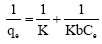
The data obtained from the adsorption experiment conducted in the present investigation was fitted in different adsorbent dosage, temperature and pH in isotherm equation as shown in Fig. 1a-c. The saturation monolayer can be represented by the expression.
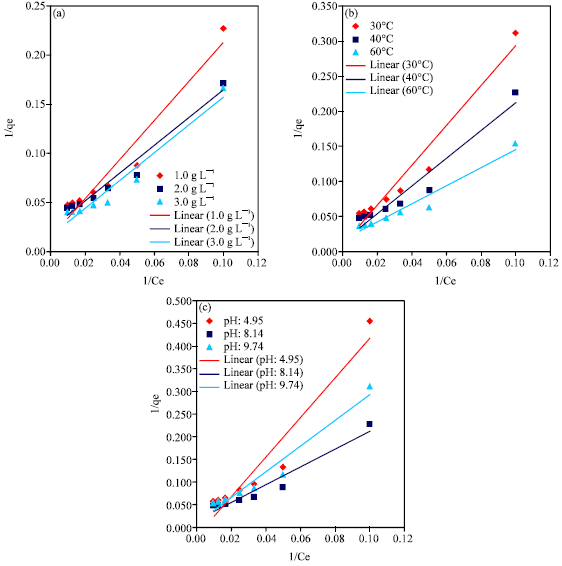 | |
| Fig. 2: | Langmuir isotherm for the adsorption of dye using Jackfruit peels (a) at different adsorbent dosages with dye concentration, (b) at different temperatures dye concentration and (c) at different pH with dye concentration |
 | (2) |
 | (3) |
A plot of (1/qe vs. 1/Ce) resulted in a linear graphical relation indicating the applicability of the above model as shown in Fig. 2a-c. The values are calculated from the slope and intercept of different straight line representing the different adsorbent dosage, temperature and pH (b) energy of adsorption and (k) adsorption capacity and Qo is represented by (K). The Langmuir isotherm constant (Qo) in Eq. 2 is a measure of the amount of dye adsorbed, when the monolayer is completed.
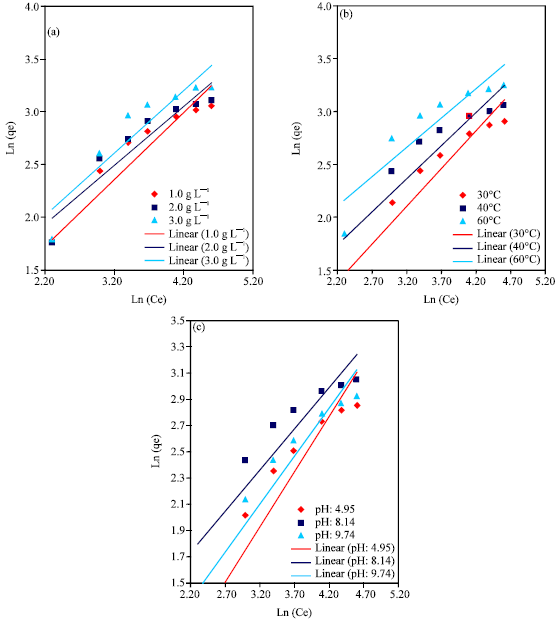 | |
| Fig. 3: | Freundlich isotherm for the adsorption of dye using Jackfruit peels (a) at different adsorbent dosages with dye concentration, (b) at different temperatures dye concentration and (c) at different pH with dye concentration |
Monolayer capacity (Qo) of the adsorbent for the dye is comparable obtained from adsorption isotherm. The observed statistically significant (at the 95% confidence level) linear relationship as evidenced of these by the R2 values (close to unity) indicate the applicability of the isotherm (Langmuir isotherm) and surface. The Langmuir isotherm constants along with correlation coefficients are reported on Fig. 2 and 3 it is also clear from the shape of the adsorption isotherm, that it belongs to the L2 category of isotherm, which indicates of the normal (or) Langmuir type of adsorption (Mohanty et al., 2006).
Freundlich isotherm (Freundlich, 1906) is used for heterogeneous surface energies system. The sorption isotherm is the most convenient form of representing the experimental data at different adsorbent dosage, temperature and pH as shown in Fig. 3a-c. Moreover, the figures show the batch isothermal data fitted to the linear form of the Freundlich isotherm (Poots et al., 1976; Ho and McKay, 1998, 1999; Mckay et al., 1987; Namasivayam et al., 1998):
 | (4) |
 | (5) |
The various constants, associated with the isotherm are the intercept, which is roughly on indicator of sorption capacity (kf) and the slope (1/n) sorption intensity values are recorded in Fig. 2 and 3. Freundlich of isotherm has been illustrated to be a special case of heterogeneous surface energies and it can be easily extended to this case. It has been stated by Poots et al. (1976), Ho and McKay (1998, 1999), Mckay et al. (1987) and Namasivayam et al. (1998) that magnitude of the exponent 1/n gives an indication of the favorability and capacity of the adsorbent/adsorbate system. The values n>1 represents favorable adsorption conditions. Most of the cases the exponent between 1<n<10 shows the beneficial adsorption.
CONCLUSIONS
The adsorption of rhodamine dye from aqueous solution using Jackfruit cellulose-based waste nano-porous peels has been investigated, under different reaction conditions in batch and equilibrium mode. The fitness of langmuir model in the present system shows the formation of monolayer coverage of the adsorbate at the outer space of the adsorbent. Freundlich model isotherm was analyzed. The monolayer adsorption capacity determined was reasonably high (g L-1) at adsorbent dosage 4.361 (g L-1), temperature 2.8496 (g L-1) and pH 4.3614 (g L-1) for adsorption of Rd dye, respectively. The monolayer adsorption capacity was determined to be 4.361 to 1.98 mg g-1. The values of dimensionless equilibrium parameter like separation factor (RL) at different particle size and temperature indicates the favorability of the process described in the present study. Langmuir and Freundlich models could be used to describe dye sorption on environmental nanomaterial at equilibrium gave a better fit. The data reported here should be useful for the design and fabrication of an economically viable treatment process using batch (or) stirred tank reactors and also it’s revealed that the agricultural waste of Jackfruit peels were used as low-cost alternatives in wastewater treatment for dye removal.
ACKNOWLEDGMENT
Authors appreciate University Grants Commission (UGC), New Delhi, INDIA for the financial assistance to carry out this work under grant of Major Research Project (F. No. 36-173-2008(SR)).
REFERENCES
- Achak, M., A. Hafidi, N. Ouazzani, S. Sayadi and L. Mandi, 2009. Low cost biosorbent banana peel for the removal of phenolic compounds from olive mill wastewater: Kinetic and equilibrium studies. J. Hazard. Mater., 166: 117-125.
PubMed - Annadurai, G., R.S. Juang and D.J. Lee, 2002. Use of cellulose-based wastes for adsorption of dyes from aqueous solutions. J. Hazard. Mater., 92: 263-274.
CrossRefPubMedDirect Link - Arunachalam, R. and G. Annadurai, 2011. Optimized response surface methodology for adsorption of dyestuff from aqueous solution. J. Environ. Sci. Technol., 4: 65-72.
CrossRefDirect Link - Asfour, H.M., M.M. Nasser, O.A. Fadali and M.S. El-Geundi, 1985. Colour removal from textile effluents using hardwood sawdust as an absorbent. J. Chem. Technol. Biotechnol., 35: 28-35.
CrossRefDirect Link - Bhatnagar, A. and A.K. Minocha, 2010. Assessment of the biosorption characteristics of lychee (Litchi chinensis) peel waste for the removal of Acid Blue 25 dye from water. Environ. Technol., 31: 97-105.
CrossRef - Bhatnagar, A., A.K. Minocha and M. Sillanpaa, 2010. Adsorptive removal of cobalt from aqueous solution by utilizing lemon peel as biosorbent. Biochem. Eng. J., 48: 181-186.
CrossRef - Choy, K.K.H., G. Mckay and J.F. Porter, 1999. Sorption of acid dyes from effluents using activated carbon. Resour. Conserv. Recycl., 27: 57-71.
CrossRef - Grag, V.K., R. Kumar and R. Gupta, 2004. Removal of malachite green dye from aqueous solution by adsorption using agro-industry waste: A case study of Prosopis cineraria. Dyes Pigments, 62: 1-10.
CrossRefDirect Link - Habib, A., Z. Hasan, A.S.M. Shajedur-Rahman and A.M. Shafiqul-Alam, 2006. Tuberose sticks as an adsorbent in the removal of methylene blue from aqueous solution. Pak. J. Anal. Environ. Chem., 7: 112-115.
Direct Link - Ho, Y.S. and G. McKay, 1998. Kinetic models for the sorption of dye from aqueous solution by wood. Process Saf. Environ. Prot., 76: 183-191.
CrossRefDirect Link - Ho, Y.S. and G. McKay, 1999. A kinetic study of dye sorption by biosorbent waste product pith. Resour. Conserv. Recycling, 25: 171-193.
CrossRef - Juang, R.S., F.C. Wu and R.L. Tseng, 1997. The ability of activated clay for the adsorption of dyes from aqueous solutions. Environ. Technol., 18: 525-531.
CrossRefDirect Link - Jumasiah, A., T.G. Chuah, J. Gimbon, T.S.Y. Choong and I. Azni, 2005. Adsorption of basic dye onto palm kernel shell activated carbon: Sorption equilibrium and kinetics studies. Desalination, 186: 57-64.
CrossRefDirect Link - Koyuncu, M., 2009. Removal of maxilon red GRL from aqueous solutions by adsorption onto silica. Int. J. Chem. Tech. Res., 1: 332-337.
Direct Link - Langmuir, I., 1918. The adsorption of gases on plane surfaces of glass, mica and platinum. J. Am. Chem. Soc., 40: 1361-1403.
CrossRefDirect Link - Lucarelli, L., V. Nadtochenko and J. Kiwi, 2000. Environmental photochemistry of surface: Adsorption studies and quantitative FT-IR spectroscopy during photo-catalyzed degradation of Azo-dye orange II on TiO2 surfaces. Langmuir, 16: 1102-1108.
CrossRef - Mckay, G., M. Geundi and M.M. Nassar, 1987. Equilibrium studies during the removal of dyestuffs from aqueous solutions using bagasse pith. Water Res., 21: 1513-1520.
CrossRef - Memon, J.R., S.Q. Memon, M.I. Bhanger, A. El-Turki, K.R. Hallam and G.C. Allen, 2009. Banana pee: A green and economical sorbent for the selective removal of Cr (VI) from industrial wastewater. Colloids Surf. B. Biointerfaces, 70: 232-237.
PubMed - Mohanty, K., J.T. Naidu, M.J. Meikap and M.N. Biswas, 2006. Removal of crystal violet from wastewater by activated carbons prepared from rice husk. Ind. Eng. Chem. Res., 45: 5165-5171.
CrossRef - Namasivayam, C., D. Prabha and M. Kumutha, 1998. Removal of direct red and acid brilliant blue by adsorption onto banana pith. Bioresour. Technol., 64: 77-79.
CrossRef - Namasivayam, C., N. Muniasamy, K. Gayatri, M. Rani and K. Ranganathan, 1996. Removal of dyes from aqueous solutions by cellulosic waste orange peel. Bioresour. Technol., 57: 37-43.
CrossRefDirect Link - Namasivayam, C., R. Radhika and S. Subha, 2001. Uptake of dyes by a promising locally available agricultural solid waste: Coir pith. Waste Manage., 38: 381-387.
CrossRefPubMedDirect Link - Poots, V.J., G. Mckay and J.J. Healy, 1976. The removal of acid dye from effluent using natural adsobents-II wood. Water Res., 10: 1061-1066.
CrossRef - Singh, B.K. and N.S. Rawat, 1994. Comparative sorption equilibrium studies of toxic phenols on fly ash and impregnated flyash. J. Chem. Technol. Biotechnol., 61: 307-317.
CrossRef - Theng, B.K.G. and N. Wells, 1995. Assessing the capacity of some New Zealand clays for decolourizing vegetable oil and butter. Applied Clay Sci., 9: 321-326.
CrossRef - Thirumavalavan, M., Y.L. Lai, L.C. Lin and J.F. Lee, 2010. Cellulose-based native and surface modified fruit peels for the adsorption of heavy metal ions from aqueous solution: Langmuir adsorption isotherms. J. Chem. Eng. Data, 55: 1186-1192.
CrossRef - Namasivayam, C. and D. Kavitha, 2002. Removal of Congo Red from water by adsorption onto activated carbon prepared from coir pith, an agricultural solid waste. Dye Pigments, 54: 47-58.
CrossRefDirect Link
Emmanuel O. Oyelude Reply
It is easy to understand and repeat. Good work.