

P. Vasantharani
Department of Physics, Annamalai University, Annamalai Nagar-608 002,Tamil Nadu, India
P. Kalaimagal
Department of Physics, Annamalai University, Annamalai Nagar-608 002,Tamil Nadu, India
A.N. Kannappan
Department of Physics, Annamalai University, Annamalai Nagar-608 002,Tamil Nadu, India
Asian Journal of Applied Sciences
Year: 2009 | Volume: 2 | Issue: 1 | Page No.: 96-100







ABSTRACT
The ultrasonic velocity, density and viscosity in ternary liquid mixtures of tri-n-butyl amine (TBA), n-hexane with aliphatic alcohols viz., 1-pentanol and 1-hexanol have been measured at three different temperatures 303, 308 and 313 K for the entire range of concentration using an ultrasonic interferometer. The measured data are used to compute the acoustical properties, namely adiabatic compressibility (β), free length (Lf), free volume (Vf) and internal pressure (πi) and their excess values. The intermolecular attraction between the components dependence on the mutual association of similar molecules and there disassociation due to attraction between dissimilar molecules. The strength of the bond dependence on the length of the alkyl chain and the branching in the alkyl group.
PDF Abstract XML References Citation
How to cite this article
P. Vasantharani, P. Kalaimagal and A.N. Kannappan, 2009. Molecular Interaction Studies on Some Organic Liquid Mixtures at
Different Temperatures Using Ultrasonic Technique. Asian Journal of Applied Sciences, 2: 96-100.
DOI: 10.3923/ajaps.2009.96.100
URL: https://scialert.net/abstract/?doi=ajaps.2009.96.100
DOI: 10.3923/ajaps.2009.96.100
URL: https://scialert.net/abstract/?doi=ajaps.2009.96.100
INTRODUCTION
Ultrasonic study of liquids and liquid mixtures has gained much importance during the last two decades in assessing the nature of molecular interactions and investigating the physicochemical behavior of these systems. Molecular association is very well studied by several workers using ultrasonic method especially in the case of alcohols. Alcohols are polar liquids (Venkatesu et al., 2006), strongly self-associated by hydrogen bonding to the extent of polymerization that may differ depending on temperature, chain length and position of the OH group and dilution by other substances. As hexane is a nonpolar chain molecule, the alcohol molecules associate with hexane medium and form clusters (Crossley, 1971). Liquid tertiary amines (Wolff and Gamer, 1972; Landeck et al., 1977; Cibulka and Nagata, 1987; Wolff et al., 1995; Matthias Kwaterski et al., 2006; Megiel et al., 2001) are weakly polar, non-associated, strong proton acceptors. It is well known, that mixture containing associating components like alkanols and amines are highly non-ideal systems. Due to the formation of hydrogen bonds between the different species large negative heats as well as volumetric effects are observed upon mixing. Therefore in order to have a clear understanding of the intermolecular interactions between the 1-alkanol + n-hexane + TBA molecules an attempt has been made to measure density, viscosity and ultrasonic velocity for the mixtures at three different temperatures over the entire composition range. From the experimental values, a few acoustical parameters such as adiabatic compressibility ( β), intermolecular free length (Lf), free volume (Vf), internal pressure ( πi) and their excess parameters have been calculated. These parameters are found to be sensitive in exploring the interactions between the component molecules, which enable us to have a better understanding of the liquid mixtures.
MATERIALS AND METHODS
The chemicals (AR-grade) 1-pentanol, 1-hexanol, n-hexane and Tri-n-butyl amine (TBA) used in the present study were purified as per standard procedures (Vogel, 1989).
The density of the various systems at different temperatures 303, 308 and 313 K has been measured using relative measurement method and the viscosity of the mixtures was measured using an Ostwald’s viscometer.
The ultrasonic velocity of the liquids mixtures are measured using a single crystal variable path interferometer at 3 MHZ (Model M81) supplied by Mittal Enterprises, New Delhi, India. The temperature of the liquid mixtures was maintained constant by circulating water from a thermostatically controlled water bath with an accuracy of ±0.01 K.
Theory
From the measured value of the ultrasonic velocity (U), density (ρ) and viscosity ( η), the following acoustical parameters were calculated:
 | (1) |
 | (2) |
The values of KT for different temperatures were taken from the work of Jacobson (1952), where KT is a temperature dependent constant,
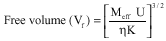 | (3) |
where, Meff is the effective molecular weight, K is a temperature independent constant equal to 4.28x10⁹ for all liquids.
 | (4) |
where, b stands for the cubic packing factor which is assumed to be 2 for all liquids and solutions, R is the gas constant and T is the absolute temperature.
Excess Values
Excess parameter AE by definition represent the difference between the parameter of real mixture (Aexp) and those corresponding change to an ideal mixture (Aid) as:
 | (5) |
Aid = ΣAi Xi, where Ai is any acoustical parameter and Xi is the mole fraction of the liquid component.
RESULTS AND DISCUSSION
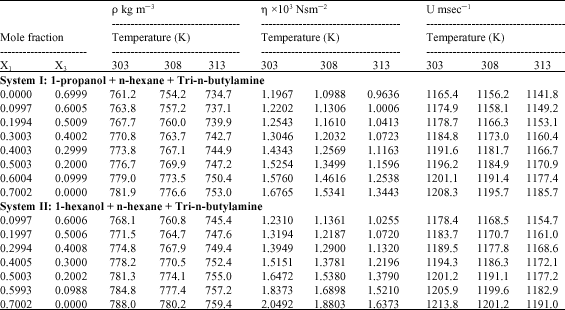
From Table 1, it can be seen that the density, viscosity and ultrasonic velocity increase with increase in mole fraction of alcohols and the same is decrease with increase of temperature. The increasing values of ρ, η and U with show that there is a moderate attraction between solute and solvent molecules. The decrease of values with temperature shows a decrease in intermolecular forces due to increasing the thermal energy of the system.
| Table 1: | Values of density (ρ), viscosity ( η) and velocity (U) |
 | |
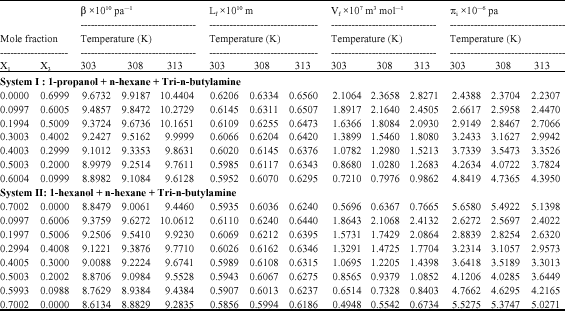
| Table 2: | Values of adiabatic compressibility ( β), free length (Lf), free volume (Vf) and internal pressure ( πi) |
 | |
The primary alkanols are having a characteristic carbo cation. The stability of a charged system is increased by the dispersal of the charge. Hence, any factor that tends to spread out the positive charge of the electron deficient carbon and distribute it over the rest of the ion must stabilize the carbo cation. Further, this carbo cation will be stabilised by electron donating substituents. The alkyl group of alcohols attached to the carbon atom bearing positive charge exerts an electron-releasing inductive effect and this reduces the positive charge of the carbon atom to which it is attached, in doing so, the alkyl group itself becomes positive. Therefore dipole-dipole interaction or hydrogen bonding is expected between the molecules.
The free length Lf dependence on the adiabatic compressibility and show a similar behavior to that of the compressibility and inverse to that of velocity. It decreases with increase in concentration of alcohol for both the systems, indicating that there is a significant interaction between solute molecules, due to which structural arrangements are considerably affected in Table 2.
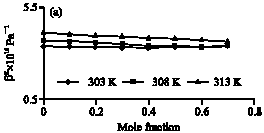
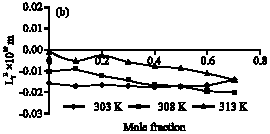
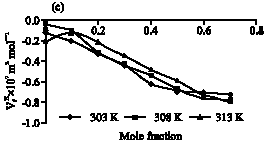
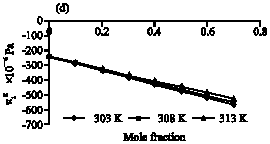
| Fig. 1a-d: | System I-Mole fraction vs excess values of adiabatic compressibility, free length, free volume and internal pressure, respectively |
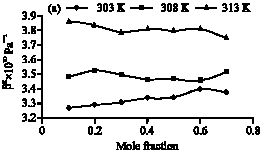
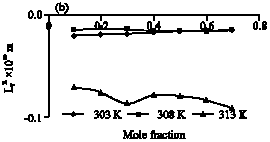
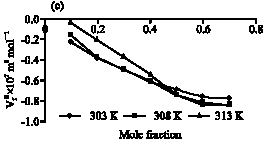
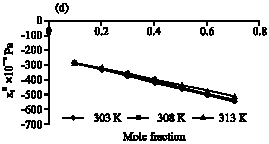
| Fig. 2a-d: | System II-Mole fraction vs excess values of adiabatic compressibility free length, free volume and internal pressure, respectively |
Free volume of the system decrease whereas the internal pressure increases with increase in concentration of alcohol. This suggests the close packing of the molecules inside the shield, which may be brought about by the increasing magnitude of interactions (Mecke, 1950).
The excess functions are found to be more sensitive towards intermolecular interactions in liquid mixtures. Figure 1a and 2a shows positive values of βE suggest that rupture of the associated structure of the alcohols dominates the hydrogen-bond interactions between like molecules. It is interesting to note that the values of βE become more positive as the carbon chain length increases, suggesting the strength of hydrogen bond between TBA and alcohol molecules should follow the order of 1-pentanol < 1-hexanol.
The change of LfE (Fig. 1b, 2b) from to increasingly negative excess values shows, greater strength of interaction between the components and may be qualitatively interpreted in terms of closer approach of unlike molecules leading to reduction in volume and compressibility.
The values of VfE (Fig. 1c, 2c) are negative and decrease with increase in the concentration of alcohols, which indicate the presence of strong molecular interaction and the magnitude of VfE indicates the formation of complex between the hetero molecules of the mixtures. Increase in the internal pressure gives rise to the negative values of πiE (Fig. 1d, 2d) as its dilution causes disruption of aromatic C-H bond stretching.
CONCLUSION
Thus the ultrasonic study of the liquid mixtures serves as a probe to detect the molecular association arising from the hydrogen bonding between nitrogen atoms of Tri-n-butyl amine (TBA) and OH group of alcohol molecules. The non-linear variation of acoustical parameters with concentration reveals the complex formation which is also strongly supported by the excess parameters in the ternary liquid mixtures.
REFERENCES
- Cibulka, I. and I. Nagata, 1987. Thermodynamics of associating component + saturated hydrocarbon mixtures at low pressures. II. Extension of the model to correlate of isothermal vapour pressures in liquid equilibria and volumetric properties of n-alcohol + n-alkane in terms of association. Fluid Phase Equilibr., 35: 43-63.
CrossRef - Crossley, J., 1971. Dieletric relaxation of 1-butanol and 1-decanol in several solvents. J. Phys. Chem., 75: 1790-1794.
CrossRef - Jacobson, B., 1952. Ultrasonic velocity of liquids and liquid mixtures. J. Chem. Phys., 20: 927-928.
CrossRef - Landeck, H., H. Wolff and R. Gotz, 1977. Two-constant model to describe amine and alcohol association from vapor pressure measurements. J. Phys. Chem., 81: 718-722.
CrossRef - Matthias, K., E.N. Rezanova and R.N. Lichtenthaler, 2006. Excess molar volumes and excess molar enthalpies of binary and ternary mixtures of 1-butanol, a tertiary amine (trin-butylamine, or tri-n-octalyamine) and n-hexane: Experimental results and ERAS model calculations. J. Chem. Thermodyn., 38: 1199-1213.
CrossRef - Megiel, E., T. Kasprzycka-Guttman, A. Jagielska and L. Wroblewska, 2001. A theoretical and experimental 14N NMR study of association of pyridine. J. Mol. Struct., 569: 111-119.
CrossRef - Venkatesu, P., G.C. Sekhar and M.V.P. Rao, 2006. Excess molar volumes of N,N-dimethylformamide + 2 - pentanone + alkan-1-ols. Tadeusz Hofman. Thermochim. Acta., 443: 62-71.
CrossRef - Wolff, H. and G. Gamer, 1972. Hydrogen bonding and complex formation of dimethylamine. Infrared investigations on the NH stretching vibration bands. J. Phys. Chem., 76: 871-876.
CrossRef - Wolff, H., H. Landeck, H.P. Frerichs and E. Wolff, 1995. The association of normal and tertiary butyl amine in mixtures with n-hexane according to isothermal vapour pressure measurements. Fluid Phase Equilibr., 109: 245-263.
CrossRef - Mecke, R., 1950. Infra-red spectra of hydroxylic compounds. Discuss. Faraday Soc., 9: 161-177.
CrossRefDirect Link